

TL;DR:
- Colorado’s fire certification system involves both state and local jurisdiction requirements.
- Inspectors must hold the correct credential level for specific tasks like system inspection or plan review.
- Ongoing verification with AHJs is essential for compliance and avoiding costly errors.
Choosing the wrong fire protection certification for your Colorado property isn’t just a paperwork problem. It can void your insurance, trigger failed inspections, or force costly re-inspections before you can reopen. Colorado operates under a layered system where state rules set the floor and local jurisdictions often stack additional requirements on top. Property managers who assume one universal list covers every scenario quickly learn otherwise. This guide breaks down exactly how the certification system works in Colorado, which inspector levels apply to your building type, and how to build a complete, verifiable certification list that holds up to scrutiny from both your state fire authority and your local AHJ.
Table of Contents
- How Colorado regulates fire protection certifications
- The three main fire inspector certification levels
- Jurisdiction-specific requirements: What Denver and others add
- How to assemble your site’s fire protection certification list
- Why most businesses get fire certification lists wrong—and what actually works
- Take the next steps toward full fire protection compliance
- Frequently asked questions
Key Takeaways
| Point | Details |
|---|---|
| State and local rules apply | You need to comply with both Colorado DFPC requirements and any local (city) fire protection licensing. |
| Inspector levels matter | The right inspector credential is legally required for certain inspections and plan review tasks. |
| No universal list | There is no single statewide certification list; accepted credentials depend on property location and occupancy. |
| Regularly update certification records | Keep current, locally recognized credentials on file to avoid penalties and ensure ongoing compliance. |
How Colorado regulates fire protection certifications
Colorado’s fire protection certification system involves two distinct layers of authority, and missing either one creates real compliance gaps. At the state level, the Division of Fire Prevention and Control (DFPC) sets baseline qualifications for fire protection professionals. Locally, each city and county Authority Having Jurisdiction (AHJ) can expand on those state minimums.
The AHJ is the entity with legal authority to enforce fire codes in a given area. In practice, that could be a city fire marshal, a county fire district, or a building department. What makes this system complex is that the AHJ’s interpretation of acceptable credentials can vary significantly from one jurisdiction to the next, even when they’re applying the same state code.
Here’s what the DFPC governs at the state level:
- Qualifications and duties for each fire inspector level
- Minimum code editions that all jurisdictions must adopt
- Standards for fire suppression systems inspectors and plan reviewers
- Requirements for testing and certification documentation
One important point many property managers overlook: DFPC adopted codes are explicitly minimum standards. Local jurisdictions are free to adopt stricter rules, newer code editions, or additional licensing requirements beyond the state baseline.
“There is no single universal list of approved fire protection certifications in Colorado. State rules define the types and levels of credentials required, but final acceptance always depends on the AHJ for your specific jurisdiction.”
Colorado’s 8 CCR 1507-101 defines ‘Fire & Suppression Systems Inspector’ qualifications, including three fire inspector levels with distinct scopes. Understanding where these rules apply and how they interact with local requirements is the first step in understanding your building fire safety requirements.
For a structured approach to staying compliant, the five-step compliance guide walks through the full process. If your building falls under commercial code, reviewing commercial code requirements is equally important before hiring any inspector or testing company.
The three main fire inspector certification levels
Colorado’s 8 CCR 1507-101 rule defines three inspector levels with increasing responsibility and scope. Getting the wrong level for a given task isn’t just a technicality. It means the inspection may not be legally recognized.
Fire Inspector I handles basic occupancy inspections. This level covers general compliance checks like verifying exit signage, checking that fire extinguishers are in place, and confirming that general occupancy conditions meet code. It’s the entry-level credential and is not sufficient for suppression system work.
Fire Inspector II is the credential required for fire suppression system inspections. If you need your sprinkler system inspected and certified, the person doing the work must hold at least this level. Many property managers mistakenly assume any certified inspector can sign off on suppression systems. That assumption leads to failed audits.
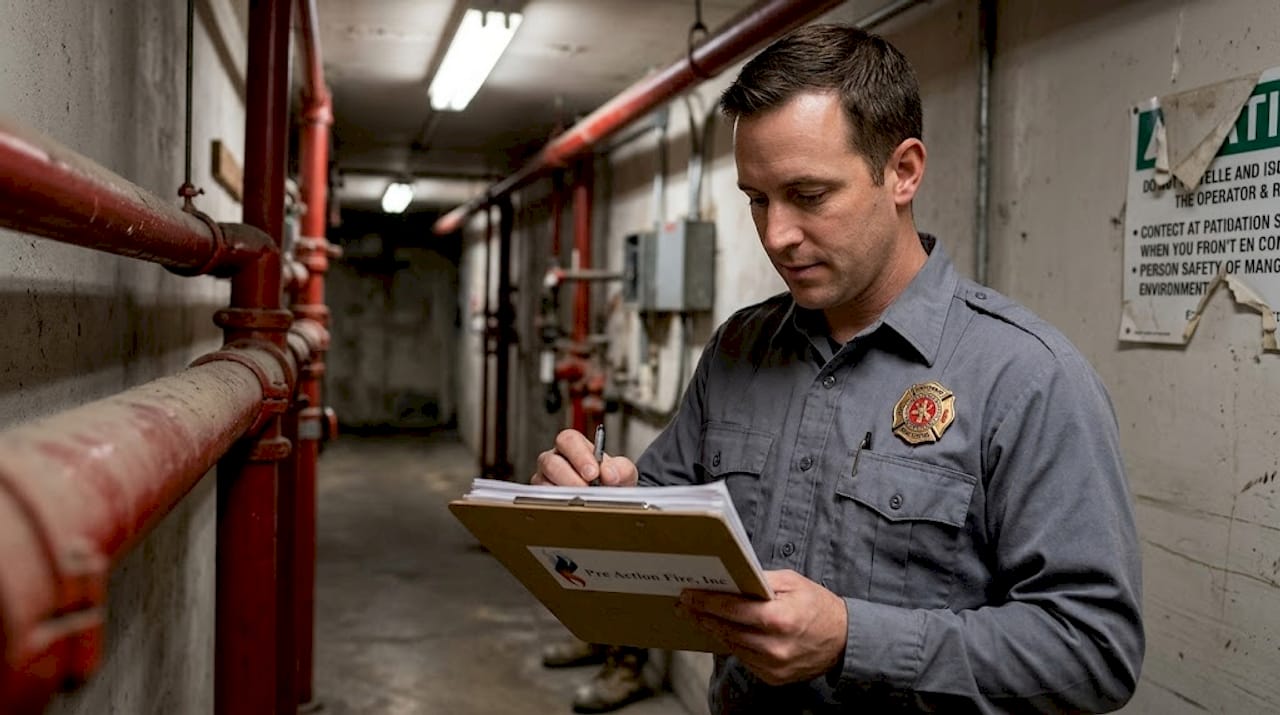
Fire Inspector III adds fire protection plan review authority. This is the credential needed when a professional must review plans for new construction or system upgrades. It’s the highest inspector tier under state rules.
Here’s a quick-reference breakdown:
| Level | Primary Scope | Common Credentials Accepted |
|---|---|---|
| Fire Inspector I | General occupancy inspections | ICC Fire Inspector I, NFPA 1031 Level I documentation |
| Fire Inspector II | Suppression system inspections | ICC Fire Inspector II, NFPA 1031 Level II documentation |
| Fire Inspector III | Plan review for fire protection systems | ICC Fire Inspector III, NFPA 1031 Level III documentation |
Credentials from national bodies like ICC or documentation demonstrating equivalent skills per NFPA 1031 are generally accepted, but local AHJ approval is still required. Experience alone does not substitute for the credential. Colorado state rules are clear that the correct level must be held for the authorized scope of work.
Pro Tip: Always ask inspectors and contractors to provide their credential level in writing before work begins. A credential card from ICC or a letter from a recognized certifying body is the standard form of documentation.
For a broader view of how certifications tie into your overall planning process, reviewing fire protection planning tips for commercial properties gives useful context before you start vetting contractors.
Jurisdiction-specific requirements: What Denver and others add
State rules are the starting line, not the finish line. In Colorado, many cities maintain their own licensing systems that run parallel to the state certification framework. Ignoring local licensing is one of the most common and costly compliance mistakes we see.
Denver is the clearest example of how far local requirements can go. The Denver Fire Department licensing system covers a wide range of system types and roles. Installers, inspectors, and testers working on life safety systems, sprinklers, fire alarms, extinguishers, and fire pumps must hold valid Denver-specific licenses in addition to any state certifications.
Here’s what that looks like in practice:
- Fire alarm system installers need a Denver-issued license, not just an NICET certification
- Sprinkler installers must be licensed by the city even if they hold a state contractor registration
- A Facility Safety Administrator role within a Denver building requires a local license tied to that specific role
- License expiration timelines and renewal fees are managed separately from state credential renewals
The table below shows how requirements stack across different Colorado jurisdictions:
| Jurisdiction | State Credential Required | Local License Required | Notes |
|---|---|---|---|
| Denver | Yes | Yes | Separate Denver Fire Department licenses for each system type |
| Colorado Springs | Yes | Verify with AHJ | El Paso County Fire may have additional requirements |
| Aurora | Yes | Verify with AHJ | Aurora Fire Rescue enforces local licensing standards |
| Unincorporated areas | Yes | Varies by fire district | Check with county or rural fire district directly |
For businesses operating in the metro area, understanding Denver fire protection compliance in detail is essential before contracting any inspection or installation work. Never assume your contractor’s national certification covers local licensing obligations.
How to assemble your site’s fire protection certification list
Knowing the rules is useful. Having an organized process to apply them at your specific property is what actually keeps you compliant. Here is the step-by-step workflow we recommend for property managers.
- Identify your AHJ. Contact your city or county fire marshal’s office to confirm who has jurisdiction over your property. Multi-tenant buildings sometimes fall under more than one AHJ.
- Request the current adopted code edition. DFPC adopted codes set the minimum, but your AHJ may be on a newer or locally amended edition. Confirm this in writing.
- List all systems on your property. Fire alarms, sprinklers, suppression systems, extinguishers, and emergency lighting each require separately credentialed inspection professionals.
- Match each system to the required inspector level. Use the state and local rules to determine whether you need a Fire Inspector I, II, or III for each item.
- Collect documentation before work begins. Request license numbers, credential levels, certifying body, and expiration dates from every contractor.
- Verify credentials are AHJ-recognized. Don’t assume. Send the contractor’s documentation to your AHJ for confirmation if there’s any doubt.
- Set calendar reminders for renewals. Credential and license expiration dates are staggered. Build a simple tracking spreadsheet with 90-day advance alerts.
Pro Tip: If a contractor provides out-of-state credentials, verify that the credential meets NFPA 1031 skill and knowledge standards and that your local AHJ will accept it. Equivalency is not automatic.
For staying current on annual inspection schedules and documentation, the NFPA compliance steps guide provides a solid framework. The essential NFPA fire standards reference is also worth bookmarking for ongoing use.
Why most businesses get fire certification lists wrong—and what actually works
Here’s an uncomfortable truth: most property managers who struggle with fire certification compliance aren’t careless. They’re relying on information that was accurate somewhere else, or accurate two years ago, or accurate for a different building type. The problem isn’t effort. It’s the assumption that a static list is enough.
We’ve seen it repeatedly. A property manager downloads a certification checklist from a trade association. The list is legitimate for general guidance. But it doesn’t account for Denver’s local licensing layer, or the fact that the city recently moved to a newer code edition. The inspection gets done, the wrong credential signs the report, and the building fails its insurance audit six months later.
What actually works is treating fire certification compliance as an ongoing conversation, not a one-time lookup. That means checking with your AHJ at least annually, not just when an inspection is due. It means asking your contractors to confirm their credentials are still current and locally accepted, even if you’ve worked with them for years. And it means keeping your own documentation file updated, not just trusting that the contractor’s paperwork is in order.
The edge cases catch people most often: a Fire Inspector I signing off on suppression work that requires a Level II, or a national NICET certification being presented for a role that also needs a Denver city license. These aren’t obscure scenarios. They’re the ones that create real liability. Explore Colorado fire protection resources for ongoing guidance and local expertise.
Take the next steps toward full fire protection compliance
Navigating Colorado’s layered fire certification requirements doesn’t have to be a solo exercise. Pre Action Fire, Inc. has been serving the Denver Metro Area since 2009 with NICET-certified technicians who understand both state rules and local AHJ expectations.
Whether you need fire safety inspections for your commercial building, want to confirm your current contractor credentials are locally valid, or need expert guidance on Colorado building safety compliance, our team is ready to help. We also work with businesses in the northwest metro through our Arvada fire safety experts team. Contact Pre Action Fire, Inc. today to get a clear, site-specific compliance review from professionals who know Colorado’s requirements inside and out.
Frequently asked questions
Do I need both state and city fire certifications for my Colorado building?
Yes, you must meet both state and local AHJ criteria for any certification to be considered valid and enforceable in your jurisdiction.
What is the difference between Fire Inspector II and III certifications?
Task authority for each level is defined by state rule: Fire Inspector II is required for suppression system inspections, while Fire Inspector III also qualifies the holder to perform fire protection plan reviews.
How do I verify a certification or license is currently valid for my site?
Contact your local Authority Having Jurisdiction directly and request written confirmation of AHJ-recognized credentials, including expiration dates, before any inspection work is performed.
Can I use out-of-state certifications in Colorado?
Yes, if the credential meets the skill and knowledge standards of NFPA 1031 and is accepted by your local AHJ, but local acceptance is required and should always be confirmed before hiring.