
TL;DR:
- Properly installed NFPA-compliant sprinkler systems significantly reduce fire damage, deaths, and containment time.
- Colorado’s diverse local codes require verifying specific NFPA editions and maintaining detailed inspection records.
- Advanced hazards like battery energy storage and high-rack warehouses demand specialized fire safety strategies.
Sprinkler systems installed to NFPA standards operate successfully in 95% of fires, reduce deaths by 92.6%, and confine 88% of fires to the room where they start. Those numbers are not regulatory trivia. They represent the difference between a contained incident and a total loss. For Colorado commercial property owners and industrial facility managers, fire safety is not about satisfying an inspector and moving on. It is about protecting revenue, employees, and assets that took years to build. This article walks you through the real costs of fire, the NFPA standards that Colorado jurisdictions rely on, the compliance traps that catch even experienced managers off guard, and the advanced strategies that address 2026’s most complex fire risks.
Table of Contents
- The real cost of fire: Asset loss, business disruption, and human impact
- NFPA standards: Colorado’s technical backbone for fire safety
- Compliance challenges: Local codes, AHJs, and common pitfalls
- Advanced fire safety: Addressing edge cases and evolving risks in 2026
- Why proactive fire safety pays off in Colorado: Beyond code and insurance
- Take the next step with compliant fire safety solutions
- Frequently asked questions
Key Takeaways
| Point | Details |
|---|---|
| Fire safety is ROI | Investing in NFPA-compliant systems prevents asset loss and lowers insurance costs. |
| Local codes vary | Colorado jurisdictions each enforce unique fire safety rules; always verify your AHJ requirements. |
| Maintenance prevents failures | Regular inspection and digital records cut common fire system failures by more than half. |
| Edge cases need expert advice | High-hazard warehouses and specialty occupancies require advanced NFPA solutions and adaptive approaches. |
The real cost of fire: Asset loss, business disruption, and human impact
Fire does not just destroy property. It interrupts operations, drives away customers, triggers lawsuits, and sometimes ends businesses entirely. Understanding the full financial picture is the first step toward making a compelling internal case for proactive investment.
Start with the numbers. Warehouse fires alone cost an estimated $323 million per year in the United States. That figure covers direct property loss, but it does not capture downtime, lost contracts, or the reputational damage that follows a major fire event. When you factor in business interruption, the real cost multiplies fast.
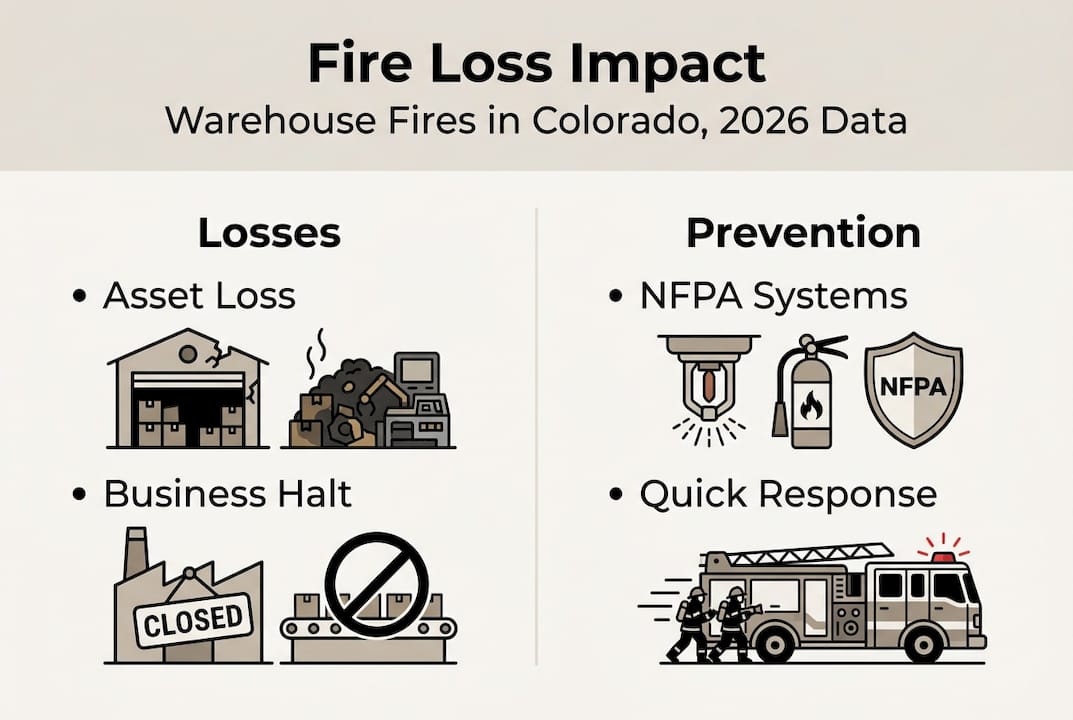
Compliant systems change the math dramatically. Consider this comparison:
| Scenario | Fire spread | Likely outcome |
|---|---|---|
| Sprinklered, NFPA-compliant | Contained to room of origin (88%) | Minimal asset loss, operations resume quickly |
| Non-sprinklered or non-compliant | Spreads beyond origin point | Major structural loss, extended downtime |
| Closed valve or skipped ITM | System fails at activation | Total loss risk, insurance claim denial |
ITM stands for Inspection, Testing, and Maintenance, the scheduled service cycle required by NFPA 25 to keep suppression systems functional.
Beyond the building itself, fire incidents create cascading human impacts. Workers face smoke inhalation, evacuation injuries, and psychological stress. Customers lose confidence. Suppliers reroute. The Colorado fire safety risk reduction picture is clear: the cost of prevention is a fraction of the cost of recovery.
Here is what the data shows about compliant versus non-compliant facilities:
- Compliant sprinkler systems reduce fire deaths by 92.6% and property damage significantly
- Warehouse fire incidents have dropped 73% since 1980, largely due to sprinkler adoption and code enforcement
- Non-compliant facilities face higher insurance premiums, potential claim denials, and greater legal exposure
- Operational downtime after a major fire averages weeks to months, not days
“The question is never whether fire safety costs too much. The question is whether you can afford to operate without it.”
For Colorado industrial facilities, where high-rack storage, flammable materials, and large open floor plans are common, the stakes are even higher. A single incident in an unprotected warehouse can wipe out years of inventory investment in minutes.
NFPA standards: Colorado’s technical backbone for fire safety
NFPA standards are not one-size-fits-all rules handed down from a federal agency. They are technically detailed, regularly updated documents that define exactly how fire protection systems must be designed, installed, and maintained. Three standards form the core framework that Colorado jurisdictions adopt.

NFPA 13, NFPA 25, and NFPA 72 cover sprinkler system design and installation, inspection and maintenance, and fire alarm systems respectively. Together, they create an interlocking technical backbone that ensures your systems will actually work when a fire starts.
Here is a quick breakdown of each:
| Standard | Scope | Key requirement |
|---|---|---|
| NFPA 13 | Sprinkler design and installation | Correct head type, spacing, water supply |
| NFPA 25 | ITM for water-based systems | Scheduled inspections, testing, maintenance logs |
| NFPA 72 | Fire alarm and signaling systems | Detection, notification, monitoring requirements |
For Colorado property owners, the NFPA inspection compliance guide is a practical starting point for understanding which edition of each standard your local Authority Having Jurisdiction (AHJ) has adopted. AHJ refers to the local government body, often a fire marshal or building department, that has legal authority to enforce fire codes in your area.
The fire protection planning guide for commercial properties adds another layer: design requirements vary based on occupancy type, storage height, and hazard classification. A light manufacturing facility has different NFPA 13 requirements than a cold storage warehouse or a multi-story office building.
Key compliance requirements across these three standards include:
- Annual inspections of sprinkler systems per NFPA 25, with quarterly checks on control valves
- Five-year internal inspections of sprinkler piping for corrosion and obstruction
- Semi-annual testing of fire alarm devices per NFPA 72
- Documentation of all ITM activities, retained and available for AHJ review
Pro Tip: Always confirm which edition of NFPA 13, 25, and 72 your local AHJ has officially adopted. Some Colorado jurisdictions are on older editions, and designing to the current edition without verifying can create costly compliance gaps during inspections.
Compliance challenges: Local codes, AHJs, and common pitfalls
Here is something that surprises many property managers: Colorado has no single statewide fire code. Each city and county AHJ independently adopts and amends the IFC and NFPA standards, meaning Denver, Aurora, and Lakewood may each enforce different editions with different local amendments. Altitude and climate also influence how some standards are interpreted and applied.
This fragmented landscape creates real compliance risk. The most common pitfalls we see:
- Checking the wrong code edition. A manager assumes the 2022 IFC applies, but the local AHJ adopted the 2018 edition with amendments. The design gets rejected.
- Skipping ITM steps. Quarterly valve inspections get missed during busy periods. A closed valve goes undetected.
- Neglecting recordkeeping. Inspection reports are stored in a filing cabinet or lost entirely. An AHJ audit finds no documentation.
- Painting over sprinkler heads. This is more common than you would think, and it renders heads non-functional by blocking the heat-sensitive element.
- Ignoring system changes. A tenant builds a mezzanine or adds high-rack storage without updating the sprinkler design to match.
The consequences are serious. Non-compliance leads to fines, facility shutdowns, denied insurance claims, and legal liability. OSHA penalties for fire safety violations have exceeded $8 million in enforcement actions. And 59% of sprinkler failures trace back to closed valves, a problem that a simple quarterly inspection would catch every time.
The Colorado fire risk assessment tips for property owners emphasize one consistent theme: the facilities that stay compliant are the ones that treat fire safety as an ongoing operational process, not a one-time installation project.
For NFPA standards in Colorado, the gap between what owners think they need and what AHJs actually require is where most violations occur.
Pro Tip: Move your ITM records to a digital platform. Cloud-based documentation gives you instant access during AHJ audits, reduces the risk of lost records, and creates a clear timeline that supports insurance claims if a fire does occur.
Advanced fire safety: Addressing edge cases and evolving risks in 2026
Core compliance covers the baseline. But Colorado’s commercial and industrial landscape includes facilities where standard approaches fall short. High-hazard warehouses, battery energy storage systems, legacy buildings, and cold storage facilities each present unique technical challenges.
High-hazard warehouses with storage over 12 feet require ESFR sprinklers and high-rack storage design rules. ESFR stands for Early Suppression Fast Response, a sprinkler type engineered to deliver large water volumes quickly enough to suppress fires in tall, dense storage environments. Standard commercial sprinklers are not designed for this application.
Battery energy storage systems (ESS) are a growing risk category. NFPA 855, updated for 2026, establishes specific requirements for lithium-ion battery installations, including suppression system design, ventilation, and spacing. Many Colorado facilities adding solar or backup power systems are installing battery ESS without realizing it triggers a separate compliance pathway.
Here is a summary of advanced scenarios and their requirements:
| Facility type | Key requirement | Standard |
|---|---|---|
| High-rack warehouse (>12 ft) | ESFR sprinklers, in-rack heads | NFPA 13 |
| Cold storage or unheated space | Dry-pipe or pre-action system | NFPA 13 |
| Battery ESS installation | Suppression, ventilation, spacing | NFPA 855 |
| Legacy or high-rise building | Performance-based design option | NFPA 101 |
Other nuanced failure points that experienced managers sometimes overlook:
- Corroded sprinkler heads in humid or chemical environments lose sensitivity and must be replaced on schedule
- Painted heads block the fusible element and fail to activate, a violation that voids insurance coverage
- Skipped ITM on dry systems allows moisture accumulation inside pipes, accelerating internal corrosion
- Altitude considerations in Colorado’s mountain communities can affect water pressure calculations and system design
“A system that looks compliant on paper but has corroded heads or a closed valve is not a fire protection system. It is a liability.”
For fire safety tips for warehouses in Denver and surrounding areas, the combination of high storage density and Colorado’s dry climate creates a specific risk profile that demands more than minimum code compliance. The Denver fire protection guide covers how local requirements layer on top of NFPA baselines for complex occupancies.
Why proactive fire safety pays off in Colorado: Beyond code and insurance
We have worked in Colorado fire protection since 2009, and the pattern is consistent: the facilities that treat fire safety as a cost center are the ones that call us after an incident. The facilities that treat it as a risk management investment rarely face catastrophic loss.
The ROI case is not abstract. NFPA-compliant sprinklers cut damage by 88%, lower insurance premiums, and prevent the denied claims that follow non-compliant system failures. Proactive ITM and digital records prevent more than 59% of the failures that lead to total losses.
There is also an honest criticism worth acknowledging: NFPA standards can update slowly relative to emerging risks like lithium-ion battery fires, and compliance costs can feel disproportionate for smaller property owners. These are real tensions. But the alternative, operating outside compliance, carries costs that dwarf the investment. Fines, shutdowns, uninsured losses, and legal liability add up fast.
The Colorado compliance risk reduction approach we recommend is straightforward: verify your AHJ’s adopted editions, schedule ITM consistently, digitize your records, and address edge cases before an inspector or an incident forces your hand. Proactive fire safety is not a burden. It is the most reliable way to protect what you have built.
Take the next step with compliant fire safety solutions
Understanding NFPA standards and compliance requirements is only the first step. Putting that knowledge into practice requires the right partner, one who knows Colorado’s AHJ landscape, understands local amendments, and can design systems that meet both code and real-world performance demands.
Pre Action Fire, Inc has served the Denver Metro Area since 2009 with NICET-certified technicians and a track record of compliant installations across commercial and industrial facilities. Whether you need Arvada fire sprinkler installation, guidance on Denver fire alarm compliance, or scheduled fire safety inspections to keep your ITM records current, we are ready to help. Contact us today to schedule a consultation and take the guesswork out of Colorado fire safety compliance.
Frequently asked questions
What are the most common fire safety compliance mistakes in Colorado?
Failing to verify the AHJ-adopted NFPA edition, skipping required ITM steps, and relying on paper-based recordkeeping are the top mistakes. Because each Colorado AHJ independently adopts and amends fire codes, what applies in one city may not apply in the next.
How do NFPA standards reduce insurance premiums and asset loss?
NFPA-compliant sprinkler and alarm systems localize fires, reduce structural damage, and demonstrate due diligence to insurers. Sprinklers confine 88% of fires to the room of origin and reduce fire deaths by 92.6%, which directly supports lower premiums and higher claim approval rates.
Can fire safety solutions be tailored for high-hazard or unusual facilities?
Yes. NFPA standards include specific provisions for ESFR sprinklers and battery ESS installations, high-rack storage, dry-pipe systems for cold environments, and performance-based design options for legacy or high-rise buildings.
Why is digital recordkeeping increasingly required for AHJ audits?
Digital records reduce documentation errors, provide instant retrieval during audits, and create a verifiable ITM timeline. Digital records are now essential for 2026 AHJ inspections and support faster, more successful insurance claims after a fire event.