
TL;DR:
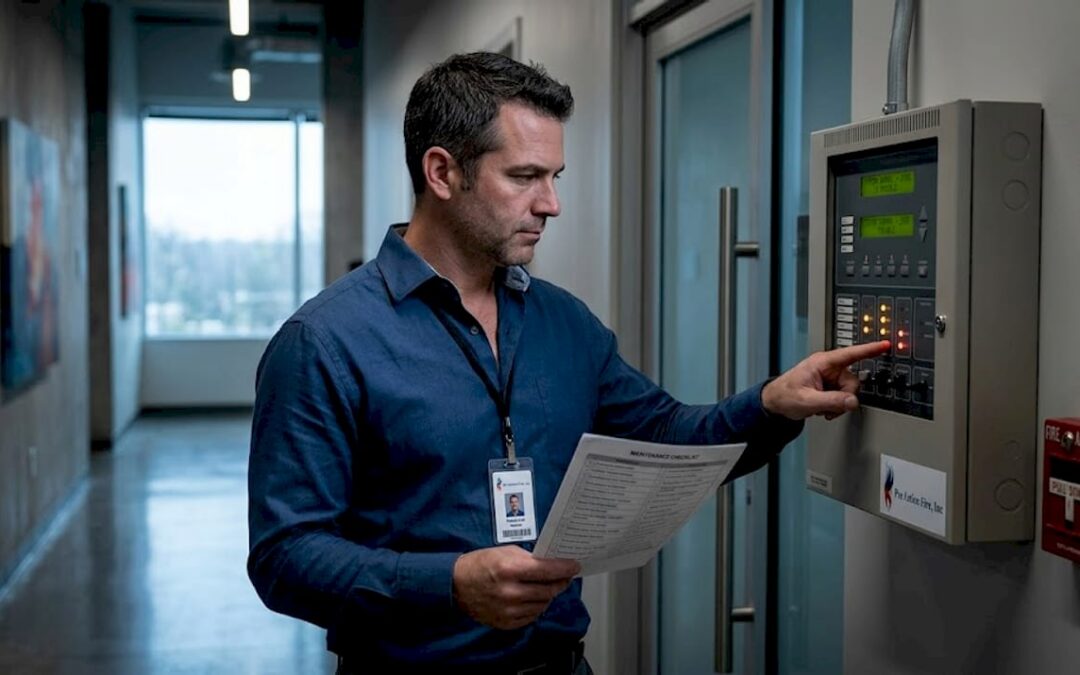
- Most facility managers install fire alarms as a one-time setup, but neglecting ongoing maintenance leads to disconnected detectors and ignored alerts. Modern fire alarm systems provide early detection, automatic emergency notifications, and reduce false alarms through proper design, enhancing safety and compliance. Regular testing, occupant training, and verification of monitoring connections are essential to maximize efficacy and minimize risks.
Most facility managers install fire alarms and move on. That “set and forget” approach is exactly how buildings end up with disconnected detectors, ignored alerts, and occupants who treat every alarm as a nuisance rather than a threat. The role of fire alarms in safety goes far beyond triggering a horn when smoke appears. Modern systems detect threats early, automatically notify emergency responders, and when designed correctly, they overcome the human tendency to dismiss alarms entirely. This article covers what you actually need to know: how detection technology works, what the data says about effectiveness, and how compliance protects your building and your bottom line.
Table of Contents
- Key takeaways
- The role of fire alarms in safety: how detection actually works
- The safety impact: statistics and the human behavior problem
- Regulatory requirements and the compliance advantage
- Choosing and maintaining effective fire alarm systems
- My honest take on where commercial fire alarm programs go wrong
- How Preactionfire can protect your building and your compliance standing
- FAQ
Key takeaways
| Point | Details |
|---|---|
| Early detection saves lives | Fire alarms provided early warning in 78% of U.S. structure fires in 2023, enabling faster evacuation. |
| Alarm fatigue is a real hazard | Frequent false alarms erode occupant trust and delay response when a real fire occurs. |
| Monitored systems change outcomes | Automatic emergency notification cuts response time by alerting dispatch without human action. |
| Compliance pays for itself | NFPA 72 compliant systems can reduce commercial property insurance premiums by 15 to 25%. |
| System design must account for behavior | Multi-sensor detectors and addressable panels reduce nuisance alerts and improve occupant response. |
The role of fire alarms in safety: how detection actually works
Fire alarms are not single devices. They are systems made up of detectors, notification appliances, control panels, and in the best cases, central monitoring connections. Understanding how each piece works helps you make smarter decisions about what your building actually needs.
Detection types and what they catch
The three main detection technologies each have different strengths:
- Ionization smoke detectors respond quickly to fast-flaming fires but can be triggered by cooking smoke or steam, making them prone to false alarms in commercial kitchens or high-humidity environments.
- Photoelectric smoke detectors are better at detecting slow, smoldering fires. They react to visible particles of combustion and tend to perform better in offices, hotels, and healthcare facilities where smoldering electrical fires are a real risk.
- Heat detectors activate at a fixed temperature or when temperature rises rapidly. They work well in spaces like boiler rooms or commercial kitchens where smoke detectors would trigger constantly.
- Multi-sensor detectors combine two or more of these technologies. Multi-sensor alarms detect 30% more smoldering fires than smoke-only detectors, and they generate far fewer false positives.
The role of smoke detectors is critical, but pairing them with the right detection type for each space is what separates a well-designed system from one that creates constant nuisance alarms.
Alert mechanisms and system integration
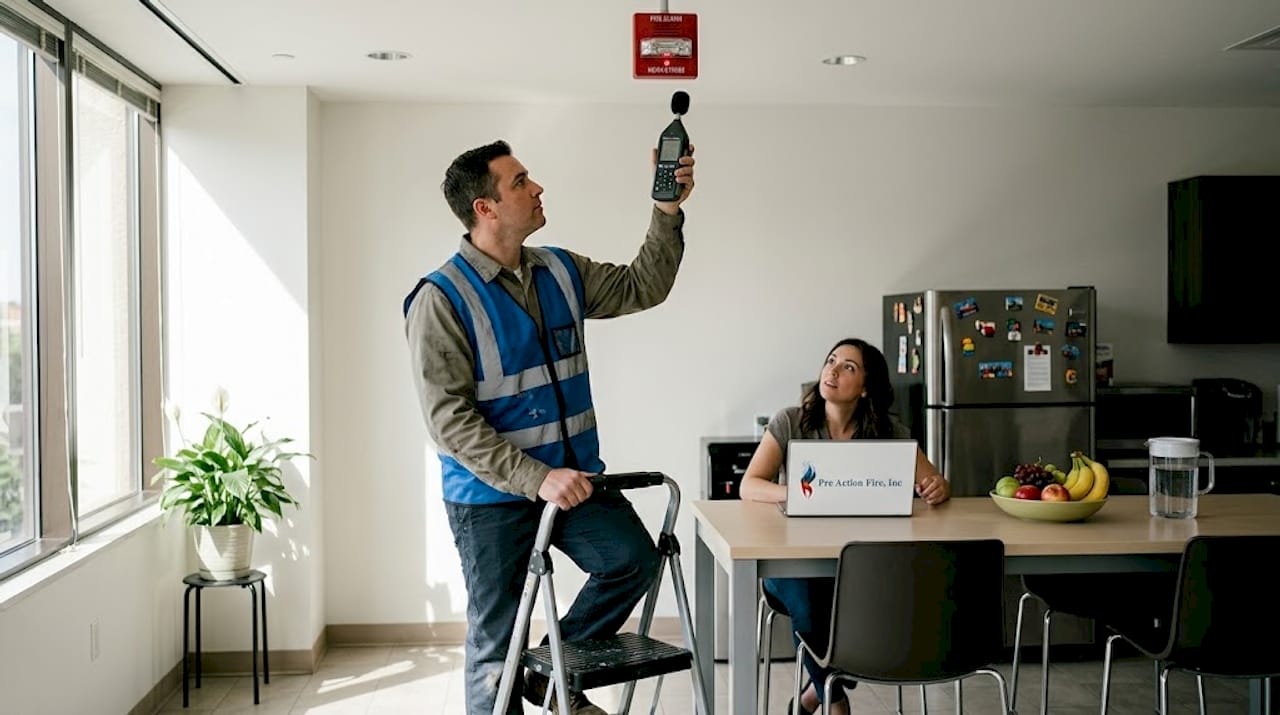
Once a detector trips, the notification side of the system takes over. NFPA 72 requires audible signals to be at least 15 dBA above ambient noise levels to be heard reliably. Visual strobes are required in spaces where occupants may have hearing impairments, and they are increasingly standard in any commercial environment. Voice notification systems go further by delivering clear spoken instructions, which research consistently shows improves evacuation behavior compared to a generic horn.
Modern systems also integrate with building automation platforms, controlling HVAC shutdowns, elevator recall, and door releases automatically when an alarm triggers. This integration speeds up safe evacuation and limits smoke spread. For full protection, professional 24/7 central station monitoring is non-negotiable in commercial settings because it automatically dispatches the fire department without relying on anyone inside the building to make that call.
Pro Tip: When evaluating notification devices for your facility, visit your building’s loudest and quietest spaces at peak hours with a sound meter. Real ambient noise levels at your site will tell you far more than a spec sheet.
The safety impact: statistics and the human behavior problem
The numbers on how fire alarms save lives are stark. Working smoke alarms reduce fire-related death risk by 55%, and nearly two-thirds of fire deaths occur in buildings without functioning alarms. Fire alarm response time directly determines survivability. Every minute between ignition and notification is a minute lost to evacuation.
But statistics tell only part of the story. The part most safety plans ignore is human behavior.
Alarm fatigue undermines everything
“Frequent false alarms reduce occupant trust and response urgency, leading people to ignore or even disconnect alarms entirely.” — CSE Magazine
Alarm fatigue causes occupants to ignore or disconnect alarms, which directly increases risk during a real fire. This is not a theoretical concern. In multi-tenant commercial buildings and healthcare facilities, staff members have been documented propping open stairwell doors and silencing alarms without investigation because the alarm had cried wolf too many times before.
The fire alarm installation benefits you get from a properly calibrated, modern system include far lower false alarm rates. In large facilities, false alarm fines in many jurisdictions run from $250 to $2,000 per incident. Those costs accumulate fast and represent only the financial damage. The behavioral damage to your evacuation culture is harder to repair.
Design strategies that improve real-world response
Addressing alarm fatigue requires more than just better hardware. The most effective approaches combine:
- Replacing single-technology detectors with multi-sensor devices in high-nuisance-alarm areas
- Implementing addressable systems that let your panel identify the exact initiating device rather than triggering a building-wide evacuation from a single sensor
- Training occupants through regular drills so the alarm response becomes automatic rather than hesitant
Human behavior is the most unpredictable element in fire safety. Designing around that reality, rather than assuming people will always respond correctly, is what separates good systems from genuinely effective ones.
Regulatory requirements and the compliance advantage
Fire alarm compliance is not optional, but it is also not purely a burden. Meeting the right codes creates measurable financial and operational benefits that go beyond avoiding fines.
The key standards you need to know
- NFPA 72 (National Fire Alarm and Signaling Code) governs the installation, performance, and inspection of fire alarm systems in the U.S. It covers everything from detector spacing to monitoring requirements and emergency notification systems.
- NFPA 101 (Life Safety Code) addresses occupant notification, means of egress, and system requirements by occupancy type. If you manage a hotel, healthcare facility, or high-rise, this code directly shapes your system design.
- IBC (International Building Code) dictates when fire alarm systems are required based on occupancy classification and building size. Consulting local amendments is essential because Colorado jurisdictions, including Denver, often adopt modified versions.
- ADA requirements mandate both audible and visible alarm notification to serve all occupants. Visual strobes complement audible alarms for people with hearing impairments, and ADA compliance is enforced alongside fire code during inspections.
For new construction projects, understanding fire protection compliance requirements from the design phase saves significant cost and rework later.
Comparing conventional and addressable systems
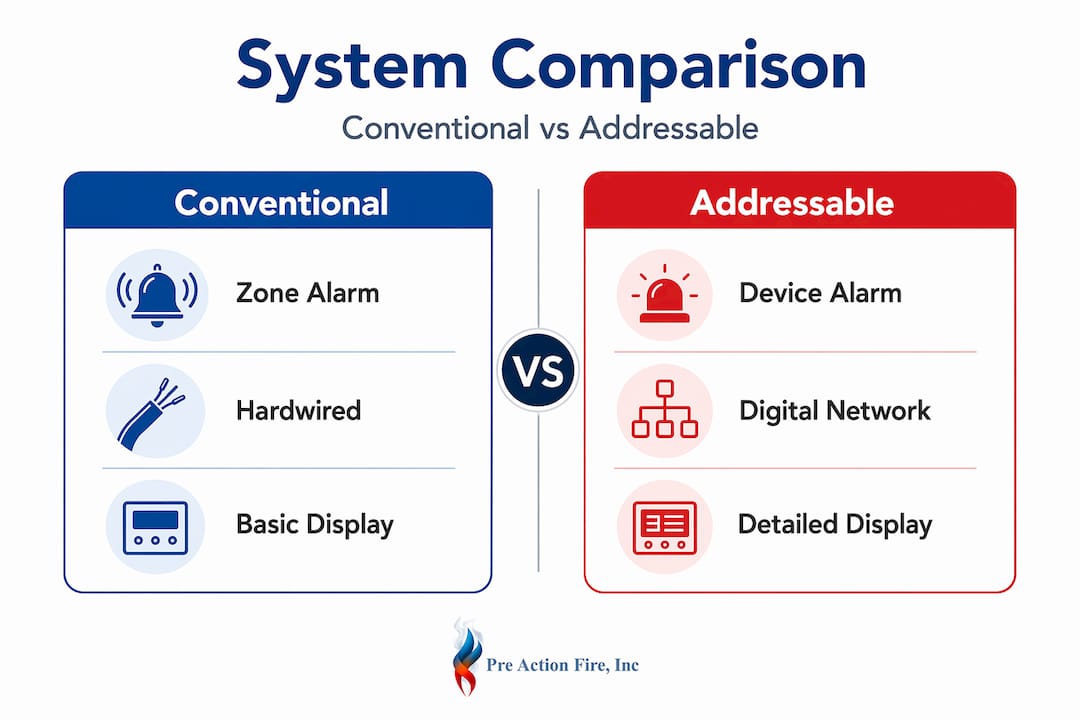
| Feature | Conventional systems | Addressable systems |
|---|---|---|
| Alarm location precision | Zone only | Exact device |
| False alarm rate | Higher | Significantly lower |
| ROI timeline | Immediate for small buildings | 18 to 24 months for buildings over 5,000 sq ft |
| Insurance premium impact | Moderate | Up to 25% reduction with monitoring |
| Maintenance efficiency | Manual zone testing | Remote diagnostic capability |
NFPA 72 compliant monitored systems typically achieve a 15 to 25% reduction in commercial property insurance premiums. For a building with $20,000 in annual property insurance costs, that reduction alone covers a meaningful portion of system installation over time.
Choosing and maintaining effective fire alarm systems
Selecting the right system for your facility is not about buying the most expensive option. It is about matching the system architecture to your building’s size, occupancy type, and risk profile.
Matching system type to facility size
- Conventional systems work well for small commercial buildings, typically under 5,000 square feet with simple floor plans. They divide the building into zones, and any alarm triggers the entire zone notification.
- Addressable systems identify the exact detector that triggered, which is critical in larger facilities. When a single photoelectric detector in a fifth-floor server room trips, your panel tells you precisely that, rather than alarming an entire wing.
- Intelligent or analog-addressable systems go further by measuring the sensitivity level of each detector continuously, flagging devices that are drifting toward nuisance-alarm territory before they become a problem. Networked architectures with distributed amplifiers prevent a single point of failure from taking down notification across large complexes or high-rise buildings.
For guidance specific to your market, Preactionfire has detailed resources on choosing fire alarms for Colorado commercial buildings that account for Denver’s adopted code amendments.
Installation, placement, and ongoing maintenance
Detector placement matters more than most facility managers realize. Mounting a smoke detector directly above a commercial HVAC return creates predictable false alarms. Installing heat detectors in an unheated parking garage sets them up to trip in summer. Professional installation with proper site assessment eliminates these problems from the start.
Maintenance is where many systems fail after installation. The key practices are:
- Monthly visual inspections of all notification appliances and panel indicators
- Annual functional testing of all detectors and pull stations per NFPA 72 schedules
- Immediate replacement of any detector that fails sensitivity testing rather than delaying to the next inspection cycle
- Documented testing records, which are required for insurance and code compliance purposes
Pro Tip: Schedule your annual fire alarm inspection at least 60 days before your insurance renewal date. Any deficiencies found and corrected before renewal can be documented for your carrier, which sometimes accelerates premium adjustments.
Reviewing fire alarm control panel options and maintenance requirements before upgrading an aging system will help you avoid replacing a panel only to find the new one requires rewiring your entire notification circuit.
My honest take on where commercial fire alarm programs go wrong
I have seen a consistent pattern in commercial facilities that struggle with fire safety outcomes. The hardware is usually fine. The breakdown almost always happens in two places: alarm fatigue that has gone unaddressed for years, and monitoring gaps that nobody noticed until an incident revealed them.
What I have learned is that treating fire alarm design as a one-time installation decision is a mistake that compounds over time. Buildings change. Occupancies shift. A space that was originally a storage room becomes a break room with a microwave and a toaster, and suddenly a detector calibrated for low-nuisance use is triggering every other week. That pattern trains people to ignore the alarm.
The practical fix is building a quarterly review into your safety program. Walk the building, pull the false alarm log from your panel, and identify which detectors are generating nuisance trips. That data tells you exactly where to focus replacement or recalibration efforts. It is not complicated, but almost nobody does it consistently.
The second issue is the assumption that a monitored system means someone is watching. I have seen facilities where the central station contract lapsed, the panel was still showing “monitored” on the keypad, and nobody caught it for over a year. Verify your monitoring connection is live, tested, and documented. The fire alarm response time advantage of a monitored system disappears completely if the monitoring link is dead.
One more thing: integrating your fire alarm with lockdown or invacuation procedures is increasingly common. Integration of fire alarm systems with lockdown procedures is valuable but must never delay or obscure fire alerts. Fire always gets priority. Design that integration carefully with your installer.
— Preactionfire
How Preactionfire can protect your building and your compliance standing
Preactionfire has served the Denver Metro Area since 2009, and the fire alarm installation benefits our commercial clients see go well beyond a passing inspection. Our NICET-certified technicians design and install systems built to NFPA 72, IBC, and local Denver code requirements, covering everything from detector selection to notification device compliance. We also handle the ongoing testing and inspection documentation your insurance carrier needs.
If you are managing an existing system that is generating too many false alarms, our fire alarm troubleshooting services can identify the root cause and get your occupants taking alarms seriously again. For new construction or full system upgrades, our team provides compliant fire alarm systems sized and designed for your specific building type and occupancy. Contact Preactionfire today to schedule a site assessment and find out exactly what your facility needs.
FAQ
How do fire alarms actually save lives?
Working smoke alarms reduce the risk of fire-related death by 55%, primarily by providing early warning that allows occupants to evacuate before conditions become unsurvivable. Monitored systems also automatically notify emergency responders, which shortens fire department response time.
What is alarm fatigue and why does it matter?
Alarm fatigue occurs when frequent false alarms condition occupants to ignore or delay responding to the alarm signal. This significantly increases risk during an actual fire because evacuation time is lost while people decide whether the alert is real.
What is the difference between conventional and addressable fire alarm systems?
Conventional systems identify alarms by zone, while addressable systems pinpoint the exact triggering device. Addressable systems reduce false alarms and improve emergency notification systems response by giving first responders precise location information.
What fire alarm standards apply to commercial buildings in Colorado?
NFPA 72, NFPA 101, and the International Building Code are the primary standards, along with local Denver amendments. ADA requirements for both audible and visual alarms also apply in most commercial occupancies.
How often should commercial fire alarm systems be tested?
NFPA 72 requires annual functional testing of all system components, with monthly visual inspections recommended. Documented testing records are required for both code compliance and insurance purposes.