
TL;DR:
- Passing a fire inspection signifies the end of compliance efforts, but true fire safety requires ongoing management. Denver’s approvals involve design review, installation verification, and continuous recordkeeping to ensure systems meet local amendments and actual building risks. Property owners remain responsible for inspections and documentation under NFPA 25, with approval meaning systems are verified to protect occupants effectively, not just minimally meet code.
Passing a fire inspection feels like crossing the finish line. For most facility managers and business owners in Denver, that certificate on the wall means you’re done. But that assumption is exactly where fire safety risk quietly accumulates. Understanding why code-approved fire systems go beyond a passing grade is one of the most practical things you can do for your building, your occupants, and your liability exposure. This article breaks down how Denver’s approval process actually works, what ongoing compliance requires, and where even well-intentioned building owners consistently fall short.
Table of Contents
- Key takeaways
- Why code-approved fire systems are the real standard
- When compliance is not enough
- Ongoing responsibilities after approval
- Technical factors that affect Denver approvals
- Practical steps for Denver facility managers
- My take on what most buildings are actually getting wrong
- Get Denver-specific fire system support from Preactionfire
- FAQ
Key takeaways
| Point | Details |
|---|---|
| Approval is not just inspection | AHJ approval covers design, installation, and ongoing verification, not just a single inspection pass. |
| Local amendments change requirements | Denver’s adopted codes include city-specific amendments that can raise or limit fire system obligations. |
| Owners hold ongoing responsibility | Under NFPA 25, property owners must schedule, document, and retain ITM records even when work is delegated. |
| Compliant does not always mean safe | Local weakening of retrofit triggers can leave buildings legally compliant but physically under-protected. |
| Jurisdiction errors cause approval failures | Designing to the wrong code edition is a frequent Denver pitfall that delays approvals and increases costs. |
Why code-approved fire systems are the real standard
The phrase “code-approved” gets used loosely, but it describes a specific process with real stakes. A fire system does not earn approval simply by being installed. The Authority Having Jurisdiction, known as the AHJ, must review and sign off on the design, verify the installation, and confirm the system performs as submitted. That distinction separates a code-approved system from one that merely cleared a checklist.
Denver operates under the Denver Building and Fire Code (DBFC), which adopts the 2024 International Code family with city-specific amendments. Those amendments are not cosmetic. They directly affect what your fire alarm system must do, how your sprinkler system must be designed, and what sequence of inspections your contractor must complete. If your contractor is working from a standard national template without accounting for Denver’s local modifications, your system may fail plan review before a single pipe is installed.
The AHJ in Denver has authority to interpret, modify, and enforce these codes on a project-by-project basis. Fire protection plans require AHJ approval before construction begins, with phased inspections tied to project milestones. That means the approval process is not a single event at the end. It runs through the entire project.
Pro Tip: Before your contractor submits plans, confirm which edition of the DBFC applies to your specific project type and occupancy. Asking this question early saves weeks in plan review delays.
The importance of fire system codes in this context cannot be overstated. The code framework sets the floor for life safety. The AHJ approval process is the mechanism that confirms your system actually meets that floor for your specific building, not just in theory.
When compliance is not enough
Here is the uncomfortable reality: a building can be legally code-compliant and still lack meaningful fire protection. Model fire-code retrofit provisions can be narrowed locally so buildings comply legally but rely on outdated fire suppression strategies. Local jurisdictions sometimes weaken retrofit triggers, which are the thresholds that require older buildings to upgrade their fire systems when renovations occur.
The result is that some buildings pass inspections and hold valid permits while carrying real exposure. Consider an older Denver assembly occupancy that was reclassified under a narrowed local amendment. It may not be required to install automatic sprinklers even though it houses hundreds of people, because the occupancy label was adjusted to fall below the retrofit threshold.
| Category | Code-compliant system | Code-approved system |
|---|---|---|
| Design review | May use a generic template | AHJ reviews project-specific plans |
| Installation verification | Pass/fail checklist inspection | Phased inspections at key milestones |
| System scope | Meets minimum code text | Confirmed adequate for actual occupancy |
| Ongoing documentation | Often incomplete | NFPA 25 ITM records maintained and accessible |
| Retrofit obligations | May be narrowed by local amendments | Evaluated against current DBFC requirements |
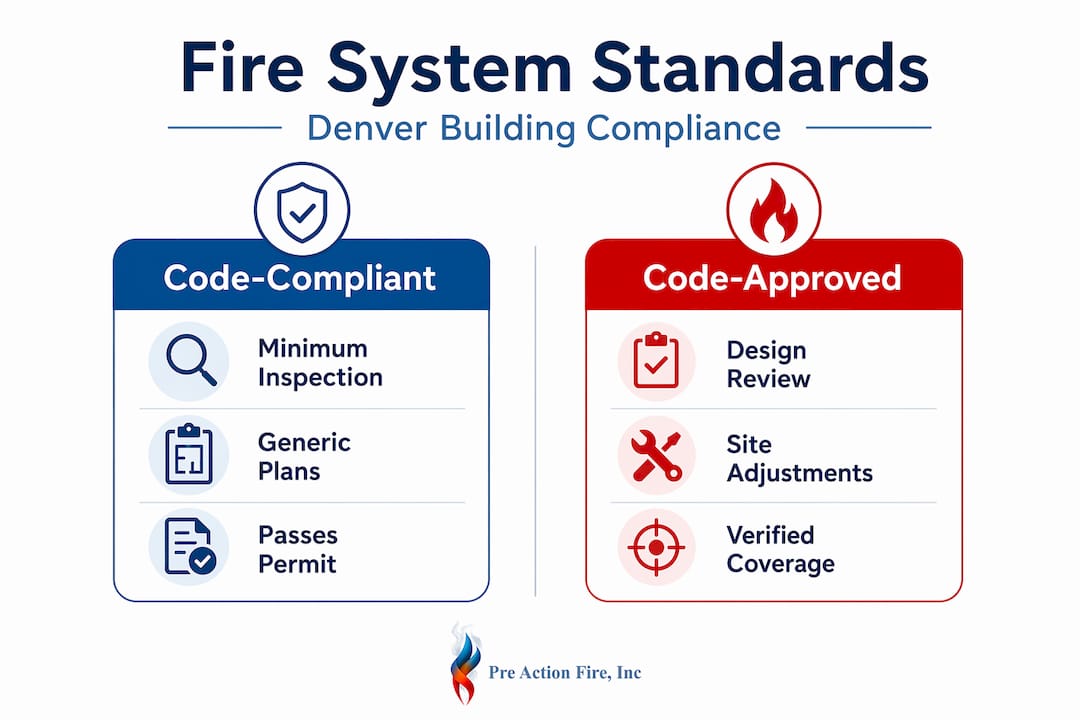
The benefits of approved fire systems go beyond paper compliance. An approved system has been verified to cover the actual occupancy, the actual hazard, and the actual building configuration. Fire alarm systems must be designed per NFPA 72 and approved by the AHJ, which means Denver requires permits and licensed contractors for all commercial fire alarm work. That approval layer catches the gaps that generic compliance misses.
Inspection passes are starting points, not endpoints. Inspections confirm minimum requirements are present. They do not confirm that those minimums fulfill your building’s actual safety needs.
Pro Tip: If your building has not had a full system design review in the past five years and has undergone any renovation, ask your fire protection contractor whether any retrofit triggers may now apply under the current DBFC.
Ongoing responsibilities after approval
Getting approved is the beginning, not the end. The regulations for fire protection systems under NFPA 25 make clear that compliance is a continuous performance requirement. Once your system is installed and approved, you take on ownership of its operational status through ongoing inspection, testing, and maintenance, commonly called ITM.
Here is what NFPA 25 requires of you as a property owner:
- Schedule ITM activities at the frequencies specified in NFPA 25, which vary by system type and component.
- Use qualified personnel for all inspections and tests, and document who performed each activity and when.
- Retain records onsite for at least one year beyond the next scheduled inspection or test of each type, accessible to the AHJ at any time.
- Document deficiencies found during ITM, along with corrective actions taken and their completion dates.
- Report impairments to the AHJ when a system or portion of a system is out of service.
NFPA 25 ITM records must show the date, responsible party, activity performed, results, and any deficiencies identified. This is not optional recordkeeping. It is what protects your approval status during AHJ surveys and insurance audits.
A critical point that trips up many facility managers: property owners remain responsible for ITM obligations under NFPA 25 even when the work is delegated to a contractor. Lease arrangements do not transfer this underlying obligation. If your tenant’s contractor missed a quarterly inspection and you cannot produce the record, the AHJ holds you accountable. This is where annual sprinkler inspections become a non-negotiable calendar item, not an optional service call.
Technical factors that affect Denver approvals
Several technical details specific to Denver’s environment create approval complications that standard fire system design templates do not address.
-
Backflow prevention and hydraulic design. Backflow prevention devices are required on fire sprinkler water supplies in Denver, and they introduce pressure loss that affects the entire hydraulic calculation for your system. Improperly oversized backflow preventers can degrade system performance and require a full hydraulic re-evaluation. Your designer must account for this pressure drop from the start, not treat it as an add-on afterthought.
-
Code edition confirmation before design. Denver’s adoption of the 2024 International Code family includes its own amendments and references specific NFPA editions. Designing to a current NFPA edition does not guarantee Denver AHJ approval if the DBFC references an earlier NFPA version. This jurisdiction switching pitfall is one of the most common and expensive mistakes fire system designers make in this market.
-
Local amendment impacts on timelines. When Denver modifies a provision from the model code, those changes affect everything from occupancy thresholds to detection requirements. A plan that sailed through approval in another Colorado jurisdiction may require significant redesign when submitted to Denver’s AHJ because of these local deviations.
-
Contractor licensing and permit coordination. Denver requires licensed contractors for commercial fire alarm and sprinkler work. Coordinating permit submissions, plan review cycles, and inspection scheduling with the AHJ requires someone who knows Denver’s specific workflow, not just fire system design in general.
Understanding these technical factors is part of why the importance of fire system codes in Denver goes beyond reading the NFPA standard. The local layer adds real complexity.
Practical steps for Denver facility managers
Getting your fire systems approved and keeping them compliant is manageable when you treat it as an active process rather than a one-time project. Here is a working framework:
- Verify the applicable code edition before any design work begins. Confirm with your contractor that they are working from the current DBFC, not an assumed national standard.
- Work with contractors licensed in Denver who have direct experience submitting to Denver Fire Rescue’s plan review process. Experience with the local AHJ matters as much as technical skill.
- Prepare complete documentation packages for plan review submissions, including hydraulic calculations, equipment cut sheets, detection device placement diagrams, and occupancy data. Incomplete submissions are the leading cause of plan review delays.
- Schedule inspections proactively and do not wait for the AHJ to reach out. Build inspection milestones into your construction or renovation timeline from day one.
- Respond to deficiency notices promptly. Unresolved deficiencies can stall occupancy certificates and, in reinspection scenarios, result in additional fees.
- Train your facilities staff on what to do when an alarm activates, what a system impairment means, and who to call. Staff awareness is part of your Colorado commercial fire code compliance picture.
Pro Tip: Create a single compliance binder that holds your current permits, inspection records, impairment logs, and contractor contact information. When the AHJ shows up unannounced, having that binder ready demonstrates active management and reduces scrutiny.
My take on what most buildings are actually getting wrong
I’ve spent years working in fire protection in Denver, and the pattern I see repeatedly is not negligence. It’s misplaced confidence. Facility managers get a passing inspection and file the certificate, and then fire safety drops off the radar until the next scheduled inspection cycle. That approach worked when buildings were simpler and codes were less demanding. It does not work now.
What concerns me more is the gap between what local amendments allow and what sound fire safety practice requires. Code-compliant buildings may lack automatic sprinklers in occupancies that genuinely need them, simply because a retrofit trigger was narrowed at the local adoption level. Legally, nobody is at fault. Practically, the risk is still there.
The most proactive facility managers I’ve worked with treat code approval as a continuous relationship with the AHJ, not a transaction. They call before submitting plans. They walk the building annually with their fire protection contractor. They treat ITM records as a liability shield, not a bureaucratic obligation. That mindset shift is worth more than any single system upgrade.
My honest advice: do not benchmark your fire safety program against minimum compliance. Benchmark it against whether your system would actually protect your occupants during a real event. Those two benchmarks are not always the same thing in Denver, and understanding that gap is the first real step toward closing it.
— Preactionfire
Get Denver-specific fire system support from Preactionfire
If this article raised questions about your current system’s approval status, that’s a signal worth acting on. Preactionfire has served the Denver Metro Area since 2009, and their NICET-certified technicians understand the specific amendments, permit workflows, and AHJ expectations that apply to your building.
Whether you need a new fire alarm system designed for Denver compliance or a review of your existing sprinkler system’s approval status, Preactionfire brings the local expertise that generic national contractors cannot match. Their team handles plan submissions, phased inspections, ITM scheduling, and deficiency resolution from a single point of contact. You can also explore their Denver sprinkler installation services to see how a properly scoped and approved system gets built from the ground up. Contact Preactionfire directly for a consultation tailored to your occupancy type and compliance timeline.
FAQ
What does “code-approved” mean for a fire system?
Code approval means the AHJ has reviewed the system design, verified the installation, and confirmed the system meets Denver’s adopted fire code requirements for your specific building. It goes beyond a simple pass or fail inspection.
Why do Denver’s local amendments matter for fire system design?
Denver adopts the 2024 International Code family with city-specific amendments through the DBFC, which can modify occupancy thresholds, detection requirements, and contractor licensing rules. Designing to national NFPA standards alone does not guarantee Denver AHJ approval.
Who is responsible for fire system ITM records in Denver?
The property owner is ultimately responsible for inspection, testing, and maintenance records under NFPA 25, even when a contractor performs the work. Records must be kept on-site and available for AHJ review at any time.
Can a building pass inspection and still have inadequate fire protection?
Yes. Local amendments can narrow retrofit triggers so buildings meet the legal code standard while lacking critical protections like automatic sprinklers. Inspection passes confirm minimum requirements are present, not that those minimums are sufficient for the actual risk.
How often should fire sprinkler systems be inspected in Denver?
NFPA 25 specifies inspection and testing frequencies by component type, with some requiring quarterly checks and others annual or five-year cycles. Denver’s AHJ enforces these schedules, and missed activities can jeopardize your system’s approval status.