
TL;DR:
- Colorado’s private commercial buildings are subject to local fire codes, not a statewide standard.
- Essential fire safety systems include sprinklers, alarms, hydrants, access roads, and hazardous material controls.
- Always verify requirements with your local fire authority before design, construction, or renovation.
Colorado is one of the few states where no mandatory statewide fire code applies to private commercial buildings. That means the rules governing your property in Denver may look nothing like those in Loveland, Aurora, or Colorado Springs. For commercial property owners and facility managers, this creates real compliance risk, especially when you’re managing multiple sites or taking over a building without a clear code history. This guide breaks down how Colorado’s fire code system actually works, what your building almost certainly needs, and how to navigate the permit and inspection process without costly surprises.
Table of Contents
- How commercial fire code requirements work in Colorado
- Essential components every Colorado commercial property needs
- Permits, inspections, and enforcements: What property owners must know
- Navigating local amendments, edge cases, and special occupancies
- Why ‘ask your AHJ first’ beats assumptions: Our take on code compliance
- Get support for your next fire code inspection or project
- Frequently asked questions
Key Takeaways
| Point | Details |
|---|---|
| Local code controls | Always verify fire code requirements with your city or county—there’s no Colorado-wide commercial standard. |
| Essential fire systems | Sprinklers, alarms, and fire apparatus access are critical for nearly all commercial properties and must meet NFPA standards. |
| Permits and inspections | Secure proper permits and schedule annual inspections to maintain compliance and avoid penalties. |
| Handling special cases | High-rises, renovations, or special occupancies may have stricter or supplemental rules—know what applies to your building. |
| AHJ is your best resource | When in doubt, consult your local fire marshal for the most accurate, enforceable requirements. |
How commercial fire code requirements work in Colorado
Understanding Colorado’s fire code landscape starts with one key fact: there is no uniform statewide standard for private commercial properties. Cities and counties adopt the IFC (International Fire Code) with their own local amendments, which means requirements can shift the moment you cross a city line. Denver, Aurora, Boulder, and Fort Collins each operate under their own adopted version, often with significant differences in scope, enforcement priorities, and technical details.
The Colorado Division of Fire Prevention and Control (DFPC) does publish and enforce codes, but its authority under state DFPC building codes primarily covers public schools, state-owned facilities, and certain regulated occupancies. For most private commercial buildings, you are dealing with local Authority Having Jurisdiction (AHJ), which is typically the city or county fire marshal.
Here is what that decentralized system means in practice:
- Denver adopted the 2021 IFC with local amendments and updated to a 2025 code cycle with fewer local modifications than previous years.
- Smaller municipalities may still be on older IFC editions (2018 or earlier) or have added requirements that exceed the base code.
- Some jurisdictions require plan review before construction; others enforce primarily through periodic inspections.
- NFPA 13 (sprinkler systems) and NFPA 72 (fire alarm systems) are referenced across virtually all Colorado jurisdictions, but local amendments can alter specific thresholds.
For a broader view of how to approach your property’s fire safety planning, a solid fire code planning guide can help you organize the process before you contact your AHJ. You can also review fire protection compliance resources specific to Colorado to understand what regulators are looking for.
Pro Tip: Never assume that because your neighboring building passed inspection, yours will too. Even properties on opposite sides of a city boundary can face entirely different code requirements. Always verify with your local fire marshal before assuming anything.
Essential components every Colorado commercial property needs
While requirements vary by jurisdiction, certain fire safety features appear in nearly every adopted code across Colorado. Knowing these gives you a reliable baseline to work from.
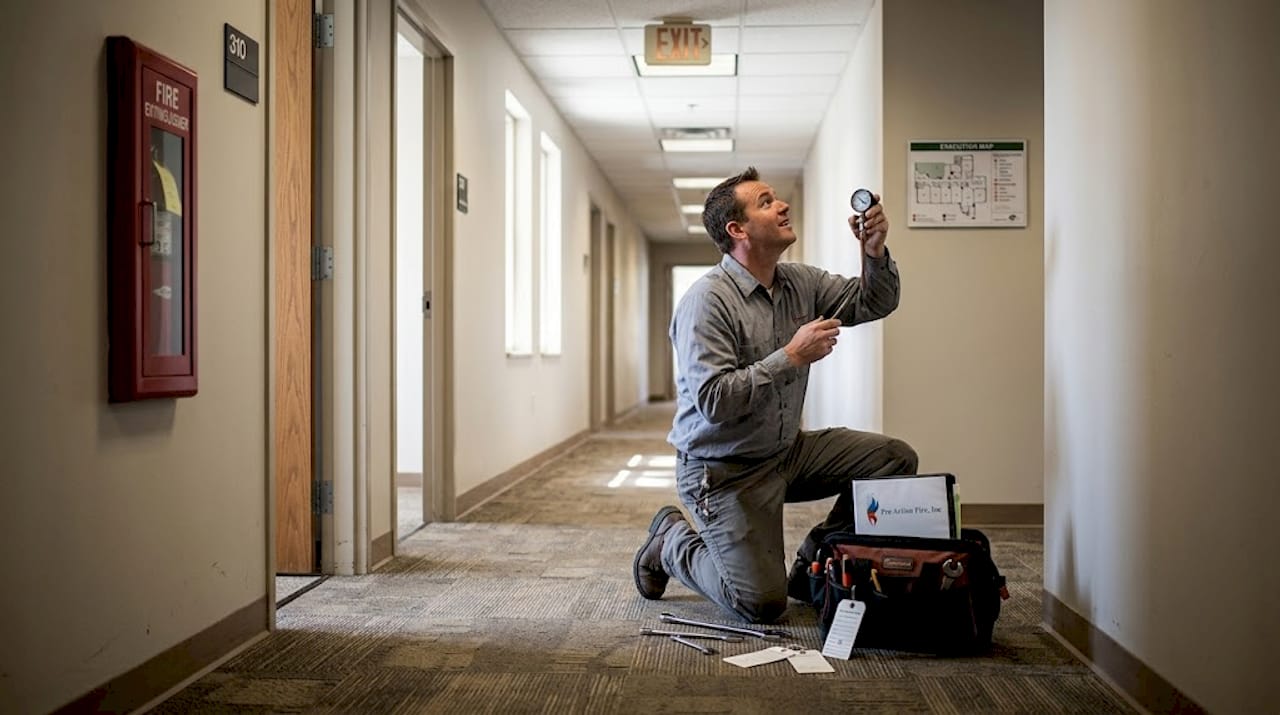
The 2025 Denver Fire Code requires fire apparatus access roads, sprinkler systems, fire alarms, hydrants, storage controls, and emergency planning as core elements for commercial occupancies. These align with IFC requirements adopted statewide.
Here are the primary systems most commercial properties must address:
- Sprinkler systems (NFPA 13): 130 sq ft spacing for sprinklers is the standard coverage area per head, with annual inspection, testing, and maintenance (ITM) required under NFPA 25.
- Fire alarm systems (NFPA 72): Includes detection devices, notification appliances, control panels, and monitoring. Annual ITM is required in virtually all jurisdictions.
- Fire apparatus access roads: Minimum 20-foot clear width, with new construction in many cities requiring dual access points for buildings over a certain square footage.
- Fire hydrants: Must meet spacing and flow rate requirements based on building type and hazard classification.
- Hazardous materials storage: Quantities and storage methods are tightly regulated, especially for industrial and mixed-use properties.
| Requirement | Universal baseline | Common local amendments |
|---|---|---|
| Sprinkler system | NFPA 13 required for most occupancies | Lower square footage thresholds in some cities |
| Fire alarm | NFPA 72 required | Added voice evacuation in high-rise buildings |
| Apparatus road width | 20 ft minimum | Some cities require 26 ft or dual access |
| Hydrant spacing | Per IFC defaults | Reduced spacing in high-density commercial zones |
| ITM frequency | Annual per NFPA 25/72 | Some jurisdictions require semi-annual for high-hazard |
For a deeper look at how these requirements apply to your specific building type, building fire safety best practices can walk you through occupancy-specific considerations.
Pro Tip: Annual ITM is one of the most commonly skipped obligations, yet it is often what triggers insurance disputes and failed inspections. Schedule it before your renewal date, not after a notice of violation.
Permits, inspections, and enforcements: What property owners must know
Installing the right systems is only part of compliance. You also need to navigate the permitting and inspection process correctly, or you risk fines, shutdowns, and insurance complications.
The Denver Fire Department enforces two primary permit categories for commercial properties:
- Operational permits: Required for ongoing activities involving hazardous materials, flammable finishes, open flames, or high-occupancy events. These must be renewed periodically.
- Construction permits: Required when installing or modifying sprinkler systems, fire alarms, suppression systems, or making structural changes that affect egress or fire separation.
Beyond permits, most jurisdictions also require specific licenses for alarm monitoring companies, kitchen hood suppression contractors, and other specialty fire protection providers. Hiring an unlicensed contractor can invalidate your system and void your permit.
Common inspection types include:
- New construction final inspection before occupancy
- Annual fire safety inspection for operational compliance
- Plan review for tenant improvements or system upgrades
- Special inspections for high-hazard occupancies or after a fire event
Non-compliance with fire code requirements can result in immediate site shutdown, civil fines, and denial of property insurance claims. In some cases, liability exposure extends to the building owner personally if a fire occurs in a non-compliant facility.
Contacting your AHJ early is the single most effective step you can take. Facility managers who schedule plan reviews before construction begins avoid the most expensive compliance corrections. Waiting until a system is installed to ask about local amendments is a costly mistake we see repeatedly.
For a clear overview of what to expect during a site visit, the fire safety inspection process page covers common inspection criteria and how to prepare. You can also review what a NFPA compliance inspection involves for system-level reviews.
Navigating local amendments, edge cases, and special occupancies
Once you understand the baseline, the harder work begins: figuring out what your specific city requires on top of it.
Denver made a notable shift in 2025 by reducing local amendments by roughly 50% to better align with the base IFC. That simplification is good news for Denver property owners, but other Colorado cities have moved in the opposite direction, adding requirements that go well beyond the IFC baseline.
Loveland and the Loveland Fire Rescue Authority (LFRA), for example, require two separate apparatus access roads for new commercial builds, mandate AEDs in high-occupancy facilities, and require larger address numbers for improved visibility. These are not IFC defaults.
| City or jurisdiction | Notable amendment | Impact on owners |
|---|---|---|
| Denver | Reduced amendments in 2025 cycle | Simpler compliance path for new builds |
| Loveland (LFRA) | Dual access roads, AED mandates | Higher upfront design costs |
| Aurora | Additional sprinkler thresholds | Lower sq ft triggers for suppression |
| Boulder | Stricter egress lighting standards | Retrofit costs for older buildings |
Special occupancy types require extra attention:
- Existing buildings fall under IFC Chapter 11, which generally requires fewer retrofits than new construction standards, but a change of occupancy can trigger a full upgrade.
- High-rise buildings (over 75 feet) require standpipe systems, voice alarm capability, and additional egress features regardless of jurisdiction.
- High-hazard occupancies such as chemical storage, paint booths, or manufacturing facilities often require specialized suppression systems beyond standard sprinklers.
If you are planning a renovation or change of use, treat it as a potential full code upgrade trigger. A fire risk assessment before finalizing renovation plans can prevent expensive redesigns. For buildings that need formal documentation, fire system certification services can verify your systems meet current code.
Why ‘ask your AHJ first’ beats assumptions: Our take on code compliance
After working with commercial property owners across the Denver Metro Area since 2009, we have seen one pattern repeat itself: owners who assume their fire code requirements match what a neighboring building did end up paying for it.
No uniform statewide code means that variability is not the exception, it is the rule. Two buildings on opposite sides of a city boundary can have meaningfully different requirements for the same occupancy type. We have seen this create real problems during tenant buildouts and property acquisitions.
Performance-based design is a legitimate path for unique buildings. Engineered systems that demonstrate equivalent safety through analysis rather than prescriptive compliance can satisfy AHJ requirements, but only with expert sign-off and explicit local approval. This is not a shortcut; it is an advanced option that requires more upfront work, not less.
Our honest advice: one direct conversation with your fire marshal before you finalize any design or renovation plan is worth more than hours of research. The compliance guide for Denver buildings is a useful reference, but it cannot replace the specific guidance your AHJ provides for your address, your occupancy, and your building’s history.
Code compliance is not a one-time checkbox. Amendments update on adoption cycles, AHJ interpretations evolve, and your building’s use may change. Build a relationship with your fire marshal’s office. It costs nothing and saves a great deal.
Get support for your next fire code inspection or project
Navigating Colorado’s patchwork of local fire codes is easier when you have a team that already knows the landscape. Pre Action Fire, Inc. has been working with commercial property owners and facility managers across the Denver Metro Area since 2009, and our NICET-certified technicians understand what local AHJs expect.
Whether you need fire alarm system compliance support, a new fire sprinkler installation in Arvada, or a thorough fire safety inspection to prepare for your next AHJ review, we can help you move from uncertainty to documented compliance. Reach out to our team to schedule a consultation and get a clear picture of where your property stands.
Frequently asked questions
Who enforces commercial fire code requirements in Colorado?
Local authorities enforce most commercial fire codes through the city or county fire marshal, not through a statewide agency. The AHJ for your property is determined by your physical address and jurisdiction.
What triggers the need for fire system upgrades in a commercial building?
A change of occupancy, major renovation, or a new code adoption cycle in your city can trigger upgrades. Change of occupancy requires upgrades, and local amendments may add requirements beyond the base IFC standard.
How often do fire sprinklers and alarms require inspection in Colorado?
Sprinklers require annual ITM per NFPA 25, and fire alarms follow the same annual cycle under NFPA 72. Some high-hazard occupancies may face more frequent requirements depending on local ordinance.
Do all Colorado commercial properties need the same fire protection systems?
No. Each city and county adopts its own version of the IFC with unique amendments, so requirements vary by jurisdiction, building type, and occupancy classification. Always confirm specifics with your local fire marshal.