
TL;DR:
- Most fire damage in sprinklered buildings is preventable with proper system maintenance and compliance.
- Fire suppression systems actively detect and fight fires, differing from fire alarms that only alert.
- Regular inspections and working with licensed Colorado contractors are essential for effective fire protection.
Sprinkler systems quietly prevent catastrophe in commercial buildings every day, yet most property owners misunderstand what they actually have installed. 96% of fires in sprinklered buildings are controlled before spreading, and U.S. businesses still lose billions annually to fire damage. The gap between those two facts usually comes down to the wrong system, poor maintenance, or a compliance lapse nobody caught in time. If you manage commercial property in Colorado, understanding your fire suppression system is not optional. It is the difference between a contained incident and a total loss.
Table of Contents
- What is a fire suppression system?
- Types of fire suppression systems for commercial properties
- How fire suppression systems work: Mechanics and design principles
- Common pitfalls, edge cases, and Colorado regulations
- Expert perspective: What most commercial owners miss about fire suppression
- Next steps: Professional fire suppression for Colorado properties
- Frequently asked questions
Key Takeaways
| Point | Details |
|---|---|
| Fire suppression systems defined | These systems automatically or manually detect and extinguish fires using various agents. |
| System type selection matters | Choosing the right system depends on property hazards and occupancy, especially in Colorado. |
| Maintenance is critical | Regular inspection and testing prevent failures and ensure compliance with state regulations. |
| Regulations impact design | Colorado and Denver codes require specific suppression system types based on building use. |
| Professional guidance reduces risk | Expert installation and ongoing maintenance provide stronger protection and regulatory assurance. |
What is a fire suppression system?
A fire suppression system is an engineered assembly designed to detect, contain, or extinguish fires automatically, without waiting for human intervention. That definition sounds simple, but the engineering behind it is anything but. These systems integrate detection devices, control panels, piping or delivery networks, and suppressing agents into a single coordinated response.
Many facility managers confuse suppression systems with fire alarm systems. They are not the same thing. A fire alarm detects smoke or heat and alerts occupants. A suppression system goes further, it actively fights the fire. In most commercial buildings, both systems work together, but having one does not replace the other.
Here is what a properly designed suppression system does:
- Detects fire through heat, smoke, or flame sensors
- Triggers an alarm to notify occupants and the fire department
- Releases a suppressing agent directly at the fire source
- Limits fire spread to protect adjacent areas and structural elements
- Reduces property loss and life safety risk simultaneously
Colorado adds a layer of regulatory complexity that property owners must understand. The state registers contractors and inspectors and has adopted both the International Fire Code (IFC) and NFPA standards as its baseline. That means the contractor installing or servicing your system must hold a current state registration, not just a general contractor license.
Working with an unregistered contractor in Colorado is not just a compliance risk. It can void your system’s certification and expose you to liability if a fire occurs.
Suppression systems appear across virtually every commercial occupancy type: office buildings, warehouses, restaurants, healthcare facilities, data centers, and parking structures. Each environment presents different hazards, and the system must be matched accordingly. Reviewing Colorado fire code requirements before any installation or upgrade is a smart first step, and a solid fire protection planning guide can help you map your specific risks before committing to a system design.
Types of fire suppression systems for commercial properties
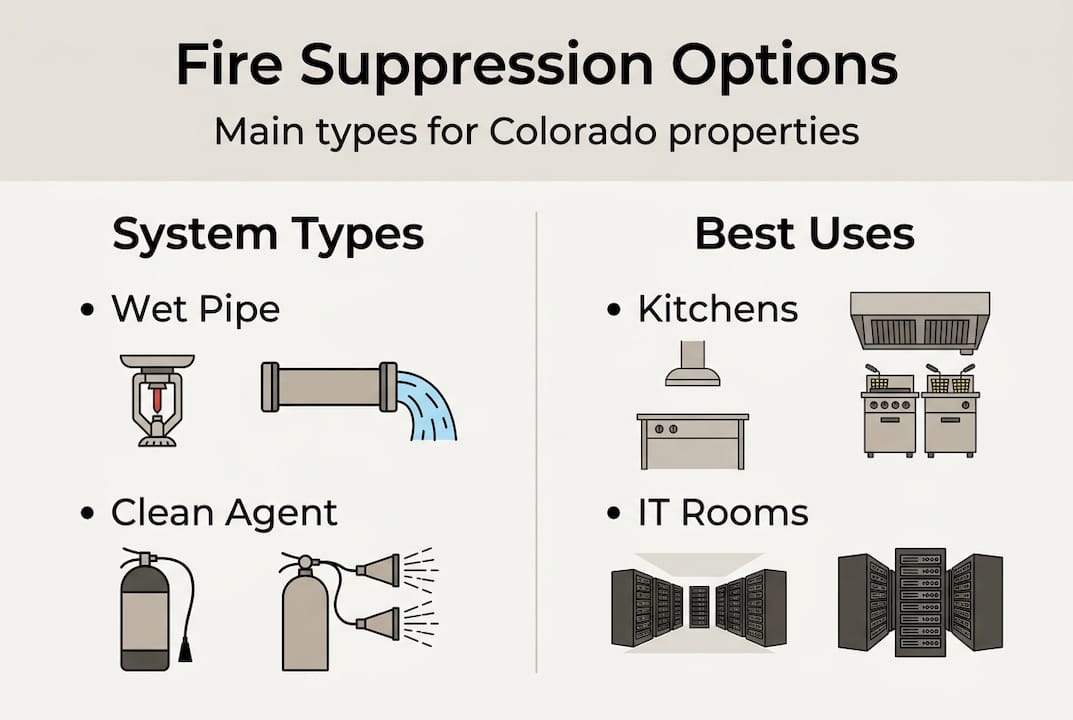
Choosing the right suppression system starts with understanding what each type does and where it performs best. The main categories are water-based, clean agent, inert gas, dry or wet chemical, and foam systems. Each uses a different mechanism to interrupt the fire triangle.
| System type | Suppression method | Best for | Not suitable for |
|---|---|---|---|
| Water-based (wet pipe) | Cools and smothers | Offices, warehouses, retail | Electrical rooms, freezing environments |
| Dry pipe | Pressurized air holds water back | Unheated spaces, parking garages | Fast-response requirements |
| Clean agent (FM-200, Novec 1230) | Removes heat, no residue | Data centers, server rooms, archives | Large open spaces |
| Inert gas (IG-541, Argon) | Reduces oxygen concentration | Occupied spaces with electronics | Areas needing rapid discharge |
| Dry chemical | Interrupts chemical chain reaction | Industrial, manufacturing | Sensitive equipment (leaves residue) |
| Wet chemical | Saponification of cooking oils | Commercial kitchens | Non-cooking environments |
| Foam | Smothers and cools | Fuel storage, aircraft hangars | Electrical hazards |
A few edge cases matter specifically for Colorado properties. Water-based systems are unsuitable for electrical fires (Class C) and oil fires (Class B). In Colorado’s cold climate, wet pipe systems in unheated spaces like loading docks or parking structures risk freezing and pipe failure. Dry pipe or antifreeze systems solve this, but they require additional maintenance attention.

Commercial kitchens need wet chemical systems, not standard sprinklers. The saponification reaction between the wet chemical agent and cooking oils creates a soapy foam layer that seals the fuel surface and prevents re-ignition. Standard water systems can actually spread a grease fire.
Pro Tip: Map every special-risk area in your building before selecting a system. IT rooms, chemical storage, commercial kitchens, and unheated spaces each need separate consideration. A single system type rarely covers every zone in a mixed-use commercial property.
For properties considering an upgrade to fire sprinkler systems, the occupancy classification and hazard level drive the design. Understanding Colorado fire protection benefits by system type can also help you make a stronger business case to ownership or insurers.
How fire suppression systems work: Mechanics and design principles
The mechanics behind suppression systems are more precise than most people realize. Detection triggers agent release, and in water-based systems, hydraulic calculations and NFPA 13 govern every design decision, from pipe diameter to sprinkler head spacing. Miss a calculation, and the system either under-delivers water pressure or floods areas unnecessarily.
Here is the sequence of events when a system activates:
- A detector (heat, smoke, or flame) reaches its activation threshold
- The control panel confirms the signal and opens the suppression valve
- The suppressing agent travels through the distribution network
- Sprinkler heads or nozzles discharge the agent at the fire source
- The alarm system simultaneously notifies building occupants and the fire department
- The system continues discharging until manually shut off or the agent supply is exhausted
For clean agent and inert gas systems, concentration calculations replace hydraulic calculations. The agent must reach a specific concentration within the protected space in a defined time window, typically 10 seconds for most clean agents, to suppress the fire before it grows beyond control.
| Design parameter | Standard requirement |
|---|---|
| Hydrostatic test pressure | 200 psi for 2 hours |
| Max sprinkler spacing (light hazard) | 15 ft between heads |
| NFPA 13 water supply duration | 30 to 90 minutes depending on hazard |
| NFPA 2001 clean agent discharge time | 10 seconds for Class A/B/C fires |
| NFPA 17 dry chemical system test interval | Every 6 years for internal inspection |
Inspection, testing, and maintenance (ITM) is where most commercial owners fall short. NFPA 25 governs ITM for water-based systems and requires quarterly, annual, and five-year inspections depending on the component. Skipping ITM is not just a compliance violation, it is the primary reason systems fail during actual fires. Staying current on building fire safety requirements and working with a licensed commercial fire protection provider in Denver ensures your system performs when it counts.
Common pitfalls, edge cases, and Colorado regulations
Even well-designed systems fail when real-world conditions are ignored. Colorado’s climate and regulatory environment create specific challenges that generic fire safety guides rarely address.
The most common failure points include:
- Corrosion in dry pipe systems: Oxygen trapped in the pipes reacts with steel, creating rust that clogs sprinkler heads and orifices over time
- False discharges: Mechanical damage, improper storage near heads, or heat from HVAC equipment can trigger accidental activation
- Freeze damage: Wet pipe systems in partially heated spaces are vulnerable during Colorado winters, especially in loading areas and stairwells
- Blocked sprinkler heads: Storage stacked too close to ceiling-mounted heads reduces discharge effectiveness significantly
- Performance vs. prescriptive design failures: Buildings with unusual layouts or mixed hazards sometimes require performance-based designs that prescriptive code alone cannot address
Colorado’s regulatory picture is layered. The Denver Fire Code adopts and amends the 2024 IFC, requiring sprinkler systems in commercial buildings based on occupancy type and hazard classification. Denver has local amendments that go beyond the state baseline, so a system compliant statewide may still fall short of Denver’s specific requirements.
Pro Tip: Request a copy of the authority having jurisdiction (AHJ) amendments for your municipality before finalizing any system design. Denver, Aurora, Lakewood, and other Front Range cities each maintain their own amendment lists on top of the state code.
Statistic callout: Buildings with lapsed ITM programs account for a disproportionate share of suppression system failures during actual fire events. Staying current is not bureaucratic overhead, it is the actual mechanism of protection.
For guidance on Denver building fire safety and local code compliance, working with a contractor who knows the AHJ’s expectations saves significant time and avoids costly redesigns. Scheduling fire sprinkler installation with a registered Colorado contractor ensures your system meets both state and local requirements from day one.
Expert perspective: What most commercial owners miss about fire suppression
After years of working with Colorado commercial properties, one pattern stands out clearly. Owners invest heavily in installation and then treat the system as a set-and-forget asset. That assumption is where real risk accumulates.
Verified compliance boosts suppression effectiveness by 82% compared to systems with lapsed maintenance records. That is not a marginal improvement. It is the difference between a system that works and one that looks like it works.
The contrarian truth is this: a fire alarm system without a paired suppression system is a notification tool, not a protection tool. It tells you a fire is happening. It does not stop it. Many facility managers believe their alarm system satisfies their fire safety obligation. It does not.
Colorado’s licensing program exists precisely because suppression system failures are almost always traceable to installation errors or maintenance gaps, not system design flaws. Partnering with a Denver fire protection company that holds current NICET certifications and state registrations is the single most reliable way to close that gap. Compliance on paper is not the same as a system that actually performs.
Next steps: Professional fire suppression for Colorado properties
Understanding fire suppression systems is the first step. Acting on that knowledge is what actually protects your property, your tenants, and your liability exposure. Colorado commercial owners need licensed contractors who know both state and local code requirements inside and out.
Pre Action Fire, Inc has served the Denver Metro Area since 2009, with NICET-certified technicians and a track record across office buildings, warehouses, restaurants, and industrial facilities. Whether you need Arvada fire sprinkler installation, Denver fire safety inspections, or guidance on the right types of fire extinguishers for your occupancy, our team delivers compliant, code-specific solutions. Contact us today to schedule a consultation and get a system that actually works when it matters most.
Frequently asked questions
What is a fire suppression system and how does it work?
A fire suppression system detects fire and automatically releases a suppressing agent, such as water, gas, or chemical, to contain or extinguish the threat before it spreads. The system integrates detection, control, and delivery components into one coordinated response.
Which fire suppression system suits data centers or electronics rooms?
Clean agent systems like FM-200 and Novec 1230 are ideal because they remove heat without leaving residue and are safe for sensitive equipment. They discharge rapidly and do not require cleanup or equipment replacement after activation.
How often must fire suppression systems be inspected or tested in Colorado?
Colorado’s state registration program requires annual testing and regular sensor maintenance to stay compliant. Specific intervals vary by system type and component, with some elements requiring quarterly checks under NFPA 25.
Are water-based fire suppression systems safe for electrical fires?
Water is unsuitable for Class C electrical fires and Class B oil fires. Clean agents or inert gases are the correct choice for server rooms, electrical panels, and any space with energized equipment.
Do Colorado regulations require fire suppression systems in all commercial buildings?
Most commercial buildings must have suppression systems, with specifics determined by occupancy type and hazard classification. The Denver Fire Code adopts the 2024 IFC with local amendments that may impose stricter requirements than the state baseline.