
TL;DR:
- Fire safety code compliance is crucial for protecting people, property, and profits in Colorado.
- Violations can lead to hefty fines, insurance issues, and legal liabilities.
- Proactive management and consistent record-keeping ensure ongoing safety and regulatory adherence.
Ignoring fire safety codes in Colorado is not a paperwork problem. It is a business survival problem. Non-compliant commercial properties face fines between $800 and $12,000 per violation annually, voided insurance policies, and potential criminal liability if someone gets hurt. For facility managers and property owners, the stakes are too high to treat compliance as a once-a-year checkbox. This article breaks down exactly which codes apply, who enforces them, what violations actually cost, and how to build a compliance process that protects your people, your property, and your bottom line.
Table of Contents
- How fire safety codes protect people, property, and profits
- What fire safety codes apply in Colorado and who enforces them?
- Legal, financial, and insurance risks of non-compliance
- Proactive compliance: Strategies, process, and action steps
- The biggest fire safety compliance mistake Colorado owners make
- Fire safety compliance made simple: How Pre Action Fire, Inc. helps Colorado properties
- Frequently asked questions
Key Takeaways
| Point | Details |
|---|---|
| Compliance protects assets | Following fire codes significantly reduces legal risk and prevents costly damages or shutdowns. |
| State and local rules matter | Different Colorado agencies enforce layered codes—always check the latest requirements for your property. |
| Fines and insurance penalties are real | Ignoring inspections can quickly lead to tens of thousands in fines or denied insurance claims. |
| Proactive management pays off | Annual audits, digital records, and quick fixes keep compliance simple and your property protected. |
How fire safety codes protect people, property, and profits
Fire safety codes exist because buildings burn, and people die when systems fail. But beyond the obvious life-safety argument, there is a compelling financial case for compliance that most property owners underestimate.
Modern building codes avert billions in property losses and prevent thousands of fatalities each year. In jurisdictions with strong code enforcement, fatality rates from commercial fires drop significantly. That is not a coincidence. It is the direct result of mandated sprinkler systems, alarm networks, and egress planning working together.
“Fire safety compliance is not just a legal obligation. It is one of the most cost-effective risk management tools available to commercial property owners.”
For Colorado property owners, fire safety compliance translates into three distinct categories of protection:
- People protection: Properly maintained alarm and suppression systems give occupants time to evacuate. Every second counts in a fire, and code-compliant systems are designed to maximize that window.
- Property protection: Sprinkler systems and fire-rated construction materials limit structural damage. A contained fire is exponentially less costly than a total loss.
- Profit protection: Compliant properties qualify for insurance discounts up to 22%, face fewer operational shutdowns, and avoid the legal costs that follow non-compliance citations.
The difference between bare-minimum compliance and proactive risk management is significant. A property that passes its annual inspection but skips monthly self-checks is not truly protected. Equipment degrades, tags expire, and small issues compound into serious violations. Proactive owners schedule quarterly walkthroughs, maintain digital records, and treat compliance as a continuous operational standard, not an annual event.
Think of it this way: a compliant building is a more insurable, more leasable, and more defensible asset. Tenants increasingly ask about fire safety records before signing leases. Lenders factor code compliance into property valuations. Compliance is not overhead. It is equity.
What fire safety codes apply in Colorado and who enforces them?
Colorado’s regulatory framework is layered, and understanding it prevents costly surprises. The state adopts IBC, IFC, and NFPA standards, enforced by both state agencies and local authorities having jurisdiction, commonly called AHJs.
The three primary code frameworks you need to know:
- International Fire Code (IFC): Governs fire prevention, hazardous materials storage, and operational fire safety requirements inside existing buildings.
- International Building Code (IBC): Covers structural fire resistance, egress design, and construction-phase fire protection requirements.
- NFPA standards: The National Fire Protection Association publishes specific technical standards. NFPA 13 covers sprinkler system design, NFPA 25 covers inspection and testing of water-based systems, and NFPA 72 governs fire alarm systems.
Here is a quick reference for how these codes are structured in Colorado:
| Code | What it governs | Who enforces | Update cadence |
|---|---|---|---|
| IFC | Operations, prevention, hazmat | Local AHJ | Every 3 years |
| IBC | Construction, egress, structure | Local AHJ / DFPC | Every 3 years |
| NFPA 13 | Sprinkler system design | Local AHJ | Periodic updates |
| NFPA 25 | System inspection and testing | Local AHJ | Periodic updates |
| NFPA 72 | Fire alarm systems | Local AHJ | Periodic updates |
The Colorado Division of Fire Prevention and Control (DFPC) sets baseline standards statewide, but local AHJs like the Denver Fire Department can adopt stricter versions or lag behind by one code cycle. That gap matters. A building permitted under a 2018 IFC edition may face different requirements than one permitted under the 2021 edition.
To verify which version applies to your property, check with your city or county building department. You can also review the Denver building compliance guide or the NFPA inspection rules for Colorado for jurisdiction-specific details.
Key steps to identify your compliance obligations:
- Contact your city or county building department to confirm your AHJ
- Ask which code edition is currently adopted and enforced
- Verify whether any local amendments modify the base code
- Confirm which NFPA standards apply to your specific building type and occupancy
Legal, financial, and insurance risks of non-compliance
Understanding who enforces the rules makes the consequences of missing something far more real. Non-compliance is not just a fine. It is a cascading risk that touches your insurance, your legal exposure, and your ability to operate.
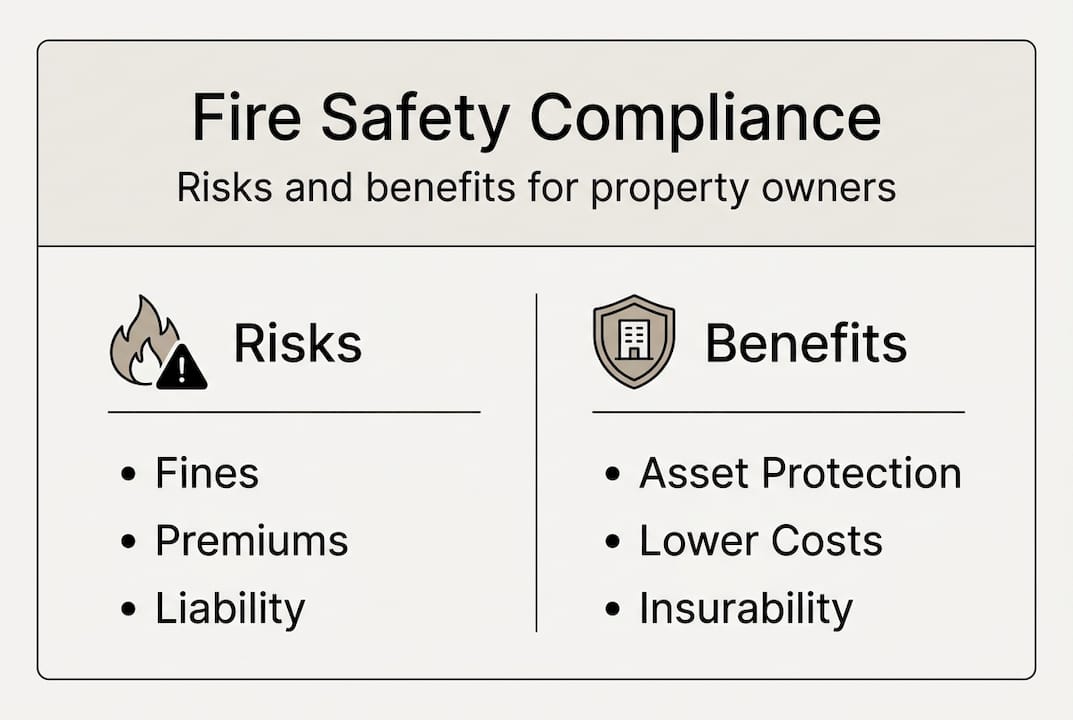
Fines reach $12,000 per year per violation category, insurance premiums can jump up to 22%, and claims may be denied outright if violations contributed to a loss. Here is how common violations break down:
| Violation type | Annual penalty range | Insurance impact | Enforcement authority |
|---|---|---|---|
| Missed inspection | $800 to $5,000 | Premium increase | Local AHJ |
| Expired maintenance tags | $800 to $3,000 | Claim denial risk | Local AHJ |
| Unapproved system modification | $2,000 to $12,000 | Policy nonrenewal | DFPC / Local AHJ |
| Blocked egress or signage | $1,000 to $8,000 | Liability exposure | Local AHJ |
Insurance ramifications deserve special attention. Insurers increasingly conduct their own compliance audits before renewing commercial policies. A property with lapsed inspection records or unapproved modifications may face nonrenewal, even if no fire has occurred. If a fire does occur and violations are discovered, the insurer may deny the claim entirely, leaving you to absorb the full cost of damages.
Civil and criminal liability is also a real risk. If a fire injures or kills an occupant and investigators find code violations, building owners can face lawsuits and, in serious cases, criminal negligence charges. Reviewing your fire risk assessment approach before an incident occurs is far less expensive than defending a lawsuit after one.
Pro Tip: When you receive a violation notice, respond within 24 hours and document every corrective action with timestamps and photos. This paper trail is your best defense in any legal or insurance dispute.
The most common missteps that lead to violations:
- Missing scheduled annual inspections entirely
- Allowing maintenance tags on extinguishers or suppression systems to lapse
- Making system modifications without AHJ approval or licensed contractor sign-off
- Blocking fire exits, extinguisher access points, or required signage compliance areas
- Failing to update records after tenant buildouts or space reconfigurations
Proactive compliance: Strategies, process, and action steps
Having seen what can go wrong, here is exactly how to get your compliance on autopilot without the headaches.
Proactive compliance means audits, digital records, and certified professionals working together to prevent failures before inspectors ever arrive. It is not just about passing the annual inspection. It is about eliminating the conditions that cause failures in the first place.
Ownership and tenant responsibility often overlap, but the liability almost always lands on the property owner. Even if your lease assigns fire safety maintenance to tenants, you are the one cited when the AHJ finds a violation. Build your fire protection planning process around that reality.
Here is a practical compliance checklist for commercial property owners:
- Schedule your annual inspection with a NICET-certified contractor and confirm it covers all systems: alarms, sprinklers, extinguishers, and emergency lighting.
- Conduct monthly self-checks on extinguisher tags, exit sign illumination, sprinkler head clearance, and fire door operation.
- Respond to deficiencies immediately. Do not wait for the next inspection cycle. Fix issues and document the repair with photos and service records.
- Maintain digital records of every inspection, test, repair, and correspondence with your AHJ. Cloud-based storage ensures records survive a fire or hardware failure.
- Verify contractor credentials before every service call. Ask for NICET certification numbers and confirm current licensing with the Colorado DFPC.
- Review NFPA standards annually to catch any updates that affect your building type or occupancy class.
Consider this real-world scenario: a Denver warehouse manager set up a shared digital calendar with monthly reminders for self-checks and quarterly reminders for system reviews. When the AHJ conducted an unannounced inspection, the manager produced a complete two-year record of inspections, repairs, and corrective actions within minutes. The inspector found no violations and noted the property as a model for the district. That outcome did not happen by accident. It happened because compliance was treated as a business process, not a one-time event.
Pro Tip: Establish a direct contact at your local AHJ office. A simple relationship built on transparency and responsiveness can turn a potential shutdown notice into a correctable deficiency with a reasonable timeline.
The biggest fire safety compliance mistake Colorado owners make
After years of working with commercial properties across the Denver Metro Area, we have seen one pattern repeat itself more than any other: owners treat compliance as a pass or fail event that happens once a year, then forget about it until the next inspection letter arrives.
This mindset is the root cause of most violations. Fires do not wait for annual inspection cycles. Equipment degrades on its own schedule. A sprinkler head gets painted over during a renovation. An extinguisher tag expires in February. A door closer fails in July. None of these issues announce themselves. They accumulate quietly until an inspector or, worse, an emergency reveals them all at once.
Compliance is an ongoing responsibility, not a one-time event. The properties that stay out of trouble are the ones where someone owns the compliance calendar year-round. They fix small things fast. They keep records without being asked. They call their AHJ with questions instead of waiting to be called.
The contrarian truth is that most fire safety failures are not caused by ignorance of the codes. They are caused by organizational habits that treat compliance risk reduction as someone else’s job until it becomes everyone’s crisis. Embedding compliance into your operational culture, not just your annual budget, is what separates resilient properties from vulnerable ones.
Fire safety compliance made simple: How Pre Action Fire, Inc. helps Colorado properties
If you are ready to ensure full compliance without the stress, Pre Action Fire, Inc. has been helping Denver Metro commercial properties stay protected and code-compliant since 2009.
Our NICET-certified technicians stay current with Colorado AHJ requirements, including Denver fire alarm regulations, so you do not have to track every code update yourself. We handle fire safety inspections for alarm systems, sprinklers, and extinguishers, and we provide the documentation your insurer and AHJ expect. Whether you need a new fire sprinkler installation in Arvada or a compliance assessment for an existing building, we bring the local expertise and technical credentials to get it done right. Contact us today to schedule your compliance review.
Frequently asked questions
What are the main fire safety codes commercial property owners must follow in Colorado?
You must comply with the IBC, IFC, and NFPA codes such as NFPA 13, 25, and 72, as adopted and enforced by your local AHJ. Always verify which code edition your jurisdiction has adopted, since local versions can differ from the statewide baseline.
What’s the penalty for failing a fire safety inspection?
Fines and shutdown risk for non-compliance range from $800 to $12,000 annually per violation category. Repeated offenses can result in loss of your operating certificate or forced closure until violations are corrected.
Do insurance companies verify fire code compliance before issuing a policy?
Yes. Insurers often request proof of compliance and may raise premiums by up to 22% or deny claims for non-compliant properties. Some carriers conduct independent audits before renewal, especially for larger commercial portfolios.
Who’s responsible for fire code compliance, the landlord or the tenant?
Owners are usually liable for code compliance, even when lease agreements assign maintenance duties to tenants. If a violation is cited, the property owner is the named responsible party in most AHJ enforcement actions.
Recommended
- Building fire safety in Colorado: compliance and risk reduction
- Protect Colorado assets: NFPA fire safety standards 2026
- Fire risk assessment tips for Colorado properties
- Denver fire alarm regulations: Your compliance guide
- Prevent water damage: protect property and ensure compliance
- Denver Commercial Fire Protection