
TL;DR:
- Fire doors are critical passive safety components engineered to resist heat, smoke, and structural failure during a fire. Proper maintenance, inspection, and compliance with NFPA 80 standards are essential to ensure their effectiveness in containment and occupant safety. Using tested materials and verifying assembly integrity helps prevent failures and legal liabilities during fire incidents.
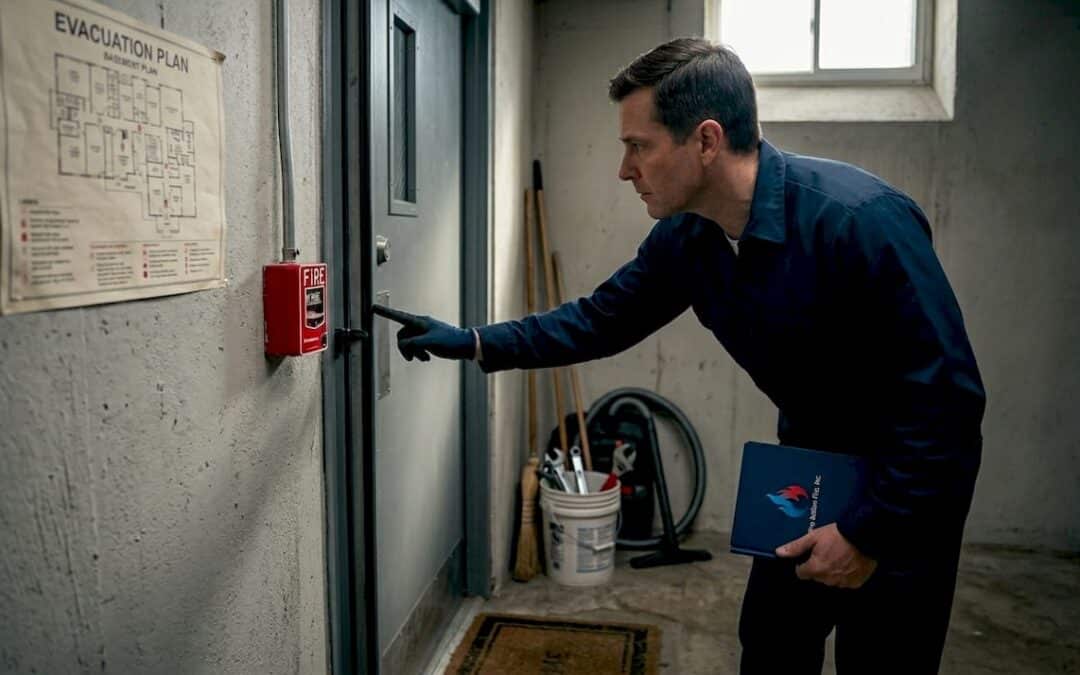
Most facility managers assume a solid door provides meaningful fire protection. It does not. The role of fireproof doors is fundamentally different from any standard door in your building. Engineered to resist extreme heat, block smoke migration, and hold structural integrity long enough for occupants to evacuate, these doors are the last line of passive defense when a fire breaks out. This guide covers everything you need to know: how fire doors work, what the 2026 compliance standards require, which materials perform best, and how to keep your doors inspection-ready year-round.
Table of Contents
- Key Takeaways
- The role of fireproof doors in fire containment
- Fire door compliance and current regulations
- Fireproof door materials and critical components
- Maintaining fire doors and preparing for inspections
- My perspective on fire doors after years in fire protection
- How Preactionfire can support your fire safety compliance
- FAQ
Key Takeaways
| Point | Details |
|---|---|
| Fire doors enable compartmentation | They slow fire and smoke spread, preserving evacuation routes even when alarms or sprinklers are delayed. |
| NFPA 80 governs clearances | Gap tolerances are strict: no more than 1/8 inch for wood doors and 3/16 inch for steel doors at the frame. |
| Material choice affects rating | Steel closers and intumescent seals outperform basic hardware in sustained heat and extend the door’s rated protection. |
| Labels must stay legible | Painted-over or missing fire door labels invalidate compliance and can require full door replacement. |
| Maintenance is a legal obligation | Regular inspection, documentation, and hardware checks are required under NFPA 80 and relevant local codes. |
The role of fireproof doors in fire containment
A fire door does something no ordinary door can: it functions passively to compartmentalize fire and smoke, buying critical time even when sprinklers or alarms have not yet responded. That passive reliability is exactly why fire doors are treated as life-safety components under building codes, not optional upgrades.
The core mechanism is compartmentation. When a fire door closes correctly within a fire-rated assembly, it creates a barrier that limits the spread of flames and toxic smoke to a defined zone. This gives occupants in adjacent areas the time they need to exit safely and gives emergency responders a more manageable fire boundary to work within.
The benefits of fire doors extend beyond physical containment:
- Extended evacuation time. A properly rated 90-minute door can hold a fire corridor long enough for full building evacuation in most commercial scenarios.
- Property protection. Containing fire to one compartment dramatically reduces total structural and asset damage.
- Insurance compliance. Many commercial property insurers require documented fire door compliance as a condition of coverage.
- Liability reduction. A building that cannot demonstrate fire door compliance faces significant legal exposure following any fire-related incident.
A fire door is not a passive element that simply exists in your wall. It is an active safety component that performs a specific, rated function when the moment demands it. Every compromised seal, misaligned frame, or propped-open door undermines that function entirely.
Compare this to a standard hollow-core interior door. Under test conditions, a standard door typically fails in under ten minutes. A rated fire door holds its assembly integrity for 20, 45, 90, or 180 minutes depending on its classification. That difference determines whether your employees have time to reach the stairwell or not.
Fire door compliance and current regulations
Understanding the regulatory framework around fire doors is not optional for facility managers. NFPA 80 is the primary U.S. standard governing fire door installation, inspection, and maintenance, and its requirements are specific enough that small oversights create real compliance failures.
Here are the key NFPA 80 requirements you need to know:
- Clearance gaps. The gap between door and frame must not exceed 1/8 inch for wood doors or 3/16 inch for steel doors. Bottom clearance cannot exceed 3/4 inch.
- Self-closing mechanisms. Every fire door must fully close and latch from any open position under its own power. No exceptions.
- Positive latching. The latch must engage automatically without the inspector or user needing to apply additional force or lift the handle.
- Label integrity. Fire rating labels must be permanently affixed and fully legible. Painted-over labels invalidate compliance.
- Frame condition. The frame must carry permanent labels and show no damage, misalignment, or unauthorized modification.
For context on global regulatory trends, the UK requires quarterly inspections for communal fire doors in residential buildings over 11 meters tall, with annual inspections for individual flat entrance doors. While these are UK-specific rules, they reflect a broader international push toward more frequent, documented verification of fire door performance.
The 2026 update to BS 8214 takes this further by shifting from prescriptive detail checks to verifying the entire door assembly as a tested system. That means the leaf, frame, hardware, and seals must all be verified together as originally certified, not evaluated as independent components. U.S. facilities following NFPA 80 already operate under a similar whole-assembly philosophy, which is why unauthorized field modifications to any component can void the entire fire rating.
Pro Tip: Never allow maintenance staff to paint over door hardware, frames, or label areas during facility repaints. A single coat of paint over a fire rating label creates a compliance failure that may require full door replacement, not just label replacement.
The most common compliance pitfalls seen during inspections are propped-open doors, excessive gap clearances, missing or painted-over labels, and damaged intumescent seals. Each one is preventable with a consistent inspection program. For facilities navigating Denver fire safety compliance, local codes layer on top of NFPA 80 requirements and should be reviewed alongside your inspection schedule.
Fireproof door materials and critical components
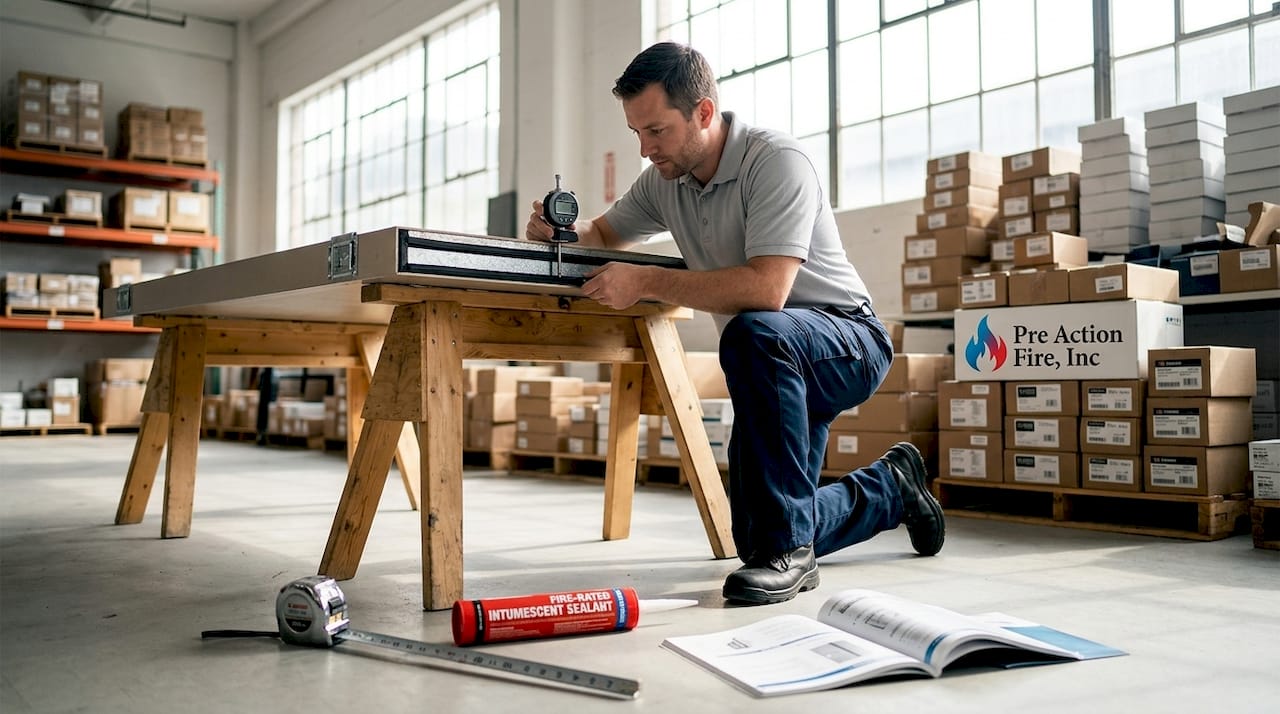
Not all fire doors are built the same way, and the material choices you make when specifying or replacing doors directly affect how long they perform under fire conditions. Here is a breakdown of the primary options:
| Material | Fire resistance | Best application | Key limitation |
|---|---|---|---|
| Steel | Excellent | Stairwells, mechanical rooms | Heavier; can be harder to self-close |
| Solid wood core | Good to excellent | Office corridors, retail | Vulnerable to moisture damage |
| Aluminum with glazing | Moderate | Lobby areas, vision panels | Limited to lower fire ratings |
| Composite core | Good | Multi-use commercial spaces | Performance varies by manufacturer |
Beyond the door leaf itself, the hardware components determine whether your door actually meets its rated performance. The importance of fireproof doors extends to every part of the assembly.
- Intumescent seals. These expand when exposed to heat, filling the gap between door and frame to block smoke and flame. Without them, even a properly rated door leaf fails at the edges.
- Self-closing devices. Overhead or concealed closers must be calibrated to close the door fully from 90 degrees. Closer springs degrade over time.
- Hinges. Fire-rated hinges must be UL-listed and match the door’s rating. Standard residential hinges are not acceptable substitutes.
- Latching hardware. Stainless steel closers and latch hardware withstand extreme heat and corrosion better than standard hardware, maintaining compliance under sustained fire exposure.
The fire door safety features that actually prevent assembly failure are often overlooked during routine maintenance. The glazing in vision panels must also carry a fire rating. A standard glass pane in a fire-rated door creates a weak point that fails long before the door itself, potentially voiding the entire rated assembly.
Pro Tip: When replacing any single component of a fire door assembly, verify that the replacement part matches the original tested assembly specifications. Swapping in a non-listed hinge or closer to save cost can void the fire rating of the entire door.
For facilities undertaking new construction fire protection, specifying coordinated, tested door assemblies from the design phase is far more cost-effective than retrofitting compliant hardware after installation.
Maintaining fire doors and preparing for inspections
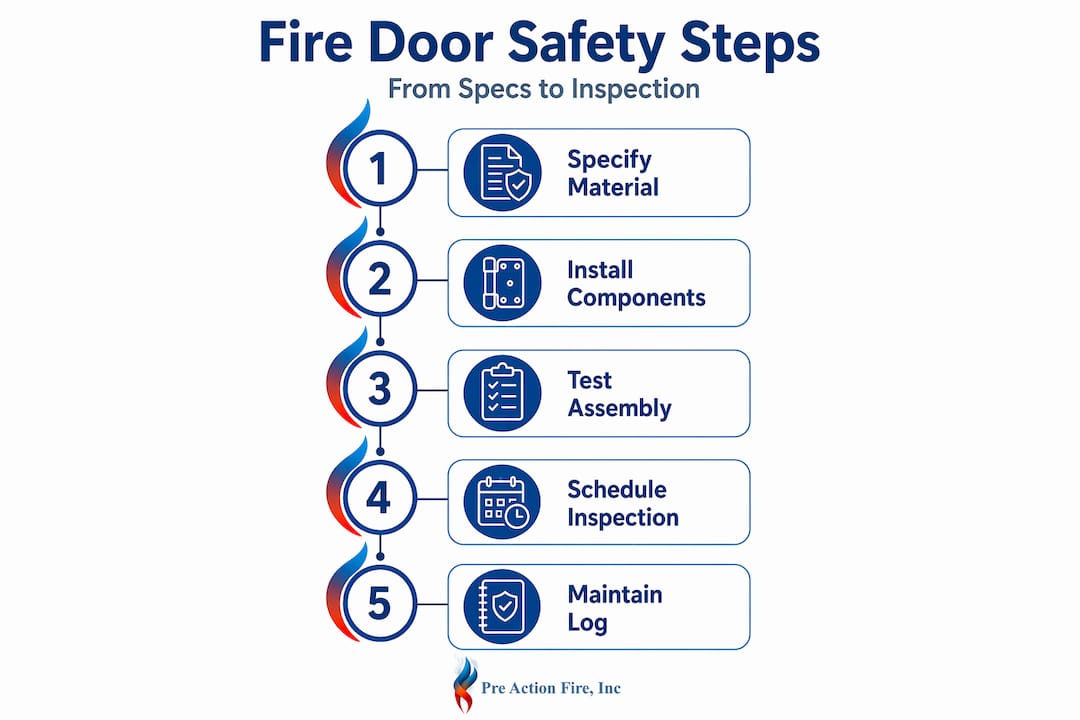
Compliance is not a one-time achievement. Fire door safety features only protect occupants if those features remain functional between inspections. Here is a practical framework for staying ahead of inspection failures.
- Conduct monthly visual checks. Walk every fire door location and look for propped-open doors, visible damage to seals or frames, and any hardware that appears loose or fails to latch. These checks take under a minute per door and catch the most common failures before they become inspection violations.
- Schedule annual professional inspections. NFPA 80 requires documented annual inspection of all fire doors. Your inspection provider should check clearance gaps with a feeler gauge, verify label integrity, test self-closing and latching function, and inspect the full frame assembly.
- Address seal damage immediately. A torn or compressed intumescent seal does not self-repair. Replace it as soon as damage is identified. Delaying seal replacement is one of the most common reasons facilities fail inspections that they could have passed easily.
- Maintain an inspection log. Document every inspection, including dates, findings, corrective actions taken, and the inspector’s credentials. During a compliance audit or a post-incident investigation, this documentation is your proof that you met your legal obligations.
- Integrate fire door checks into your broader fire safety plan. Fire protection maintenance is most effective when door inspections, sprinkler checks, alarm testing, and extinguisher maintenance are coordinated on a single schedule rather than managed in isolation.
Pro Tip: Add a photo log to your inspection records. Photographing each door’s label, seals, and hardware condition during inspection creates a time-stamped record that is invaluable during insurance claims or regulatory audits.
The frame must be inspected as an integral part of the rated assembly. Facilities that inspect only the door leaf while ignoring the frame routinely fail audits, because frame misalignment or unlabeled frames disqualify the entire assembly regardless of the door’s condition. Treating installing fireproof doors as a permanent set-and-forget investment is the single biggest mistake facility managers make.
My perspective on fire doors after years in fire protection
I have seen the full spectrum of fire door situations in commercial buildings across the Denver area. The most dangerous ones are not the doors that are visibly broken. They are the doors that look fine but have been quietly compromised. A self-closer that was adjusted once by a maintenance tech because “it closed too hard” and now fails to fully latch. A seal that was replaced with the wrong product during a corridor remodel. These are the failure points that no one catches until an inspection or, worse, an actual fire.
What I have learned working in this field is that fire door compliance problems are almost always management problems. The buildings with clean inspection records are not the ones with the best doors. They are the ones where facility managers treat fire doors as functional equipment that requires scheduled maintenance, not as architectural features that exist passively in the background.
The updated standards like BS 8214:2026 shifting to whole-assembly verification reflect where the industry is heading globally. The U.S. is already aligned with this thinking under NFPA 80. The message is clear: fire doors must be treated as systems, not individual components. Every hardware substitution, every paint coat, every propped door is a decision that degrades a tested, engineered system. Once you internalize that, the compliance steps stop feeling like bureaucratic obligations and start feeling like the straightforward protection they actually are.
— Preactionfire
How Preactionfire can support your fire safety compliance
Fire door compliance does not exist in isolation. For commercial facilities in the Denver Metro Area, it is one layer of a coordinated fire protection system that includes alarm systems, sprinkler coverage, and regular professional inspections. Preactionfire has been helping Colorado businesses maintain compliant, inspection-ready fire safety systems since 2009. Our NICET-certified technicians understand both the letter of NFPA 80 and how fire door performance integrates with fire alarm systems and suppression equipment in your building. Whether you are preparing for an upcoming inspection, upgrading an existing facility, or managing fire safety for new construction, Preactionfire can build a protection plan tailored to your building type and occupancy. Contact us today to schedule a consultation and get your facility fully compliant.
FAQ
What is the role of fireproof doors in a commercial building?
Fireproof doors contain fire and smoke within a defined compartment, protecting evacuation routes and limiting structural damage. They function as passive fire protection that operates independently of alarms or sprinklers.
How often do fire doors need to be inspected?
NFPA 80 requires annual inspection and documentation for all fire doors in commercial buildings. Some local codes and high-risk occupancies may require more frequent checks.
What causes a fire door to fail inspection?
The most common failures are excessive clearance gaps, painted-over rating labels, damaged intumescent seals, self-closers that do not fully latch, and frame damage or misalignment.
What are the best materials for fireproof doors?
Steel is the top-performing material for high-risk areas like stairwells and mechanical rooms. Solid wood core doors perform well in office corridors. All materials require UL-listed hardware and intumescent seals to meet their rated classification.
Can you replace a single component of a fire door assembly?
Yes, but only with a component that matches the original tested assembly specifications. Substituting a non-listed hinge, closer, or seal can void the entire fire rating of the door, even if all other parts remain intact.