
TL;DR:
- Property managers in Colorado are legally required to notify fire authorities of fire incidents and system impairments to ensure safety and compliance. Standard fire alarms do not automatically contact the fire department unless connected to monitored systems that verify alerts before dispatch. Prompt and accurate notification, along with detailed post-incident reports, are critical for effective emergency response, insurance claims, and legal protection.
Notifying fire authorities is a legal obligation and a life-safety requirement for every property owner and manager in Colorado. Whether you manage a commercial building in Denver or a multi-unit residential complex in Boulder, the duty to notify emergency services when fire hazards or incidents occur is defined by the International Fire Code (IFC), NFPA standards, and local Colorado fire ordinances. Fire alarms alone do not guarantee that the fire department is called. Knowing when to alert the fire department and why call fire services promptly can mean the difference between a contained incident and a catastrophic loss.
Why notify fire authorities: the legal and safety case
The core reason to notify fire authorities is straightforward. Colorado fire codes, aligned with the IFC and NFPA 72, require property managers to report fire incidents, fire protection system impairments, and imminent hazards to the appropriate fire code officials. This is not optional guidance. It is a binding obligation with real consequences for non-compliance.
Fire authorities require notification not only of active fires but also of imminent fire risks to enable proactive intervention before emergencies arise. This means your duty to report begins before flames appear. A gas leak near electrical equipment, a malfunctioning suppression system, or a blocked fire exit all qualify as reportable hazards in many jurisdictions.
The IFC sets specific thresholds for system impairments:
- Fire alarm system outages exceeding 4 hours require immediate notification to the fire department per IFC impairment standards.
- Sprinkler system outages exceeding 10 hours trigger the same mandatory notification requirement.
- Unplanned outages require immediate notification, while planned outages require advance notice within 48 hours.
Failing to notify fire authorities of these impairments can result in code violations and may void your property insurance during the outage period. That combination of legal exposure and financial risk makes the importance of fire reporting impossible to ignore.
Pro Tip: Keep a written log of every system impairment, including the time it started, who was notified, and when the system was restored. This documentation protects you during insurance audits and code inspections.
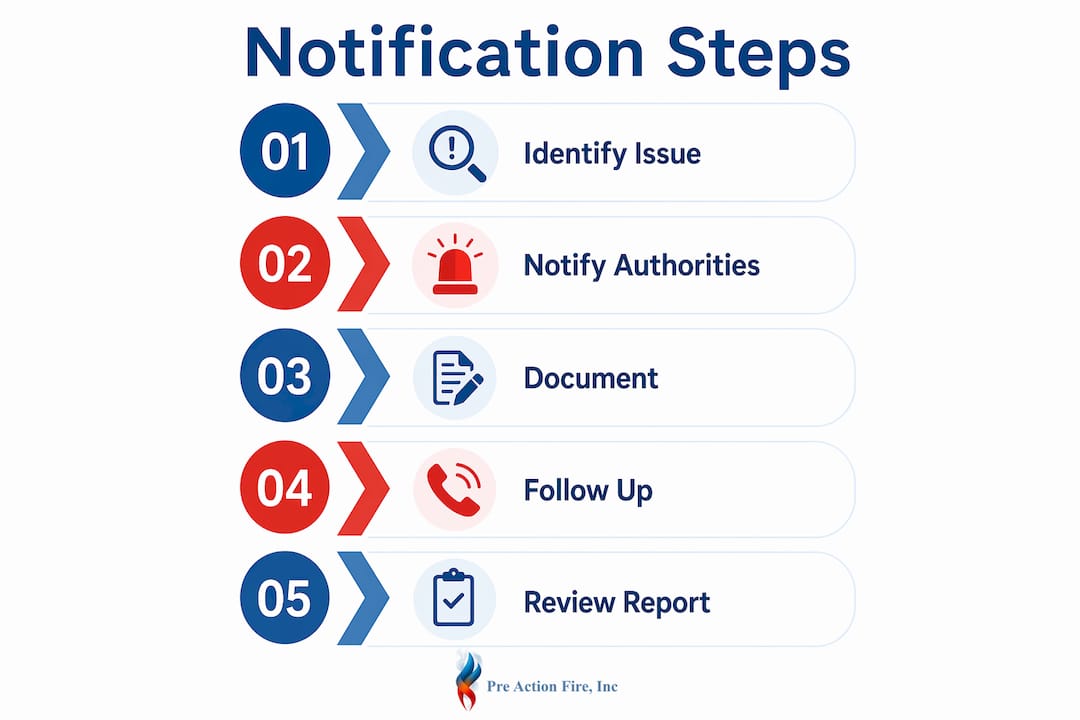
Does your fire alarm actually call the fire department?
The most dangerous misconception in property management is that a fire alarm automatically alerts the fire department. Standard fire alarms do not notify the fire department. They alert occupants inside the building. Unless your system is connected to a monitored central station, someone must still call 911 manually.

The difference between a local alarm and a monitored system is significant in a real emergency.
| Feature | Local (audible-only) alarm | Monitored alarm system |
|---|---|---|
| Alerts occupants on-site | Yes | Yes |
| Automatically notifies fire department | No | Yes |
| Verification before dispatch | No | Yes, via central station |
| Response time advantage | None | Up to 10 minutes faster |
| False alarm filtering | None | Central station verifies first |
Monitored systems transmit signals instantly to a central station, which verifies the alert and contacts 911 dispatch. Automated monitoring reduces fire department response times by up to 10 minutes compared to local alarms that depend on a bystander making a manual call. In a structure fire, 10 minutes is the difference between a salvageable building and a total loss.
For Colorado property managers, this means a local alarm system places the entire burden of notification on whoever happens to be present and alert at the time of the incident. That is an unacceptable single point of failure for any occupied building.
How timely notification improves emergency response
Speed is the defining variable in fire emergency outcomes. Traditional fire notification through verbal relay, meaning someone calls 911, describes the situation, and waits for dispatch to process the call, takes 3 to 7 minutes. Modern monitoring platforms like RapidSOS deliver verified alerts to 911 dispatch in under 10 seconds. That gap directly affects how quickly firefighters arrive and how much of your property survives.
The practical benefits of rapid notification extend beyond response time:
- Faster evacuation coordination. When fire authorities receive early alerts, they can communicate with building management to direct occupant flow and prevent bottlenecks at exits.
- Reduced property damage. Earlier suppression deployment limits fire spread to fewer rooms or floors, reducing structural damage and smoke contamination.
- Lower liability exposure. Documented, timely notification demonstrates due diligence, which matters significantly in post-incident litigation and insurance claims.
- Efficient resource deployment. Verified alerts allow dispatch to send the appropriate number of units rather than defaulting to a maximum response that strains department resources.
Every minute of delay in notifying fire authorities adds measurable damage. A fire doubles in size roughly every minute during its growth phase. Timely notification is not a formality. It is the most consequential decision a property manager makes in the first moments of an incident.
Unreported fires or delayed notifications also create secondary risks. Neighboring properties may not receive timely warnings. Utility shutoffs may be delayed. And if a fire reignites after appearing to self-extinguish, responders who were never called have no awareness of the prior event.
Why fire incident reporting matters after the emergency
Notification does not end when the fire trucks leave. Detailed fire incident reports must be submitted within 72 hours of the event, covering specifics of the incident, personnel involved, and damage assessments. These reports serve multiple functions that directly affect your property’s financial and legal standing.
Here is why post-incident reporting is as critical as the initial emergency notification:
- Insurance claim support. A complete incident report documents the cause, timeline, and extent of damage. Insurers use this to process claims accurately and defend against disputes.
- Liability documentation. If a tenant, visitor, or contractor is injured, the incident report establishes what happened, when, and what actions were taken. This is your primary legal defense.
- Hazard identification. Reports reveal patterns. A recurring ignition source or a repeatedly impaired suppression zone signals a systemic problem that requires correction before the next incident.
- Resource allocation data. Fire departments use incident data to justify budget requests, staffing levels, and equipment purchases. Your report contributes to the department’s capacity to protect your building in the future.
- Federal compliance. The transition to NERIS (National Emergency Response Information System) in 2026 demands accurate, detailed fire reporting to secure federal grants and operational funding for local departments. Incomplete reports from property managers weaken the data quality that departments rely on for federal support.
Pro Tip: Request a copy of the fire department’s incident report after any event at your property. Cross-reference it with your own documentation to identify any discrepancies before your insurer reviews the file.
Best practices for notifying fire authorities effectively
Knowing why to notify fire authorities is only half the equation. Knowing how to do it correctly prevents delays, miscommunications, and unnecessary emergency responses.
Follow these practices to meet your notification obligations under Colorado fire code:
- Call 911 immediately for any active fire or life-safety threat. Do not wait to assess severity. Dispatch can scale the response up or down based on incoming information.
- Notify your local fire code official for system impairments. This is a separate call from 911 and is required under IFC standards when alarm or sprinkler systems go offline beyond threshold times. Review Denver compliance requirements to confirm the specific contacts and timelines for your jurisdiction.
- Report controlled burns to dispatch before and after the event. Controlled burns must be reported with location details and a contact number to prevent unnecessary emergency vehicle responses. First responders confirm that this single step preserves emergency line availability and prevents high-speed vehicle travel on false alarms.
- Initiate a fire watch when required. When fire protection systems are out of service beyond IFC thresholds, a legal fire watch obligation activates. This requires continuous patrol of the affected area and maintained communication with fire authorities until systems are restored.
- Train staff on notification protocols. Every person on your team who might be present during an incident should know the exact steps: call 911, notify building management, initiate evacuation, and contact the fire code official for system-related events.
- Document every notification. Record the time of the call, the name of the dispatcher or official contacted, and the information provided. This record is your compliance evidence.
For property managers overseeing renovation or demolition projects, demolition hazard protocols include specific requirements for informing fire officials about site conditions that affect fire access and suppression capability.
Key takeaways
Notifying fire authorities promptly and accurately is the single most consequential fire safety action a Colorado property manager can take, because it triggers emergency response, satisfies legal obligations, and protects insurance coverage simultaneously.
| Point | Details |
|---|---|
| Legal notification thresholds | Alarm outages over 4 hours and sprinkler outages over 10 hours require mandatory fire authority notification under IFC. |
| Alarms do not call the fire department | Local alarms alert occupants only. Monitored systems are required to automatically notify 911 dispatch. |
| Speed determines outcomes | Automated monitoring delivers verified alerts in under 10 seconds, reducing response times by up to 10 minutes. |
| Post-incident reports are mandatory | Detailed incident reports must be submitted within 72 hours to support insurance claims and compliance records. |
| Controlled burns require advance notice | Calling dispatch before and after planned burns prevents wasted emergency responses and preserves line availability. |
The notification gap most Colorado property managers overlook
After working alongside fire protection professionals in the Denver Metro Area for years, the pattern I see most consistently is not negligence. It is assumption. Property managers assume their fire alarm system handles notification automatically. They assume a monitored system is in place when it is not. They assume the previous management team filed the right paperwork after the last system outage.
Those assumptions are the most expensive mistakes in fire safety. The gap between a local alarm and a monitored system is not a technical detail. It is the difference between a fire department arriving in 4 minutes versus 14. In a three-story commercial building with occupied floors, that gap is measured in lives and in total structural loss.
The other overlooked area is proactive hazard reporting. Colorado fire authorities want to hear from you before an incident, not only during one. A call about a compromised suppression zone or a planned maintenance outage builds a working relationship with your local fire marshal. That relationship pays dividends when you need a variance, an inspection expedited, or guidance on a code question. Property managers who treat fire authorities as partners rather than regulators consistently navigate compliance with less friction and lower risk.
Invest in a monitored fire alarm system. Train your team on notification procedures. File your incident reports within the 72-hour window. These are not burdensome obligations. They are the operational baseline for any property that takes occupant safety seriously.
— Preactionfire
How Preactionfire helps Colorado properties stay compliant
Pre Action Fire has served the Denver Metro Area since 2009, specializing in fire alarm systems, sprinkler installations, and monitoring solutions that meet IFC, NFPA, and Colorado fire code requirements. For property managers who need to close the gap between a local alarm and a fully monitored system, Preactionfire’s NICET-certified technicians design and install monitored fire alarm systems that automatically notify 911 dispatch, eliminating the manual notification risk. Preactionfire also provides compliance support for system impairment notifications, fire watch coordination, and post-incident documentation. Contact Preactionfire directly to schedule a compliance review for your Colorado property and confirm your notification protocols meet current code requirements.
FAQ
Does a fire alarm automatically notify the fire department?
No. Standard fire alarms alert occupants inside the building but do not contact the fire department. Only monitored systems connected to a central station automatically notify 911 dispatch.
When must a property manager notify fire authorities in Colorado?
Property managers must notify fire authorities immediately for any active fire or life-safety threat, and must also report fire alarm system outages exceeding 4 hours or sprinkler system outages exceeding 10 hours under IFC standards.
What happens if I fail to notify fire authorities of a system impairment?
Failing to notify fire authorities of a system impairment can result in fire code violations and may void your property insurance coverage for the duration of the outage.
Do I need to report a controlled burn to the fire department?
Yes. Controlled burns must be reported to local dispatch before and after the event, including location details and a contact number, to prevent unnecessary emergency vehicle responses and preserve emergency line availability.
What is a fire watch and when is it required?
A fire watch is a legally mandated continuous patrol of a building required when fire protection systems are out of service beyond IFC threshold times. It must be maintained until systems are fully restored and fire authorities have been notified throughout the outage period.