TL;DR:
- Fire hazards in facilities include ignition sources and combustible materials that can start or spread fires, requiring identification, control, and protection layers for safety. Regular hazard assessments, proper controls like permits and housekeeping, and continuous management are vital for effective fire hazard mitigation. Proper detection systems, extinguishers, and staff training ensure fire protection remains reliable and compliant.
A fire hazard is defined as any ignition source or accumulation of combustible material that can start or spread a fire in your facility. Knowing how to address common fire hazards is the difference between a compliant, protected building and one that faces catastrophic loss. For facility managers and business owners, fire hazard management requires more than posting exit signs and buying extinguishers. It demands a structured process: identify ignition sources and fuel loads, apply controls to remove or reduce risks, and protect people with detection systems and evacuation plans. OSHA, NFPA, and local fire codes all define the minimum standard. This guide walks you through each layer.
How to identify common fire hazards in your facility
Fire hazards include ignition sources and combustible materials that can start or feed a fire. Identifying them accurately is the foundation of every effective fire risk assessment. Most facility managers focus on the obvious risks and miss the ones hidden in plain sight.
Common ignition sources to look for
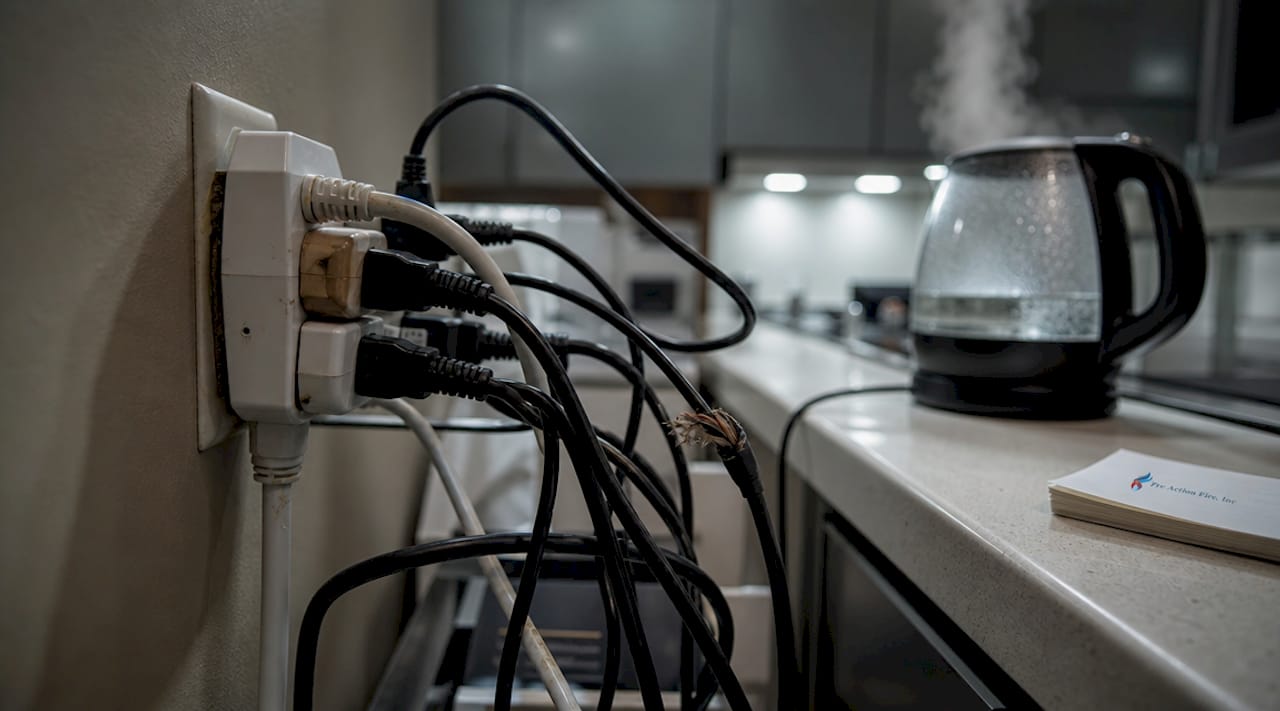
Electrical equipment is the leading ignition source in commercial buildings. Overloaded outlets, frayed extension cords, faulty wiring inside walls, and malfunctioning heating units all generate heat capable of igniting nearby materials. Hot work operations including welding, grinding, and cutting produce sparks that travel up to 35 feet from the work point. Cooking areas, smoking zones, and portable heating appliances round out the most frequent ignition categories. Arson, while less predictable, is a real risk for facilities with poor perimeter security or unsecured storage areas.
Fuel sources that accelerate fire spread
Combustible materials are everywhere in a typical commercial or industrial facility. Paper packaging, cardboard, wooden pallets, upholstered furniture, and plastic components all serve as fuel. Flammable liquids like solvents, cleaning agents, and fuels stored improperly create concentrated fire risks. Combustible dust is one of the most underestimated hazards in manufacturing, woodworking, and food processing environments. Dust that settles on beams, ductwork, and equipment surfaces can ignite from a single spark and trigger a secondary explosion far more destructive than the initial fire.
Oxygen and airflow accelerate every fire. Open doors, ventilation gaps, and HVAC systems can carry flames and smoke through a building faster than most people expect. During your facility walk-arounds, check storerooms, ceiling voids, and areas behind equipment where combustibles accumulate unseen.
Pro Tip: Schedule walk-arounds at different times of day and after shift changes. Fire hazards like waste accumulation and blocked exits often appear during production hours and disappear before formal inspections.
For a structured approach to identifying building fire risks specific to commercial properties, a systematic hazard inventory by zone is the most reliable method.
What are the best strategies to reduce fire hazards?
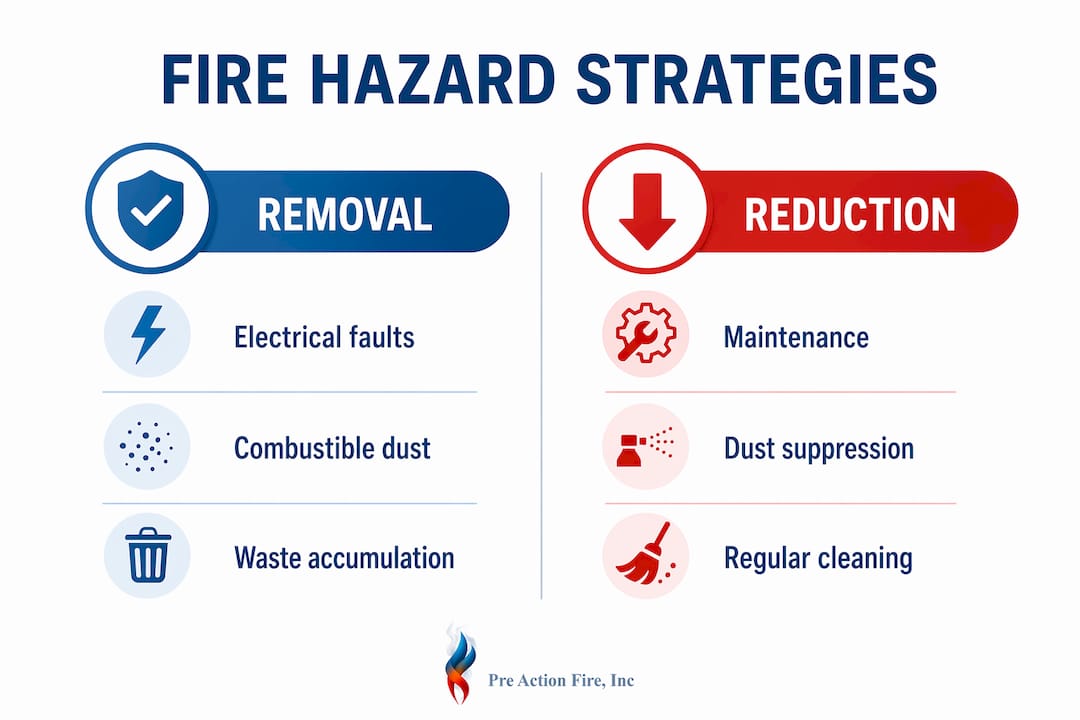
The standard framework for preventing fire risks follows three steps: remove the hazard entirely where possible, reduce the risk through controls where removal is not feasible, and protect people when residual risk remains. This hierarchy, recommended by fire safety guidance, gives facility managers a clear decision sequence rather than a checklist of disconnected tasks.
Electrical safety controls
Electrical hazards respond well to scheduled maintenance. Hire a licensed electrician to inspect wiring, panels, and outlets on a defined cycle. Replace extension cords with permanent wiring wherever equipment is used regularly. Label electrical panels clearly and keep the areas in front of them clear of storage. Any damaged cable or overheating outlet is a removal priority, not a “monitor and wait” situation.
Hot work permit systems
OSHA standard 29 CFR 1910.252 requires that combustible materials be moved at least 35 feet from any hot work location or protected with fire-resistant guards. A hot work permit system formalizes this requirement. Before any welding or grinding begins, the permit documents the work location, identifies nearby combustibles, confirms clearance distances, and designates a fire watch. Hot work operations require a fire watch to remain on site for at least 30 to 60 minutes after work ends, since smoldering materials can ignite long after sparks stop flying.
Housekeeping and combustible dust management
Generic cleaning schedules do not work for combustible dust environments. NFPA 660 emphasizes that housekeeping must be designed around how dust actually accumulates and behaves within your specific process. A woodworking facility accumulates dust differently than a grain processing plant. Avoid dry sweeping, which suspends dust particles in the air and creates an explosion risk. Use industrial vacuums with HEPA filtration instead. For facilities looking to improve building cleanliness standards, integrating fire hazard awareness into routine cleaning protocols is a practical starting point.
The table below compares removal versus reduction strategies across the most common hazard categories.
| Hazard type | Removal strategy | Reduction strategy |
|---|---|---|
| Electrical faults | Replace damaged wiring immediately | Schedule annual licensed inspections |
| Hot work sparks | Relocate work to a fire-safe area | Apply 35-foot clearance and fire watch |
| Combustible dust | Eliminate dust-generating process | HEPA vacuuming matched to accumulation pattern |
| Flammable liquids | Remove excess stock from work areas | Store in approved flammable storage cabinets |
| Waste and packaging | Remove daily from production areas | Designate covered waste containers away from ignition sources |
Pro Tip: Flammable liquid storage cabinets must be grounded and bonded when dispensing. Static discharge from pouring solvents into ungrounded containers is a documented ignition source that most facility audits miss.
What fire protection measures should every facility have?
Fire protection measures are the final layer of defense after hazard controls are in place. Regular testing and maintenance of detection systems, extinguishers, and emergency lighting is what keeps that layer functional when it matters most.
Detection and alarm systems for commercial and industrial facilities must match the occupancy type and hazard profile. Smoke detectors work well in office areas. Heat detectors are better suited for kitchens and dusty production floors where smoke alarms generate false activations. Carbon monoxide detectors belong in any space with combustion equipment. A properly designed fire alarm system integrates detection, notification, and monitoring into a single response chain.
Key fire protection elements every commercial facility needs:
- Emergency escape routes that are clearly marked, unobstructed, and tested during drills
- Emergency lighting that activates automatically during power failure along all exit paths
- Fire extinguishers placed within 75 feet of any point in the facility for Class A hazards, with appropriate extinguisher types matched to the specific fire risk in each area
- Fire blankets in cooking areas and laboratories where small contained fires are likely
- Sprinkler systems in storage areas, warehouses, and high-value equipment zones
- Staff training covering evacuation procedures, extinguisher use, and alarm response at least annually
Selecting the right extinguisher type for each hazard zone is not optional. A CO2 extinguisher appropriate for electrical panels is the wrong choice near a flammable liquid storage area, where dry chemical or foam units are required.
How to maintain a continuous fire hazard management program
Fire hazard management is not a one-time project. Effective programs treat hazard identification as a continuous loop where risk assessments generate specific recurring actions that are reviewed and updated as operations change. A facility that installs new equipment, changes materials, or modifies its layout has introduced new hazards that the original assessment did not cover.
A practical continuous program follows these steps:
- Conduct a formal fire risk assessment at least annually and after any significant operational change. Document findings and assign corrective actions with deadlines.
- Integrate fire hazard controls into management-of-change processes. Before new equipment goes live or a new chemical enters the facility, fire risk implications must be evaluated and controls confirmed.
- Maintain inspection and testing records for all fire protection equipment. NFPA standards specify inspection frequencies for sprinklers, alarms, extinguishers, and emergency lighting. Gaps in documentation create compliance exposure.
- Update staff training whenever procedures change. New employees and contractors working on site must receive fire safety orientation before starting work.
- Coordinate with your local fire authority. Fire departments in Colorado and across the country offer pre-incident planning visits that identify facility-specific risks and improve emergency response times.
Pro Tip: Treat your fire risk assessment as a living document stored in a shared location, not a PDF filed after the annual inspection. When a supervisor notices a new hazard during a shift, they need a clear process to log it and trigger a review.
For Colorado properties, fire risk assessment tips that account for local climate factors like dry conditions and wildland-urban interface risks add an important layer to standard commercial assessments.
Key takeaways
Effective fire hazard management requires identifying ignition sources and combustible materials, applying removal or reduction controls, and maintaining fire protection systems through a continuous review cycle.
| Point | Details |
|---|---|
| Define hazards precisely | Identify both ignition sources and combustible fuel loads in every zone of your facility. |
| Follow the remove-reduce-protect hierarchy | Remove hazards first; apply controls like hot work permits and housekeeping where removal is not possible. |
| Match protection to the hazard type | Select detection systems, extinguishers, and sprinklers based on the specific fire risks in each area. |
| Treat management as a continuous loop | Update risk assessments after operational changes and maintain documentation for compliance. |
| Train staff and test equipment regularly | Annual drills and scheduled equipment testing are the minimum standard for commercial facilities. |
What facility managers consistently get wrong about fire safety
Working across commercial and industrial facilities, the pattern I see most often is not a lack of equipment. It is a lack of process. A facility might have extinguishers on every wall and a fire alarm system that passed its last inspection, yet have no hot work permit system, no combustible dust housekeeping protocol, and a risk assessment that has not been updated since a major equipment addition two years ago.
The second most common failure is treating fire safety as a compliance exercise rather than an operational discipline. When the annual inspection passes, attention moves elsewhere. But fire hazards change constantly. New materials arrive, processes shift, and maintenance defers repairs that become ignition sources. The facilities I have seen handle this best are the ones where fire hazard awareness is embedded in daily operations, not reserved for inspection season.
Combustible dust is the hazard I would flag most urgently for manufacturing and processing facilities. Most managers know it exists. Far fewer have a housekeeping program that actually matches how dust accumulates in their specific process. Generic weekly cleaning schedules are not sufficient. The dust accumulation behavior in your facility is unique to your materials and equipment layout, and your cleaning program needs to reflect that.
The facilities that sustain strong fire safety records share one trait: they treat the risk assessment as a working document, not an annual deliverable.
— Preactionfire
How Preactionfire supports your fire protection program
Identifying and controlling fire hazards is only part of the equation. The protection layer, including detection, suppression, and extinguishment, must be designed, installed, and maintained to code. Preactionfire has served the Denver Metro Area since 2009, providing NICET-certified technicians for fire alarm installation and compliance, commercial sprinkler systems, and fire extinguisher services across commercial and industrial properties. Whether you are upgrading an existing system or building out a new facility, Preactionfire delivers solutions calibrated to NFPA standards and Colorado code requirements. Contact Preactionfire to schedule a consultation and confirm your facility’s fire protection meets current compliance standards.
FAQ
What is a fire hazard in a commercial building?
A fire hazard is any ignition source or combustible material that can start or spread a fire. Common examples include overloaded electrical circuits, flammable liquid storage, combustible dust accumulation, and hot work operations like welding.
How often should a fire risk assessment be conducted?
A fire risk assessment should be conducted at least once per year and immediately after any significant operational change, such as new equipment installation, layout modifications, or changes in materials used on site.
What does a hot work permit system require?
A hot work permit system requires documenting the work location, confirming combustible materials are cleared at least 35 feet from the work area, and assigning a trained fire watch who monitors the area during and for 30 to 60 minutes after work ends.
What fire extinguisher types are required in commercial facilities?
The correct extinguisher type depends on the hazard class in each area. Class A extinguishers cover ordinary combustibles, Class B covers flammable liquids, Class C covers electrical equipment, and Class D covers combustible metals. Most facilities require multiple types placed according to NFPA 10 spacing requirements.
How does combustible dust create a fire and explosion risk?
Combustible dust suspended in air at sufficient concentration can ignite from a single spark and cause a deflagration or explosion. The secondary explosion triggered when a primary event disturbs settled dust is typically more destructive than the initial fire, making process-specific housekeeping the primary control measure.