

TL;DR:
- Effective fire safety communication, using clear language and consistent messaging, is crucial for successful evacuations.
- Pre-incident planning, closed-loop confirmation, and channel redundancy ensure messages are understood and reliable during emergencies.
Effective fire safety communication is the difference between an orderly evacuation and a catastrophic one. Most facilities managers understand fire systems well enough. What they underestimate is how quickly clear messaging breaks down under pressure. Ambiguous instructions, overloaded communication channels, and inconsistent training erode compliance before a single alarm sounds. This article gives you a research-backed framework to design, test, and sustain fire safety messaging that actually works when it matters most.
Table of Contents
- Key takeaways
- 1. Use plain, actionable language in all fire safety messaging
- 2. Maintain a consistent message library across every channel
- 3. Prioritize voice evacuation intelligibility, not just volume
- 4. Implement closed-loop communication in training
- 5. Design scenario-based message templates before an incident occurs
- 6. Pre-assign communication roles to prevent authority drift
- 7. Build channel redundancy into your emergency communication strategy
- 8. Make fire drills communicatively realistic
- 9. Account for multilingual and multicultural audiences
- 10. Measure and refine communication effectiveness continuously
- My take on why most fire safety communication actually fails
- How Preactionfire supports fire safety communication in Denver
- FAQ
Key takeaways
| Point | Details |
|---|---|
| Plain language drives compliance | Messages with clear, specific instructions reduce misinterpretation during high-stress emergencies. |
| Closed-loop communication is non-negotiable | Requiring message confirmation between sender and receiver prevents critical misunderstandings during incidents. |
| Redundancy protects your response | Relying on a single channel creates vulnerability when networks are congested during an active emergency. |
| Pre-assign communicators before incidents | Designating who speaks, to whom, and when prevents authority drift and conflicting instructions in a crisis. |
| Regular drills reinforce retention | Training that simulates real conditions builds muscle memory for communication protocols, not just evacuation routes. |
1. Use plain, actionable language in all fire safety messaging
The single most common failure in fire safety messaging is vagueness. Instructions like “respond appropriately” or “proceed to safety” leave occupants making judgment calls at the worst possible moment. Plain language messaging with explicit dos and don’ts reduces misinterpretation under stress, especially when people are panicked or unfamiliar with the building.
Write instructions as commands. “Exit via stairwell B. Do not use elevators.” That is a message. “Please evacuate in an orderly fashion” is noise. The distinction sounds obvious in theory, but reviewing actual signage and PA scripts in most commercial buildings reveals how far short the standard falls.
Pro Tip: Audit every communication touchpoint in your building, from posted evacuation maps to PA scripts, and replace any instruction that could be interpreted in more than one way.
2. Maintain a consistent message library across every channel
Inconsistent terminology between your posted signage, PA announcements, and training materials is a genuine safety hazard. When an occupant hears “assembly area” in a drill but sees “muster point” on a sign, confusion adds seconds. Seconds matter.
A standardized message library locks in consistent phrasing across all channels. This means training materials, printed signs, digital displays, and PA scripts all use identical language for the same instructions. For multi-tenant buildings or facilities with multilingual workforces, a unified message library also makes accurate translation far easier and more reliable.
Consistency extends to tone. If your training uses calm, procedural language and your PA announcement sounds frantic, you create cognitive dissonance. Occupants mirror the tone of the messenger. Keep both the words and the register aligned.
3. Prioritize voice evacuation intelligibility, not just volume
Most facilities managers evaluate PA and voice evacuation systems by asking whether they are loud enough. The more important question is whether occupants can actually understand what they hear. Speech intelligibility is measured using the Speech Transmission Index (STI), which quantifies how clearly spoken words are conveyed in a given acoustic environment.
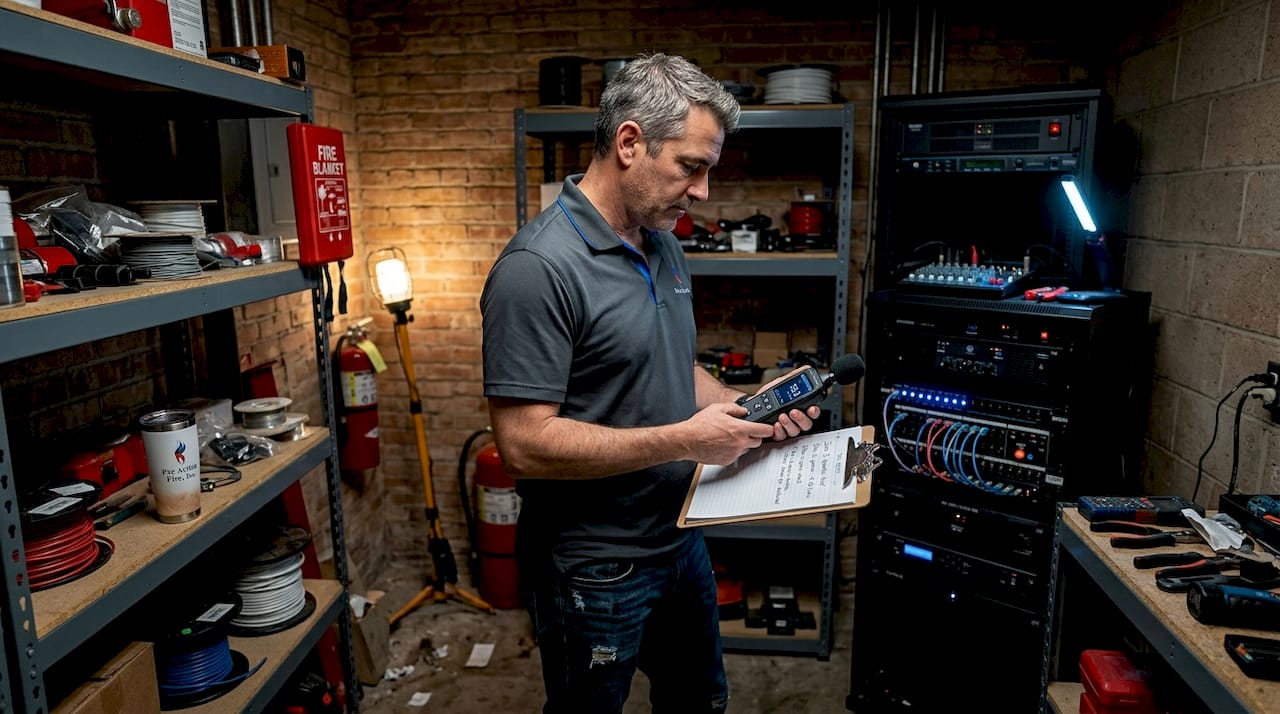
A system scoring poorly on STI can be deafeningly loud yet completely unintelligible in reverberant spaces like parking garages, atria, or warehouse floors. When commissioning or upgrading a voice evacuation system, require STI validation testing alongside decibel measurements. Your fire alarm systems compliance documentation should include both.
This distinction between loudness and clarity is where many older installations fall short, particularly in buildings that have undergone renovations without a corresponding re-evaluation of the acoustic environment.
4. Implement closed-loop communication in training
Closed-loop communication means the receiver repeats a message back to the sender, who then confirms or corrects it before action is taken. It originated in aviation and healthcare safety protocols and has since been adopted through the TeamSTEPPS framework for any safety-critical environment where miscommunication has consequences.
For fire safety professionals, this practice is most relevant during incidents involving multiple communicators: floor wardens relaying evacuation status, maintenance staff reporting system faults, or emergency coordinators updating responders. Without a closed-loop habit, messages get garbled, misheard, or assumed rather than confirmed.
Building this norm requires deliberate practice during fire drills, not just a mention in the training manual. Role-play exercises where participants practice message confirmation are far more effective than passive instruction.
Pro Tip: During fire drills, require floor wardens to verbally confirm every instruction received before acting on it. This builds the habit before a real incident creates pressure to skip the step.
5. Design scenario-based message templates before an incident occurs
Waiting until an active fire to compose your communication is a recipe for confusion. Pre-planning scenario-based templates for each phase of a crisis gives your team pre-approved language they can deploy immediately without deliberating under pressure.
Your templates should cover at minimum: initial alarm notification, shelter-in-place instruction, full evacuation order, all-clear, and post-incident briefing. Each template should specify the channel it is delivered on, the designated communicator, and the exact wording. Treat these templates as living documents. Review and update them after every drill and any real incident.
For buildings with complex evacuation requirements such as high-rises or mixed-occupancy structures, templates should also account for phased evacuation sequences and zone-specific instructions.
6. Pre-assign communication roles to prevent authority drift
When an emergency occurs and no one has been designated as the primary communicator, multiple people often start sending messages simultaneously. Instructions conflict. Occupants receive contradictory directions. The result is hesitation at precisely the moment when speed matters.
Pre-assigning communication roles and sequencing message releases prevents this. Your fire safety communication plan should name specific individuals for each role: who broadcasts on the PA, who coordinates with first responders, who manages floor warden reports, and who handles external communication. Each person should have a backup.
This is not bureaucracy. It is the structural difference between a coordinated response and a chaotic one.
7. Build channel redundancy into your emergency communication strategy
A common failure point in emergency communication is over-reliance on a single channel. Mobile networks saturate quickly during emergencies. Keeping non-emergency calls to a minimum during incidents helps conserve network capacity, but the safer approach is to never depend on one channel alone.
Your emergency communication strategies should layer at minimum three channels: the building PA system, posted physical signage, and a digital notification platform such as mass text or email alert. Each channel should carry the same message, formatted for its medium.
Redundancy also protects against technical failure. A PA system that loses power, a mass notification platform with a server outage, or a network that goes down under load are all real scenarios. Facilities with fire safety zones defined in their floor plans are better positioned to maintain localized communication even when building-wide systems are compromised. Reviewing your fire safety zone planning is a practical place to start.
8. Make fire drills communicatively realistic
Most fire drills test whether people know where to walk. Few test whether they can communicate effectively during an evacuation. Realistic drills should include PA announcements delivered with the actual script your system uses, floor wardens practicing closed-loop message relay, and deliberate simulation of system failures to test backup protocols.
Fire prevention education is retained far better when it is practiced under conditions that approximate real stress, even partially. A drill where participants follow a familiar routine in a low-stakes environment does not build the communication behaviors you need when adrenaline is high.
Consider introducing deliberate complications: a jammed stairwell door, a PA system that cuts out mid-announcement, a warden who does not report in. These scenarios expose the gaps in your communication plan before an actual incident does.
9. Account for multilingual and multicultural audiences
Fire prevention education fails when it assumes a single language and a single cultural context. In commercial buildings across the Denver Metro Area, occupant populations are often diverse. A message library designed only for English speakers, delivered only through audio channels, is not a complete communication strategy.
Best practices for communicating fire risks across multilingual buildings include translated signage posted alongside English versions, multilingual PA capability or pre-recorded messages in common languages, and culturally specific training for populations with different emergency response norms. Visual communication, particularly color-coded evacuation maps and pictogram-based signage, works across language barriers in ways text cannot.
Pro Tip: Survey your building’s occupant population annually. If language demographics shift, your fire safety messaging must shift with them. Outdated translation is worse than none because it creates false confidence.
10. Measure and refine communication effectiveness continuously
Fire safety communication is not set-and-forget. After every drill, conduct a structured debrief that asks specific questions: Did everyone receive the initial alarm message? Were evacuation instructions understood clearly? Did any floor wardens receive conflicting information? Where did communication break down?
Transparency in post-incident review builds trust and surfaces problems that would otherwise be invisible until a real emergency. Documenting debrief findings and tracking improvements over time gives you defensible evidence of a continuous improvement process, which regulators and insurers both value.
Comparing this data year over year also reveals trends. If a particular floor consistently reports confusion about evacuation routes, that is a communication design problem, not a training compliance problem. Treating the symptom without diagnosing the cause wastes your effort.
My take on why most fire safety communication actually fails
I’ve watched a lot of fire safety communication plans fall apart in practice, and the pattern is almost always the same. The plan looks thorough on paper. The signage is up. The drills happen on schedule. But nobody has stress-tested the actual language, confirmed that the PA system is intelligible in the loading dock, or practiced message relay with the floor wardens who actually work evening shifts.
What I’ve found is that fire safety messaging fails not because professionals don’t care, but because communication quality is treated as a secondary concern. The focus lands on system installation, compliance documentation, and drill frequency. But a technically perfect alarm system that announces unintelligible instructions still fails occupants.
The hardest lesson I’ve absorbed is about transparency under uncertainty. When facts are incomplete during an incident, communicators often go silent because they don’t want to say the wrong thing. That silence is more dangerous than an imperfect message. Occupants will fill the vacuum with rumors and assumptions. Saying “we are assessing the situation and will update you in two minutes” is better than nothing, every single time.
My honest recommendation is to treat your communication plan with the same rigor you give your physical suppression systems. Test it. Break it. Fix it. Repeat.
— Preactionfire
How Preactionfire supports fire safety communication in Denver
Effective fire safety communication depends on systems that perform reliably when occupants need them most. At Preactionfire, our fire alarm systems are designed with both compliance and communication intelligibility in mind, so your PA and notification devices deliver messages that are actually understood, not just heard.
Our NICET-certified technicians also service and inspect fire alarm notification devices across the Denver Metro Area, helping facilities managers identify gaps in coverage and acoustic performance. From fire safety inspections that evaluate your full communication and suppression systems, to consultations on customized solutions for your building type, Preactionfire brings 15 years of Denver-area experience to every engagement. Contact us to schedule a consultation.
FAQ
What makes fire safety communication effective?
Effective fire safety communication uses plain, specific language, consistent messaging across all channels, and closed-loop confirmation to prevent misunderstandings. Timeliness and channel redundancy are also critical factors.
How often should fire drills include communication testing?
Fire drills should test communication protocols every time they are conducted, not just evacuation routes. This means running actual PA scripts, practicing floor warden message relay, and debriefing specifically on communication breakdowns.
What is closed-loop communication in fire safety?
Closed-loop communication requires the message receiver to repeat instructions back to the sender for confirmation before acting. This practice, drawn from the TeamSTEPPS framework, prevents misheard or misunderstood orders during high-pressure incidents.
How do you communicate fire risks to a multilingual workforce?
Use translated signage, visual and pictogram-based evacuation maps, multilingual PA recordings, and culturally adapted training materials. A standardized message library makes accurate translation much more consistent across all formats.
Why does voice evacuation intelligibility matter more than volume?
A loud system that is acoustically unclear in reverberant spaces conveys nothing useful. Speech Transmission Index testing validates that occupants can actually understand spoken instructions, which is the only metric that matters during an evacuation.