

TL;DR:
- Fire door checks involve inspecting components, testing hardware, measuring clearances, and documenting compliance with NFPA 80 standards. Regular visual inspections by trained staff and annual certified assessments are essential to ensure fire safety and prevent critical failures during a fire event. Proper documentation and prompt remediation of defects are vital to maintaining legal compliance and safeguarding lives.
Fire door checks are the systematic process of inspecting door components, testing hardware functionality, measuring clearances, and documenting findings to verify compliance with fire safety standards like NFPA 80. Every facility manager and safety officer responsible for a commercial or multi-unit building carries a legal and moral obligation to conduct these inspections on a defined schedule. A fire door that looks intact but fails to latch, carries painted-over seals, or has unauthorized modifications provides zero protection during a fire event. Knowing how to perform fire door checks correctly is the difference between genuine life safety and a false sense of security.
What you need before starting fire door checks
Before you inspect a single door, gather the right tools and understand your role in the inspection hierarchy. The industry draws a clear line between routine visual checks performed by trained facility staff and formal compliance inspections conducted by certified professionals. Routine checks vs full professional inspections are not interchangeable, and treating them as equivalent is one of the most common compliance errors facility managers make.
Tools required for a fire door inspection checklist:
- A calibrated clearance gauge or a coin of known thickness (a standard U.S. quarter measures approximately 1.75mm; for metric reference, a 3mm clearance gauge is the field standard)
- Measuring tape for threshold and gap measurements
- A flashlight for low-light areas and recessed hardware
- A mirror or smartphone camera to inspect door edges for fire rating labels hidden behind frames or paint
- A printed or digital fire door inspection checklist aligned with NFPA 80 requirements
- A camera or mobile device for photographic documentation
Pro Tip: Use a dedicated inspection app like iAuditor or a PDF form built to NFPA 80 fields. Digital forms timestamp entries automatically, which strengthens your audit trail.
Qualifications matter significantly for formal inspections. NFPA 80 requires knowledgeable individuals for annual compliance inspections, and many inspectors hold credentials from the International Fire Door Inspector Association (IFDA) or manufacturer-specific training programs. For routine quarterly walkthroughs, trained facility staff can conduct visual checks. For the annual formal assessment, bring in a certified inspector.
| Inspection type | Who performs it | Frequency |
|---|---|---|
| Routine visual check | Trained facility staff | Quarterly (communal areas) |
| Formal compliance inspection | Certified professional (IFDA or equivalent) | Annually (minimum) |
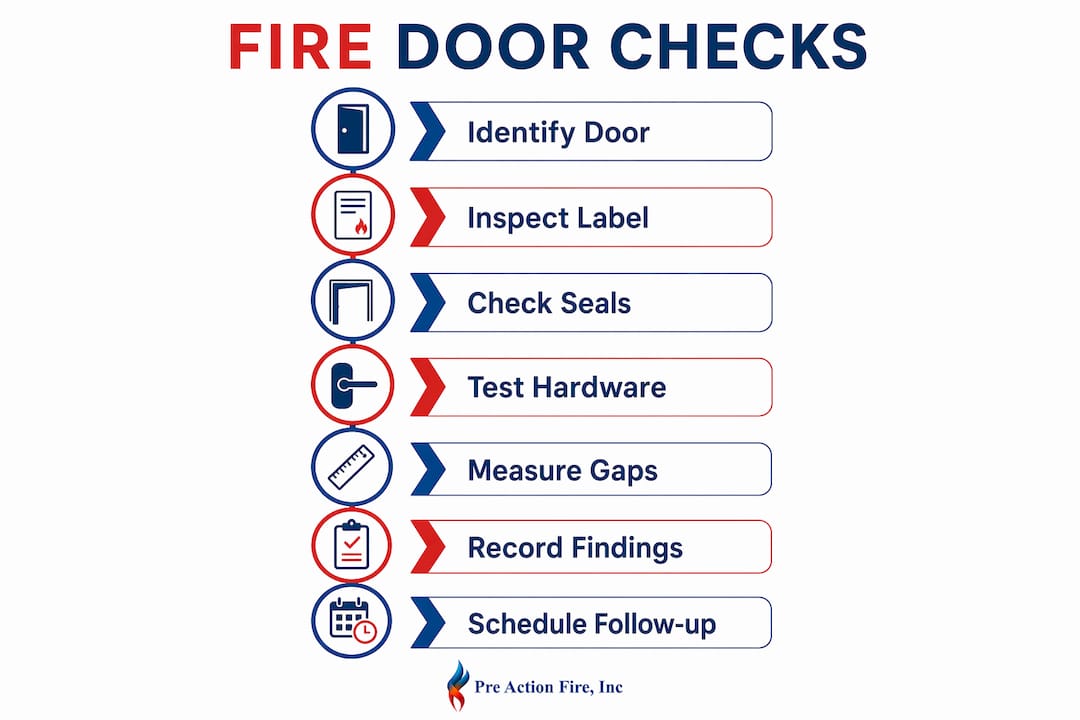
Refer to the broader fire safety zones guide for context on how fire door checks fit within your facility’s overall fire protection program.
How to perform fire door checks step by step
A thorough fire door check follows a consistent sequence. Skipping steps or changing the order increases the chance of missing defects that only appear under specific conditions.
-
Conduct a visual inspection of the door leaf and frame. Look for physical damage including cracks, warping, holes, and delamination on both faces of the door. Any penetration through the door leaf compromises its fire rating immediately.
-
Locate and verify the fire rating label. The certification label is typically found on the door edge or top rail. Labels can be hidden or painted over, so use a mirror or camera to inspect edges thoroughly. A missing label must be treated as non-compliant until the rating can be verified through documentation.
-
Inspect intumescent seals and smoke seals. Run your fingers along all four edges of the door. Seals must be continuous, undamaged, and free of paint. Any gap, compression damage, or painted-over section requires replacement before the door can be considered compliant.
-
Check all hardware. Examine hinges for missing screws, corrosion, or loose fixings. Inspect the door closer mechanism for fluid leaks, damaged arms, or signs of tampering. Verify that hold-open devices are electromagnetic and connected to the fire alarm system, not mechanical wedges.
-
Test self-closing and latching from multiple positions. Open the door to 90 degrees and release it. It must close fully and latch without manual assistance. Then open it to just 15 degrees and release it again. Doors failing to latch from a 15-degree opening indicate a failing closer or misaligned latch, a defect that passes casual observation but compromises compartmentalization entirely. A fire door is only effective if it latches firmly on release. Closing without latching provides no fire or smoke protection.
-
Measure clearances at all four edges. NFPA 80 sets maximum clearances at 1/8 inch (3.2mm) at the head and jambs, and 3/4 inch (19mm) at the bottom threshold. Use your gauge at multiple points along each edge, not just the center. Gaps that exceed these limits allow smoke and fire gases to pass through before the intumescent seals activate.
-
Check for unauthorized modifications. Look for drilled holes, added hardware, or any alteration not present in the original certification. Unauthorized modifications void fire door ratings immediately and require remediation before the door can return to service.
-
Verify signage. Confirm that “Fire Door Keep Shut” or “Fire Door Keep Locked” signage is present, legible, and correctly positioned on both sides of the door.
-
Document all findings. Record defects, measurements, observations, and required actions before moving to the next door.
Pro Tip: Number each door in your facility with a permanent identifier and tie every inspection record to that number. This creates a traceable history that auditors and insurers can follow without ambiguity.
For a parallel look at how these steps apply to fire barriers more broadly, the fire barrier inspection steps resource covers complementary procedures for facility managers.

What common defects look like and how to fix them
Most fire door failures fall into a predictable set of categories. Recognizing them on sight speeds up your inspection and prevents defects from being logged as minor when they are actually disqualifying.
The most frequently cited defects during fire door assessments:
- Painted or missing intumescent seals. Paint fills the expansion gaps in intumescent material, preventing it from activating under heat. The only fix is full seal replacement. Scraping paint off is not an accepted remediation.
- Excessive gaps at head, jambs, or threshold. Gaps beyond NFPA 80 limits allow smoke migration before seals activate. Adjust the door, refit the frame, or replace worn seals depending on the root cause.
- Self-closer failures. A closer that cannot pull the door shut from any position must be replaced, not adjusted. Partial function is not acceptable under fire safety requirements.
- Latch engagement failure. If the latch bolt does not engage the strike plate fully, the door will not hold against fire pressure. Realign the strike plate or replace the latch set.
- Unauthorized modifications. Drilled cable holes, added cat flaps, or non-rated glazing panels all void the fire rating. These require certified repair using rated components.
- Damaged or missing glazing. Fire-rated glazing carries its own certification. Cracked or replaced panels must match the original specification exactly.
| Defect | Severity | Required action |
|---|---|---|
| Painted intumescent seal | Critical | Full seal replacement |
| Gap exceeding NFPA 80 limits | Critical | Frame adjustment or seal replacement |
| Self-closer not pulling door shut | Critical | Closer replacement |
| Missing fire rating label | High | Verify via documentation or replace door |
| Loose hinge screws | Moderate | Retighten or replace with correct fixings |
| Worn or missing signage | Low | Replace signage immediately |
Pro Tip: Never allow a door with a critical defect to remain in service without a physical interim control, such as a posted notice and a temporary barrier, while you arrange repair. Logging the defect without acting on it creates legal exposure.
Review current fire door maintenance requirements to confirm that your remediation methods align with 2026 standards before signing off on any repair.
How to document fire door inspections for compliance
Documentation is not a formality. It is the legal record that proves your facility met its obligations under NFPA 80 and applicable local codes. An inspection without a record is, from a compliance standpoint, an inspection that did not happen.
Every inspection report must include the following elements:
- Inspector identification. Name, role, and credential level of the person conducting the check.
- Date and time of inspection. Timestamp each entry, not just the report submission date.
- Door identification number. Tie every finding to a specific, permanently labeled door.
- Observations and measurements. Record actual gap measurements, not just pass or fail. Actual numbers give you a trend line over time.
- Defects identified. Describe each defect specifically, including location on the door and severity.
- Corrective actions taken or scheduled. Note what was fixed on the spot and what requires a follow-up work order, including the target completion date.
- Photographic evidence. Attach photos of defects and of compliant conditions. Images are the strongest defense in an audit or liability claim.
Inspection records must be retained for a minimum of three years, though many fire safety professionals recommend keeping records for the full service life of the door. Electronic logs stored in a cloud-based system satisfy retention requirements and are far easier to retrieve during an audit than paper files.
Pro Tip: Set a calendar reminder 30 days before each quarterly and annual inspection due date. Late inspections are a compliance violation even if the physical doors are in perfect condition.
The Responsible Person designated under your facility’s fire safety plan carries personal legal accountability for maintaining these records. That accountability does not transfer to a contractor unless the contract explicitly assigns it in writing. Understand what you own before you delegate.
Key takeaways
Effective fire door checks require a documented, repeatable process covering visual inspection, hardware testing, clearance measurement, and formal record-keeping aligned with NFPA 80 standards.
| Point | Details |
|---|---|
| Follow a defined sequence | Inspect label, seals, hardware, clearances, and signage in the same order every time. |
| Test latching from 15 degrees | A door that latches from 90 degrees but not 15 degrees has a failing closer that must be replaced. |
| Apply NFPA 80 clearance limits | Maximum 1/8 inch at head and jambs; maximum 3/4 inch at the bottom threshold. |
| Document every finding | Retain inspection records for at least three years with photos, measurements, and corrective actions. |
| Know your inspection tier | Quarterly visual checks by trained staff do not replace the required annual certified inspection. |
Why thorough fire door checks matter more than most managers realize
After years of working alongside facility teams across commercial and industrial properties, the pattern I see most often is not negligence. It is overconfidence in a superficial process. A manager walks a corridor, glances at each door, confirms it closes, and marks it inspected. That walkthrough misses painted seals, fails to test latching from a partial opening, and never checks the label on the door edge. The door looks fine. It is not fine.
The 15-degree latch test is the single most revealing step in the entire process, and it is the one most commonly skipped. A closer that works from a wide swing but fails at a narrow angle is a closer that will fail during a fire, when doors are often partially open. That detail is not in most generic checklists.
I also see facilities where unauthorized modifications accumulate over years because no one connects the facilities work order system to the fire door record. A contractor drills a cable through a rated door. The work order closes. The fire door record never updates. The next inspector sees a hole and has no context for when it appeared or whether it was ever addressed. Integrated documentation systems prevent this. Paper logs do not.
The legal exposure from poor fire door maintenance is real and personal for the Responsible Person. Beyond the legal dimension, a fire door that fails during an event is a door that did not protect the people on the other side of it. That outcome is preventable with a consistent, documented, and properly resourced inspection program.
Facilities that treat fire door checks as a compliance checkbox rather than a safety function will eventually face an audit, an incident, or both. The ones that treat it as a genuine operational discipline rarely face either.
— Preactionfire
How Preactionfire supports your fire door compliance program
Fire door checks are one layer of a facility’s fire protection system, and they work best when integrated with a broader inspection and alarm infrastructure. Preactionfire has served the Denver Metro Area since 2009 with NICET-certified technicians who understand how fire doors, alarm systems, and suppression systems interact within a compliant facility. Whether you need a comprehensive fire safety inspection covering doors, alarms, and suppression, or you are building out fire protection for a new construction project, Preactionfire delivers solutions built to NFPA standards. Contact Preactionfire directly to discuss a tailored fire safety plan for your facility.
FAQ
How often should fire door checks be performed?
Routine visual inspections in communal residential areas must occur at least every three months, and a full professional inspection is required at least annually under NFPA 80 and equivalent standards.
What clearances does NFPA 80 allow for fire doors?
NFPA 80 sets the maximum gap at 1/8 inch at the head and jambs, and 3/4 inch at the bottom threshold. Gaps beyond these limits require immediate remediation.
Can facility staff perform fire door inspections without certification?
Trained facility staff can conduct routine visual checks, but formal compliance inspections must be performed by knowledgeable individuals with credentials from IFDA or equivalent manufacturer training programs.
What happens if a fire door has unauthorized modifications?
Unauthorized modifications such as drilled holes or non-rated hardware void the door’s fire rating immediately. The door must be taken out of service or repaired using certified components before it can be considered compliant.
How long must fire door inspection records be kept?
Records must be retained for a minimum of three years, though retaining them for the full service life of the door is the recommended practice for facilities that want to protect themselves during audits or liability reviews.