
TL;DR:
- Audible and visible fire alarms are both legally required in commercial buildings, with combined systems offering superior safety. Proper deployment, synchronization, and placement under NFPA 72 and ADA standards are essential for effective occupant notification. Regular audits and technology updates ensure compliance, safety, and optimal performance in diverse environmental conditions.
Audible fire alarms are sound-emitting notification devices, including horns, bells, and voice evacuation systems, while visible fire alarms are light-emitting devices such as LED strobes and flashing lights designed to alert occupants who cannot hear or cannot hear clearly in high-noise environments. The comparison of audible vs visible fire alarms is not a question of which type to choose. It is a question of how to deploy both correctly under NFPA 72 and ADA requirements to protect every occupant in your facility. For safety professionals managing commercial or industrial buildings in Denver and beyond, understanding the technical specifications, compliance obligations, and integration strategies for both fire alarm types is the foundation of an effective life safety program.
What are the regulatory standards for audible vs visible fire alarms?
NFPA 72 and ADA standards set the legal baseline for fire alarm notification devices in commercial and industrial buildings, and both standards require audible and visible systems working together. Meeting only one requirement does not satisfy either code. This is the compliance reality that many facility managers underestimate until an inspection or incident exposes the gap.
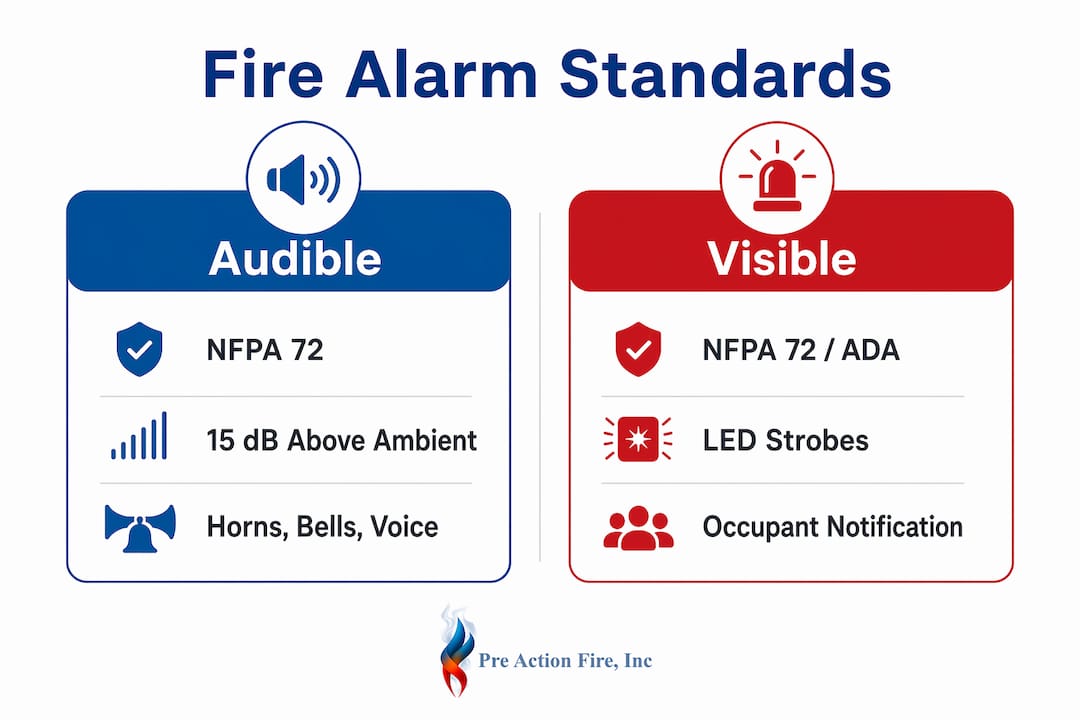
For audible alarm systems, NFPA 72 specifies that horns must exceed ambient noise by 15 dB above average ambient or 5 dB above maximum ambient for at least 60 seconds. In a typical office environment with 55 dBA ambient noise, that translates to a minimum practical output of 75 dB. Sleeping areas require 85 dB measured at pillow level, a specification that applies directly to hotels, dormitories, and any commercial facility with overnight occupancy.
For visible fire alarms, the technical requirements are equally precise. Strobes must flash at 1 to 2 Hz with a minimum candela output of 75 cd in general occupancy spaces and 110 cd in sleeping rooms. These are not suggestions. They are enforceable minimums that affect device selection, placement, and spacing calculations.
Key compliance requirements at a glance:
- Audible minimum (general): 75 dB, measured at occupant position
- Audible minimum (sleeping areas): 85 dB at pillow level
- Strobe flash rate: 1 to 2 Hz
- Strobe output (general): 75 candela minimum
- Strobe output (sleeping rooms): 110 candela minimum
- Synchronization: Required for all strobes in the same field of view
| Requirement | Audible Standard | Visible Standard |
|---|---|---|
| Governing code | NFPA 72 | NFPA 72 / ADA |
| Minimum output | 75 dB general, 85 dB sleeping | 75 cd general, 110 cd sleeping |
| Flash/tone rate | Continuous or coded signal | 1 to 2 Hz |
| Synchronization | Not required | Required in same sightline |
| ADA mandate | Not directly | All occupiable spaces |
Pro Tip: Review your Denver-specific obligations alongside NFPA 72 by consulting the Denver fire alarm regulations guide before specifying devices. Local amendments can tighten national minimums.
How do audible and visible fire alarms perform in real facility environments?
Audible alarms face a direct challenge in industrial settings: ambient noise. A manufacturing floor running heavy machinery can sustain ambient levels above 90 dB, which means a standard 75 dB horn is acoustically invisible to workers on the floor. Workers wearing hearing protection or noise-canceling headphones compound the problem further. Audible alarms alone often fail to alert occupants in these conditions, making visible alarm integration a functional necessity rather than an accessibility add-on.
Visible alarms address this gap directly, but their effectiveness depends on placement and synchronization. A strobe mounted in a corner of a large warehouse bay may not be visible from every work station. Synchronized strobes alongside audible sounders reduce response times and mitigate human factor risks. The combination forces awareness through two sensory channels simultaneously, which is why combined systems consistently outperform single-modality installations in evacuation drills.
“Visual alarms are essential for noisy and high-ambient sound environments as well as for occupants wearing headphones or PPE. They are a universal safety necessity, not just an accommodation for hearing-impaired individuals.” — Why You Need Both Visual and Audible Fire Alarms
Alarm fatigue is a documented risk with audible-only systems. Repeated false alarms condition occupants to ignore horn signals, which is a behavioral pattern that can be fatal in an actual emergency. Voice evacuation systems address this directly by delivering specific, calm instructions rather than an undifferentiated tone. NFPA 72 requires voice systems to meet a Common Intelligibility Scale score of 0.70 or higher, meaning the spoken message must be clearly understood by occupants in the target space.
| Environment type | Primary challenge | Recommended solution |
|---|---|---|
| Open office | Moderate noise, mixed occupancy | Horn-strobe combination units |
| Industrial floor | High ambient noise, PPE use | High-output strobes, voice evacuation |
| Sleeping areas | Occupants unaware during sleep | 85 dB low-frequency horn, 110 cd strobe |
| Large commercial atrium | Visual dead zones, echo | Multiple synchronized strobes, speakers |
| Restrooms and enclosed spaces | No line of sight to main devices | Dedicated wall-mount strobe per code |
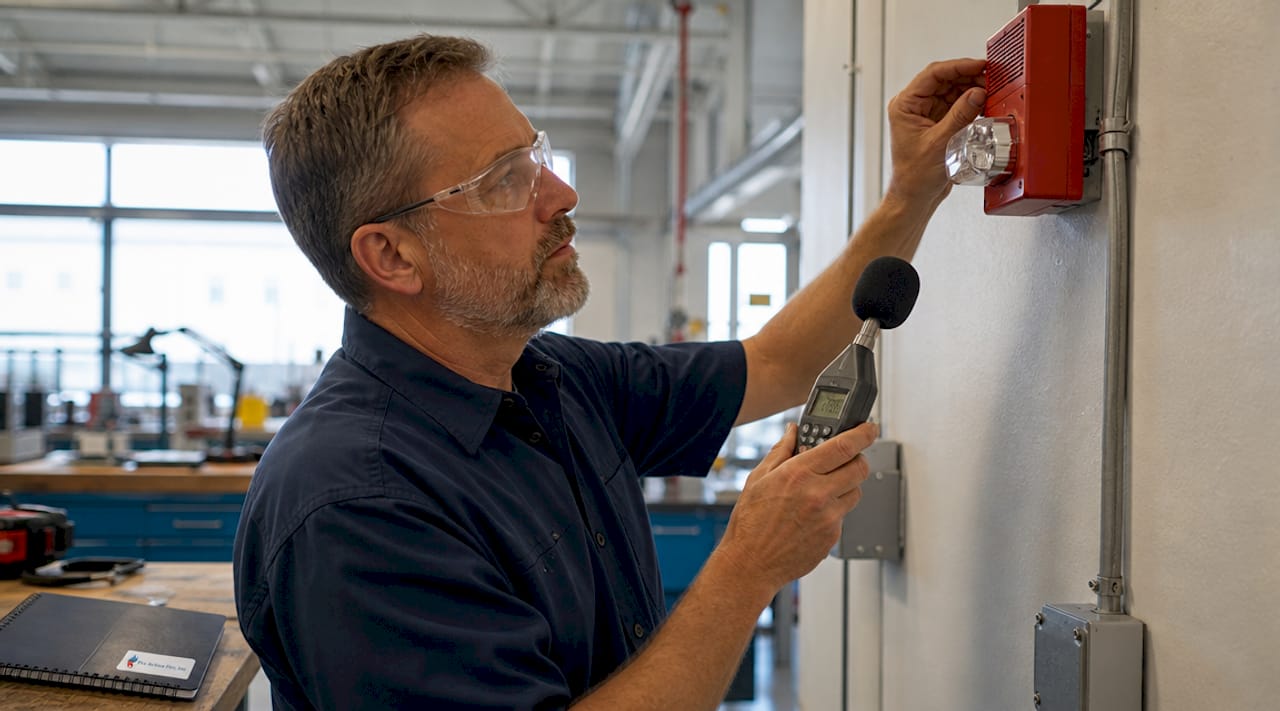
Pro Tip: Conduct a noise survey of your facility before specifying audible devices. Measure ambient dB levels at peak production hours, not during a quiet walkthrough. The difference can shift your device selection by an entire product tier.
Best practices for integrating audible and visible fire alarm systems
Placement is the single most controllable variable in fire alarm effectiveness, and it is also the most frequently underspecified. NFPA 72 requires that synchronized strobes prevent seizures and disorientation by ensuring no two unsynchronized strobes are visible from the same location. This rule drives the entire layout strategy for visible alarms in open-plan spaces.
Follow this sequence when designing an integrated system:
- Map occupancy zones. Identify every space where occupants spend more than transient time, including restrooms, break rooms, server rooms, and loading docks. Each requires coverage.
- Conduct an ambient noise survey. Measure dB levels at peak operational hours in every zone. Use these measurements to specify horn output, not catalog defaults.
- Calculate strobe spacing. Use NFPA 72 Table 18.5.5.4.1 spacing requirements based on room dimensions and candela output. Do not estimate.
- Select combination horn-strobe units where possible. Combination audible and visible devices reduce installation complexity and guarantee co-location of sound and light signals. Brands such as System Sensor, Gentex, and Potter Electric manufacture UL-listed combination units rated for commercial and industrial use.
- Specify synchronized control. All strobes in the same field of view must be driven by a synchronization module or a panel with built-in sync output. Unsynchronized strobes in the same sightline violate NFPA 72 and create a seizure risk.
- Address sleeping areas and restrooms separately. These spaces have higher candela and decibel requirements and often require dedicated devices rather than relying on corridor coverage.
- Document and test. Conduct a full notification appliance circuit test after installation. Record measured dB levels and strobe visibility from every occupant position. This documentation supports AHJ inspections and insurance audits.
LED strobes are replacing xenon strobes across new commercial installations due to lower power consumption and longer service life. However, LED strobes require careful photometric planning because their directional light output differs from the omnidirectional pattern of xenon units. Spacing calculations valid for xenon devices do not automatically transfer to LED products. Verify manufacturer photometric data before finalizing layouts.
Pro Tip: Integrate your fire alarm notification devices with your building’s fire monitoring platform from day one. Facilities that connect audible and visible alarms to a monitored fire safety system catch faults and false alarm patterns before they become compliance violations.
How to choose between audible, visible, or combined fire alarm solutions
The decision framework for selecting fire alarm types starts with a risk assessment, not a product catalog. Three factors drive the specification: ambient noise levels, occupant population characteristics, and building layout complexity.
Ambient noise determines whether audible alarms can physically reach occupants. Any space with sustained ambient noise above 80 dB requires visible alarms as a primary notification method, not a supplement. Facilities with variable noise, such as warehouses that are quiet at night and loud during shifts, need systems that perform across both conditions.
Occupant population determines ADA exposure. Any commercial building with public access or employees covered under the ADA must provide visible alarms in all occupiable spaces. This is not optional, and it applies regardless of whether any known hearing-impaired individual currently occupies the building. The standard is anticipatory, not reactive.
Building layout determines system complexity. Large footprints, multiple floors, and enclosed spaces such as stairwells and mechanical rooms each require individual coverage analysis. A single horn-strobe at the end of a 200-foot corridor does not satisfy NFPA 72 spacing requirements for either device type.
Cost considerations are real but secondary to compliance. Combination horn-strobe units from manufacturers such as System Sensor or Gentex typically cost more per device than separate units but reduce wiring runs, conduit, and labor hours. Over a full installation, combination units often lower total installed cost while simplifying maintenance. The fire alarm selection guide for Colorado commercial buildings provides a practical framework for comparing system types against facility-specific requirements.
Voice evacuation systems represent the highest-capability audible solution for large or complex facilities. They comply with NFPA 72 speech intelligibility requirements and deliver specific instructions that reduce panic. The tradeoff is higher equipment and programming cost, plus the need for ongoing message management. For facilities with complex evacuation routes or high occupant density, the investment is justified by measurable improvement in evacuation outcomes.
Key takeaways
Both audible and visible fire alarm systems are legally required in commercial and industrial facilities under NFPA 72 and ADA standards, and combined systems consistently outperform single-modality installations in real-world evacuation scenarios.
| Point | Details |
|---|---|
| Dual-modality is mandatory | NFPA 72 and ADA require both audible and visible alarms in all occupiable commercial spaces. |
| Ambient noise drives specification | Spaces above 80 dB sustained noise require visible alarms as primary notification, not secondary. |
| Synchronization is non-negotiable | All strobes in the same field of view must be synchronized to prevent seizures and meet NFPA 72. |
| Combination units reduce cost | Horn-strobe combination devices lower wiring and labor costs while guaranteeing co-location of signals. |
| Voice systems reduce alarm fatigue | Voice evacuation systems meeting CIS 0.70 deliver clearer instructions and improve evacuation outcomes over tone-only horns. |
The case for treating visible alarms as primary, not supplemental
After working with commercial and industrial fire protection systems across the Denver Metro Area for years, the pattern I see most often is this: facilities treat visible alarms as an ADA checkbox rather than a core notification strategy. That thinking is wrong, and it creates real risk.
The hearing-impaired population is the obvious use case, but it is not the dominant one in most industrial facilities. The dominant case is the worker wearing hearing protection on a loud floor, the employee in a server room with HVAC masking the horn, or the office worker with noise-canceling headphones who never hears the first two minutes of an alarm. Visible alarms serve all of these occupants equally. Framing strobes as a universal notification tool rather than an accommodation changes how you specify and budget for them.
The shift from xenon to LED strobes is also worth watching closely. LED units offer real advantages in power draw and lifespan, but the photometric differences require updated spacing calculations. Facilities that swap xenon for LED without recalculating coverage are creating invisible gaps in their notification systems. That is a compliance problem and a life safety problem simultaneously.
My practical advice: schedule a notification appliance audit every three years, not just when an inspection forces it. Technology changes, occupancy changes, and the gap between your current system and current code widens quietly. Proactive upgrades are cheaper and safer than reactive ones. The role of fire alarms in business safety is too consequential to manage on a reactive schedule.
— Preactionfire
How Preactionfire supports Denver facilities with compliant fire alarm systems
Preactionfire has served the Denver Metro Area since 2009, designing and installing fire alarm systems that meet NFPA 72, ADA, and local code requirements for commercial and industrial clients.
Pre Action Fire’s NICET-certified technicians specify and install combination audible and visible alarm systems tailored to your facility’s noise profile, occupancy type, and layout. Whether you are upgrading an existing system or designing notification appliances for new construction, Preactionfire provides the technical documentation, testing records, and ongoing maintenance support that AHJ inspections require. Explore the full range of fire alarm system solutions for Denver businesses, or contact Preactionfire directly to schedule a compliance assessment for your facility.
FAQ
What is the minimum dB level for a commercial fire alarm horn?
NFPA 72 requires fire alarm horns to produce sound at least 15 dB above average ambient noise or 5 dB above maximum ambient, with a practical minimum of 75 dB in general spaces and 85 dB at pillow level in sleeping areas.
Are visible fire alarms required in all commercial buildings?
ADA and NFPA 72 mandate visible alarms in all occupiable spaces in commercial buildings, regardless of whether hearing-impaired occupants are currently present. The standard applies anticipatorily to any space where people work or gather.
Can audible alarms be silenced without disabling visible alarms?
Yes. Fire alarm silencing functions temporarily mute audible signals while continuing strobe operation, allowing occupants to communicate during false alarm investigations. The system automatically reactivates audible alarms when a new fire condition is detected.
What is the difference between a strobe and a horn-strobe combination unit?
A strobe provides visible notification only, while a horn-strobe combination unit delivers both audible and visible signals from a single device. Combination units simplify installation, reduce wiring runs, and guarantee that sound and light signals originate from the same location.
When should a facility use a voice evacuation system instead of standard horns?
Voice evacuation systems are the right choice for large, complex, or high-occupancy facilities where specific evacuation instructions reduce panic and improve coordination. NFPA 72 requires these systems to meet a speech intelligibility score of 0.70 or higher, and they are particularly effective in buildings with multiple exit routes or phased evacuation protocols. For guidance on selecting the right notification devices for Denver facilities, Preactionfire provides compliance-focused assessments tailored to your building type.