
TL;DR:
- Properly maintained fire alarm panels are essential for compliance, safety, and quick emergency response.
- Addressable panels offer better scalability and precise device identification for larger or complex buildings.
- Regular inspections, documentation, and licensed contractor work ensure long-term reliability and code compliance.
Treating every fire alarm control panel as interchangeable is one of the most expensive mistakes a Denver property manager can make. A mismatched or poorly maintained panel can trigger compliance failures, false alarms that disrupt tenants, and in worst cases, delayed emergency response during an actual fire. Denver’s commercial building landscape has grown more complex, and both local fire codes and NFPA 72 standards have kept pace. This guide breaks down exactly how fire alarm control panels work, which type fits your property, what Denver’s 2025 code demands, and how to keep your system reliable year after year.
Table of Contents
- What does a fire alarm control panel do?
- Conventional vs. addressable panels: Which is right for your property?
- Denver fire code & NFPA 72: What property managers must know
- Installation, inspection, and maintenance: Keys to reliability
- What most Denver property managers miss about fire panels
- Denver fire alarm compliance: Simplify safety and inspections
- Frequently asked questions
Key Takeaways
| Point | Details |
|---|---|
| Central safety role | The fire alarm control panel is critical for connecting safety devices and triggering emergency responses. |
| Panel type matters | Choosing the right panel—conventional or addressable—depends on your building’s size and code requirements. |
| Strict Denver codes | Denver requires licensed contractors, annual inspections, and adherence to the 2025 fire code and NFPA 72. |
| Maintenance prevents fines | Proactive inspection and certified maintenance prevent costly compliance failures and false alarms. |
What does a fire alarm control panel do?
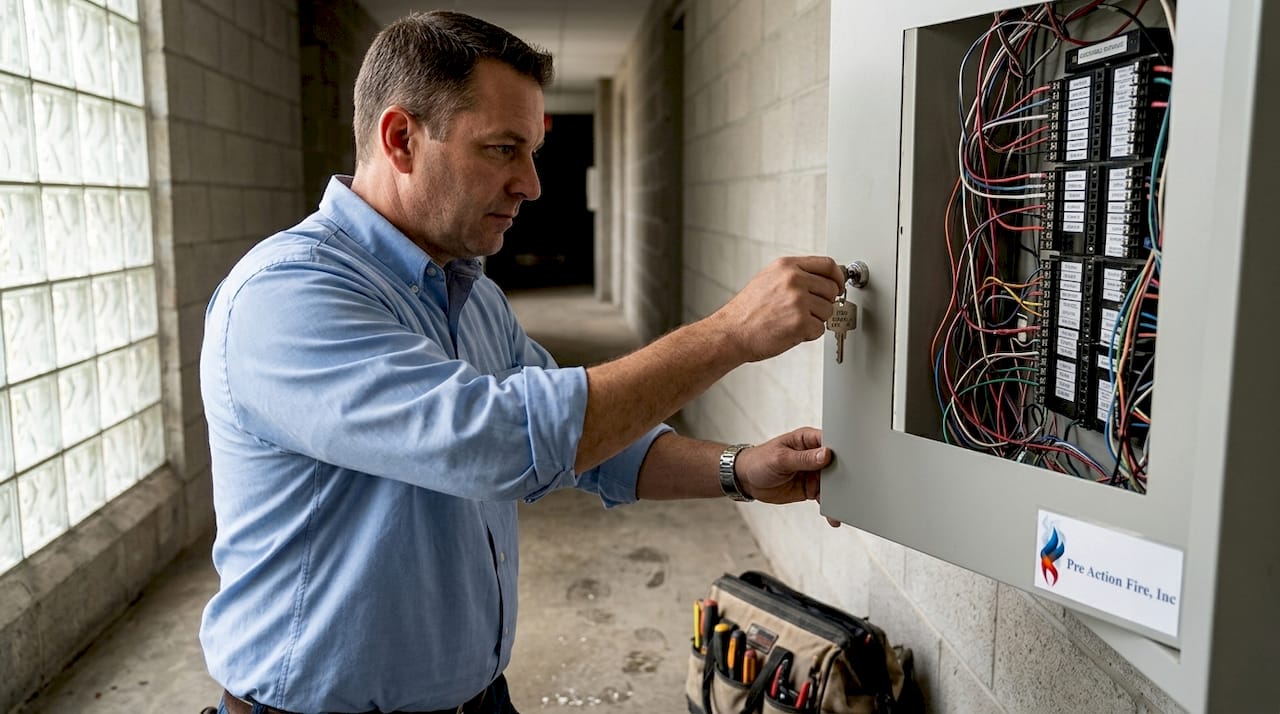
Think of the fire alarm control panel, often called an FACP, as the central nervous system of your building’s fire safety setup. Every detector, pull station, sprinkler flow switch, and notification device runs through it. When a smoke detector triggers, the panel receives that signal, processes it, and decides what to do next. That decision happens in milliseconds.
As the central hub, the FACP connects fire safety devices, powers circuits, and triggers alarms and notifications throughout the building. It does not just ring a bell. It can shut down HVAC systems to stop smoke from spreading, recall elevators to the ground floor, release magnetic door holders, and simultaneously alert a central monitoring station.
Here are the key components inside a typical FACP:
- Power supply with battery backup: Keeps the system running during a power outage. Denver inspection standards require a minimum of 24 hours of standby power followed by 5 minutes of full alarm operation.
- Central processing unit (CPU): Interprets incoming signals and executes programmed responses.
- Input/output circuit boards: Connect initiating devices (detectors, pull stations) and notification appliances (horns, strobes).
- Display and keypad: Allows technicians and first responders to read system status, silence alarms, and reset the panel.
- Relays and auxiliary outputs: Control ancillary systems like HVAC shutdowns and elevator recall.
The battery backup requirement is not optional. During Denver’s periodic inspections, a panel that cannot hold standby charge is an immediate deficiency. Understanding these components helps you ask the right questions when a technician flags a problem. For a broader look at how panels fit into your building’s overall strategy, Denver fire protection resources can clarify what a fully integrated system looks like.
Conventional vs. addressable panels: Which is right for your property?
Not all panels are wired the same, and that wiring difference has real consequences for how fast you can pinpoint a problem and how well your system scales as your building grows.
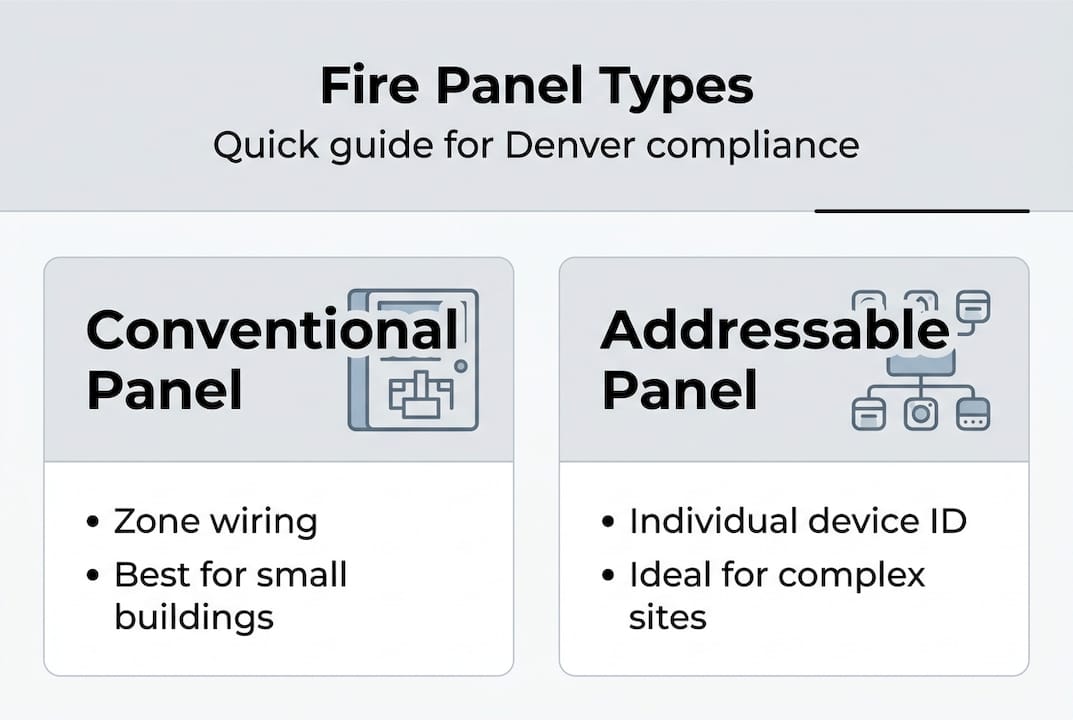
Conventional panels divide a building into zones. Each zone is a radial circuit connecting multiple devices. When a device triggers, the panel tells you which zone activated, but not which specific device. Fault isolation is limited. If a wire breaks mid-circuit, you may lose an entire zone.
Addressable panels assign a unique address to every single device on a signaling line circuit (SLC) loop. When a detector activates, the panel displays the exact device location. Troubleshooting is faster, false alarm response is more precise, and the system is far easier to expand.
| Feature | Conventional panel | Addressable panel |
|---|---|---|
| Device identification | Zone only | Individual device |
| Wiring style | Radial circuits | SLC loops |
| Fault isolation | Limited | High |
| Scalability | Low | High |
| Best fit | Small properties | Medium to large buildings |
| Typical cost | Lower upfront | Higher upfront, lower long-term |
Here is a straightforward way to match panel type to your property:
- Under 5,000 sq ft, simple layout: A conventional panel may be acceptable, though addressable is still worth considering.
- 5,000 to 50,000 sq ft, mixed use or multi-tenant: Addressable panels are the practical choice.
- Over 50,000 sq ft or high-rise: Addressable or networked panels are essentially required for operational and code reasons.
Conventional panels suit small properties while addressable systems are superior for larger or more complex buildings, and Denver’s commercial stock skews toward complexity.
Pro Tip: If your building has undergone renovations or tenant changes in the last five years, an addressable panel pays for itself quickly in reduced service calls and faster alarm verification. Confirm your panel type aligns with current fire system certification requirements before your next inspection cycle.
Denver fire code & NFPA 72: What property managers must know
Compliance is not just about having a panel. It is about having the right panel, installed correctly, tested on schedule, and monitored continuously. Denver’s fire code and NFPA 72 work together to define every one of those requirements.
NFPA 72 is the National Fire Alarm and Signaling Code. It sets the baseline for inspection, testing, and maintenance (ITM) intervals, power supply requirements, wiring standards, and documentation. Denver adopts and locally amends this standard. The 2025 Denver Fire Code mandates permits for new or modified systems, licensed contractors for all installation work, central monitoring for most commercial occupancies, and annual inspections under NFPA 72.
| Inspection type | Frequency | Who performs it |
|---|---|---|
| Visual inspection | Semiannual | Licensed fire alarm contractor |
| Functional test | Annual | Licensed fire alarm contractor |
| Battery test | Annual | Licensed fire alarm contractor |
| Central monitoring verification | Annual | Monitoring provider + contractor |
Key obligations for Denver property managers:
- Pull a permit before any new installation or system modification.
- Use only licensed contractors. The Authority Having Jurisdiction (AHJ) in Denver will flag unlicensed work immediately.
- Maintain a written record of every ITM visit. Missing documentation is treated the same as a missed inspection.
- Ensure your panel connects to a UL-listed central monitoring station.
“Compliance is not a one-time event. It is a continuous process tied to every change in occupancy, renovation, or code cycle.”
Emerging fire alarm code changes at the national level also influence Denver’s local amendments, so staying current matters. Pair your panel knowledge with a solid understanding of Denver fire alarm compliance requirements and schedule your NFPA compliance inspection well before any lease renewal or building sale.
Installation, inspection, and maintenance: Keys to reliability
A code-compliant panel on day one does not guarantee compliance on day 365. Reliability comes from consistent, documented maintenance and a clear process for responding when something goes wrong.
Here is a step-by-step approach to keeping your panel reliable:
- Hire a licensed contractor for installation and upgrades. Verify their license with the Colorado Division of Fire Prevention and Control before signing any contract.
- Schedule semiannual visual inspections. A technician checks wiring, device condition, panel display, and battery voltage.
- Complete annual functional testing. Every initiating device and notification appliance gets tested. Results are logged and provided to the AHJ on request.
- Test and replace batteries on schedule. Most sealed lead-acid batteries in FACPs need replacement every three to five years, regardless of apparent condition.
- Document everything. Keep ITM records on-site and in a digital backup. Denver inspectors can and do ask for multi-year histories.
Fire alarm panels average 15 to 20 years of service life, but poor maintenance triggers nuisance alarms, false failures, and raises overall risk well before that lifespan ends.
Pro Tip: When a trouble signal appears on your panel, do not silence it and walk away. A trouble condition means a circuit, device, or power supply needs attention. Ignoring it can mask a real alarm condition during an actual emergency.
Common maintenance pitfalls to avoid:
- Skipping semiannual visits because the system “seems fine”
- Allowing unauthorized personnel to reset or silence the panel
- Failing to notify your monitoring station before testing
- Delaying battery replacement past the manufacturer’s recommended interval
Proactive fire safety inspections and a current system certification checklist are your best tools for staying ahead of violations and keeping tenants safe.
What most Denver property managers miss about fire panels
After years of working with commercial properties across the Denver Metro Area, we have noticed a consistent pattern. Building managers who stay compliant tend to treat their fire alarm panel as infrastructure, like an elevator or HVAC unit, with a real maintenance budget and a scheduled replacement cycle. Those who struggle tend to treat it as a checkbox item, something to address only when an inspector shows up.
The real cost of that mindset shows up in three ways. First, false alarms. A poorly maintained conventional panel in a mid-size building can generate multiple false alarms per year, each one costing hundreds in emergency response fees and damaging tenant trust. Second, documentation gaps. The leading cause of flagged violations during Denver inspections is not a broken device. It is missing ITM records. Third, code drift. Fire alarm technology and local amendments move faster than most managers realize. Waiting for a letter from the AHJ to learn your panel is out of compliance is an expensive way to stay informed.
Upgrading to an addressable or networked panel should be a higher priority than most owners assign it. The long-term savings in service time, false alarm reduction, and smoother inspections outweigh the upfront cost. The Denver fire protection guide offers a clear framework for evaluating where your building stands and what an upgrade path looks like.
Denver fire alarm compliance: Simplify safety and inspections
Understanding fire alarm control panels is one thing. Having a trusted local partner to handle installation, upgrades, and annual inspections is what turns that knowledge into a reliably compliant building.
Pre Action Fire, Inc. has served the Denver Metro Area since 2009, with NICET-certified technicians who know local code requirements inside and out. Whether you need a new panel installed, an aging system upgraded to addressable technology, or a complete Denver fire alarm regulations compliance review, we handle it from permit to final inspection. Our team also provides ongoing monitoring coordination and ITM documentation to keep your records clean. Reach out to discuss your property’s specific needs and get a straightforward plan for commercial fire protection that meets Denver’s 2026 standards.
Frequently asked questions
How often do fire alarm control panels need inspection in Denver?
Denver requires semiannual visual and annual functional inspections for every FACP under NFPA 72 and local code. NFPA 72 specifies both semiannual visual and annual functional tests as the minimum standard.
Can I use a conventional panel for a large Denver property?
Addressable panels are strongly preferred for medium and large buildings because of scalability and precise device identification. Addressable panels are ideal for larger and more complex properties, and conventional systems may not meet current operational or code needs.
Do I need to hire a licensed contractor for panel installation or upgrade?
Yes. The 2025 Denver Fire Code requires only licensed contractors to perform fire alarm installation and upgrades, with permits pulled and inspections completed before the system goes live.
How long does a fire alarm control panel last?
With proper maintenance, panels typically last 15 to 20 years, but code changes or system expansions may require an upgrade before that timeline ends.