
TL;DR:
- Understanding trouble signals is crucial for proper fire alarm troubleshooting and compliance.
- A methodical approach involving documentation, testing, and professional help ensures system reliability.
- Regular maintenance and awareness of local construction impacts reduce false alarms and system faults.
A fire alarm trouble signal flashing on your panel at 7:45 AM is not the way anyone wants to start a workday. In busy Denver commercial buildings, that single alert can freeze operations, trigger tenant panic, and put you directly in the crosshairs of code compliance deadlines. The pressure to fix it fast is real, but moving too quickly without understanding what the system is actually telling you often makes things worse. This guide walks you through a clear, methodical approach to fire alarm troubleshooting, built specifically for commercial property managers and business owners operating under Denver’s fire safety requirements.
Table of Contents
- What to do first: Assess the fire alarm trouble signal
- Step-by-step fire alarm troubleshooting methodology
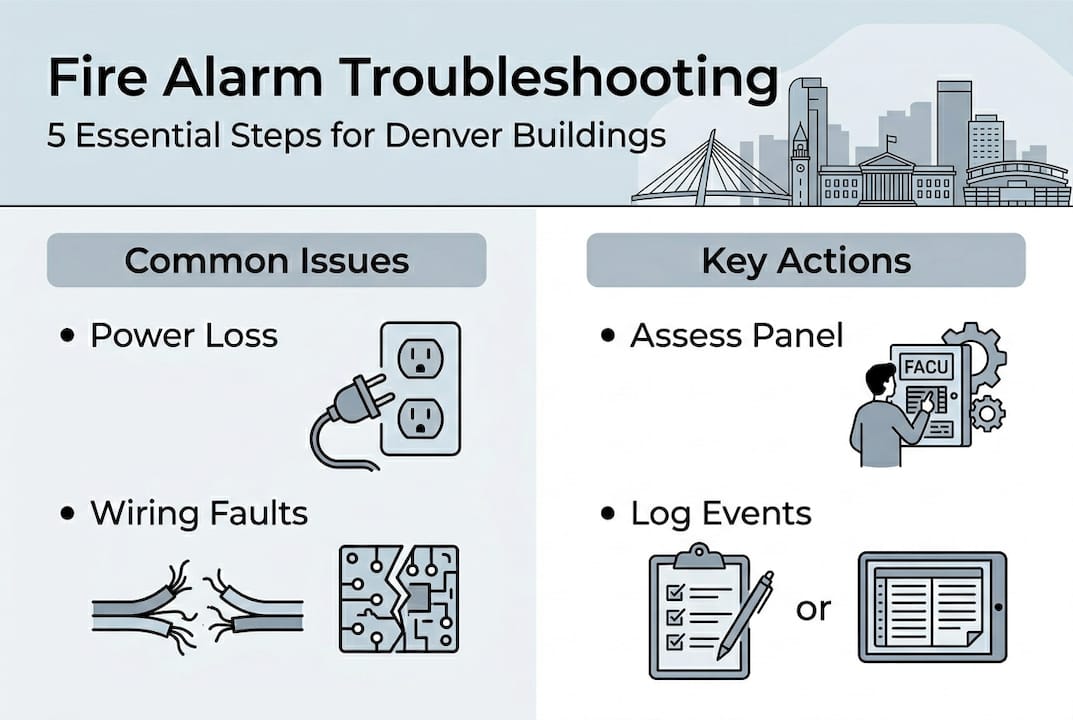
- Common causes and edge cases of fire alarm trouble in Denver buildings
- Reducing false alarms and ensuring compliance
- When to call a certified fire alarm professional
- Why a methodical troubleshooting mindset prevents emergencies
- Trusted fire alarm solutions for Denver businesses
- Frequently asked questions
Key Takeaways
| Point | Details |
|---|---|
| Document trouble details | Always log the exact trouble code, affected zone, time, and device before taking action. |
| Follow systematic steps | A phased troubleshooting method reduces downtime and compliance risks. |
| Address root causes | Common trouble sources include power failures, wiring issues, and environmental effects. |
| Prioritize regular ITM | Routine inspection, testing, and maintenance prevent 25% of detector failures and most false alarms. |
| Call professionals when needed | Certified technicians are required for wiring, programming, and unresolved trouble signals. |
What to do first: Assess the fire alarm trouble signal
Before you can fix fire alarm problems, you must understand exactly what your system is telling you. A trouble signal is not the same as an alarm. An alarm means a detector has sensed smoke, heat, or another fire condition. A trouble signal means the system itself has detected an internal fault, such as a power failure, a disconnected device, or a communication error. No fire is confirmed, but the system is telling you something is wrong and needs attention.
Here are the most common trouble codes you will see on commercial panels:
| Trouble code | What it means |
|---|---|
| AC power failure | Main power to the panel is lost |
| Low battery / battery fault | Backup battery is weak or disconnected |
| Device fault | A detector, pull station, or module is offline |
| Ground fault | Wiring is making unintended contact with ground |
| Communication loss | Panel cannot reach a zone, device, or monitoring center |
| Supervisory signal | A valve, damper, or auxiliary device changed state |
When you see a trouble signal, document exact trouble message, zone/device before you touch anything else. Retrieval of these details shapes every decision that follows.
Here is what to capture immediately:
- Exact trouble message shown on the panel
- Zone number and device address or location
- Time and date of the alert
- Whether any recent work, weather events, or power outages occurred
- Any prior trouble signals in the past 30 days
Pro Tip: Write down the time, zone, and device description before silencing the audible alert. Silencing the panel does not clear the trouble, and that log entry becomes your compliance record.
Safety note: Never bypass or reset the system without first understanding why the trouble signal appeared. Repeated blind resets mask real problems and can void your insurance coverage.
For Denver commercial alarm systems, understanding the specific panel type matters. Addressable systems give you device-level detail. Conventional systems point you to a zone. Both require documentation before any action.
Step-by-step fire alarm troubleshooting methodology
With documentation in place, you are ready to follow a methodical troubleshooting process. Phased troubleshooting covers safety assessment, details retrieval, criticality evaluation, test and repair, verification, and documentation. Skipping phases creates gaps that come back to haunt you during inspections.
Follow these steps in order:
- Document the trouble using the checklist above before doing anything else.
- Verify power supply. Check main AC power, then inspect backup battery voltage. Most panels report battery voltage on the status screen.
- Check the environment near the flagged device. Look for construction dust, steam, extreme temperature, or physical damage.
- Acknowledge the alert on the panel. This silences the audible tone but keeps the trouble displayed. Do not reset repeatedly.
- Isolate the device or circuit. For addressable systems, use the panel software to isolate the specific device. For conventional systems, you may need to disconnect the circuit.
- Test and repair. Clean the device, reseat connections, or replace the component. Verify the fix before restoring the circuit.
- Document every action taken with date, time, technician name, and outcome.
A quick comparison of how this plays out across system types:
| Troubleshooting step | Conventional loop system | Addressable system |
|---|---|---|
| Locating the fault | Zone-level only | Exact device address |
| Isolation method | Disconnect zone circuit | Software isolation per device |
| Verification | Re-enable zone, test | Re-enable device, test individually |
Keep Denver fire alarm regulations in mind at every step. Denver follows NFPA 72 with local amendments, and any repair that modifies panel programming must be performed by a licensed technician.
Pro Tip: Keep a running log on a shared drive or printed binder at the panel. Inspectors regularly ask for these records, and having them ready saves time and demonstrates proactive management.

Common causes and edge cases of fire alarm trouble in Denver buildings
Knowing the troubleshooting steps is important, but understanding what actually causes fire alarm trouble signals in Denver buildings gives you a real edge. Most faults trace back to a short list of root causes.
The most frequent culprits include:
- AC power failure from utility outages or tripped breakers
- Aging or failed backup batteries, which typically last 3 to 5 years
- Loose or corroded wiring connections, especially in older buildings
- Contaminated detectors from construction dust, kitchen grease, or steam
- Network or communication drops in newer networked or cloud-connected systems
Denver’s construction boom adds a layer of complexity most other cities do not see. Active renovation projects nearby generate ground faults from vibration and dust infiltration. Edge cases like intermittent ground faults and wireless interference from new construction equipment are real problems in Denver’s LoDo, RiNo, and Stapleton corridors.
Colorado’s rapid humidity swings, from dry winter air to spring moisture, also stress detector electronics. High-altitude conditions affect some sensor calibrations as well. If your building sits near a parking structure or loading dock with exhaust exposure, you are at higher risk for sensor contamination.
Detectors that receive routine inspection, testing, and maintenance (ITM) fail 25% less often compared to neglected units. That statistic alone makes the case for scheduled maintenance programs.
“Local construction activity is one of the most underestimated threats to fire alarm system reliability. Ground faults from jobsite vibration and dust intrusion into detectors can trigger persistent trouble signals that are difficult to trace without device-level diagnostics.”
For a broader look at how Colorado fire safety compliance connects to system reliability, understanding local risk factors is step one. Common fire alarm system issues can also point you toward patterns worth monitoring in your specific building type.
Reducing false alarms and ensuring compliance
Addressing root causes is only part of the solution. Ongoing prevention and compliance lock in reliability over time. False alarms are a serious problem for Denver commercial properties. They desensitize occupants, cost money in emergency response fees, and can trigger fines under city ordinance.
Follow this process to reduce nuisance alarms:
- Inspect all detectors quarterly for visible dust, debris, or physical damage.
- Clean detectors using manufacturer-approved methods. Vacuuming or compressed air works for most ionization and photoelectric units.
- Reposition detectors that sit too close to HVAC vents, cooking equipment, or steam sources.
- Run sensitivity checks using listed test equipment to verify each detector is within its rated range.
- Verify multi-sensor devices are programmed to require confirmation from more than one sensing technology before triggering an alarm.
Reducing false alarms through cleaning, multi-sensor verification, environmental controls, and regular testing is the standard approach recommended by fire safety professionals nationwide.
For Denver compliance specifically, your maintenance program should include:
- Annual inspection and testing per NFPA 72, with records retained for at least three years
- Quarterly device checks for high-risk areas like commercial kitchens and loading docks
- Written documentation of all tests, repairs, and technician credentials
- Sensitivity testing for smoke detectors at least every other year
Pro Tip: Schedule your ITM visit in late February or early March, before Denver’s spring construction season ramps up and pollen counts rise. Both factors increase false alarm rates significantly.
Following this process protects your Denver fire protection standing and reduces the risk of fines. Understand the full scope of fire alarm trouble signals to make your prevention program complete.
When to call a certified fire alarm professional
Even with diligent troubleshooting, some fire alarm issues demand certified professional involvement. Knowing where that line sits protects you legally, financially, and operationally.
Contact a licensed fire alarm technician when:
- Trouble signals return within 24 to 48 hours after a reset
- The panel displays a fault you cannot locate on the device map
- You find damaged, burned, or water-exposed wiring
- Panel programming changes are needed to resolve the issue
- A device isolation does not clear the trouble code
- You are unsure whether a repair meets Denver fire code
Certified technicians are required for wiring or programming problems, persistent troubles, and situations where device isolation fails to resolve the signal. This is not just a best practice. In Denver, unlicensed modifications to fire alarm systems can trigger permit violations, insurance denials, and liability exposure if a fire occurs afterward.
Amateur repairs that go wrong often cost three to five times more to fix correctly later. And if the fire marshal discovers non-compliant work during a scheduled inspection, you may face mandatory shutdown notices while corrections are made.
“An unresolved or improperly repaired fire alarm system is not just a safety risk. It is a business liability that can invalidate your insurance policy and expose your organization to civil litigation if an incident occurs.”
Scheduling a professional fire safety inspection is far less expensive than managing the fallout from a missed fault. For specific panel makes, consulting resources like Notifier fire alarm troubleshooting guides can help you understand what to expect before the technician arrives.
Why a methodical troubleshooting mindset prevents emergencies
Here is a view that does not get enough attention in fire safety discussions: the steps matter, but the mindset behind them matters just as much. Most escalations we see at Pre Action Fire do not start with catastrophic equipment failures. They start with a property manager who reset the panel three times in a row because the tone was disruptive, and nobody wrote anything down.
Repeated resets without investigation are the single biggest cause of small problems becoming big ones. The system is designed to tell you something is wrong. Silencing it without listening is the equivalent of turning off your check engine light and driving to Nevada.
Methodical record-keeping is not just a compliance box to check. It is a business asset. When an insurance claim is filed or a legal dispute arises after an incident, your maintenance log is evidence. It shows due diligence. It demonstrates that your staff responded appropriately and that you invested in system health.
Pro Tip: Train your facilities staff to read basic panel status screens and identify the difference between an alarm and a trouble signal. They do not need to perform repairs. They just need to know what to document and when to call for help.
System health equals business continuity. A well-maintained alarm system keeps your building open, your tenants safe, and your compliance record clean. Explore how proactive fire alarm system strategies support long-term operational stability for Denver commercial properties.
Trusted fire alarm solutions for Denver businesses
When in-house solutions are not enough, rely on local experts dedicated to Denver’s safety standards.
Pre Action Fire, Inc. has been serving the Denver Metro Area since 2009 with NICET-certified technicians who specialize in commercial fire alarm troubleshooting, repair, and compliance. Whether you manage a high-rise, a warehouse, or a multi-tenant retail center, we service all major makes and models of fire alarm systems for Denver businesses. Do not wait for a recurring trouble signal to become a citation or a liability. Review the Denver fire alarm compliance guide and contact us to schedule an inspection, repair, or full system assessment. Fast response, documented work, and code-compliant results every time.
Frequently asked questions
What does a ‘trouble’ signal mean on my fire alarm panel?
A trouble signal indicates a system issue such as power loss, wiring problems, device fault, or communication error, not an active fire. It means the alarm system needs attention before it can protect your building reliably.
How can I reduce false alarms in my commercial building?
False alarms decrease with regular detector cleaning, multi-sensor verification, environmental controls, and scheduled sensitivity testing. Repositioning detectors away from HVAC vents and cooking areas also helps significantly.
When should I call a certified fire alarm technician?
Contact a professional if trouble signals persist after a reset, if you find wiring or programming issues, or if Denver code compliance is in question. Repeated trouble codes that return within 48 hours are a clear sign professional diagnostics are needed.
How often should fire alarm systems be tested in Denver?
Annual inspection and testing are required under NFPA 72, with records retained for compliance purposes. High-risk areas like commercial kitchens may warrant more frequent quarterly checks.
Does replacing fire alarm batteries prevent system trouble?
Yes. Backup batteries last three to five years, and replacing them on schedule is one of the simplest ways to prevent power-related trouble signals from disrupting your operations.