

TL;DR:
- Colorado’s fire protection regulations combine national NFPA standards with state and local amendments, notably Denver.
- Proper fire risk assessment, system design, permitting, installation, and ongoing maintenance are vital for compliance.
- Clear documentation and communication with authorities and contractors prevent costly delays and inspection failures.
Missing a single permit or skipping a required inspection can trigger stop-work orders, insurance claim denials, and fines that reach into the tens of thousands. For commercial and industrial property managers in Colorado, the building fire protection process is not a one-time event but an ongoing obligation shaped by layered federal, state, and local regulations. Getting it right means understanding every stage, from initial risk assessment through long-term maintenance. This guide breaks down each step clearly so you can move through the process with confidence, stay ahead of code requirements, and avoid the costly surprises that catch unprepared facilities off guard.
Table of Contents
- Understanding fire protection codes and requirements in Colorado
- Step 1: Fire risk assessment and preliminary planning
- Step 2: System design, permitting, and approval
- Step 3: Installation, commissioning, and ongoing maintenance
- The overlooked keys to fire protection process success
- Next steps for turnkey fire protection in Colorado
- Frequently asked questions
Key Takeaways
| Point | Details |
|---|---|
| Know your codes | Colorado fire protection relies on both IFC and key NFPA standards with local amendments. |
| Document everything | Accurate risk, system, and maintenance records are essential for code compliance and insurance. |
| Follow stepwise process | Assessment, design, permitting, installation, and maintenance are all mandatory steps in Colorado. |
| Ongoing ITM is critical | Fire protection systems must be regularly inspected and maintained to stay compliant year after year. |
Understanding fire protection codes and requirements in Colorado
Before any system is designed or installed, you need a firm grasp of which codes apply to your building and why. Colorado operates within a framework that blends national standards with state and city-level amendments, and the differences between those layers can trip up even experienced property managers.
At the national level, the two most relevant standards are the International Fire Code (IFC) and the National Fire Protection Association (NFPA) standards. For sprinkler systems, that means NFPA 13 compliance. For fire alarm systems, it means NFPA 72. These documents define minimum design, installation, and performance requirements that apply across the country.
Colorado layers its own requirements on top through the Colorado fire protection standards, which incorporate NFPA standards with state-specific amendments. At the city level, Denver goes further. The Denver Fire Code 2025 requires permits for the installation or modification of sprinkler systems (NFPA 13), fire alarm systems (NFPA 72), and fire pumps. It also requires operational permits for specialized industrial equipment including high-temperature ovens and inert gas systems.
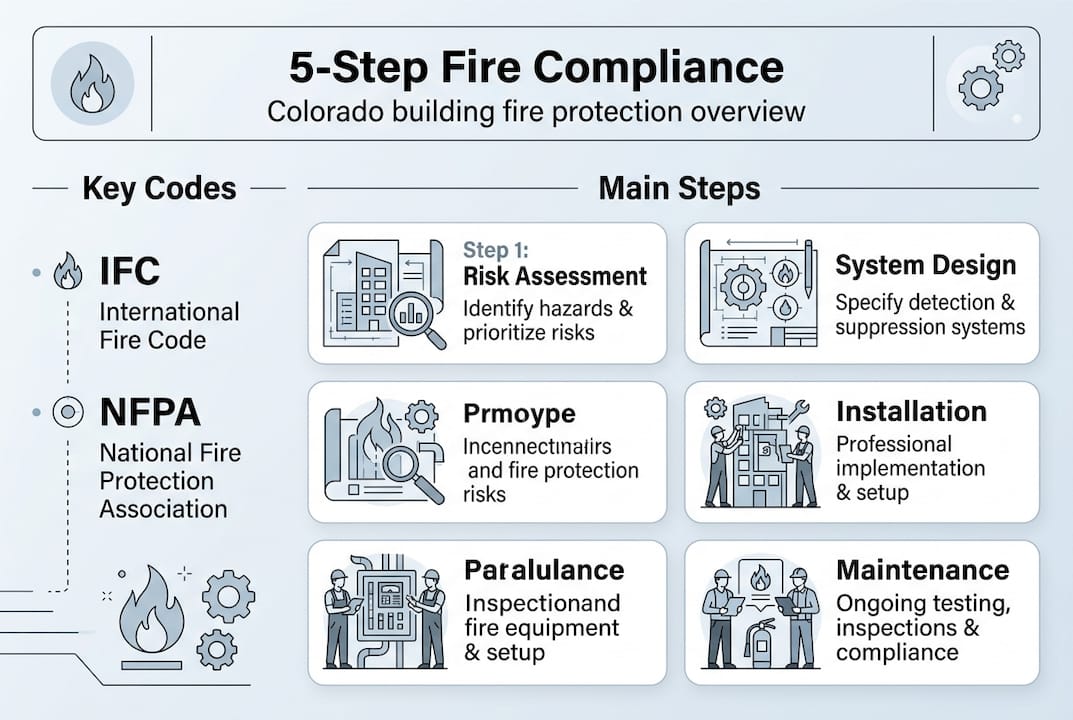
Here is a quick look at the key standards and what they govern:
| Standard | Governs | Applies to |
|---|---|---|
| IFC (amended) | General fire and life safety | All commercial/industrial buildings |
| NFPA 13 | Sprinkler system design and installation | Buildings requiring suppression |
| NFPA 72 | Fire alarm and signaling systems | Most commercial occupancies |
| NFPA 25 | Inspection, testing, and maintenance | All installed fire suppression systems |
| Denver Fire Code 2025 | Local permits and operational requirements | Denver jurisdiction properties |
The critical areas these codes address include sprinkler systems, fire alarms, fire pumps, emergency lighting, and special hazard systems such as clean agent suppression for server rooms or foam systems for fuel storage.
Important: Following only national NFPA standards without accounting for Denver or Colorado amendments can still result in a code violation. Local amendments are not optional additions. They are legally binding requirements for properties in those jurisdictions.
For a full breakdown of how these regulations interact in practice, the Denver building fire protection guide and the Colorado commercial fire code resource are both solid starting points.
Step 1: Fire risk assessment and preliminary planning
With the regulatory landscape clear, the first real action in the building fire protection process is a structured fire risk assessment. This phase directly shapes every system choice, every permit application, and every inspection outcome that follows. Skip it or rush it, and you will be fixing gaps at every later stage.
The fire risk assessment standards outline a structured approach that ties system requirements to occupancy type and hazard classification. The Denver Fire Code 2025 confirms that the building fire protection process begins with this assessment, using occupancy type, identified hazards, and construction details to drive all downstream decisions.
Here is a practical sequence for completing a compliant fire risk assessment:
- Walk every area of the building. Do not rely on floor plans alone. Physical walkthroughs reveal storage patterns, equipment placement, and construction details that drawings miss.
- Identify all fire hazards. This includes flammable or combustible materials, high-pile storage (racking systems over 12 feet), cooking equipment, electrical panels, and industrial process hazards.
- Classify the occupancy. Is it a warehouse, a manufacturing facility, a mixed-use commercial space? Occupancy classification determines which NFPA standards apply and at what level.
- Determine the hazard category. Light, ordinary, or extra hazard classifications drive sprinkler density requirements and suppression system selection.
- Document everything. Construction type, square footage, occupant load, hazardous materials inventory, and any process equipment must all be recorded in detail.
Documentation is where many property managers underinvest. Fire marshals conducting plan reviews look specifically for clear, complete hazard documentation. Vague or missing data about occupancy type or process hazards is one of the top causes of delayed permit approvals.
Pro Tip: Create a standardized site hazard checklist and update it every time operations change. Even seemingly minor changes, like adding a new chemical storage area or expanding rack storage, can shift your hazard classification and trigger new code requirements.
For deeper guidance on structuring this phase, commercial fire protection planning and fire safety and risk reduction resources provide useful frameworks for Colorado facilities.
Step 2: System design, permitting, and approval
Once risks are identified, the next step is translating those findings into a compliant system design and navigating the permitting process with your local Authority Having Jurisdiction (AHJ), which is the governing body, often the local fire department, responsible for reviewing and approving fire protection plans.
System design must directly reflect the hazard classification and occupancy type from your risk assessment. Per the Denver Fire Code requirements, sprinkler systems must be designed per NFPA 13 with full hydraulic calculations, and alarm systems must meet NFPA 72 requirements. Special systems like clean agent or foam suppression carry their own NFPA standards.
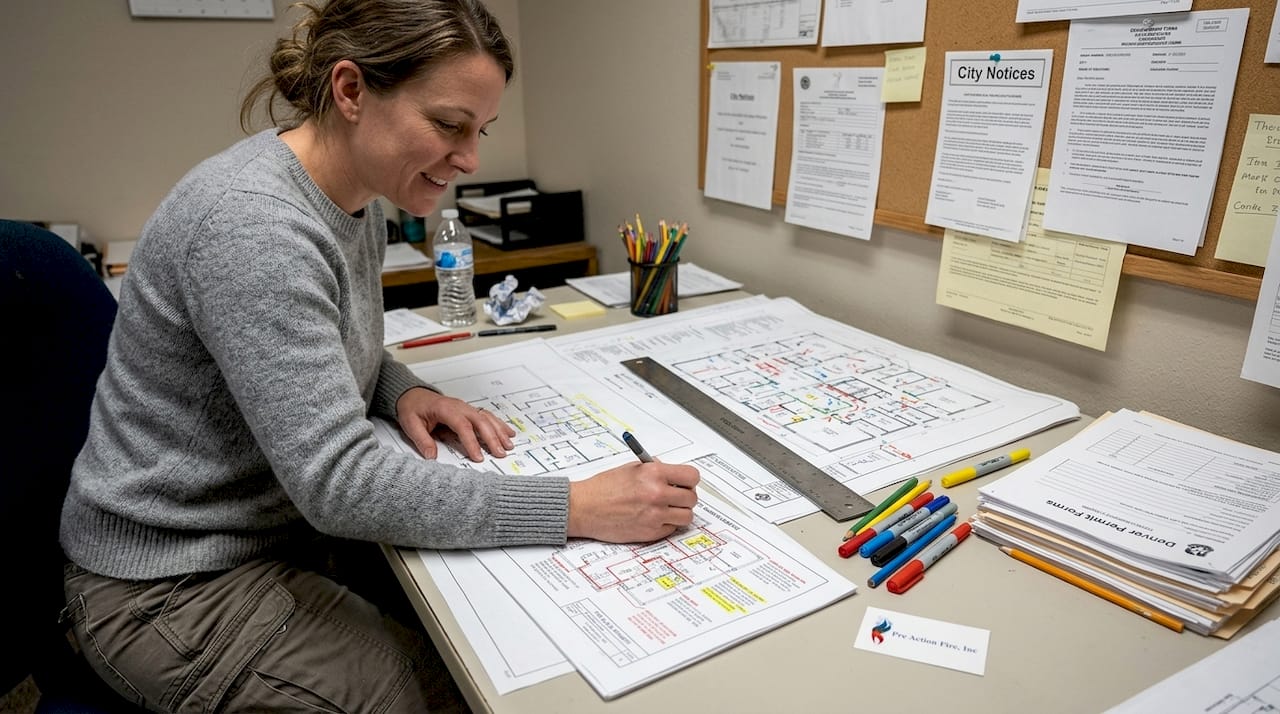
Here is a comparison of what each major system type requires for design and permitting:
| System type | Design standard | Key submittal requirements |
|---|---|---|
| Sprinkler system | NFPA 13 | Hydraulic calcs, layout drawings, head specs |
| Fire alarm system | NFPA 72 | Device layout, battery calcs, riser diagram |
| Special hazard system | NFPA 2001, 11, or 750 | Agent quantity calcs, room integrity test plan |
| Fire pump | NFPA 20 | Pump curve data, suction/discharge specs |
The permitting process involves two main categories. Construction permits cover the physical installation of systems. Operational permits cover ongoing use of equipment that presents fire risk. Both may apply to your property.
For AHJ submission, your package typically needs to include:
- Scaled plan drawings with all device and head locations
- Hydraulic or load calculations showing code compliance
- Equipment specifications and cut sheets for all listed products
- Occupancy hazard documentation from the risk assessment
- Contractor license numbers and relevant certifications
Pro Tip: Contact the AHJ before you submit anything. A brief pre-submittal meeting can clarify exactly what format, level of detail, and documentation that specific office expects. Most resubmission cycles happen because plans meet national code requirements but miss a local formatting preference or a city-specific amendment.
For a full overview of how suppression and alarm systems come together under Colorado requirements, the fire protection compliance guide is a practical reference, and Denver fire protection resources can help you identify what local support is available.
Step 3: Installation, commissioning, and ongoing maintenance
Approved plans move the project to the installation phase, but getting systems physically installed is only the beginning. Commissioning and long-term maintenance are where many facilities fall short, and those failures show up during inspections and insurance reviews at the worst possible times.
Installation must be performed by licensed contractors who are verified to hold active Colorado contractor licenses and are familiar with both the approved plans and local inspection procedures. Never assume that national certification alone satisfies Colorado and Denver licensing requirements.
Post-installation, every system must go through a formal commissioning process. This includes:
- Witnessing functional tests for all sprinkler heads, alarm devices, and suppression agent delivery
- Verifying that water flow, pressure, and coverage meet the approved hydraulic calculations
- Confirming alarm signal routing to the monitoring station and fire department
- Obtaining sign-off documentation from both the installing contractor and the AHJ inspector
Once a system is in service, Colorado fire maintenance rules and the Denver Fire Code 2025 require ongoing inspection, testing, and maintenance (ITM) per NFPA 25. Here is what a compliant ITM schedule looks like:
- Monthly: Visual inspection of sprinkler heads and alarm control panels
- Quarterly: Waterflow alarm tests and supervisory signal tests
- Annually: Full system inspection, flow tests, fire pump performance tests, and extinguisher service
- Five-year: Internal pipe inspections for sprinkler systems in corrosive environments
Warning: Missed ITM deadlines are one of the most common reasons commercial properties fail fire inspections. Worse, an insurance carrier can deny a fire damage claim if maintenance records show the system was not kept in compliance at the time of loss.
Keep all inspection and test reports on file, accessible for AHJ review at any time.
The overlooked keys to fire protection process success
After covering the technical steps, it is worth talking about where real-world projects actually break down. From our experience working with commercial and industrial facilities across the Denver Metro Area since 2009, the most expensive fire protection failures are not caused by technical errors. They are caused by communication gaps.
Property managers often assume that once a contractor is hired or a permit is submitted, the process runs itself. It does not. Misunderstandings between design engineers, installing contractors, and fire marshals create compliance gaps that only surface during final inspection, costing weeks of rework and significant money.
Document every single interaction with your AHJ and your contractors. Verbal approvals are not approvals. If a fire marshal says something is acceptable during a phone call, follow up with a written summary and ask for confirmation. This protects you legally and creates a clear audit trail if questions arise later.
Colorado’s multi-jurisdictional environment makes this even more critical. State requirements, city amendments, and evolving code cycles mean that what was compliant two years ago may not pass inspection today. Keeping a living compliance checklist updated against current code cycles is not optional for facilities that want to stay ahead.
Pro Tip: Appoint a single compliance coordinator for every fire protection project. This person owns communication with all parties, tracks all submittals and approvals, and maintains the documentation file. Shared responsibility usually means no one owns it.
For ongoing best practices guidance, fire protection planning best practices is a useful resource to revisit as your facility or the code environment changes.
Next steps for turnkey fire protection in Colorado
For those ready to act, working with a Colorado-focused fire protection partner simplifies every stage of this process significantly.
At Pre Action Fire, Inc, we have supported commercial and industrial property managers across the Denver Metro Area since 2009, handling everything from initial risk assessments through Denver fire safety inspections, system design, permitting, and ITM programs. Our NICET-certified technicians know Colorado and Denver code requirements in detail and coordinate directly with the AHJ on your behalf. Whether you need Denver fire alarm solutions or a full fire sprinkler installation, we offer no-obligation consultations and site evaluations. Reach out today to get your facility on a compliant, documented, and defensible fire protection program.
Frequently asked questions
What are the main fire protection standards adopted in Colorado?
Colorado follows the International Fire Code with state amendments and incorporates NFPA standards, including NFPA 13 for sprinklers and NFPA 72 for alarms. Denver adds its own permit requirements on top through the Denver Fire Code 2025.
How often are fire protection systems required to be inspected?
NFPA 25 mandates inspections at monthly, quarterly, annual, and five-year intervals depending on system type, and local AHJ requirements may add further obligations specific to Denver or Colorado.
What documents must be submitted for fire system permitting in Denver?
You need scaled plan drawings, hydraulic calculations, equipment specifications, occupancy hazard documentation, and contractor credentials. The Denver Fire Department reviews these as part of the AHJ approval process for both construction and operational permits.
What are common mistakes that lead to failed fire code inspections?
Missing or outdated maintenance records, non-permitted system modifications, and incomplete commissioning documentation are the most frequent causes of failed inspections and insurance coverage issues.