
TL;DR:
- Most facility managers in Colorado are aware of fire extinguishers and alarms but often overlook the layered regulatory standards essential for comprehensive fire safety compliance. Ensuring current adherence to national, state, and local codes involving systems like sprinklers, alarms, and hazardous materials handling is vital to avoid costly fines, operational halts, and safety risks. Continuous maintenance, staff training, and regular expert reviews are critical for long-term safety and legal compliance in dynamic industrial environments.
Most facility managers in Colorado know they need fire extinguishers and alarms. What many don’t realize is that this assumption only scratches the surface of what industrial fire safety compliance actually requires. The full regulatory landscape involves layered standards from national bodies, state adoption, and local municipal amendments that collectively determine exactly what your facility must have, maintain, and document. Getting this wrong doesn’t just mean a citation during an inspection. It can mean halted operations, major fines, and worst of all, putting people at risk.
Table of Contents
- Understanding industrial fire safety standards: The what and why
- How fire codes apply in Colorado: State, local, and industrial specifics
- Critical code highlights for industrial facilities: Extinguishers, alarms, sprinklers, and more
- Navigating complex risk areas: Storage heights and code interpretation challenges
- Steps to ensure compliance and prepare for inspections
- What most guides miss about fire safety standards
- Fire safety solutions and next steps for Colorado businesses
- Frequently asked questions
Key Takeaways
| Point | Details |
|---|---|
| NFPA codes guide compliance | NFPA standards form the foundation for most enforceable industrial fire safety regulations in Colorado. |
| Local amendments matter | Cities like Denver adopt and adapt model fire codes with local requirements that directly impact industrial sites. |
| Key systems must be covered | Fire extinguishers, alarms, and sprinklers each have specific regulations—missing one can mean non-compliance. |
| Documentation and training are essential | Accurate records and employee training help ensure passing inspections and real-world safety. |
| Ongoing review prevents surprises | Regularly revisiting standards keeps your facility compliant as codes and operations evolve. |
Understanding industrial fire safety standards: The what and why
Fire safety standards are technical documents that specify how to design, install, inspect, and maintain systems that prevent and control fires. They are not the same as laws by default, but they become enforceable when adopted by government authorities at the state or local level.
Two organizations drive most of the standards you’ll encounter as a facility manager in Colorado:
- NFPA (National Fire Protection Association): Publishes codes covering sprinkler systems, alarm systems, extinguisher placement, emergency egress, and dozens of industrial-specific hazards. NFPA codes and standards reduce fire risk and are commonly adopted into enforceable requirements by governments and other stakeholders.
- OSHA (Occupational Safety and Health Administration): Sets worker safety requirements at the federal level, many of which overlap with fire protection, especially around hazardous materials handling and emergency response procedures.
Understanding the importance of compliance goes beyond avoiding fines. Non-compliance can void insurance policies, expose ownership to liability in the event of a fire, and create conditions where a small incident becomes a catastrophic one.
“Fire safety standards exist not to burden facility operators, but to formalize what decades of fire investigation data have shown actually saves lives and reduces losses.”
The practical reasons every industrial facility in Colorado should care about these standards include:
- Life safety: Standards are written specifically to give occupants time to evacuate and responders time to intervene.
- Property protection: Properly maintained suppression and alarm systems dramatically reduce structural losses.
- Legal operation: Many insurance carriers and local jurisdictions require documented compliance before issuing or renewing commercial permits.
- Liability reduction: When an incident does occur, documented compliance is your strongest legal defense.
Supporting fire risk reduction in Colorado industrial operations means understanding that standards aren’t static. They are updated regularly, and staying current is part of your compliance obligation.
How fire codes apply in Colorado: State, local, and industrial specifics
Colorado adopts model codes at the state level and allows local jurisdictions to amend them. This creates a layered system where your facility may need to satisfy both the state baseline and additional local requirements specific to your city or county.
Here’s how that cascade works in practice:
- National model code published: Organizations like the International Fire Code (IFC) or NFPA 1 publish a new edition with updated requirements.
- Colorado adopts the model code: The state formally adopts the model code, often with a slight delay after publication.
- Local jurisdiction adds amendments: Cities like Denver adopt the state code but layer in their own modifications based on local risk profiles, building stock, and community priorities.
- Facility must comply with both layers: Your industrial site must meet whatever is stricter between the state baseline and local amendments.
Denver is a useful example. The 2025 Denver Fire Code incorporates enforceable requirements based on model code amendments that reference specific editions and provisions unique to the city’s environment and building inventory.
| Code level | Who creates it | Who enforces it | Scope |
|---|---|---|---|
| National model code | NFPA, ICC | Not directly enforceable alone | Sets baseline requirements across all occupancy types |
| State adopted code | Colorado Division of Fire Prevention | State-level oversight, often via AHJ | Applies statewide unless locally amended |
| Local amended code | City/county fire marshal | Local fire department, AHJ | Applies within the jurisdiction, may be stricter |
Understanding Colorado commercial fire code requirements means knowing which layer governs your building type, occupancy classification, and operational hazards.
Pro Tip: Always request the current local amendment schedule from your authority having jurisdiction (AHJ) before beginning any renovation, change of occupancy, or operational expansion. Basing your plans only on the national model code without checking local amendments is one of the most common and costly compliance mistakes we see in industrial fire protection planning.
Critical code highlights for industrial facilities: Extinguishers, alarms, sprinklers, and more
Industrial facilities face the most demanding fire code requirements of any occupancy type. High fuel loads, hazardous materials, complex machinery, and large floor areas all increase both the likelihood of a fire starting and the difficulty of controlling it once it does.
Here are the four areas that generate the most citations and compliance questions for Colorado industrial sites:
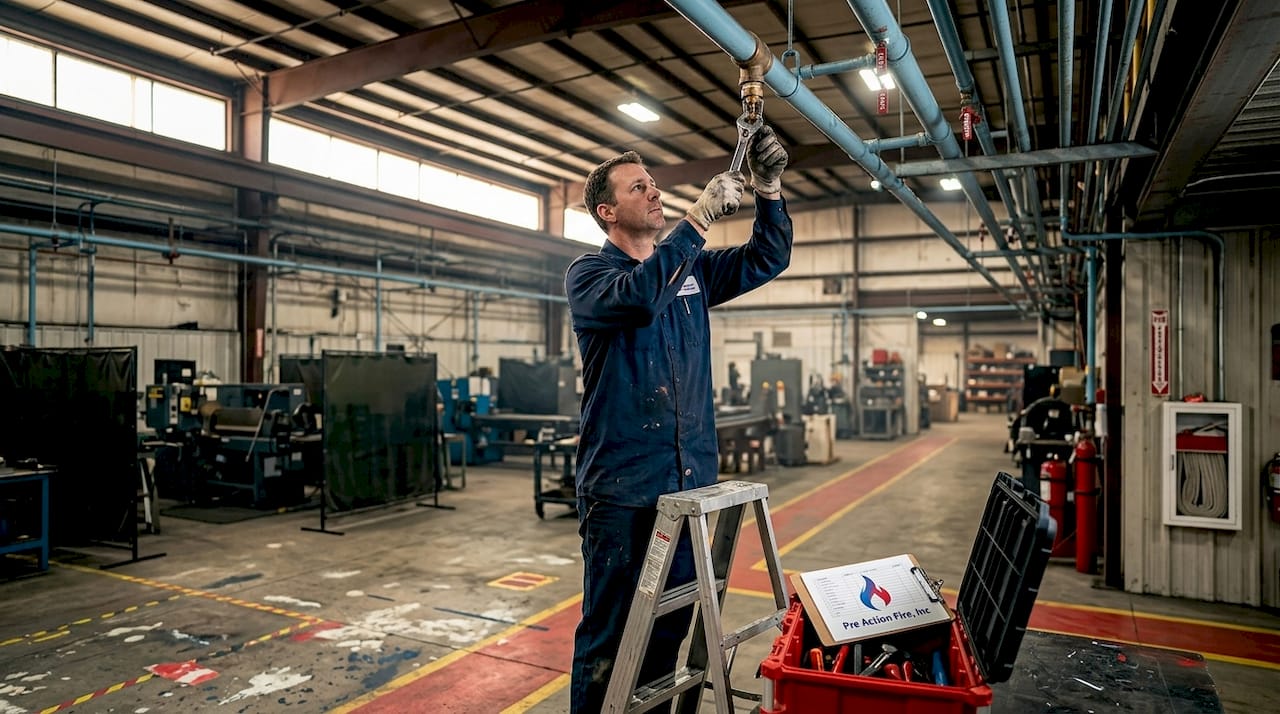
Portable fire extinguishers: OSHA’s 29 CFR 1910.157 governs portable fire extinguishers for employee use in workplace settings, including placement, maintenance, and inspection requirements. Importantly, OSHA does allow certain exceptions when a facility has a documented emergency action plan and fire prevention plan that direct employees to evacuate rather than fight fires. However, if extinguishers are provided for employee use at all, full compliance with OSHA 1910.157 is mandatory. Understanding fire extinguisher types matters here because different fire classes require different agents, and placing the wrong type in the wrong location is itself a code violation.
Fire alarm and notification systems: Industrial facilities above certain size thresholds or housing hazardous materials must have automatic fire detection tied to a monitored notification system. The system must be designed per NFPA 72, which governs detection technologies, signal transmission, and notification appliance placement. Audibility and visual strobe requirements are stricter in high-noise industrial environments.
Automatic sprinkler systems: NFPA 13 governs sprinkler installation in industrial and commercial settings. Requirements vary significantly based on building height, occupancy hazard classification (light, ordinary, extra), and commodity type for storage occupancies. A building that was once code-compliant can fall out of compliance simply by changing what it stores.
Hazardous materials and special operations: Facilities handling flammable liquids, compressed gases, or reactive chemicals must comply with additional NFPA standards (NFPA 30, NFPA 55, NFPA 400) and often require separate permit applications and operational inspections.
| System | Governing standard | Key trigger | Common violation |
|---|---|---|---|
| Portable extinguishers | OSHA 1910.157 / NFPA 10 | Workplace hazard present | Missing monthly inspections, wrong rating |
| Fire alarm/detection | NFPA 72 | Occupancy type and size | Gaps in coverage, outdated devices |
| Sprinkler suppression | NFPA 13 | Occupancy hazard classification | Incorrect head type, storage changes |
| Hazmat storage | NFPA 30 / NFPA 400 | Type and quantity of material | Improper segregation, ventilation failures |
Pro Tip: Document your emergency action plan and fire prevention plan formally, even if you aren’t required to. These documents can qualify your facility for code flexibilities, demonstrate good-faith compliance to inspectors, and provide the structure your team needs when an incident actually happens. Prioritizing fire safety in documentation is as important as the physical systems themselves.
Navigating complex risk areas: Storage heights and code interpretation challenges
Warehouses and distribution centers face some of the most nuanced fire code compliance challenges in the industrial sector. The problem isn’t that the standards are unclear in isolation. It’s that multiple standards apply simultaneously, and they must be read together to determine what your specific operation actually requires.
High-piled storage occupancies are a prime example. Commodity classification and storage parameters drive which sprinkler and storage requirements apply, and codes and standards must be interpreted together rather than in isolation. This means the model fire code and the sprinkler installation standard (NFPA 13) are both in play, and sometimes their provisions don’t align cleanly.
Here’s what makes high-piled storage particularly complex:
- Commodity class matters more than storage height alone. A facility storing Class IV commodities (items with plastic or combustible packaging) triggers more demanding sprinkler requirements at lower heights than one storing Class I materials like non-combustible products.
- Rack storage vs. floor storage uses different rules. Rack storage generates faster fire spread due to flue spaces between pallets, requiring in-rack sprinklers in many configurations that floor storage wouldn’t need.
- Operational changes void old compliance. Switching from a single product category to mixed commodity storage, changing rack configurations, or increasing maximum storage height all potentially require a new sprinkler system design review.
“The facility that was compliant last year may not be compliant today, simply because the operational team changed what they store and how high they stack it.”
Questions every industrial manager should be able to answer (and ask their fire protection consultant or AHJ):
- What is the current commodity classification for everything we store?
- What is our maximum permitted storage height under the current sprinkler design?
- Does our sprinkler system design match our actual storage configuration today?
- Have we changed materials, rack layouts, or ceiling heights since our last formal review?
Keeping your sprinkler best practices documentation current, including the original design basis and any modifications, is essential for answering these questions quickly when an inspector shows up.
Steps to ensure compliance and prepare for inspections
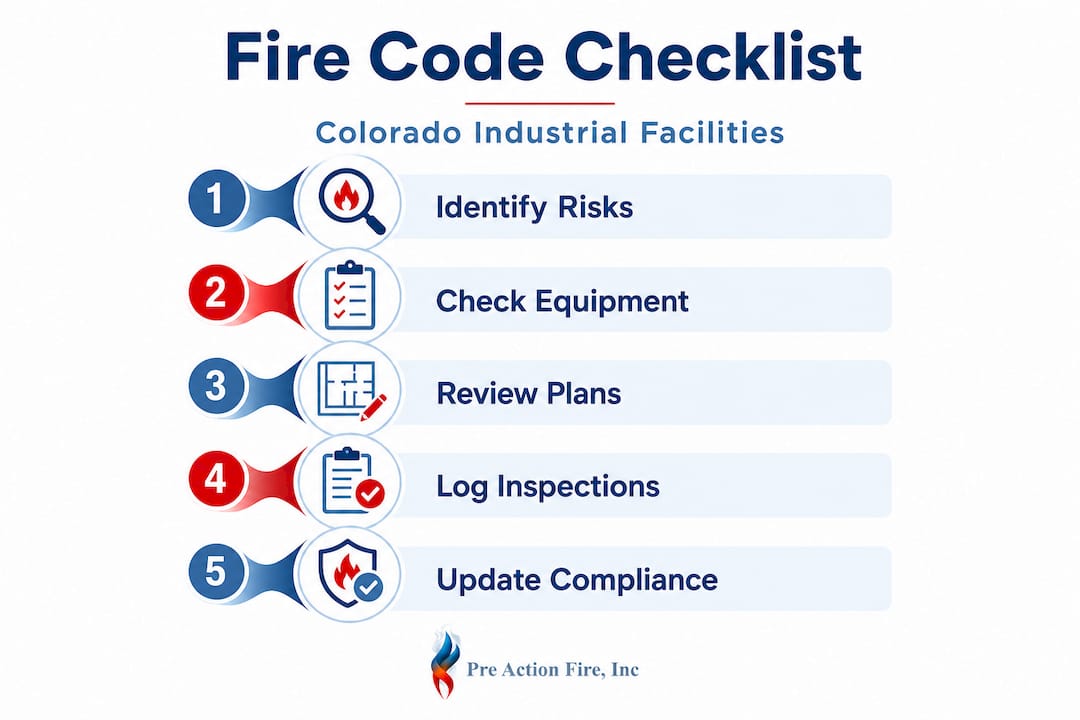
Compliance isn’t a one-time event. It’s an ongoing operational discipline. Here are the concrete steps that separate facilities that sail through inspections from those that face citations and shutdown orders:
- Conduct a self-inspection using current local codes. Pull the applicable local amendment schedule and go through each requirement systematically. Don’t rely on memory or the last formal inspection report.
- Verify all permits are current. Fire suppression systems, alarm systems, and hazardous materials storage often require separate operational permits that must be renewed periodically.
- Audit maintenance records. Monthly extinguisher inspections, annual sprinkler system inspections, and quarterly alarm tests all generate records that inspectors will check. Gaps in records are treated as missed maintenance, even if the work was done.
- Review and update emergency plans. Your emergency action plan and fire prevention plan should reflect your current operations, headcount, and layout. A plan written for 40 employees doesn’t adequately cover a facility now operating with 150.
- Train staff on fire safety devices and procedures. OSHA and NFPA both require documented training for employees who may use extinguishers or respond to alarms. Training records must be retained.
- Schedule formal inspections proactively. Don’t wait for the fire marshal to show up. Proactive inspections by a qualified third party let you find and fix issues before they become official citations.
Use our NFPA inspection guide to structure your internal review process and make sure you’re aligned with current standards. For facilities with storage areas, reviewing warehouse safety tips specific to Denver and Colorado operations is a practical starting point.
Pro Tip: Build a compliance calendar that ties specific tasks (monthly extinguisher checks, quarterly alarm tests, annual sprinkler inspections) to the people responsible for completing them. When a task is someone’s explicit job, it actually gets done.
What most guides miss about fire safety standards
Here’s something most compliance guides won’t tell you: the majority of fire code violations we see aren’t from facility managers who don’t care. They come from facilities that checked the boxes once, certified everything was fine, and then moved on while their operations quietly changed around them.
Industrial operations are dynamic. You add a production line. You change your storage product mix. You hire a new contractor who routes conduit through a sprinkler zone without understanding the implications. None of these people had any intention of creating a compliance problem. But intention doesn’t matter when there’s an incident.
The uncomfortable truth is that checklist compliance is a starting point, not a destination. A checklist tells you what the system looked like on the day someone walked through. It tells you nothing about whether that system is still matched to your current operational risk profile.
What actually works long-term is building a safety mindset into daily operations and involving frontline supervisors and workers in identifying changes before those changes become compliance gaps. The person loading the dock every day knows when storage configurations shift. The maintenance tech knows when a sprinkler head gets painted over. Tapping into that frontline awareness is more valuable than any annual inspection.
We’ve seen this firsthand working on new construction safety projects and retrofit upgrades alike. The facilities with the strongest safety records treat their fire protection systems as living parts of the operation, not fixed infrastructure to occasionally check on.
Regular expert review, at least annually and any time operations change significantly, is the only way to keep pace with both evolving standards and evolving operations.
Fire safety solutions and next steps for Colorado businesses
Industrial fire safety compliance requires expertise across multiple systems, and getting it right matters too much to piece together on your own.
Pre Action Fire, Inc has served the Denver Metro Area since 2009, working with industrial facilities, warehouses, and commercial properties to design, install, inspect, and maintain code-compliant fire protection systems. Our NICET-certified technicians understand both the national standards and Colorado’s specific local amendments, so your facility stays protected and compliant as both operations and codes evolve.
Whether you need support with fire alarm system compliance, a full sprinkler system installation or design review for a changing warehouse operation, or a full audit of your fire extinguisher solutions and placement, our team can help. Contact us today for a consultation and take the guesswork out of your compliance obligations.
Frequently asked questions
What is the most widely recognized industrial fire safety standard?
The NFPA publishes the most widely adopted fire safety codes for industrial settings, which form the basis of many local regulations across Colorado and the rest of the country.
Who enforces fire safety standards for industrial facilities in Colorado?
Local fire departments and authorities having jurisdiction (AHJ) enforce fire codes that incorporate both national standards and city-specific amendments for industrial facilities.
Are fire extinguishers always required in industrial workplaces?
Portable fire extinguishers are typically required unless the facility meets specific OSHA exemptions involving documented emergency action and fire prevention plans directing employees to evacuate.
What triggers sprinkler requirements in Colorado warehouses?
Sprinkler requirements are triggered by commodity classification and storage parameters, meaning the type and height of goods stored drives which system requirements apply under both the fire code and NFPA 13.
How often must industrial facilities in Colorado be inspected for fire safety?
Inspection frequency depends on local ordinances, occupancy type, and operational risk level, but annual formal inspections are standard for most industrial facilities, with some systems requiring quarterly or monthly checks.