
TL;DR:
- Failure to obtain proper permits and early coordination with Denver’s Fire Department can cause costly delays and non-compliance.
- A thorough site survey, appropriate system selection, and phased planning help minimize disruptions and ensure code adherence.
- Early engagement with AHJ officials and detailed documentation are critical to completing a compliant and efficient fire alarm retrofit.
Picture this: your facility manager just started a fire alarm retrofit without a permit. Two weeks in, the city issues a stop-work order. Your emergency fire watch costs $800 per day. Your tenants are restless. And the re-inspection queue stretches another three weeks out. This is not a hypothetical — it’s a pattern we see repeatedly across commercial properties throughout the Denver Metro Area. Planning a custom fire system setup requires more than picking the right hardware. It demands a thorough understanding of local permit rules, a site-specific design strategy, and a phased execution plan that keeps your building operational throughout the process.
Table of Contents
- Understand Denver fire code requirements
- Prepare your site for a custom installation
- Step-by-step: Custom fire system setup and installation
- Verification, troubleshooting, and ongoing compliance
- The overlooked realities of custom fire setups in Denver
- Get expert help for your Denver fire system upgrade
- Frequently asked questions
Key Takeaways
| Point | Details |
|---|---|
| Know your permit requirements | Always check Denver’s fire code and apply for permits before modifying fire alarm systems. |
| Match system type to your needs | Choosing wireless or hybrid fire detection can minimize downtime and operational costs during retrofits. |
| Coordinate closely with authorities | Work with the AHJ early to clarify rules, speed approvals, and avoid costly project setbacks. |
| Plan for ongoing compliance | Schedule inspections and keep up with local code changes to protect your property and occupants. |
Understand Denver fire code requirements
With the risks clear, the first step is knowing exactly what Denver requires from both a technical and a legal standpoint.
The 2025 Denver Fire Code governs virtually every aspect of fire alarm and detection system installation and modification in commercial properties. One of the most important things to understand: construction permits are required before any fire alarm or detection system is installed or modified. That means no preliminary wiring, no panel swaps, no detector placements before the permit is in hand — period.
The code also identifies specific triggers that require full permitting. These include new system installations, significant modifications to existing alarm zones, panel replacements, and adding detection coverage to previously unprotected areas. Even upgrading from an older system to an addressable panel can trigger a permit review. It is critical to understand Denver fire alarm regulations before scoping your project, because the permit pathway you choose will affect your timeline by weeks.
Standard vs. emergency permitting
Denver offers two main permitting routes for fire system work.
| Permit pathway | When it applies | Key deadline |
|---|---|---|
| Standard construction permit | All planned installations and modifications | Before work begins |
| Emergency permit exception | Life-safety emergencies requiring immediate work | Notify city within 2 business days; full application within 10 business days |
| After-the-fact permit | Work completed without prior approval | Subject to full review and potential penalties |
The emergency path is narrow. It is not a loophole for skipping paperwork — it exists for genuine life-safety situations where waiting for a standard permit would create immediate danger. If you use it outside that narrow window, you risk fines and mandatory removal of installed equipment.
“Facilities that coordinate with the Authority Having Jurisdiction early in the planning process consistently experience fewer delays and lower total project costs than those that treat the AHJ as a final-step checkpoint.” — Industry observation from NICET-certified fire protection engineers
The Authority Having Jurisdiction (AHJ) in Denver is the Denver Fire Department. Contacting them during your design phase, not after, is the single most effective step you can take to streamline your project. They can flag code interpretations specific to your occupancy type and confirm whether your proposed system design meets local adoption standards before you invest in materials or subcontractors.
For deeper context on how fire alarm system compliance works specifically for Denver businesses, the technical requirements extend beyond basic permitting to include zoning, notification device placement, and documentation standards that vary by building use.
Prepare your site for a custom installation
With codes and permit pathways clear, it’s vital to translate requirements into an actionable facility plan.
Before any design work begins, you need a thorough site survey. This is not just a walkthrough. It is a systematic assessment of every factor that will influence your system design, your budget, and your construction schedule.
Site survey checklist:
- Floor plan review: current detector locations, panel placement, and alarm zone boundaries
- Structural analysis: ceiling type, wall construction, and conduit routing options
- Occupancy classification: what activities occur in each zone and how they affect hazard ratings
- Existing system condition: age, compatibility, and whether components can be reused
- Power supply review: available circuits, backup battery capacity, and load calculations
- Communication pathways: monitoring connection types and network infrastructure
Once you have this data, you can make an informed decision about system type. This is where many facility managers get it wrong — they default to a full wired replacement without evaluating alternatives. Wireless or hybrid detection during retrofits is often driven by downtime and disruption costs rather than pure technical preference. In an occupied office tower or a functioning warehouse, cutting through walls for new conduit runs creates real business interruption costs that easily outpace the premium on wireless components.
| System type | Best for | Trade-offs |
|---|---|---|
| Fully wired | New construction or gut renovations | Lowest long-term cost; high upfront disruption |
| Fully wireless | Historic buildings, occupied retrofits | Lower disruption; higher component cost |
| Hybrid wired/wireless | Mixed-use or phased upgrades | Flexible staging; requires careful panel integration |
Vendor coordination matters significantly during this phase. Your fire protection contractor needs to align with your general contractor, your electrician, and any tenant coordination schedules. Material lead times for addressable panels and specialty detectors can run four to eight weeks in current supply chains, so locking in procurement early prevents costly schedule gaps.
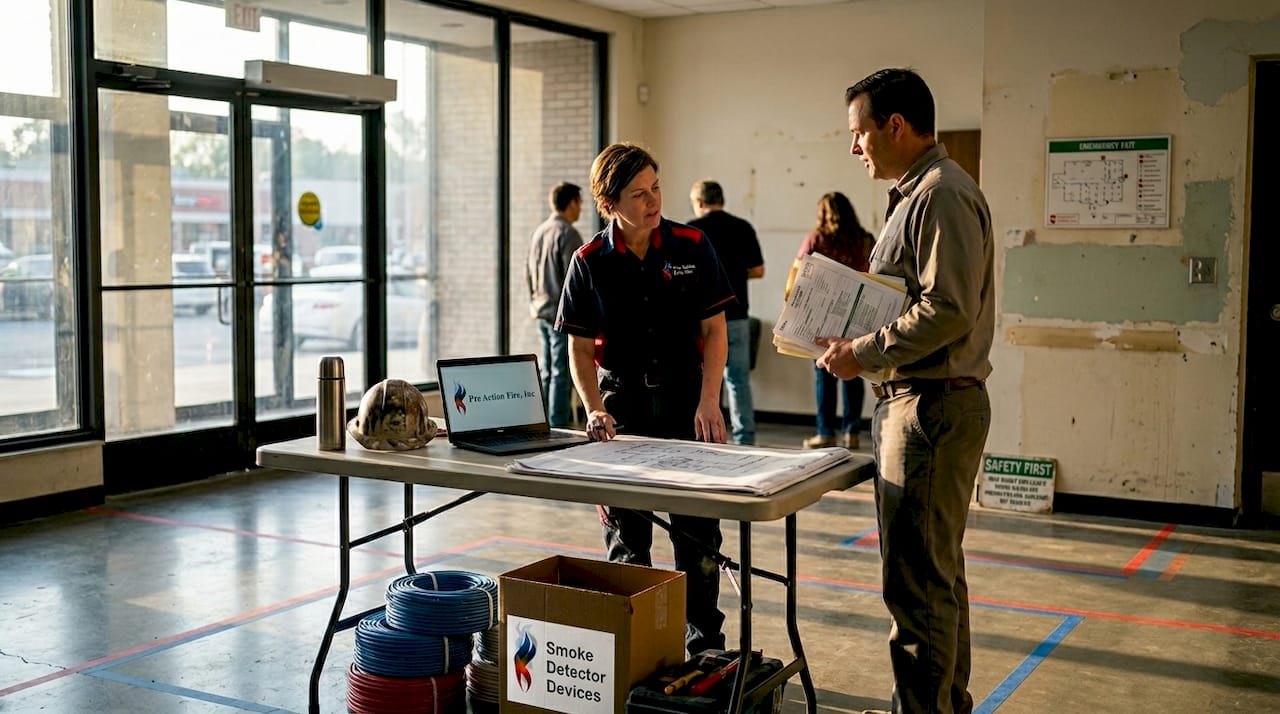
For facilities with complex panel requirements, understanding fire alarm control panel compliance in Denver provides critical guidance on panel selection, programming requirements, and documentation that inspectors will review. Similarly, your notification device compliance plan, covering strobes, horns, and speaker placement, must meet NFPA 72 spacing standards and ADA audibility requirements for every occupiable space.
Pro Tip: Create a risk zone map for your facility before finalizing your design. Identify which areas have the highest fire load, the most occupants, and the longest evacuation paths. Use this map to prioritize detector placement and ensure your system design addresses the highest-risk areas first, not just the easiest ones to wire.
Step-by-step: Custom fire system setup and installation
Once you’ve set your requirements and chosen the right technology, you’re ready to manage installation. Here’s how to execute efficiently and safely.
Step 1: Submit your permit application. Prepare a complete submittal package including system drawings, equipment cut sheets, load calculations, and occupancy documentation. Incomplete submittals are the leading cause of permit delays. Allow two to three weeks for standard review in Denver.
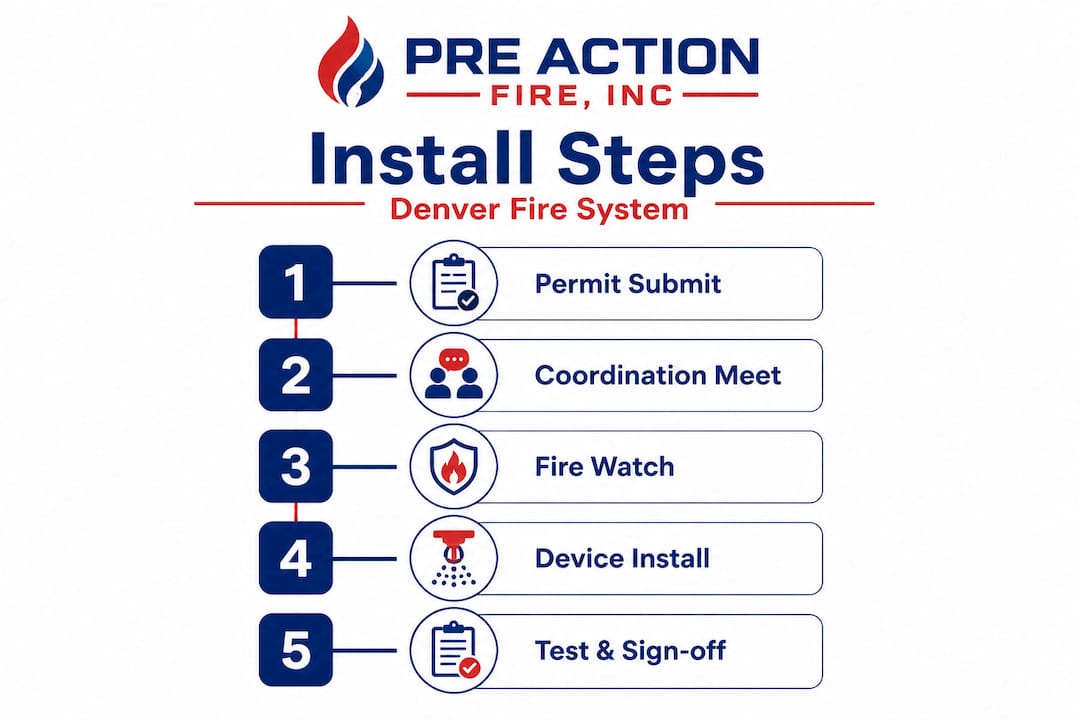
Step 2: Pre-construction coordination meeting. Before any work starts, hold a meeting with your fire protection contractor, general contractor, electrical subcontractor, and your AHJ contact if possible. Align on sequencing, access requirements, and temporary protection measures.
Step 3: Establish temporary fire watch procedures. If your existing system must go offline during installation, you are legally required to implement a fire watch. This means trained personnel patrolling affected areas continuously. The cost adds up fast, so minimize the offline windows through careful phasing.
Step 4: Rough-in and device installation. This is the physical work: conduit runs, wire pulls, device mounting, and panel installation. For phased projects, complete one zone at a time and restore that zone to full service before moving to the next.
Step 5: Panel programming and point-to-point testing. Every addressable device must be programmed to its correct address, zone, and response protocol. Point-to-point testing verifies that each device communicates correctly with the panel before any partial system is restored.
Step 6: System commissioning. Full system commissioning includes functional testing of every initiating device, notification appliance, and supervisory signal. This is the final internal verification before you request an AHJ inspection.
Step 7: AHJ final inspection and certificate of occupancy. Schedule your inspection only after commissioning is complete and documented. Have all permit documents, as-built drawings, and test records on site for the inspector.
“In live-occupancy properties, the economics of downtime can make wireless and phased strategies far preferable to full rewiring — the fire watch and restoration logistics alone can consume a significant portion of your project budget.”
A common mistake at this stage is underestimating restoration time after the work is done. Patching walls, repainting, and cleaning up conduit debris takes time that doesn’t show up in most contractor bids. Build it into your schedule. Your building’s emergency fire protection obligations don’t pause during a renovation, which makes tight phasing and realistic scheduling non-negotiable.
If issues appear during commissioning, consult a detailed fire alarm troubleshooting guide to diagnose wiring faults, address conflicts, and panel communication errors before they become inspection failures.
Verification, troubleshooting, and ongoing compliance
Your installation is in place, but the job isn’t finished until your system is fully compliant and operating smoothly.
Final inspection success depends on preparation, not luck. Inspectors arrive with a checklist covering system documentation, panel labeling, zone maps, test records, and notification device coverage. If any of these are incomplete or inconsistent with your permit submittal, the inspection fails and you start the scheduling queue over again.
What inspectors check during final review:
- As-built drawings that match field conditions
- Labeled circuit breakers and panel directories
- Battery backup calculations and load test results
- Alarm zone maps posted near the fire alarm control panel
- Signal verification for every detector and pull station
- Notification device coverage and decibel measurements in required areas
- Monitoring service certificate and central station connection test
Tracking post-installation issues is equally important. The most common problems in the first 90 days after a commercial fire system installation include:
| Common issue | Likely cause | Resolution |
|---|---|---|
| Nuisance alarms | Detector sensitivity misconfiguration | Reprogram or replace head |
| Supervision faults | Loose wire connections or end-of-line resistor errors | Physical inspection of all terminations |
| Communication failure | Monitoring network configuration error | Coordinate with monitoring provider |
| Ground faults | Insulation damage during rough-in | Wire-by-wire fault isolation |
Per the 2025 Denver Fire Code, the local adoption schedule matters because Denver can and does amend base NFPA standards. Coordinating with the AHJ on code interpretation questions before your inspection protects you from surprises on inspection day.
Ongoing compliance is not a one-time event. Set a calendar for scheduled fire safety inspections based on Denver’s required frequency for your occupancy type, typically annually for most commercial properties. Subscribe to code update notifications so that system modifications required by future code adoptions don’t catch you unprepared.
The overlooked realities of custom fire setups in Denver
Most articles in this space walk you through code sections and installation steps. Few of them say plainly what seasoned fire protection professionals see regularly: the planning phase is where most Denver commercial properties either win or lose on compliance.
We have worked with facility managers who made technically correct hardware decisions but still ended up with failed inspections, extended fire watch bills, and frustrated tenants because the sequencing of their project was wrong. They chose the right panel, bought the right detectors, hired licensed contractors — and still faced a three-week delay because nobody contacted the AHJ before the submittal was filed, and the reviewer flagged a documentation inconsistency that took two rounds of corrections to resolve.
The hidden costs that rarely appear in project budgets include fire watch labor, tenant notifications, temporary alarm system monitoring during the transition period, and the staff time spent managing inspector scheduling. In a mid-size commercial building with multiple tenants, these costs can easily reach $15,000 to $30,000 on a project that was originally budgeted at $80,000 for hardware and labor alone.
One pattern we see repeatedly: a property owner scopes a system upgrade based on hardware pricing alone, approves a bid, and only discovers during permitting that their building’s occupancy classification requires a full voice evacuation system rather than a basic horn/strobe configuration. That single code detail can double the equipment cost and add four to six weeks to the schedule.
The economics of downtime in live-occupancy buildings are what truly drive the best upgrade strategies. Wireless and phased approaches cost more per device, but when you factor in fire watch hours, tenant disruption, and the reputational cost of a visibly compromised building, the math often flips completely in their favor.
For property owners considering new construction as well as retrofits, early integration of fire protection planning into the architectural and MEP design phases prevents the costly mid-construction design changes that drive up both budget and schedule.
The professionals who get these projects right aren’t just technically skilled. They start AHJ conversations months before permits are filed, build downtime modeling into their proposals, and treat the coordination work as just as important as the installation work itself.
Get expert help for your Denver fire system upgrade
Navigating custom fire system requirements in Denver is genuinely complex, and the margin for error is low when permit delays, fire watch costs, and code violations are on the table.
Pre Action Fire, Inc. has been designing, installing, and maintaining custom fire alarm system solutions for commercial properties across the Denver Metro Area since 2009. Our NICET-certified technicians handle everything from permit submittals to AHJ coordination, phased installation planning, and final commissioning. We also provide sprinkler installation guidance to ensure your suppression systems meet Denver’s current code standards alongside your alarm system. When you work with a team that already knows how Denver’s AHJ reviews submittals and what inspectors prioritize, your project moves faster and costs less. Contact Pre Action Fire today to schedule a site assessment and get a project roadmap built around your facility’s specific compliance needs.
Frequently asked questions
What permits are required for new fire system installations in Denver?
A construction permit is required before installing or modifying fire alarm and detection systems under the 2025 Denver Fire Code. Work cannot legally begin until this permit is issued.
How do I choose between wireless, hybrid, or wired fire alarm systems for a retrofit?
Consider downtime costs and operational disruptions first — wireless or hybrid systems often minimize closures compared to wired retrofits in occupied buildings. The right choice depends on your building’s structure, occupancy, and tolerance for disruption.
What’s the emergency permitting process for fire system work in Denver?
If emergency work is started due to a genuine life-safety situation, you must notify the city within two business days and submit a full permit application within ten business days. This path is not available for planned upgrades.
What are common mistakes during custom fire system setup?
Missing permit deadlines, skipping early AHJ coordination, and failing to plan for downtime and fire watch costs are the most frequent and costly mistakes facility managers make during custom fire system projects.
How can I ensure ongoing compliance after installation?
Schedule annual inspections and monitor Denver Fire Code updates to confirm your system remains current with any local amendments. Keep all as-built documentation and test records readily accessible for inspection reviews.