

TL;DR:
- Colorado’s decentralized fire codes require property managers to verify local amendments and collaborate early with fire authorities. The new Wildfire Resiliency Code mandates ignition-resistant construction in WUI zones, with stringent standards and compliance thresholds for repairs exceeding 25% of structure value. Proper documentation and proactive coordination are essential for navigating inspections, minimizing delays, and maintaining legal and insurance compliance.
Colorado fire codes are not a monolith. For commercial and industrial property managers, knowing how to comply with Colorado fire codes means operating in a state where every jurisdiction can write its own rules, where a new statewide wildfire code just reshaped construction requirements, and where the cost of getting it wrong ranges from inspection failures to uninsurable losses. This guide breaks down the full compliance picture, from understanding Colorado’s decentralized code framework and the Colorado Wildfire Resiliency Code (CWRC), to the step-by-step process for getting your property through inspections and keeping documentation audit-ready.
Table of Contents
- Key takeaways
- How to comply with Colorado fire codes: the framework first
- Colorado Wildfire Resiliency Code: what property managers must know
- Step-by-step compliance guide for commercial properties
- Common pitfalls and how to avoid them
- Verifying and documenting compliance
- My take on navigating Colorado’s fire codes
- How Preactionfire supports your compliance goals
- FAQ
Key takeaways
| Point | Details |
|---|---|
| Home rule complicates compliance | Colorado has no single statewide fire code; verify local amendments and consult your AHJ before finalizing any plans. |
| CWRC changes WUI construction rules | New construction and major repairs in wildfire-prone zones must meet ignition-resistant material and structural standards by April 2026. |
| Early fire marshal engagement is critical | Consulting local fire marshals before design lock-in prevents costly redesigns and approval delays. |
| Documentation protects your investment | Permits, inspection reports, and system test records are required for legal compliance, insurance claims, and future audits. |
| Sprinkler thresholds vary by jurisdiction | Local Colorado amendments often require sprinklers at lower occupancy thresholds than the base International Fire Code specifies. |
How to comply with Colorado fire codes: the framework first
Before you can follow the rules, you need to know which rules apply. Colorado is a home rule state with no single mandatory statewide fire code. That means Denver, Aurora, Boulder, and a rural county outside Fort Collins can each adopt, amend, and enforce fire codes independently. The International Building Code (IBC) and International Fire Code (IFC) serve as the baseline references most jurisdictions start from, but local amendments frequently push requirements stricter in ways that can catch property managers off guard.
Your first move on any project is identifying the Authority Having Jurisdiction (AHJ). That is the local fire marshal or code enforcement office whose interpretation is legally binding for your specific address. Two properties on opposite sides of a city line may face different sprinkler thresholds, different fire-lane width requirements, and different materials approval processes.
Local amendments are not minor footnotes. They commonly modify:
- Automatic sprinkler system trigger thresholds (often lower than base IFC)
- Fire apparatus access road widths and turning radii
- Fire hydrant placement and water supply flow rates
- Emergency responder communication system requirements
- Occupancy load and egress width calculations
Zoning and land-use codes can also impose restrictions that go beyond what building and fire codes require. Height limits, building envelope rules, and fire-lane easements defined in a zoning ordinance can shape your fire protection design just as much as the IFC itself. Reconciling these overlapping systems early prevents expensive surprises.
Pro Tip: Request a pre-application meeting with both the local fire marshal and the planning department simultaneously. Getting conflicting code interpretations on the table before design work begins saves far more money than the time that meeting costs.
Colorado Wildfire Resiliency Code: what property managers must know
The CWRC is the most significant change to colorado building fire codes in recent memory. It represents a statewide minimum standard for wildfire-resistant construction, specifically targeting properties in Wildland-Urban Interface (WUI) zones where development meets fire-prone vegetation.
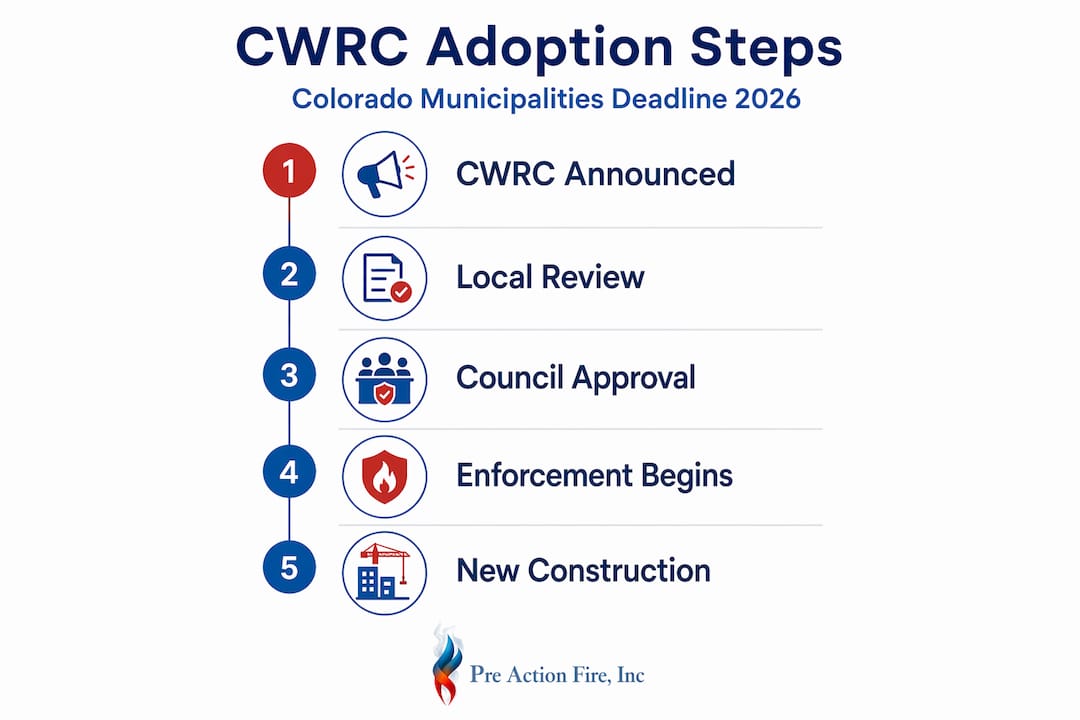
All Colorado municipalities and counties must adopt the CWRC by April 1, 2026 for new construction and additions over 500 square feet within designated WUI areas. The code classifies fire risk into two tiers:
| Feature | Class 1 (Moderate Risk) | Class 2 (High Risk) |
|---|---|---|
| Roofing | Class A fire-rated assembly required | Class A fire-rated assembly required |
| Exterior walls | Noncombustible or ignition-resistant | Noncombustible or fire-retardant-treated |
| Vents and gutters | Ember-resistant vent screens | Noncombustible gutters and ember-resistant vents |
| Glazing | Tempered or multilayer safety glass | Tempered or multilayer safety glass |
| Decks and projections | Ignition-resistant materials | Noncombustible materials only |
The CWRC was developed around evolving fire science focused on ember ignition, not just direct flame contact. Embers traveling ahead of a fire front are the primary cause of structure ignition in WUI zones, which is why vent screens and soffit details matter as much as roofing materials.
Material selection under the CWRC carries real budget implications. Fiber cement siding meets Class 2 requirements with less complexity than alternatives. Fire-retardant-treated wood technically complies but adds ongoing maintenance cost and requires careful documentation of treatment certification. Vinyl cladding over a rated assembly is technically allowed but creates verification headaches during inspection.

For existing commercial structures, the trigger is repairs or alterations that exceed 25% of the structure’s assessed value. When repairs exceed 25% of structure value, the entire building envelope must be brought into CWRC compliance. That threshold is especially relevant after wildfire damage, where insurance-funded repairs could inadvertently push a structure into full code upgrade territory.
Pro Tip: Before accepting an insurance settlement on a WUI property, calculate whether the repair scope will exceed the 25% threshold. A slightly smaller first-phase repair may let you stage compliance upgrades on your own timeline rather than absorbing them all in one project.
Step-by-step compliance guide for commercial properties
Getting from code confusion to a signed certificate of occupancy requires a structured process. Here is how experienced property managers execute it without costly backtracking.
-
Identify your jurisdiction’s active code version. Contact the local building department and fire marshal’s office to confirm which edition of the IBC and IFC is currently adopted, and request a list of local amendments. Do not assume the base model codes apply without modification.
-
Determine WUI designation. Check with the county assessor or planning department whether your property falls within a designated Wildland-Urban Interface zone. If it does, CWRC compliance is mandatory for new construction or qualifying alterations.
-
Engage the fire marshal before design is finalized. Local fire marshal collaboration at the pre-design phase prevents plan revisions that cost significantly more once drawings are complete. Ask specifically about apparatus access, hydrant flow requirements, and any local occupancy-specific rules.
-
Select compliant materials and fire protection systems. For sprinkler systems and fire alarm design, Colorado requires NICET-certified designers whose plans must pass fire marshal review. This is not optional and not something an architect alone can cover. Automatic sprinkler requirements vary by occupancy class and local amendments, so confirm thresholds with your AHJ rather than relying on the base IFC.
-
Submit for plan review with complete documentation. Plans should include fire protection system drawings, materials specifications, site access layouts, and hydrant placement. Incomplete submittals are the single most common cause of plan review delays.
-
Coordinate site design for apparatus access. Improper site design is a leading cause of noncompliance citations. Confirm fire lane widths, turning radii, and overhead clearance with the fire department before finalizing civil drawings.
-
Schedule and pass inspections in sequence. Most jurisdictions require rough-in inspections before covering walls and a final system acceptance test for sprinklers and alarms. Missing an interim inspection often requires destructive investigation later.
-
Maintain defensible space for WUI properties. Even after construction approval, Colorado fire prevention guidelines require ongoing vegetation management within defined distances from the structure. This is an operational requirement, not just a one-time construction task.
Common pitfalls and how to avoid them
Compliance failures in Colorado rarely come from ignoring fire codes entirely. They come from misreading which codes apply and how they interact.
-
Relying solely on base I-Codes. The IBC and IFC are starting points, not the final word. Local amendments frequently add sprinkler requirements, tighten egress rules, and change materials standards. A property manager who designs to national model codes without checking local amendments will fail plan review.
-
Underestimating fire apparatus access requirements. Fire department site approvals cover apparatus access roads, hydrant placement, and fire lanes. These must be reviewed by the fire marshal early in the site planning process, not after civil drawings are complete.
-
Missing WUI thresholds on renovation projects. Property managers sometimes approve repair contracts without checking whether cumulative scope crosses the 25% value threshold that triggers full CWRC compliance. Track repair costs as a percentage of assessed value across all active projects.
-
Inadequate materials documentation. For CWRC compliance, inspectors need manufacturer certification, installation instructions, and third-party test data for every rated assembly. Showing up with materials on site but no documentation is a fast path to a failed inspection and reorder delays.
-
Ignoring zoning and fire code conflicts. Local zoning ordinances can supersede fire codes in ways that create design constraints not visible in the fire code alone. Always review both in parallel.
Pro Tip: Designate a single internal contact person for all AHJ communication. Fragmented coordination where a contractor calls the fire marshal and your engineer calls the building department separately creates contradictory direction that delays projects and creates liability.
Verifying and documenting compliance
Passing an inspection is one thing. Maintaining proof of compliance for insurance audits, future sales, and periodic reinspections is an entirely different discipline. Good record-keeping enables smoother audits and is legally required in most jurisdictions.
Here is the documentation framework every commercial property manager should maintain:
-
Permit file. Keep original building and fire permits, all plan review correspondence, and any approved variances or modifications in a single accessible folder per project.
-
Inspection reports. Retain every inspection record, including failed inspections and correction notices. Inspectors and insurance adjusters want to see a complete history, not a curated one.
-
Fire protection system test records. Annual sprinkler inspections, alarm system functional tests, and fire extinguisher service tags all need dated records. Many jurisdictions require these to be available on-site, not just in an off-site archive.
-
Materials certifications. For CWRC projects, file manufacturer data sheets, third-party test reports, and installation compliance letters for every rated assembly in the building envelope.
-
Reinspection schedule. Build a calendar for required periodic inspections. Fire suppression systems typically require annual testing; some alarm components require quarterly checks. Missing a reinspection can trigger violation notices even if the system is functioning correctly.
Good compliance documentation also has direct financial value. Well-organized fire safety records support better risk management for insurance claims and can reduce commercial property premiums. Document the fact of compliance, not just the existence of systems.
My take on navigating Colorado’s fire codes
I’ve seen more commercial projects delayed by code confusion than by actual construction problems. The assumption that the IBC is the IBC regardless of where you build in Colorado causes expensive mid-project pivots more often than any other single mistake.
What I’ve learned after years of working with Colorado property managers and fire protection systems is that the property managers who do this best treat the AHJ as a project resource rather than a gatekeeper. They schedule meetings before drawings go out. They ask the fire marshal what the last three projects in their category got wrong. That intelligence is free, and it saves real money.
The other thing most articles get wrong: zoning codes and fire codes are treated as separate departments, but they are the same problem for your site plan. I’ve watched projects where fire apparatus access was compliant under the IFC but blocked by a zoning setback. That kind of conflict does not surface until someone actually looks at both documents side by side.
My honest advice is to treat colorado fire safety regulations as a risk management framework, not a compliance checklist. The property managers who get ahead are the ones who build compliance into their acquisition due diligence, their renovation budgets, and their annual operating calendars. Not the ones who scramble when an inspection is scheduled.
— Preactionfire
How Preactionfire supports your compliance goals
Preactionfire has served Denver Metro commercial and industrial clients since 2009, and fire code compliance is the foundation of everything we do. Our NICET-certified technicians understand local amendments across Denver, Arvada, Aurora, and surrounding jurisdictions, which means we do not hand you a generic solution and walk away. Whether you need a fire alarm system designed and installed to meet your specific AHJ’s requirements, a sprinkler system inspection that produces the documentation your insurer actually needs, or a full code compliance review before breaking ground on a WUI property, Preactionfire brings the technical depth and local knowledge to get it right the first time. Contact us to schedule a consultation and get a compliance plan built around your property’s actual code requirements.
FAQ
What codes govern commercial fire safety in Colorado?
Colorado jurisdictions most commonly adopt the International Building Code and International Fire Code as base references, then add local amendments. Because Colorado is a home rule state, there is no single mandatory statewide commercial fire code outside of the new CWRC for WUI areas.
When does the CWRC apply to existing commercial buildings?
The CWRC applies to existing structures in designated WUI zones when repairs or alterations exceed 25% of the building’s assessed value, requiring the entire envelope to be upgraded to current fire-resistant standards.
Who has authority to interpret Colorado fire codes?
The local AHJ, typically the city or county fire marshal, has final interpretive authority over fire code requirements. Their determination overrides the base model code where local amendments exist.
Do commercial buildings in Colorado require sprinkler systems?
Most commercial buildings in Colorado require automatic sprinklers under the IBC and local amendments, but the specific threshold varies by jurisdiction and occupancy type. Local amendments frequently require sprinklers at lower thresholds than the base IFC specifies.
What documentation should property managers keep for fire code compliance?
Property managers should retain permits, plan review correspondence, inspection reports, fire protection system test records, materials certifications, and a current reinspection schedule. This documentation supports insurance claims, audits, and future permit applications.