
TL;DR:
- Facility managers often overlook that fire alarm zones require continuous updates to ensure safety and compliance. Accurate zoning helps first responders quickly locate fires, facilitates targeted evacuation, and reduces liability risks. Regularly reviewing, updating, and physically posting zone maps are essential practices to maintain effective fire protection systems.
Most facility managers assume fire alarm zones are just labeled sections on a building map, a minor administrative detail handled once during initial installation. That assumption is exactly what leads to delayed emergency response, failed inspections, and serious liability exposure. Fire alarm zones are living components of your safety system, and in Colorado, keeping them accurate and compliant is your ongoing legal and operational responsibility. This guide breaks down what zones actually are, how they should be structured, where most facilities go wrong, and what you need to do to protect your building and the people inside it.
Table of Contents
- What are fire alarm zones and why do they matter?
- Types of fire alarm zones in Colorado facilities
- Common pitfalls and how to keep fire alarm zones accurate
- Your responsibilities as a Colorado facility manager or business owner
- The overlooked truth: Why zoning details matter more than most compliance checklists
- Ensuring your Colorado facility is safe and compliant
- Frequently asked questions
Key Takeaways
| Point | Details |
|---|---|
| Zones drive safety | Properly maintained fire alarm zones allow first responders to act quickly and save lives. |
| Maps must be current | Renovations or device moves require immediate zone plan updates for compliance. |
| Errors carry risk | Outdated or unclear zoning increases liability and delays emergency response. |
| Active management | Regular auditing and collaboration with vendors keeps your facility protected. |
What are fire alarm zones and why do they matter?
A fire alarm zone is a defined section of your building that your fire alarm system monitors as a single, distinct unit. When a detector triggers within that zone, the alarm panel identifies the zone, not just the individual device. This matters enormously in practice because it tells arriving firefighters and emergency personnel exactly where to focus.
Think of zones like rooms in a hotel with a map at the front desk. If the front desk clerk tells first responders “there’s a problem in the building,” that’s useless. But if the panel says “Zone 4, third floor east wing,” responders can move directly to the source. Every second counts in an active fire event, and clear zoning is what makes that precision possible.
Here’s what correct fire alarm zoning accomplishes for your facility:
- Faster emergency response: First responders locate the source immediately without searching.
- Targeted evacuation: Building staff can direct occupants away from the affected zone while others shelter in place or use safe egress routes.
- Code compliance: Denver fire alarm regulations require that zone documentation be clear, posted, and accurate.
- Liability protection: Documented, up-to-date zoning demonstrates due diligence if incidents are investigated.
- Reduced false alarm confusion: Zoning helps separate genuine alerts from nuisance alarms in unrelated parts of the building.
Incorrect or incomplete zoning creates the opposite of all these benefits. Responders searching for the alarm source in a 200,000-square-foot warehouse because the panel shows a vague zone label is not a hypothetical. It happens. And the consequences range from property damage to loss of life.
“Zone maps and labels must be actively maintained for accuracy after renovations, device relocation, or tenant changes.”
Colorado fire codes align with NFPA 72 standards, which govern fire system zoning at the national level. Those standards require zone documentation to match physical reality at all times. The moment you move a smoke detector, reconfigure a space, or welcome a new tenant, the zone map must reflect that change. This is not optional, and it is not a one-time task.
Understanding control panel zoning rules is equally critical because the panel is the brain of your fire alarm system. Zones are programmed into the panel and displayed when alarms activate. If the panel zones don’t match your current floor plan, the entire system’s value is compromised from the moment an alarm sounds.
Types of fire alarm zones in Colorado facilities
Not all facilities zone their systems the same way, and that’s intentional. The correct zoning strategy depends on your building’s size, layout, occupancy type, and complexity. Colorado facilities range from single-story retail spaces to multi-story mixed-use developments, and each requires a different approach.
Common zoning strategies include:
- Floor-based zoning: Each floor is its own zone. Common in multi-story office buildings where each level functions independently.
- Use-based zoning: Areas are divided by occupancy type, such as warehouse storage versus office space versus loading docks. This is critical in facilities where fire behavior might differ significantly by area.
- System-component zoning: Zones separate types of detection devices, such as smoke detectors, heat detectors, and manual pull stations, sometimes mapped independently.
- Tenant-based zoning: In multi-tenant buildings, each tenant space is its own zone to allow for precise identification and independent management.
Here’s a quick comparison of simple versus complex zoning layouts, which helps clarify what’s appropriate for different Colorado facility types:
| Factor | Simple zoning | Complex zoning |
|---|---|---|
| Building size | Small, single-use | Large or multi-use |
| Number of zones | 1 to 5 | 6 or more |
| Occupancy types | One consistent use | Multiple mixed uses |
| Renovation frequency | Rare | Regular |
| Map update complexity | Straightforward | Requires detailed coordination |
| First responder impact | Moderate benefit | Critical for fast response |
| Code documentation burden | Low | High but non-negotiable |
Mixed-use facilities present the greatest zoning challenge in Colorado’s growing urban markets. A building in Denver’s RiNo or LoDo neighborhoods might house a restaurant on the ground floor, offices on floors two and three, and residential units above. Each use carries a different fire risk profile, which means zones must reflect those distinctions precisely. Zoning best practices for mixed-use properties require careful coordination between the fire alarm system designer, the installer, and the building manager.
Failing to update fire alarm zone plans after renovations or tenant build-outs can leave building maps dangerously inaccurate for first responders. This is not a theoretical risk. When walls move, fire detection devices get relocated, and zone boundaries shift. If the map still reflects the old layout, responders walk into a building with incorrect information.

Pro Tip: After any renovation permit closes, add a “zone map review” line item to your project closeout checklist. Treat it the same as final cleaning or punch list items. It takes less than an hour with your fire protection contractor and prevents months of compliance exposure.
Colorado’s compliant fire protection requirements also mandate that zone maps be physically posted at the fire alarm control panel, printed clearly, and legible. Digital-only records are not sufficient. This means your posted map needs to match your current layout, every single time a fire marshal or authority having jurisdiction (AHJ) walks through your door.
Common pitfalls and how to keep fire alarm zones accurate
Even well-managed facilities fall into zoning compliance gaps. The problem is not usually negligence. It’s that zone plan updates fall through the cracks during otherwise well-executed projects. Here are the most common mistakes and what to do instead:
| Common mistake | Why it’s a problem | Recommended solution |
|---|---|---|
| Not updating maps after renovation | Responders navigate by wrong info | Update zone plan before project closeout |
| Missing or faded zone labels at panel | Inspectors cite violations; responders waste time | Replace labels annually or after any changes |
| No printed map at control panel | Code violation, immediate failure on inspection | Print and post current map, laminate for durability |
| Zones too broad for large facilities | Can’t narrow source to specific area | Redesign zone layout to limit device count per zone |
| No change log for zone modifications | Can’t prove compliance history | Keep a dated change log adjacent to the panel |
The process for keeping zones accurate doesn’t have to be complicated. Here’s a practical numbered sequence you can implement today:
- Conduct a current-state review. Pull out your existing zone map and physically walk the building to verify that every zone boundary and device location matches what’s documented. You may be surprised how much has drifted.
- Flag all discrepancies immediately. Document what’s wrong before you fix it. This creates a record of the gap and demonstrates proactive discovery.
- Engage your fire protection contractor. Device relocations and zone programming changes must be made by a licensed technician. Don’t attempt to update panel programming without proper credentials.
- Print and post the updated map. Once changes are verified and programmed, print a clean, legible copy and mount it adjacent to the fire alarm control panel.
- Schedule a follow-up verification. Confirm the system functions correctly in the newly zoned configuration with a functional test before signing off.
Premises management should update zone plans and ensure printed and posted plans remain legible and adjacent to the fire alarm control equipment after renovations or device relocations.
Pro Tip: Photograph your posted zone map quarterly and store those images in a dated folder. If a compliance dispute arises, you have timestamped visual proof that your maps were current and clearly posted. This costs nothing and is invaluable in an investigation.
If your system has been generating false alarms or unexplained signals, zone disorganization is often a contributing factor. Reviewing your zoning setup as part of broader fire alarm troubleshooting frequently uncovers mapping errors that were causing operational headaches.
Your responsibilities as a Colorado facility manager or business owner
Colorado law and NFPA standards place clear responsibility on facility managers and property owners for maintaining fire alarm systems in compliant condition. That includes zoning. This is not something you can delegate entirely to your alarm company and forget. You have an active, ongoing role.
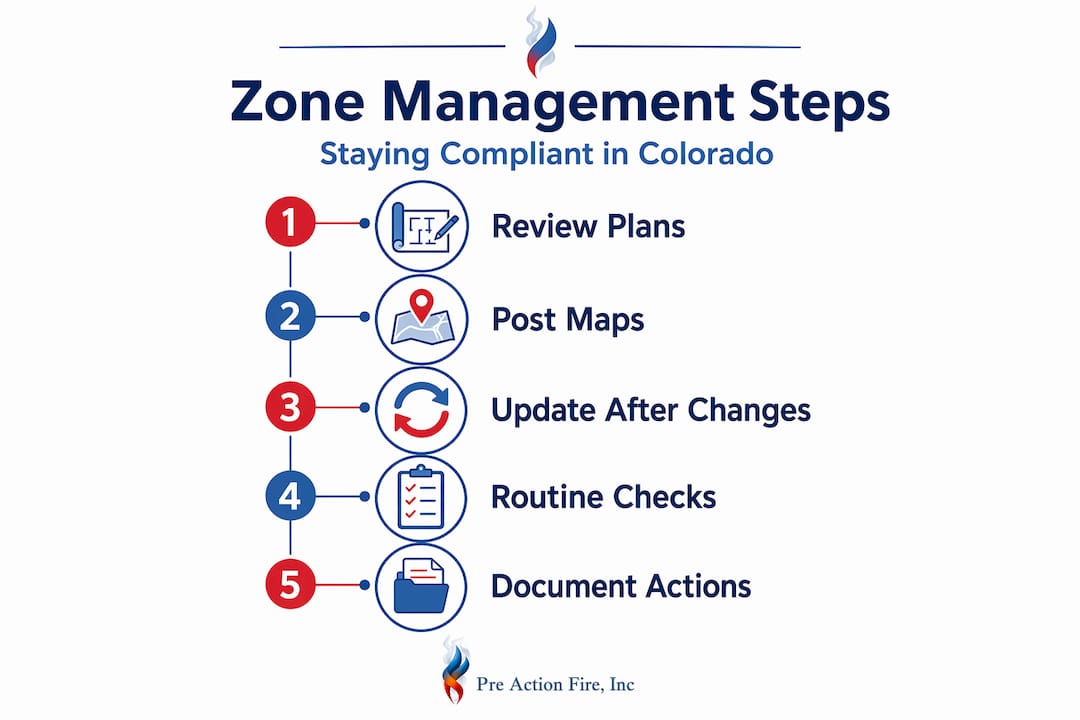
Regularly reviewing and updating zone plans is essential for compliance, especially after renovations or tenant changes.
Your core responsibilities as a facility manager or business owner include:
- Keeping zone maps current at all times, not just at the time of installation or last inspection.
- Ensuring maps are posted in the correct location, properly printed, and legible.
- Documenting all changes to your building that affect fire alarm devices or zones.
- Scheduling regular audits with your fire protection contractor to verify system accuracy.
- Notifying your alarm vendor before and after any construction, demolition, or tenant turnover.
Here is a practical responsibility checklist you can use right now:
- Locate your current fire alarm zone map and verify it matches the physical building.
- Check that the map is posted clearly at the fire alarm control panel.
- Review your change log. If you don’t have one, start one today.
- Schedule a zone audit with your fire protection contractor if you’ve had any renovations in the past 12 months.
- Confirm that your vendor has the most current architectural drawings for your facility.
- Verify that all zone labels on the panel are legible and accurately identify the correct areas.
“Proactive zone management is not about passing inspections. It’s about ensuring that when an emergency actually happens, the system works exactly as intended. Every delay costs lives and property.”
The liability exposure from neglected zone plans is real. Insurance carriers and legal counsel in fire-related incidents routinely examine whether the facility’s fire alarm system was properly documented and maintained. Outdated maps can be used to demonstrate negligence. More importantly, building fire safety management that keeps zoning current reduces the actual risk of harm to people in your building.
The overlooked truth: Why zoning details matter more than most compliance checklists
Here’s something we’ve seen consistently since 2009 working with Colorado facilities of all types. Most compliance failures around fire alarm zones don’t happen because managers don’t care. They happen because zone plan maintenance is invisible until it suddenly isn’t.
Standard compliance checklists focus on inspection dates, battery replacements, and device counts. They rarely ask: “Does your zone map reflect what your building actually looks like today?” That question gets skipped. And it’s the one that matters most when a fire starts on a Tuesday afternoon.
The uncomfortable reality is that zone maps and labels are only as good as their upkeep. After renovations, tenant buildouts, or device relocations, premises management should update the zone plan and ensure printed and posted plans remain legible and adjacent to the fire alarm control and indicating equipment. That guidance exists because buildings change constantly, and maps get stale silently.
We’d also push back on the idea that zone compliance is a once-a-year event. Annual inspections catch obvious gaps, but a renovation completed in March that shifts three smoke detectors and changes a zone boundary creates a compliance gap from the day construction ends. Waiting until the next annual inspection means operating with inaccurate documentation for months.
The solution is treating zone management as a live process integrated into your facility operations. Every time your maintenance team, your tenants, or your contractors touch the building in ways that affect detection devices or space configurations, zone review should be triggered automatically. That’s not excessive. That’s what genuine compliance actually looks like.
The facilities that handle fires best are rarely the ones with the most sophisticated systems. They’re the ones where first responders arrive with accurate information and can act immediately. That’s the real value of system zoning details done right.
Ensuring your Colorado facility is safe and compliant
Knowing the rules is only half the battle. Applying them correctly in a real building takes experienced eyes and technical expertise. At Pre Action Fire, Inc., we’ve been helping Denver Metro facilities maintain accurate, code-compliant fire alarm systems since 2009.
Our NICET-certified technicians assess your current zone configuration against your actual building layout, identify gaps before they become violations, and update your system documentation to match current NFPA 72 and Colorado AHJ requirements. Whether you need a first-time zone assessment, a post-renovation update, or ongoing support for your fire alarm system compliance, we provide practical solutions tailored to your specific facility. We also offer expert alarm annunciation guidance to ensure your panel displays and reports zones correctly every time. Contact us to schedule an assessment for your Denver area property.
Frequently asked questions
Do Colorado fire codes require buildings to post fire alarm zone maps?
Yes, zone maps must be posted at the fire alarm control panel and kept current after any renovation, tenant change, or device relocation. Printed plans must remain legible and clearly positioned at the panel at all times.
What happens if fire alarm zones aren’t updated after renovations?
Outdated zone maps can send first responders to the wrong area of the building, wasting critical time and increasing fire damage and injury risk while also exposing the facility owner to legal liability.
Who is responsible for maintaining accurate fire alarm zone plans?
Facility managers and building owners hold direct responsibility for ensuring zone plans are legible, posted, and reviewed regularly, with licensed contractors making any technical system changes.
How often should fire alarm zone maps be reviewed?
Zone maps should be reviewed and updated after every renovation, tenant buildout, or device relocation, and at minimum confirmed accurate during each annual fire alarm inspection.