
TL;DR:
- Properly maintained fire alarm systems significantly enhance life safety in commercial buildings.
- Compliance with NFPA and Denver codes requires regular inspections and testing to prevent penalties.
- Advanced detection technology reduces false alarms, improving occupant trust and emergency response.
For every real fire emergency in a commercial building, roughly two false alarms occur. That ratio might sound manageable until you realize that alarm fatigue from repeated false alerts trains occupants to hesitate before evacuating, which can be fatal when a real fire breaks out. Denver property owners face a layered challenge: protecting people, staying compliant with local and national codes, and avoiding the financial fallout of a poorly maintained system. This article walks you through why modern fire alarm systems matter, how they prevent expensive losses, and what the rules actually require for commercial buildings in the Denver Metro Area.
Table of Contents
- Fire alarm systems: The foundation of commercial building safety
- Compliance and regulations: Meeting Denver and NFPA standards
- System design and technology: Reducing false alarms and improving response
- Integrating alarms, sprinklers, and staff: The holistic fire protection approach
- A practical reality check: What most Denver managers miss about fire safety
- Ready to improve your fire alarm system?
- Frequently asked questions
Key Takeaways
| Point | Details |
|---|---|
| Regular maintenance matters | Up to 68% of fire alarm failures can be prevented with routine inspections and testing. |
| Compliance protects more than property | Meeting NFPA and Denver codes reduces fines, legal risk, and keeps tenants safer. |
| Modern systems boost safety | Advanced alarms with clear signaling and integration enable faster, more effective evacuations. |
| False alarms cut effectiveness | Too many false alarms create ‘alarm fatigue,’ lowering response rates in real emergencies. |
Fire alarm systems: The foundation of commercial building safety
A fire alarm system is not just a legal box to check. It is the first line of defense between a small incident and a catastrophic loss. When smoke or heat triggers a detector, or when an employee pulls a manual station, the system sets off a chain of events: occupants are alerted, emergency services are notified, and suppression systems may activate. Every second of that chain matters.
Denver’s climate adds a layer of urgency that property managers outside Colorado may not fully appreciate. The region’s low humidity and high altitude create conditions where fires spread faster and smoke moves differently than in more humid climates. Older building stock in neighborhoods like LoDo, Capitol Hill, and the Platte Valley often features materials and layouts that accelerate fire spread. These factors make reliable fire detection not just a code requirement but a genuine life-safety necessity.
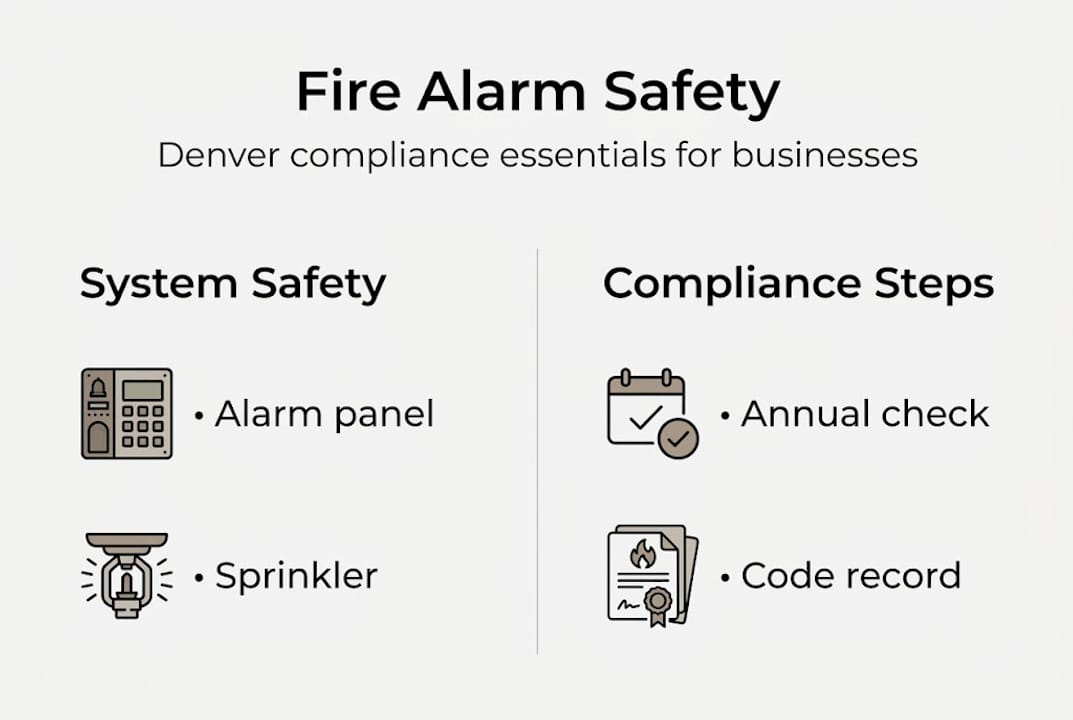
The problem is that not all fire alarm systems perform equally. NFPA-compliant systems with regular inspections reduce injuries and property losses by 8 to 15 percent compared to poorly maintained alternatives. That gap is significant when you consider the cost of a single commercial fire claim, which can easily reach six figures.
Here is what a well-functioning fire alarm system actually does for your building:
- Detects smoke, heat, and carbon monoxide at the earliest possible stage
- Triggers audible and visual alerts throughout the occupied space
- Sends automatic signals to the fire department and monitoring stations
- Activates door closers, elevator recalls, and HVAC shutoffs
- Provides a clear record of alarm events for post-incident review
False alarms undermine all of this. When occupants hear an alarm and assume it is another malfunction, they delay or skip evacuation entirely. This is alarm fatigue in action, and it is one of the most underestimated risks in commercial building fire safety compliance.
“A fire alarm system that cries wolf too often is almost as dangerous as no system at all. The goal is not just detection. It is credible, reliable detection that people trust.”
The foundation of that credibility is proper system design paired with consistent maintenance. Neither alone is enough.
Compliance and regulations: Meeting Denver and NFPA standards
A well-designed fire alarm system still needs to meet Denver’s strict codes. Here is what property leaders must know about compliance.

Commercial buildings in the Denver Metro Area are governed by a layered set of rules. At the national level, NFPA 72 (the National Fire Alarm and Signaling Code) sets the baseline for system design, installation, and testing. NFPA 25 (the Standard for the Inspection, Testing, and Maintenance of Water-Based Fire Protection Systems) covers sprinkler-related components. Locally, the Denver Fire Department enforces its own ordinances that often exceed national minimums, particularly for high-rise buildings, assembly occupancies, and structures with overnight guests.
For Denver managers, annual NFPA inspections are not optional. They are the minimum standard, and skipping them creates compounding risk.
| Requirement | Standard | Frequency |
|---|---|---|
| Fire alarm system inspection | NFPA 72 | Annual (minimum) |
| Sprinkler system inspection | NFPA 25 | Annual/Quarterly |
| Smoke detector testing | NFPA 72 | Semi-annual |
| Battery backup testing | NFPA 72 | Annual |
| Pull station testing | Denver Fire Code | Annual |
Non-compliance carries real consequences that go beyond a warning letter:
- Fines from the Denver Fire Department, which can reach thousands of dollars per violation
- Revocation of your Certificate of Occupancy, which can shut down operations
- Increased liability exposure if a fire occurs and records show missed inspections
- Higher insurance premiums or outright policy cancellation
On the positive side, buildings with documented NFPA compliance inspection records often qualify for reduced commercial property insurance rates. Insurers view consistent ITM (inspection, testing, and maintenance) as evidence of reduced risk, and they price policies accordingly.
Pro Tip: Keep a digital log of every inspection, test, and repair. When an insurance claim or legal dispute arises, that paper trail is your strongest defense. A single missing record can shift liability significantly.
Staying current with the NFPA inspection compliance guide for Colorado is especially important in 2026, as updated code cycles are bringing new requirements for notification appliances and monitoring connectivity in commercial properties.
Understanding what regulations demand, let’s turn to system technology and what separates a barely compliant system from one that truly protects your building.
System design and technology: Reducing false alarms and improving response
The most common causes of false alarms in commercial buildings are not mysterious. Cooking fumes near incorrectly placed detectors, steam from bathrooms triggering smoke sensors, dust during renovation work, and low battery warnings account for the majority of nuisance activations. Each one chips away at occupant trust.
Modern fire alarm control panels address these problems with smarter detection logic. Addressable systems, for example, pinpoint the exact device that triggered an alarm rather than sounding a building-wide alert based on a single zone. This allows trained staff to verify the source before a full evacuation, reducing disruption without compromising safety.
Here is a direct comparison between legacy and advanced fire alarm technologies:
| Feature | Legacy systems | Advanced systems |
|---|---|---|
| Detection type | Zoned (area-based) | Addressable (device-specific) |
| False alarm filtering | Minimal | Multi-criteria algorithms |
| Notification method | Horn only | T3 temporal pattern, voice, strobe |
| Remote monitoring | Rarely included | Standard |
| Maintenance alerts | Manual inspection only | Automated fault reporting |
The difference in real-world performance is substantial. Design upgrades and maintenance prevent up to 68 percent of fire alarm failures, which means the majority of system breakdowns are preventable with the right approach.
Here are four upgrades that deliver the most impact for Denver commercial properties:
- Replace single-criteria smoke detectors with multi-sensor devices that evaluate both smoke and heat before triggering
- Install voice evacuation systems that deliver clear verbal instructions instead of generic horn tones
- Add visual strobes in areas with high ambient noise or hearing-impaired occupants
- Connect the panel to a 24-hour central monitoring station with cellular backup
Pro Tip: If your building underwent renovation in the last five years without a corresponding alarm system review, schedule one now. Construction debris and relocated walls frequently create detection gaps that pass visual inspection but fail under real conditions.
Once your alarm system is up to date, thinking holistically is the final step, combining technology and team for the strongest defense.
Integrating alarms, sprinklers, and staff: The holistic fire protection approach
Fire alarm systems work best when they are part of a larger, coordinated protection strategy. Alarms detect and notify. Sprinklers suppress. Staff respond and guide. When these three elements work together, the outcome is dramatically better than any one of them operating in isolation.
Combining alarms and sprinklers yields additive safety gains that neither system achieves alone. A sprinkler system without an alarm may suppress a fire but leave occupants unaware. An alarm without sprinklers notifies people but does nothing to slow the fire’s growth. Together, they create a window of time that saves lives and limits damage.
But technology is only part of the equation. Staff training is where many commercial properties fall short. Consider building a safe, compliant fire protection culture with these practices:
- Conduct fire drills at least twice per year, including at least one unannounced drill
- Train new employees on evacuation routes within their first week, not their first month
- Assign floor wardens who know how to verify alarms and assist occupants with mobility challenges
- Post evacuation maps at every elevator lobby and stairwell entrance
- Review and update your emergency action plan whenever your occupancy or layout changes
System integration also means ensuring your alarm panel communicates correctly with your sprinkler inspection workflow and that both systems are tested together, not separately. Many buildings pass individual component inspections but have never verified that the alarm actually triggers the sprinkler flow switch correctly.
Establishing an ongoing safety improvement cycle, where you review alarm data, update training, and schedule proactive maintenance, turns fire protection from a reactive expense into a managed, predictable part of building operations.
A practical reality check: What most Denver managers miss about fire safety
Here is something we see repeatedly after years of working with commercial properties across the Denver Metro Area. The buildings with the most serious safety gaps are rarely the ones that skipped fire protection entirely. They are the ones that did just enough to pass inspection and then stopped thinking about it.
A signed inspection report does not mean your staff knows what to do when an alarm sounds at 2 p.m. on a Tuesday. It does not mean your newest maintenance employee knows which pull station is closest to the boiler room. Paper compliance and real readiness are two different things.
The question worth asking yourself right now is this: when did you last test your staff’s response to an alarm, not just the alarm itself? Running a drill, watching how people actually move, and identifying the person who hesitates or heads the wrong way is irreplaceable information. No vendor check captures that.
We encourage every property manager to treat deeper fire safety compliance as a living practice, not an annual event. Walk your building with fresh eyes twice a year. Ask your team what they would do. The answers will tell you more than any inspection certificate.
Ready to improve your fire alarm system?
Pre Action Fire, Inc. has been helping Denver Metro Area businesses build reliable, code-compliant fire protection since 2009. Our NICET-certified technicians design and service systems for every type of commercial occupancy, from office buildings to warehouses to multi-tenant retail.
Whether you need a full system upgrade, a compliance review, or just a second opinion on your current setup, we have the local expertise to help. Explore our detailed guide to Denver fire alarm control panels or review the Denver fire alarm regulations guide to understand exactly what your building requires. Contact us today to schedule a consultation and get a clear picture of where your fire protection stands.
Frequently asked questions
What is the most common reason fire alarm systems fail?
Lack of regular maintenance is the leading cause of fire alarm system failures, responsible for up to 68 percent of breakdowns. Consistent inspection and testing schedules are the most effective prevention.
How often should fire alarm systems be inspected in Denver?
Denver regulations require annual fire alarm inspections under NFPA 72, with some components like smoke detectors requiring semi-annual testing. Local Denver Fire Department ordinances may add further requirements depending on building type.
What are the consequences of false fire alarms?
Frequent false alarms create alarm fatigue, which slows occupant response during real emergencies. They can also result in fines from the Denver Fire Department and disrupt normal business operations.
How do advanced alarm systems help with compliance?
Smart fire alarm systems use multi-criteria detection and automated fault reporting to reduce false alarms, simplify documentation, and make annual inspections more efficient for Denver commercial properties.
Are fire sprinklers and alarm systems required to work together?
Combining sprinklers and alarms provides cumulative protection that exceeds either system alone, and many Denver commercial occupancies are required by code to have both systems integrated and tested together.
Recommended
- Fire alarm control panels: Denver compliance & safety guide
- Denver fire alarm regulations: Your compliance guide
- Denver Commercial Fire Protection | Pre Action Fire, Inc
- Fire protection guide: safe, compliant Denver buildings
- Sécurité incendie en PME : obligations et principes clés
- Denver Commercial Fire Protection