
TL;DR:
- Interpreting NFPA rules correctly distinguishes a compliant, safe facility from one facing fines or inspections failure.
- Understanding the difference between codes and standards, along with local adoption and enforcement, is essential for accurate compliance.
Interpreting NFPA rules correctly is the difference between a compliant, safe facility and one that faces fines, failed inspections, or worse. The National Fire Protection Association publishes over 300 codes and standards covering everything from sprinkler design under NFPA 13 to occupant safety under NFPA 101. For facility managers, safety officers, and business owners, knowing how to read NFPA standards goes beyond scanning a document. You need to understand what is legally binding, which edition applies to your building, and how your local Authority Having Jurisdiction shapes enforcement. This guide gives you that framework.
How to interpret NFPA rules: codes vs. standards
The first step in understanding NFPA guidelines is knowing that codes and standards are not the same document type. A code specifies what must be done. A standard specifies how to do it. NFPA 1, the Fire Code, is a code. NFPA 13, the Standard for the Installation of Sprinkler Systems, is a standard. NFPA 1 references NFPA 13 when it requires sprinkler installation. That relationship matters because you cannot read one without the other.
NFPA documents only become legally enforceable when a state or local jurisdiction formally adopts them. Colorado, for example, adopts specific editions of NFPA codes through state and municipal processes. A requirement in the 2024 edition of NFPA 13 carries no legal weight in your facility unless your jurisdiction has adopted that edition. This is the single most common misunderstanding among facility managers who read NFPA documents without first checking local adoption status.
| Document Type | Purpose | Example | Legal Force |
|---|---|---|---|
| Code | Defines what is required | NFPA 1 (Fire Code) | When adopted by jurisdiction |
| Standard | Defines how to comply | NFPA 13 (Sprinkler Systems) | When referenced by an adopted code |
| Recommended Practice | Offers guidance | NFPA 72 Chapter 10 guidance sections | Advisory only |
Pro Tip: Before reading any NFPA document, confirm whether your jurisdiction has adopted it and which edition is in force. Your state fire marshal’s office or local building department can confirm this in one call.
Understanding NFPA standards for Colorado businesses requires this codes-versus-standards distinction as a foundation. Without it, you risk applying the wrong requirements or missing a critical cross-reference.
What do “shall” and “should” mean in NFPA documents?
The most consequential skill in reading NFPA standards is recognizing the difference between mandatory and advisory language. “Shall” denotes a mandatory obligation. “Should” indicates a strongly recommended best practice that is not legally binding unless your jurisdiction has specifically adopted it as mandatory.
This distinction has real consequences:
- “Shall” creates a legal obligation. Ignoring it exposes your facility to violations, fines, and potential liability in the event of a fire.
- “Should” is advisory. Ignoring it will not trigger a code violation, but it can create functional failures, insurance complications, or safety gaps.
- “Shall not” is an absolute prohibition. No exceptions apply unless the code itself provides one.
- “Permitted” means the action is allowed but not required.
- “Required” reinforces a mandatory condition, often used to emphasize a “shall” statement.
Many facility managers treat “should” as optional rather than as a strong safety signal. That is a mistake. A “should” statement in NFPA 72 about notification appliance placement may not be enforceable, but ignoring it can mean occupants in a far corner of your building do not hear an alarm in time.
“Treat every ‘should’ as a safety flag. If you choose not to follow it, document your reasoning and confirm with your AHJ that the deviation is acceptable.” — Practical guidance from fire protection professionals
Local Authorities Having Jurisdiction can also amend NFPA language. AHJs enforce NFPA codes and may apply their own interpretations or local amendments that override the published document. A “should” in the NFPA standard may become a “shall” in your city’s local amendment. Always verify with your AHJ before treating any advisory language as truly optional.
How to identify which NFPA codes apply to your facility
Knowing your building’s occupancy classification and local adoption status is the starting point for every NFPA compliance review. A warehouse, a hospital, and a retail store each trigger different code requirements. Getting this wrong means you are reading the right document for the wrong building type.
Follow these steps to identify applicable codes:
- Determine your occupancy classification. Use NFPA 101, the Life Safety Code, to identify whether your building is a business occupancy, industrial occupancy, assembly occupancy, or another category. Each classification carries specific egress, alarm, and suppression requirements.
- Confirm local adoption status. Contact your state fire marshal’s office or local building department. Ask which edition of NFPA 101, NFPA 13, NFPA 14, and NFPA 25 is currently adopted. Do not assume the most recent edition applies.
- Identify cross-referenced standards. Once you know which code applies, pull every standard it references for your occupancy type. NFPA 101 will point you to NFPA 72 for fire alarm systems and NFPA 13 for sprinklers.
- Check for local amendments. Your city or county may have adopted the base NFPA code with modifications. These amendments are often published by the local fire department or building department.
- Review existing system documentation. For existing buildings, check what edition was in force when the system was installed. Older buildings may have exemptions or modified requirements depending on renovation scope and local amendments.
| NFPA Document | Covers | Who Needs It |
|---|---|---|
| NFPA 101 | Life safety, egress, occupancy | All commercial facility managers |
| NFPA 13 | Sprinkler system installation | Buildings with suppression systems |
| NFPA 14 | Standpipe and hose systems | Multi-story or large-footprint buildings |
| NFPA 25 | Inspection, testing, maintenance | Any building with water-based suppression |
| NFPA 72 | Fire alarm and signaling systems | Buildings with fire alarm systems |
Pro Tip: Use the NFPA compliance inspection process as a structured checklist. A certified inspector will cross-reference your occupancy type against locally adopted editions and flag gaps you may have missed.

How do edition differences and site conditions affect interpretation?
Applying NFPA codes to real buildings is where interpretation gets genuinely complex. Edition differences alone can change specific numeric requirements. Sprinkler hose connection travel distance is 200 feet in fully sprinklered buildings but only 130 feet in buildings that are not fully sprinklered. That single number changes your design layout. Between the 2019 and 2024 editions of NFPA 14, requirements for air supervision in manual dry standpipes also changed. Misinterpretation of these edition-specific requirements is a documented cause of project delays and expensive rework.
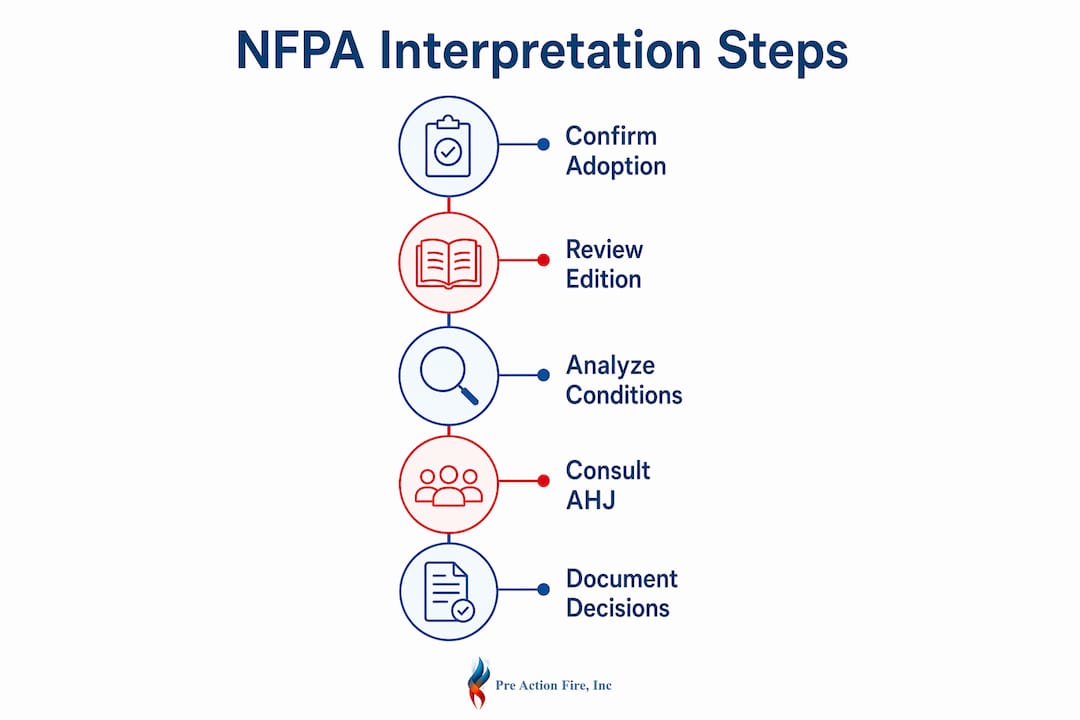
Real-world site conditions add another layer. NFPA standards are written for typical conditions. Your facility may have atypical ceiling heights, unusual occupancy mixes, or legacy systems that do not fit neatly into any code section. Technical NFPA standards cannot always anticipate unique site conditions. When the code does not directly address your situation, manufacturer installation instructions and engineering judgment fill the gap.
Practical steps for handling these complexities:
- Confirm the edition your AHJ enforces before starting any design or inspection work. Do not assume the edition on the document you downloaded matches what your inspector will reference.
- Request a pre-application meeting with your AHJ for any project involving unusual site conditions. This meeting costs nothing and can prevent months of rework.
- Cross-reference manufacturer instructions with NFPA language. Where the two conflict, bring the discrepancy to your AHJ for a formal interpretation.
- Document every AHJ communication in writing. An email confirming an interpretation protects you if the inspector changes or the project is reviewed later.
“Building a working relationship with your AHJ is not optional. It is the most reliable way to align your interpretation with enforcement reality before you spend money on installation.” — Fire protection industry consensus
Proactive collaboration with local AHJs is the most reliable method for preventing costly interpretation errors. The role of fire marshals in this process is significant. They are the final word on how a code section applies to your specific building, and engaging them early consistently produces better outcomes than seeking clarification after a failed inspection.
Key takeaways
Effective NFPA interpretation requires distinguishing codes from standards, reading mandatory language precisely, and confirming local adoption before applying any requirement.
| Point | Details |
|---|---|
| Codes vs. standards | A code defines what is required; a standard defines how to comply. Always read both together. |
| “Shall” is non-negotiable | Any requirement using “shall” is legally binding once the code is adopted locally. Violations carry fines and liability. |
| Confirm local adoption | The edition your jurisdiction has adopted governs your facility, not the most recent NFPA publication. |
| AHJ is the final authority | Local Authorities Having Jurisdiction can amend or interpret NFPA language. Engage them early on any project. |
| “Should” still matters | Advisory language signals a safety best practice. Ignoring it without documentation creates operational and insurance risk. |
What i’ve learned after years of NFPA compliance work
The biggest mistake I see facility managers make is treating NFPA documents like a checklist to scan rather than a technical language to read. The difference between “shall” and “should” is not a minor editorial choice. It is the line between a legal obligation and a professional recommendation, and confusing the two in either direction creates problems.
The second pattern I see consistently is over-reliance on the published NFPA document without confirming local adoption. I have watched projects get redesigned because a contractor used the 2024 edition of NFPA 13 in a jurisdiction that had only adopted the 2019 edition. That is not a code complexity problem. It is a process problem that one phone call to the building department would have solved.
The practitioners who navigate NFPA interpretation most effectively share one habit: they treat the AHJ as a resource, not an adversary. Early conversations with inspectors and fire marshals surface local amendments, clarify ambiguous sections, and build the kind of working relationship that makes inspections go smoothly. Combine that with solid documentation of every interpretation decision, and you have a compliance process that holds up under scrutiny. Ongoing education matters too. NFPA updates its documents on a three-year cycle, and a requirement that was advisory in one edition can become mandatory in the next.
— Preactionfire
How Preactionfire helps denver facilities stay NFPA compliant
Interpreting NFPA rules correctly is one part of the compliance equation. Having a qualified team execute the installation, inspection, and documentation is the other.
Preactionfire has served the Denver Metro Area since 2009, with NICET-certified technicians who work directly with local AHJs and understand which editions are enforced across Colorado jurisdictions. Whether you need fire alarm system compliance for a new build or a full NFPA compliance inspection for an existing facility, Preactionfire brings the technical depth to get it right the first time. Contact Preactionfire for a consultation and take the guesswork out of your next inspection cycle.
FAQ
What is the difference between an NFPA code and a standard?
A code defines what fire protection requirements must be met, while a standard defines how to meet them. NFPA 1 is a code; NFPA 13 is a standard that NFPA 1 references for sprinkler installation details.
Does every NFPA requirement apply to my facility?
Only NFPA documents formally adopted by your state or local jurisdiction are legally enforceable. Confirm which editions are in force with your local building department or state fire marshal before applying any requirement.
What does “shall” mean in an NFPA document?
“Shall” indicates a mandatory legal obligation. Ignoring a “shall” requirement in an adopted code exposes your facility to violations, fines, and liability.
How do i handle NFPA requirements for an older building?
Older buildings may qualify for exemptions or modified requirements depending on local amendments and the scope of any renovation. Consult your AHJ and review local amendments before assuming new construction requirements apply.
What should i do when NFPA language is ambiguous?
Request a written interpretation from your local AHJ. Document the response and keep it on file. Where manufacturer instructions conflict with NFPA language, bring both to the AHJ for a formal ruling before proceeding.