
TL;DR:
- Fire compartmentation divides buildings into fire-resistant zones to prevent the spread of fire, smoke, and gases. Its integrity relies on sealed barriers, fire doors, and proper penetration fire-stopping, and it must meet strict code requirements for openings and continuous construction. Regular inspections and maintenance are essential to ensure these passive systems work effectively alongside active fire safety measures.
Compartmentalization in fire safety is the practice of dividing a building into self-contained, fire-resistant zones designed to stop fire, smoke, and toxic gases from spreading beyond their point of origin. Known formally as fire compartmentation, this strategy is a cornerstone of passive fire protection in commercial and institutional buildings. Compartments are rated for 30 minutes to 2 hours of fire resistance, giving occupants time to evacuate and emergency responders time to act. For facility managers and building owners, understanding how compartmentation works is not optional. It is the physical backbone of every compliant fire safety strategy.
How does compartmentalization work in buildings?
Fire compartmentation works by constructing physical barriers that confine a fire to the room or zone where it starts. These barriers use fire-resistant walls, floors, and ceilings rated to withstand heat and flames for a defined period without structural failure. The goal is simple: buy time. Every minute a fire stays contained is a minute more for evacuation and suppression.
The core components of a working compartment include:
- Fire-resistant walls and floors: Constructed from materials like concrete, masonry, or fire-rated gypsum board, these form the outer shell of each compartment.
- Fire doors: Rated assemblies that close automatically to seal openings. The entire fire door assembly, including the door, frame, seals, and hardware, must be tested and maintained as a unit.
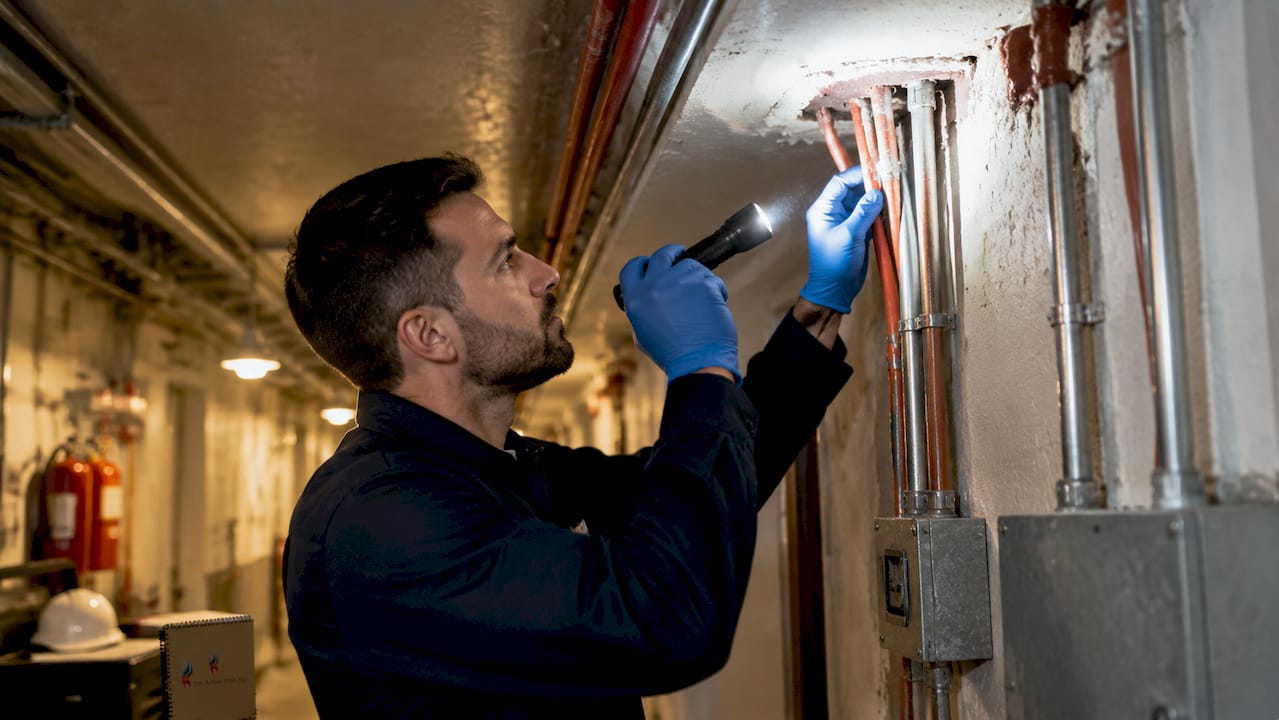
- Fire-stopping at penetrations: Every cable, pipe, or duct that passes through a fire-rated wall or floor creates a potential breach. Fire-stopping materials used at these points must match or exceed the fire-resistance rating of the surface they penetrate.
- Intumescent seals: These expand when exposed to heat, sealing gaps around doors and penetrations that would otherwise allow smoke and flames to pass through.
Pro Tip: The weakest point in any compartment is almost always a junction. Where a fire-rated wall meets a floor or ceiling, special construction techniques are required to maintain the barrier’s continuous rating through concealed plenums and cavities. Never assume a wall is fully rated without verifying how it terminates.
Compartments are not just about walls. The entire assembly must form a sealed envelope. A single unsealed cable penetration can allow smoke to travel freely, defeating the purpose of the entire system.
What are the key types of fire separations?
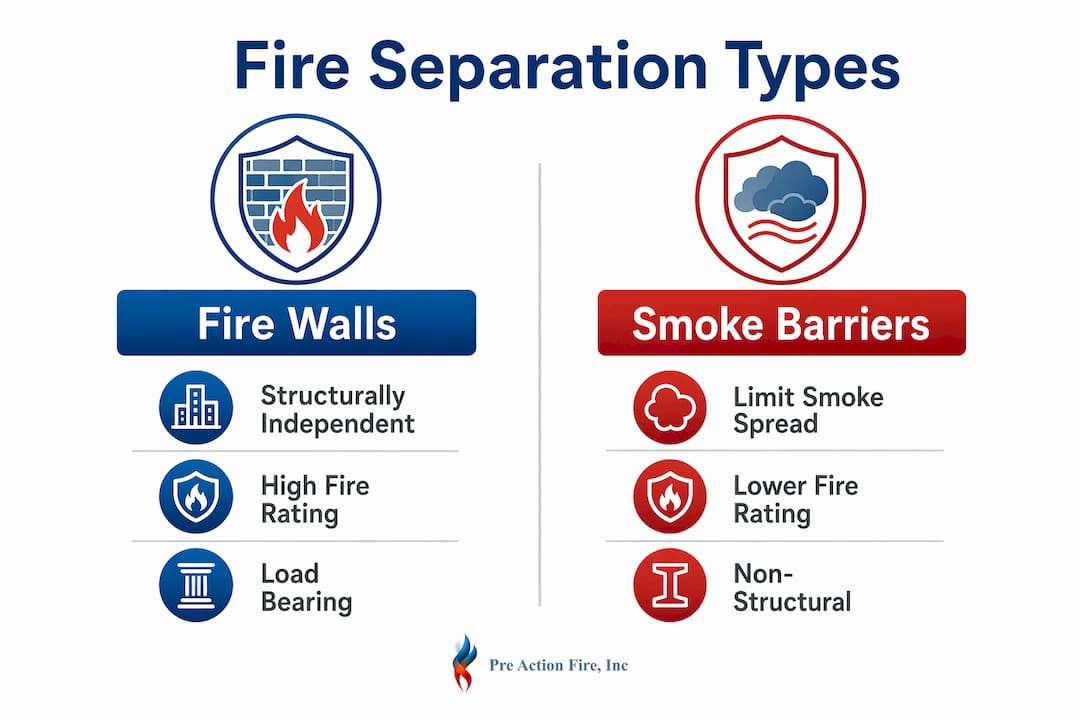
Not all fire barriers are the same. The International Building Code (IBC) defines several distinct types of fire separations, and confusing fire walls with fire barriers is the most common design error facility managers encounter. Each type has a different structural requirement, fire-resistance rating, and application.
| Separation Type | Purpose | Structural Independence | Typical Rating | Code Reference |
|---|---|---|---|---|
| Fire Wall | Creates two separate buildings | Required | 3–4 hours | IBC Section 706 |
| Fire Barrier | Subdivides spaces within a building | Not required | 1–3 hours | IBC Section 707 |
| Fire Partition | Separates tenant spaces or corridors | Not required | 1 hour | IBC Section 708 |
| Smoke Barrier | Limits smoke migration across a floor | Not required | 1 hour | IBC Section 709 |
| Smoke Partition | Limits smoke in specific occupancies | Not required | None required | IBC Section 710 |
Fire walls carry the most stringent requirements. They must be structurally independent, meaning the wall stays standing even if the construction on either side collapses. Fire barriers, by contrast, extend continuously from floor to floor but do not require that level of independence. Fire partitions are the lightest-duty option, used to separate tenant spaces or protect corridor walls.
Smoke barriers and smoke partitions address a different threat entirely. Smoke is responsible for the majority of fire fatalities, often traveling far beyond the fire’s origin. A smoke barrier limits that migration across a floor plate, while a smoke partition is used in specific occupancy types like healthcare facilities. Confusing these categories leads to underperforming compartmentation and expensive corrective work after the fact.
For a detailed breakdown of how fire-rated partitions differ under building codes, that resource is worth reviewing before your next renovation or compliance audit.
What fire codes govern compartmentalization requirements?
Fire compartmentation is not a design preference. It is mandated by building codes including the Regulatory Reform (Fire Safety) Order 2005 and the International Building Code, both of which treat passive fire protection as a legal requirement. Facility managers in the United States work primarily under the IBC, which sets specific limits on how compartments can be constructed and where openings are permitted.
The IBC’s key requirements for fire barriers include:
- Opening size limits: No single opening in a fire barrier may exceed 156 square feet. This prevents large unprotected gaps that would allow fire to pass through freely.
- Aggregate opening limits: The total area of all openings in a fire barrier wall cannot exceed 25% of the wall’s total length. This rule prevents a wall from being mostly glass or door openings with minimal solid barrier.
- Continuity through concealed spaces: The fire-rated barrier must run continuously from the foundation through any concealed spaces to the roof deck. Gaps in attics, plenums, or interstitial spaces break the rating.
- Rated opening protectives: Every door, window, or duct penetration in a fire barrier must be protected with a rated assembly that matches the barrier’s required resistance level.
- Documentation and inspection records: Code compliance requires documented evidence that barriers were installed correctly and are being maintained. Verbal assurances do not satisfy an inspector.
Non-compliance carries real consequences. Failed inspections can trigger stop-work orders, insurance claim denials, and personal liability for building owners. In Denver and across Colorado, the Authority Having Jurisdiction (AHJ) enforces these standards during permitting, construction, and periodic inspections. Knowing the code before a violation is discovered is always the better path.
Common pitfalls and best practices for maintaining compartments
Fire compartmentation is static and often invisible until it fails. That invisibility is exactly what makes it dangerous. A wall looks the same whether it is fully rated or riddled with unsealed penetrations. Proactive inspection is the only way to know your compartments are actually working.
The most common failure points include:
- Unsealed penetrations from renovations: Every time an electrician, plumber, or IT contractor runs new cables or pipes through a fire-rated wall, a new breach is created. Without fire-stopping, that breach stays open indefinitely.
- Disabled or damaged fire door closers: A fire door propped open or fitted with a broken closer provides zero compartmentation. Door self-closers, intumescent seals, and frames are all integral to performance. Neglecting any one component compromises the entire assembly.
- Damaged intumescent seals: Seals that are painted over, physically damaged, or simply aged past their service life will not expand properly in a fire.
- Assumed compliance without verification: Many facility managers inherit buildings with no documentation of fire-stopping work. Assuming prior contractors completed the work correctly is a risk that inspections regularly expose.
Pro Tip: Schedule an independent fire-stopping survey after any renovation, tenant fit-out, or major service installation. These surveys catch minor breaches before they become major liabilities. Coordinate the findings with your active systems, including sprinklers and alarms, to confirm your passive and active protection layers are working together.
Compartmentation also complements active systems like sprinklers and fire alarms. Sprinklers suppress fire; compartments contain it. Alarms detect it; barriers slow its spread. None of these systems works as well in isolation as they do together. A building with excellent sprinkler coverage but compromised compartments is still a building where smoke can travel freely through every floor.
Key takeaways
Fire compartmentation is the single most critical passive fire protection strategy in any building, and its effectiveness depends entirely on the integrity of every barrier, door, and sealed penetration.
| Point | Details |
|---|---|
| Compartments are time-rated zones | Fire-resistant barriers are rated for 30 minutes to 2 hours, giving occupants time to evacuate safely. |
| Fire separation types differ significantly | Fire walls, barriers, partitions, and smoke barriers each have distinct ratings, structural requirements, and IBC code sections. |
| Code limits govern every opening | IBC caps single openings at 156 sq ft and aggregate openings at 25% of wall length in fire barriers. |
| Penetrations are the most common failure point | Every unsealed cable or pipe through a rated wall breaks the compartment and must be fire-stopped to the same rating. |
| Active and passive systems must work together | Sprinklers and alarms complement compartmentation but cannot replace the containment function of physical barriers. |
Why compartmentalization gets overlooked until it’s too late
Most facility managers I speak with know their sprinkler zones and alarm panel locations by heart. Ask them where their fire barriers terminate in the ceiling plenum, and the room goes quiet. That gap in knowledge is not negligence. It reflects how compartmentation is designed: invisible, static, and silent until the moment it is needed most.
The uncomfortable truth is that compartmentation failures are almost always discovered in one of two ways. Either an inspector finds them during a routine audit, or a fire does. The second scenario is obviously worse, but the first is also costly. Corrective fire-stopping work after a building is occupied and finished is expensive, disruptive, and sometimes structurally complicated.
What I have seen work consistently is treating compartmentation as a living system rather than a one-time construction task. Every renovation is a potential breach. Every new tenant brings contractors who may not know or care about fire-rated walls. Building a simple protocol that flags any wall penetration work for fire-stopping review costs almost nothing and prevents the kind of cumulative degradation that turns a code-compliant building into a liability.
The other piece that gets underestimated is the relationship between compartmentation and fire system design. Passive and active systems are designed to work as a team. When compartments are intact, sprinklers have a better chance of controlling a fire within a single zone. When they are not, you are asking your active systems to do a job they were never designed to do alone.
— Preactionfire
How Preactionfire supports your compartmentation strategy
Compartmentation is only as strong as its last inspection. Pre Action Fire has served Denver Metro Area facilities since 2009, and our NICET-certified technicians understand exactly where compartments fail and what it takes to bring them back into compliance.
Whether you need a full fire alarm system review to confirm your active protection aligns with your passive barriers, or you need a compliance evaluation of your fire-rated assemblies, Preactionfire delivers the technical depth your building requires. We work with facility managers and building owners across Denver, Arvada, Westminster, and the surrounding Colorado communities. Contact Preactionfire today to schedule a professional fire safety evaluation and confirm your compartmentation is doing the job it was built to do.
FAQ
What is fire compartmentation in simple terms?
Fire compartmentation is the practice of dividing a building into fire-resistant zones using rated walls, floors, doors, and sealed penetrations. Each zone is designed to contain fire and smoke for 30 minutes to 2 hours.
How does a fire door contribute to compartmentalization?
A fire door seals an opening in a fire-rated barrier when closed. The entire assembly, including the door, frame, intumescent seals, and self-closer, must be intact and functional to maintain the compartment’s rated resistance.
What is the difference between a fire wall and a fire barrier?
A fire wall creates two structurally independent buildings and must remain standing even if construction on either side collapses. A fire barrier subdivides spaces within a single building and does not require structural independence.
How often should fire compartments be inspected?
Facility managers should commission an independent fire-stopping survey after any renovation, service installation, or tenant change. Annual inspections of fire doors and visible barriers are a minimum baseline for most commercial buildings.
Does compartmentalization replace sprinklers or fire alarms?
No. Compartmentation is a passive system that contains fire and smoke. Sprinklers suppress fire and alarms detect it. All three systems work together, and none fully compensates for the absence of another.