
TL;DR:
- Fire barrier inspections ensure fire-rated assemblies maintain integrity, compliance, and function to protect occupants and responders. Proper preparation, thorough documentation, and accurate measurements are essential for successful assessments under NFPA 80, ASTM standards, and IBC 2021. Consistent record-keeping and standards adherence significantly increase the likelihood of passing inspections and ensuring fire safety.
Fire barrier inspection steps are the systematic procedures facility managers and safety compliance officers use to verify that fire-rated assemblies maintain their integrity, fire-resistance rating, and code compliance. The industry standard term for this process is “fire barrier assessment,” governed primarily by NFPA 80, IBC 2021, and ASTM standards including E2174 and E2393. A failed fire barrier does not just trigger a code violation. It removes the passive protection that buys occupants time to evacuate and firefighters time to respond. This guide walks you through every stage of the process, from pre-inspection setup to firestop verification, with the measurement criteria and documentation practices that determine whether you pass or fail.
What tools and documentation do you need before starting?
A fire barrier inspection fails before it begins when inspectors arrive without the right tools or records. The physical inspection tools you need include door gap gauges, door pressure gauges, depth gauges, a measuring tape, and a flashlight rated for confined spaces. Each tool serves a specific measurement function. A door gap gauge, for example, verifies the 1/8-inch maximum clearance at the top and sides of fire doors per NFPA 80. Without it, you are estimating, and estimates do not hold up under AHJ (Authority Having Jurisdiction) review.
Documentation requirements are equally specific:
- Inspection checklists aligned to NFPA 80 for fire doors and ASTM E2174 or ASTM E2393 for firestop systems
- Fire door labels and listings confirming the rated assembly
- UL system listings for each firestop penetration and joint system on site
- Prior inspection reports to identify recurring deficiencies
- Corrective action logs from previous cycles
Well-organized life safety records directly reduce on-site correction orders. Inspectors who arrive with complete prior reports spend less time reconstructing history and more time verifying current conditions.
| Document | Purpose |
|---|---|
| NFPA 80 checklist | Guides fire door inspection criteria |
| UL system listing sheets | Confirms firestop product and configuration compliance |
| Prior inspection reports | Identifies repeat deficiencies before the walk |
| Corrective action log | Tracks open items and resolution status |
Pro Tip: Create a site-specific binder or digital folder for each building that holds all fire door labels, UL listings, and prior reports. Inspectors who reference this during the walk catch discrepancies faster and document findings with greater precision.
Fire barrier inspection steps for fire doors under NFPA 80
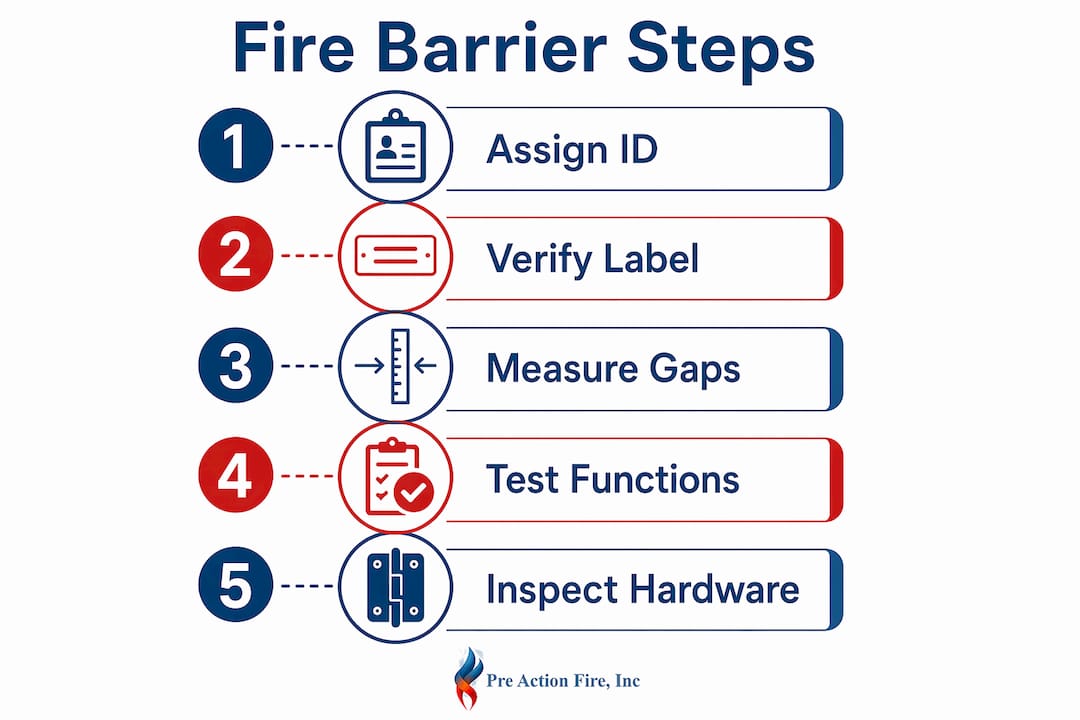
NFPA 80 mandates annual written inspection of all fire door assemblies in commercial buildings, with records retained for AHJ review. The inspection covers door clearances, hardware operation, labels, and physical condition. Follow these steps in sequence for each door assembly on your inventory.
Step 1: Assign a unique door ID and record location
Every fire door must be cataloged with a unique identifier tied to its floor, zone, and room number. This ID links the physical door to its listing documentation and all future inspection records. Without traceable IDs, standardized inspection templates lose their defensibility during AHJ and insurance audits.
Step 2: Verify the fire rating label
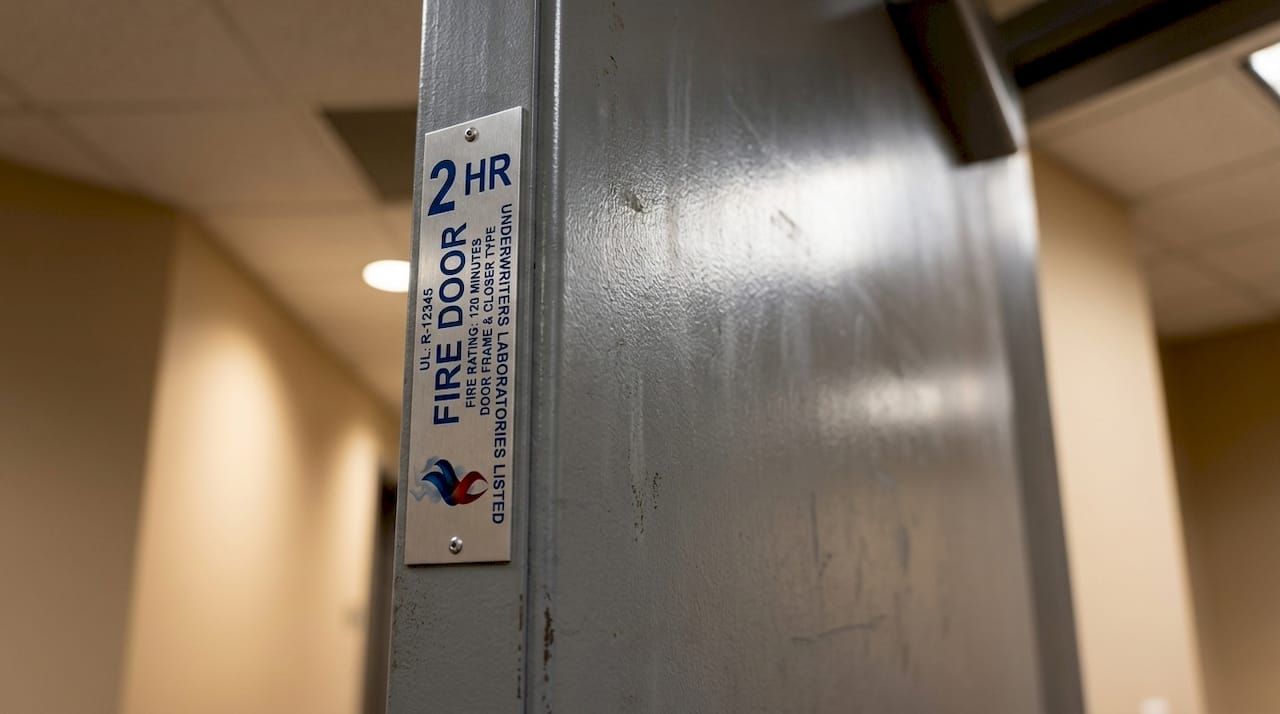
Locate the label on the door edge or frame. Confirm it is legible, permanently attached, and matches the required fire-resistance rating for that location. A painted-over or missing label is an automatic deficiency. The label is the only field-verifiable proof that the door was manufactured to a listed standard.
Step 3: Measure all door clearances
Use a door gap gauge to measure:
- Top gap: maximum 1/8 inch
- Side gaps (both hinge and latch sides): maximum 1/8 inch
- Bottom gap: maximum 3/4 inch unless a listed bottom seal modifies the requirement
These tolerances are not suggestions. A gap exceeding 1/8 inch at the top or sides allows smoke and flame passage that compromises the rated assembly. Record the actual measured value, not just pass/fail.
Step 4: Test self-closing and self-latching functions
Open the door to near-full open position and release it. The door must close completely and latch without manual assistance. Test from multiple positions if the door has a hold-open device. Rolling steel fire doors require annual drop testing twice, with a closing speed between 6 and 24 inches per second per NFPA 80. Document the result of each functional test with the date and inspector name.
Step 5: Inspect all hardware
Door hardware must be listed for fire door use under NFPA 80 and ANSI/BHMA standards. Check hinges, panic hardware, coordinators, door stops, and closers. Any unlisted hardware or unauthorized modification voids the assembly listing. Look for field-drilled holes, added surface hardware, or replaced components that do not carry a fire-rated listing.
| Hardware Item | Inspection Criteria |
|---|---|
| Hinges | Listed, intact, no missing screws |
| Self-closer | Closes door fully from near-full open |
| Latch | Engages strike without manual assist |
| Panic hardware | Listed, functional, no field modifications |
| Coordinator | Sequences double doors correctly |
Pro Tip: Photograph every hardware component with the door ID visible in the frame. This creates a timestamped visual record that supports corrective action documentation and protects you during AHJ disputes.
For a deeper look at how fireproof door compliance affects your inspection outcomes, review the function and maintenance requirements specific to commercial assemblies.
How do you inspect firestop penetrations and joint systems?
Firestop inspections and fire-resistive joint system inspections are not the same process. Confusing them is one of the most common errors in the fire barrier assessment process. Firestop penetrations occur where pipes, conduit, cables, or ducts pass through a fire-rated wall or floor. Fire-resistive joint systems protect the gaps between rated assemblies, such as perimeter gaps at curtain walls or expansion joints. Each requires a different standard: ASTM E2174 for penetrations and ASTM E2393 for joint systems.
Follow this sequence for firestop penetration inspections:
- Identify the penetrating item. Record the type (pipe, conduit, cable tray), material, and diameter. The UL system listing is only valid for the specific penetrating item type and size it covers.
- Locate the applicable UL system listing. IBC 2021 Section 1705.18 requires third-party verification that installed firestop systems match their UL listing. Pull the listing sheet and compare it to field conditions.
- Measure the annular space. The gap between the penetrating item and the opening must fall within the range specified in the listing. Any deviation invalidates the system.
- Verify sealant depth and backing. Measure sealant depth with a depth gauge. Confirm the backing material type matches the listing. Missing or incorrect backing is one of the most frequent causes of firestop failure.
- Check for the red UL label. Many listings require a red UL label at the penetration site. Its absence is a deficiency even if the product is otherwise correct.
- Photograph and document. Capture the penetrating item, annular space, sealant application, and label. Photo evidence is the most defensible form of firestop documentation.
| Inspection Element | Firestop Penetration (ASTM E2174) | Joint System (ASTM E2393) |
|---|---|---|
| Standard | ASTM E2174 | ASTM E2393 |
| Primary concern | Penetrating item, annular space, sealant depth | Gap width, movement capability, joint filler |
| Label required | Red UL label at penetration | Per listing requirements |
| Common failure | Wrong sealant or missing backing | Incorrect joint width or filler type |
Proper firestop installation depends on exact UL listing compliance. Any trade that modifies a penetration after the original firestop is applied can invalidate the listing without the facility manager’s knowledge. Build a re-inspection trigger into your change management process for any construction activity near rated assemblies.
Pro Tip: Create two separate inspection checklists: one for penetrations and one for joint systems. Using a single generic checklist is the fastest way to apply the wrong acceptance criteria and miss a real deficiency.
Common mistakes that cause fire barrier inspections to fail
Most inspection failures trace back to a small set of repeatable errors. Recognizing them before you walk the site is the most efficient way to improve your pass rate.
- Skipping documentation review. Inspectors who do not review prior reports before the walk miss recurring deficiencies and spend time re-discovering known issues. Compliance failures frequently originate from poor record-keeping, not physical defects.
- Using generic fire-rated products instead of listed systems. A product labeled “fire-rated” is not the same as a product installed per a specific UL system listing. The listing defines the entire assembly, not just the sealant.
- Failing to verify hardware listings. Inspectors often check that hardware is present and functional but skip confirming it carries a fire-rated listing. Unlisted hardware voids the entire door assembly.
- Estimating gap measurements. Eyeballing a gap instead of measuring it with a door gap gauge produces unreliable results. The 1/8-inch tolerance at door tops and sides is tight enough that visual estimation is not defensible.
- Treating firestop and joint inspections as interchangeable. The distinction between these two systems causes consistent confusion. They require different checklists, different standards, and different acceptance criteria.
“Inspection success depends on traceable evidence of visual inspection, measurements, and functional testing rather than just a pass/fail check.” FDAI Inspection Criteria Insights by Allegion
Pro Tip: Before any inspection walk, spend 20 minutes reviewing the prior report and flagging every open corrective action. Arriving with that list in hand turns a reactive inspection into a targeted verification exercise.
Key takeaways
A fire barrier assessment program succeeds when it combines precise measurement, traceable documentation, and separate checklists for fire doors, firestop penetrations, and joint systems.
| Point | Details |
|---|---|
| Prepare documentation first | Gather UL listings, prior reports, and checklists before the inspection walk begins. |
| Measure every clearance | Use door gap gauges to verify the 1/8-inch top and side tolerances required by NFPA 80. |
| Separate firestop checklists | Apply ASTM E2174 for penetrations and ASTM E2393 for joint systems to avoid wrong criteria. |
| Verify hardware listings | Confirm every hardware component carries a fire-rated listing; unlisted items void the assembly. |
| Document with photos | Timestamped photos of labels, gaps, and sealant applications are the most defensible evidence. |
What I’ve learned from years of fire barrier inspections
After working with facility managers across the Denver Metro Area on hundreds of fire protection evaluations, the pattern that separates passing inspections from failing ones is almost never about the physical condition of the barriers. It is about preparation and documentation discipline.
The facilities that consistently pass NFPA 80 reviews are the ones where someone, before the inspector arrives, has already pulled the prior report, flagged the open items, and organized the UL listing sheets by location. That pre-walk discipline takes maybe 30 minutes. It saves hours of on-site scrambling and eliminates the embarrassing situation of discovering a known deficiency that was never corrected.
The other insight I would push back on from conventional wisdom: most facilities over-invest in corrective repairs and under-invest in inspector training. A technician who does not understand the difference between a firestop penetration listing and a fire-resistive joint listing will pass things that should fail and flag things that are compliant. That costs you money either way. Invest in NFPA compliance training for your inspection team before you invest in another round of repairs.
The measurement rigor piece is non-negotiable. I have seen facilities fail AHJ reviews on doors that looked perfect because no one had actually measured the top gap. It was 3/16 inch instead of 1/8 inch. That is a gap you cannot see with confidence. You can only know it with a gauge.
— Preactionfire
How Preactionfire supports your inspection readiness
Facility managers in the Denver Metro Area do not have to navigate fire barrier compliance alone. Pre Action Fire has served commercial and industrial clients since 2009 with NICET-certified technicians who understand NFPA 80, IBC 2021, and ASTM inspection standards at the field level.
Whether you need a full fire alarm system evaluation to support your broader fire protection system evaluation, or you want a qualified team to conduct your annual fire door and firestop assessment, Preactionfire brings the documentation discipline and measurement precision that AHJ reviews demand. Partnering with a specialized provider means fewer correction orders, faster compliance cycles, and inspection records that hold up under scrutiny. Contact Preactionfire to schedule a consultation and get your facility inspection-ready.
FAQ
What does NFPA 80 require for annual fire door inspections?
NFPA 80 requires a written annual inspection of all fire door assemblies covering door clearances, hardware condition, label legibility, and self-closing and self-latching operation, with records kept for AHJ review.
What is the maximum gap allowed at the top of a fire door?
The maximum allowable gap at the top and sides of a fire door is 1/8 inch per NFPA 80. The bottom gap maximum is 3/4 inch unless a listed bottom seal changes that requirement.
How do firestop penetration inspections differ from joint system inspections?
Firestop penetration inspections follow ASTM E2174 and focus on penetrating item type, annular space, and sealant depth. Fire-resistive joint system inspections follow ASTM E2393 and evaluate gap width, joint filler, and movement capability. Applying the wrong standard to either system produces unreliable results.
When does IBC 2021 require special inspection of firestop systems?
IBC 2021 Section 1705.18 triggers special inspection requirements for firestop systems in certain building types, requiring third-party verification that installed systems match their UL listing for product type, backing, annular space, and fire-resistance rating.
How often should fire barriers be inspected?
Fire doors require annual inspection under NFPA 80. Firestop systems should be inspected after any construction activity that affects a rated assembly, and at minimum during each annual fire protection system evaluation cycle.