
TL;DR:
- Choosing the correct fire and life safety components in Colorado is crucial for code compliance, occupant safety, and system effectiveness. Integration of detection, suppression, and passive protection systems ensures reliable performance during a fire, while regular maintenance and testing prevent costly failures. Proper selection, installation, and ongoing management of these systems create a comprehensive safety approach that truly protects properties and lives.
If you manage commercial property in Colorado, choosing the right fire and life safety components is one of the highest-stakes decisions you make. Get it wrong and you face code violations, liability exposure, and real danger to occupants. The challenge is that most properties need multiple integrated systems working together: detection, suppression, passive containment, and egress support. This guide breaks down every major category of fire protection components you need to understand, with the practical depth to make informed decisions rather than just check boxes.
Table of Contents
- Key takeaways
- 1. Key criteria for selecting fire and life safety components
- 2. Fire alarms, detectors, and notification systems
- 3. Fire suppression and extinguishing components
- 4. Passive fire protection components
- 5. Emergency lighting, exit signage, and evacuation systems
- My take on what actually separates effective fire safety from compliant-on-paper
- Protect your Colorado property with expert fire safety solutions
- FAQ
Key takeaways
| Point | Details |
|---|---|
| Integration matters most | Siloed systems fail; your fire and life safety components must communicate and function as one unified system. |
| Passive protection is underrated | Fire dampers and fire-rated walls contain fire spread and buy critical evacuation time. |
| Dual-sensor detectors outperform single-type | Combining photoelectric and ionization technology catches both smoldering and flaming fires faster. |
| Maintenance drives compliance | Undocumented or skipped inspections are the fastest path to costly code failures in Colorado. |
| Suppression type must match occupancy | Kitchens, server rooms, and warehouses each require different suppression solutions to meet code. |
1. Key criteria for selecting fire and life safety components
Before you buy a single detector or schedule a sprinkler installation, you need a clear selection framework. The wrong criteria lead to components that technically exist in your building but fail when it counts.
Compliance with Colorado and national codes. Colorado follows the International Fire Code and adopts NFPA standards including NFPA 72 (fire alarms) and NFPA 13 (sprinklers). Your local fire code compliance requirements may add layers above the national baseline, particularly in Denver and surrounding jurisdictions.
System integration and interoperability. This is where most problems start. Coordinated integrated testing confirms that interconnected signals, like smoke detection triggering HVAC smoke control, function reliably during an actual emergency. Buying best-in-class components from different vendors without confirming they communicate with each other is a genuine operational risk.
Building type and occupant risk profile. A high-rise office building, a restaurant, and a cold storage warehouse each have completely different risk profiles. The life safety systems appropriate for one may be inadequate or even wrong for another.
- Code compliance with IFC, NFPA 72, and NFPA 13
- Integration compatibility between detection, suppression, and notification
- Occupancy classification and building construction type
- Ease of maintenance access and inspection scheduling
- Technology generation (analog vs. addressable systems)
- Total lifecycle cost, not just installation price
Pro Tip: Ask your fire protection contractor to provide an integration matrix showing how each proposed component signals to the others. If they cannot produce one, that is a red flag.
Modern life safety systems also need to support multi-hazard functions. Integrated systems must balance fire alerts with lockdown and invacuation protocols without one function interfering with the other.
2. Fire alarms, detectors, and notification systems
Detection and notification are where your life safety strategy either works or does not. These are the components that wake people up, direct them to exits, and summon the fire department.
Detector types and why the technology gap matters
Photoelectric detectors use light-scatter technology and excel at catching slow, smoldering fires. Ionization detectors respond faster to fast-flaming fires but are more prone to nuisance alarms from cooking. Dual-sensor detectors combine both technologies in a single unit with battery life up to 10 years, making them the preferred choice for commercial spaces where nuisance alarms disrupt operations and desensitize occupants.
Fire alarm control panels (FACPs) serve as the brain of your detection network. Addressable panels identify the exact device that triggered an alarm, down to the specific room or zone. That specificity matters enormously during an emergency response. Voice evacuation systems and notification devices including strobes and speakers must meet ADA requirements for hearing-impaired occupants.
- Photoelectric detectors: Best for smoldering fires, low nuisance alarm rate
- Ionization detectors: Fast response to flaming fires, higher sensitivity
- Dual-sensor units: Recommended for most commercial applications in 2026
- Addressable panels: Enable zone-specific identification and faster response
- Strobes and speakers: Required in areas where audible alarms alone are insufficient
- Central station monitoring: 24/7 professional response dispatch when your staff is not present
Emergency notification systems now integrate mass notification capabilities, sending simultaneous alerts through speakers, texts, and building intercoms. For larger Colorado commercial properties, this is no longer optional; it is what code authorities expect.
3. Fire suppression and extinguishing components
Detection tells people there is a fire. Suppression systems actually fight it. These are two very different functions requiring completely different engineering.
Automatic sprinkler systems
Automatic sprinklers are the single most effective tool for controlling fire in commercial buildings. NFPA 13 governs design density and coverage for commercial properties, while NFPA 13R applies to residential occupancies up to four stories. Wet pipe systems are standard for most Colorado commercial spaces, but dry pipe systems are necessary in areas subject to freezing temperatures, which matters significantly in Colorado’s mountain communities and unheated warehouses.
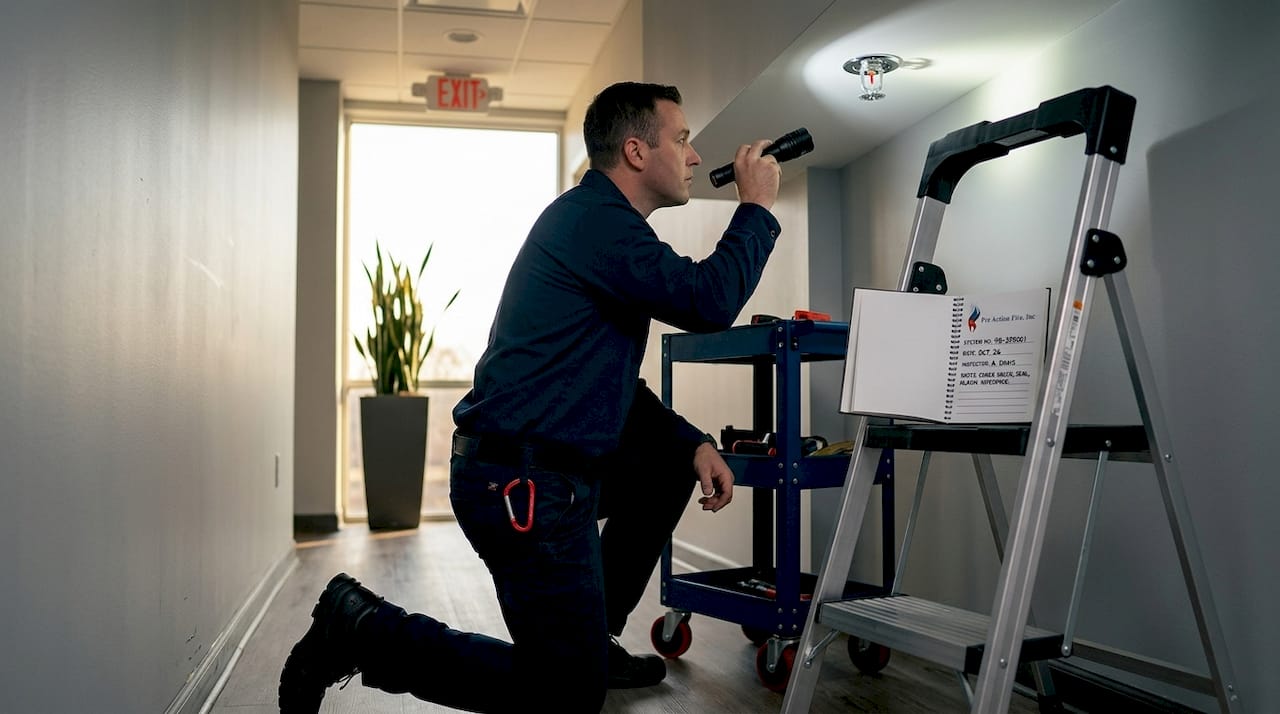
Pre-action systems add a layer of verification before water releases, making them suitable for data centers and archival storage where water damage is nearly as costly as fire damage.
Extinguishers and special suppression
Portable fire extinguishers must be classified correctly to match the fire risks present. Class A covers ordinary combustibles, Class B covers flammable liquids, and Class C covers energized electrical equipment. Regular inspections are mandatory and extinguishers must be strategically placed so any occupant can reach one within 75 feet of travel distance for most commercial occupancies.
Special suppression systems deserve attention in restaurant kitchens and server rooms. Wet chemical systems protect cooking equipment from grease fires. Clean agent systems (like FM-200 or Novec 1230) protect electronics without leaving residue. These are not optional upgrades in high-risk occupancies. They are code requirements.
Pro Tip: Do not size your sprinkler system only for current use. If you plan to reconfigure warehouse storage height or change occupancy type, your sprinkler density requirements will change and retrofits are expensive.
4. Passive fire protection components
Active systems detect and suppress. Passive systems slow down how fast a fire can spread, buying time for evacuation and suppression. Both categories are required by code; neither is a substitute for the other.
| Component | Primary function | Code standard | Maintenance requirement |
|---|---|---|---|
| Fire dampers | Seal HVAC ducts during fire to block spread | NFPA 80, IFC | Inspect every 4 years (6 years first cycle) |
| Fire-rated walls | Contain fire within a compartment for rated duration | IBC fire resistance ratings | Visual inspection during building permits |
| Fire doors | Maintain compartment integrity at openings | NFPA 80 | Annual inspection required |
| Fire-rated floors/ceilings | Prevent vertical fire spread between stories | IBC | Inspect any penetration repairs |
Fire dampers seal at 72°C and can maintain fire integrity and insulation for up to 120 minutes when properly specified and installed. That detail is critical: improperly installed fire dampers can undermine your entire compartmentation strategy. The damper must match the wall’s fire rating and the ductwork must not bridge a fire barrier without a properly rated assembly.
Smoke causes fatalities faster than fire spread. Passive compartmentation contains both smoke and fire, making it the most underappreciated layer of a complete life safety strategy. Property managers who invest heavily in alarms and sprinklers but cut corners on fire-rated construction are making a costly calculation error.
5. Emergency lighting, exit signage, and evacuation systems
When power fails during a fire, or when smoke fills a corridor, occupants rely entirely on emergency lighting and exit signage to find their way out. This category of emergency safety devices is non-negotiable under both IFC and NFPA 101 (Life Safety Code).
Emergency lighting requirements. Battery-backed emergency lights must activate within 10 seconds of power failure and maintain at least 1 foot-candle of illumination at floor level for a minimum of 90 minutes. NFPA 101 governs path-of-travel illumination, and your local authority having jurisdiction (AHJ) in Colorado may require additional coverage in high-occupancy or complex floor plan buildings.
Exit signs and supplemental systems. Illuminated exit signs must be visible from any point in an exit access corridor. Photoluminescent systems are increasingly used as supplemental signage because they glow during power outages without requiring electricity. They work well in stairwells and long corridors as a complement to powered signs.
Evacuation communication. Voice evacuation is now standard in high-rise buildings and large assembly occupancies in Colorado. Two-way communication between floors and a central fire command station is required in many occupancies above a threshold height.
- Battery backup tested monthly; full load discharge tested annually
- Exit signs inspected monthly for lamp function
- Emergency lighting tested for full 90-minute duration annually
- Voice evacuation systems require periodic message and speaker testing
- Systems with battery backup must comply with NFPA standards and local AHJ requirements
Digital monitoring aids maintenance tracking for battery-powered alarm components and lighting systems, flagging units that need replacement before they fail an inspection. For larger Colorado properties managing dozens or hundreds of devices, this is a real operational advantage.
My take on what actually separates effective fire safety from compliant-on-paper
I have seen properties that passed their annual inspection and still had serious vulnerabilities. And I have seen properties with older equipment that were genuinely safer because the systems were maintained and tested with discipline. The paperwork matters far less than whether the systems will actually work at 2 a.m. on a Tuesday.
The biggest mistake I observe is treating fire and life safety components as separate purchases rather than as one integrated system. A smoke detector that triggers an alarm but does not signal the HVAC to close fire dampers is a gap. Integrated systems testing verifies those signal chains actually work. Without it, you are relying on hope.
My honest recommendation: budget for lifecycle management from day one. The cost of replacing batteries, testing dampers, and scheduling sprinkler inspections is small relative to a failed compliance audit or, worse, a fire where your systems did not perform as expected. Ongoing maintenance programs are not overhead. They are the actual product you are buying when you invest in fire safety.
— Preactionfire
Protect your Colorado property with expert fire safety solutions
If you are sorting through which fire and life safety components your building actually needs, or whether your current systems meet the latest Colorado and NFPA requirements, the team at Preactionfire can help.
Pre Action Fire has served the Denver Metro Area since 2009, and their NICET-certified technicians work across new construction and retrofits for commercial and industrial properties. Whether you need fire alarm system installation and compliance verification, professional sprinkler installation in Arvada, or guidance on extinguisher selection and placement, they bring the code knowledge and field experience to get your facility compliant and genuinely protected. Contact Preactionfire to schedule a consultation.
FAQ
What are the main fire and life safety components in commercial buildings?
The main fire and life safety components include smoke detectors, fire alarm control panels, automatic sprinkler systems, portable fire extinguishers, fire dampers, fire-rated walls and doors, emergency lighting, and exit signage. Each component addresses a different phase of fire detection, suppression, or evacuation.
How often should fire and life safety systems be inspected in Colorado?
Most fire protection components require annual inspection under the International Fire Code and NFPA standards. Fire dampers require inspection every four years after the initial six-year cycle, while emergency lighting and exit signs require monthly functional checks and annual full-load tests.
What is the difference between active and passive fire protection?
Active fire protection components, such as sprinklers and alarms, respond dynamically to a fire event. Passive components, including fire-rated walls, fire doors, and fire dampers, are structural elements that contain fire and smoke spread by design and require no activation to function.
Why do dual-sensor smoke detectors outperform single-technology units?
Dual-sensor detectors combine photoelectric and ionization technologies, catching both slow smoldering fires and fast-flaming fires more reliably than any single-technology detector. For most Colorado commercial applications, they offer the broadest detection coverage with fewer nuisance alarms.
What happens if fire and life safety components are not properly integrated?
System integration failures are one of the most common causes of emergency response breakdowns. When components are not properly connected, a smoke detector may trigger an alarm without signaling the HVAC system to close fire dampers, allowing smoke to spread through ductwork and compromising the entire compartmentation strategy.