
TL;DR:
- Passive fire protection works silently within building structures to contain fire and smoke without activation. It includes fire-rated assemblies, fire doors, dampers, and firestopping, which require ongoing inspection and maintenance to ensure compliance. Properly integrated PFP significantly enhances fire safety, reduces violations, and supports Colorado buildings in meeting code requirements.
Most property owners and facility managers focus their fire safety budgets on sprinkler systems and alarm panels. Both are critical, no question. But there’s a category of fire protection that works silently behind your walls, above your ceilings, and inside your floors, and it never makes a sound until the day it matters most. Passive fire protection (PFP) is built into the structure of your building, and without it, even the best active systems face an uphill battle. For Colorado commercial properties, fire-rated assemblies ensure IBC and NFPA compliance and form the structural backbone of any responsible fire safety plan.
Table of Contents
- What is passive fire protection?
- Key components of passive fire protection in commercial buildings
- How passive fire protection helps you meet Colorado codes
- Best practices for inspection and maintenance of PFP systems
- Why most buildings underuse passive fire protection
- Colorado fire protection solutions for your property
- Frequently asked questions
Key Takeaways
| Point | Details |
|---|---|
| Core definition | Passive fire protection uses fire-resistant construction to contain fire and smoke, complementing active alarms and sprinklers. |
| Compliance focus | Colorado commercial buildings must meet IBC/NFPA codes for fire-rated assemblies and regular inspections. |
| Maintaining effectiveness | Routine inspection and prompt repair of penetrations and fire doors are critical for ongoing safety. |
| Common risks | Neglecting PFP maintenance, especially after renovations, is a leading cause of safety failures. |
| Expert support | Partnering with local fire protection professionals ensures full legal compliance and durable safety. |
What is passive fire protection?
Passive fire protection refers to building materials, assemblies, and features that contain or slow the spread of fire and smoke without needing to be activated. Unlike sprinklers that discharge water or alarms that sound an alert, PFP works whether anyone is present or not. It’s designed into the building itself.
The primary goal of PFP is compartmentalization, which means dividing a building into fire-resistant zones so that a fire starting in one area cannot quickly engulf an adjacent space. This buys time. Time for occupants to evacuate, time for first responders to arrive, and time to limit property damage. Three functions make PFP essential:
- Compartmentalization: Fire-rated walls and floors divide a building into zones that contain a fire within a defined boundary.
- Smoke containment: Smoke is responsible for the majority of fire fatalities. PFP systems like smoke seals and fire dampers limit smoke movement through a structure.
- Structural integrity: Certain PFP measures, like fire-resistive coatings on steel beams, protect load-bearing elements so a building doesn’t collapse prematurely during a fire.
Here’s how passive and active fire protection compare:
| Feature | Passive fire protection | Active fire protection |
|---|---|---|
| Activation | Always in effect | Triggered by heat, smoke, or manual action |
| Examples | Fire-rated walls, fire doors, firestop sealants | Sprinklers, alarms, suppression systems |
| Primary role | Contain and slow fire spread | Detect and suppress fire |
| Maintenance need | Periodic inspection | Regular testing and servicing |
| Code requirements | IBC, NFPA 101, NFPA 5000 | NFPA 13, NFPA 72 |
Colorado’s commercial building code aligns closely with national International Building Code (IBC) and NFPA standards. The one notable area of divergence is in Wildland Urban Interface (WUI) zones, where buildings face elevated exterior fire exposure, and local codes may layer on additional requirements for exterior wall assemblies and openings. If your property sits near the foothills or in a WUI-designated area, that’s a conversation worth having with a fire protection professional who knows fire protection in new construction and local code nuances.
Pro Tip: Any hole cut through a fire-rated wall for a new cable, pipe, or duct dramatically reduces the effectiveness of that assembly. Unsealed penetrations are among the most cited PFP violations during inspections.
Consider fire suppression systems as your partner to PFP. Active suppression slows fire growth while PFP limits where that fire can travel. Together, they form a layered defense that neither could provide alone.
Key components of passive fire protection in commercial buildings
With a clear understanding of what passive fire protection means, it’s time to look at the major components you’ll encounter in Colorado buildings and why each one matters for code compliance.
Fire-rated assemblies are walls, floors, and ceiling systems that carry a time rating, typically one or two hours, meaning they’re tested to resist fire penetration for that duration. A two-hour wall assembly between a parking garage and an occupied office space is a standard IBC requirement. These ratings are assigned based on standardized testing, and substituting materials without verification can void the assembly’s rating entirely.
Fire doors and hardware are often overlooked but critically important. A fire door is a rated assembly on its own. It must be properly labeled, self-closing, and latching to perform correctly. A propped-open fire door or one with a broken self-closer is essentially a hole in your fire barrier. Dampers serve a similar role inside ductwork and HVAC systems, closing automatically when a fire or smoke sensor signals them to block the spread through the mechanical system.
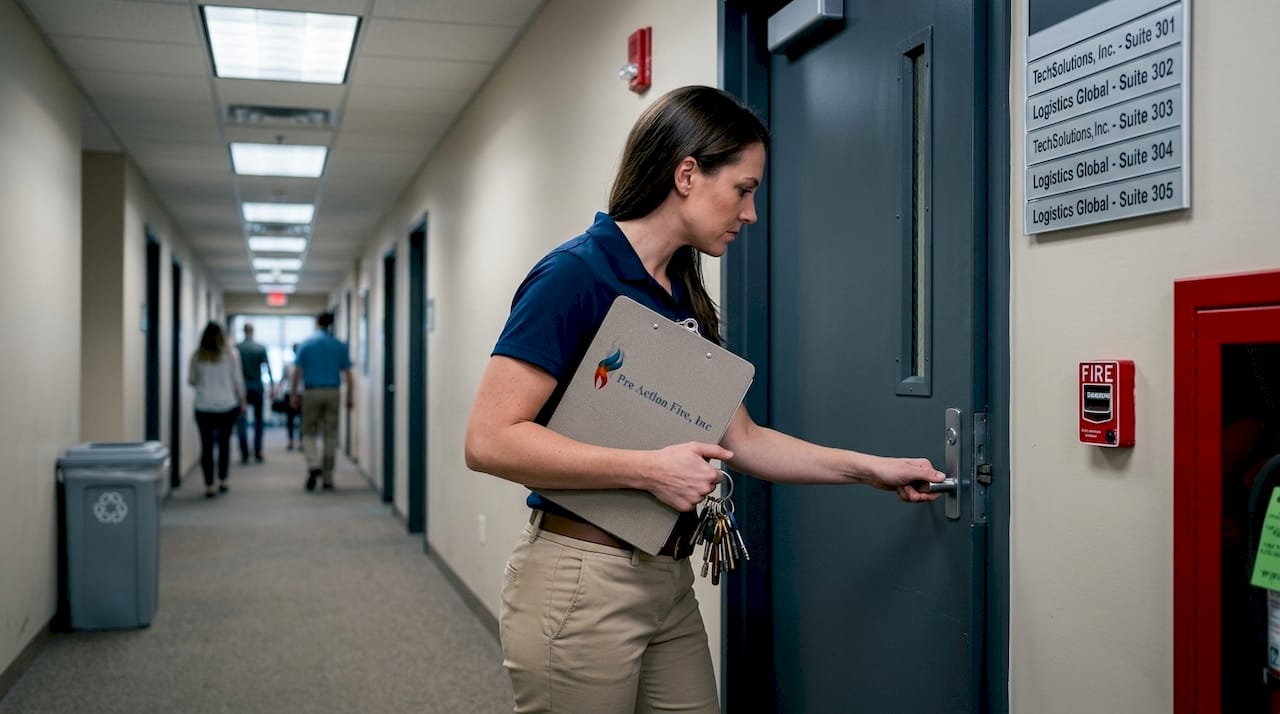
Firestopping and joint systems are where many commercial buildings quietly fail over time. Every time a contractor runs new conduit, pipes, or ductwork through a fire-rated floor or wall, that penetration must be sealed with listed firestop materials. The same applies to construction joints between rated assemblies. Inspecting penetrations and doors is a primary focus of code compliance reviews for exactly this reason.
Fire-rated glazing is used in stairwells, corridors, and other locations where code requires transparency but also a fire rating. Standard glass fails within minutes under fire conditions. Rated glazing is required in specific locations under IBC and must carry the appropriate label.
Here’s a quick summary of common PFP components and their purpose:
| Component | Function | Typical rating |
|---|---|---|
| Fire-rated wall | Compartmentalize occupancy zones | 1 to 4 hours |
| Fire door assembly | Close off openings in rated walls | 20 minutes to 3 hours |
| Firestop sealant | Seal penetrations in rated assemblies | Matches wall assembly rating |
| Fire damper | Block duct openings in rated walls or floors | 1.5 to 3 hours |
| Fire-rated glazing | Rated transparency in doors and walls | 20 minutes to 2 hours |
Pro Tip: Build annual visual inspections of all PFP components into your calendar. A quick walk-through of mechanical rooms, stairwells, and recently renovated spaces can catch issues before they become official violations. Reviewing your Colorado fire code requirements alongside your inspection notes keeps everything organized and audit-ready.
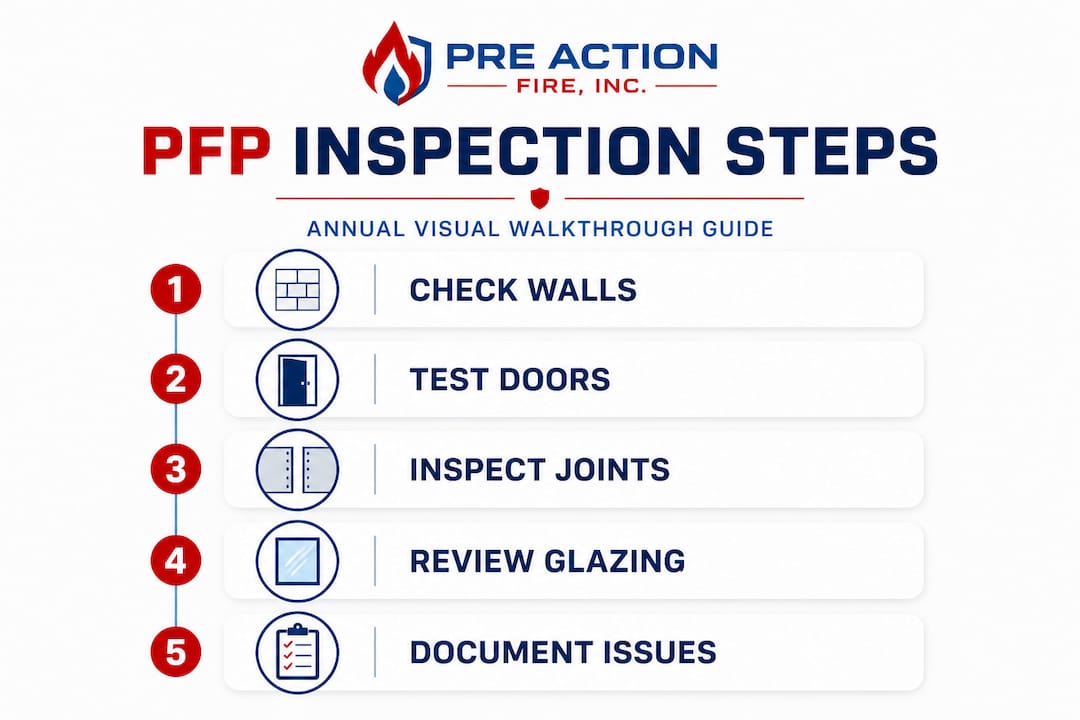
Understanding the fire risks in Colorado properties specific to your building type, whether it’s a high-rise, a warehouse, or a mixed-use development, helps prioritize which PFP components deserve the most attention in your maintenance schedule.
How passive fire protection helps you meet Colorado codes
After breaking down each vital PFP component, let’s focus on how these pieces work together to satisfy Colorado’s fire safety requirements and avoid costly citations.
The IBC and NFPA codes don’t treat PFP as optional. For commercial buildings, PFP is required through fire-rated assemblies that are specified based on occupancy type, building height, construction type, and floor area. Fail to maintain those assemblies after the initial build, and you’re out of compliance even if nothing has visibly changed.
What fire inspectors look for comes down to a few consistent priorities:
- Integrity of fire barriers: Are fire-rated walls and floor assemblies intact? No missing sections, no obvious damage from water, mechanical contact, or renovations.
- Firestopping at penetrations: Is every pipe, conduit, and duct penetration through a rated assembly properly sealed with a listed product?
- Fire door compliance: Does each door in a rated assembly have a visible label, a working self-closer, a proper latch, and clearance gaps within code limits?
- Damper documentation: Are fire and smoke dampers labeled, accessible for inspection, and tested on the required schedule?
- Documentation records: Can you show inspection logs, repair records, and the original rated assembly documentation?
“A single breach in a fire-rated wall can compromise an entire floor’s safety strategy.” This isn’t an exaggeration. Compartmentalization is only as strong as its weakest point. One unsealed conduit penetration in a two-hour wall reduces that wall’s actual performance in a real fire scenario.
Common compliance failures in Colorado commercial properties include unsealed penetrations after tenant buildouts, fire doors wedged open, missing firestop material where new electrical runs were installed, and damaged wall sections that were patched with non-rated materials. These issues often accumulate gradually, especially in active buildings where contractors come and go.
Preparing for a fire inspection doesn’t have to be stressful. Follow these steps to get ahead of it:
- Pull your original construction documents and identify every fire-rated assembly in the building.
- Walk each rated wall and floor, checking for any visible damage, gaps, or penetrations.
- Test every fire door in rated corridors and stairwells for self-closing and latching function.
- Verify that all penetration seals are labeled and intact, and request documentation from contractors for any recent work.
- Compile all inspection records and repair logs into a single file that can be shown to an inspector on request.
Following structured fire protection compliance steps makes this process repeatable and manageable, not a scramble every time an inspection comes up.
Best practices for inspection and maintenance of PFP systems
Staying compliant means not just installing PFP, but also frequently checking and maintaining it. Here’s how to make that process efficient and worry-free for Colorado facilities.
Passive fire protection doesn’t have a dashboard. There’s no indicator light that turns red when a firestop seal degrades or a fire door hinge wears out. That invisibility is exactly why consistent maintenance practices matter more for PFP than almost any other building system.
Here’s what a solid annual PFP review should include:
- Fire-rated door inspection: Check labels, self-closers, latches, door clearances, and hinge condition. Replace worn hardware immediately.
- Wall and floor penetration audit: Document every penetration in rated assemblies and verify each one is sealed with a listed firestop product. Pay extra attention to areas where recent work has occurred.
- Damper testing: NFPA 80 and NFPA 105 require regular testing of fire and smoke dampers. Schedule this with a qualified technician.
- Joint and seam inspection: Construction joints, head-of-wall joints, and expansion joints in rated assemblies need periodic review for cracking or separation.
- Documentation update: Record every inspection result, repair performed, and product used. Keep it organized and accessible.
“Post-renovation periods are the highest-risk window for PFP failures. Every time a wall is opened, a contractor has the opportunity to leave a penetration unsealed.”
Watch for these common post-construction vulnerabilities:
- New IT cabling run through mechanical room walls without firestop
- Plumbing upgrades that left old penetration seals in place next to new pipes
- HVAC modifications that changed duct routing through rated floors
- Drywall patches made with non-rated compounds after equipment removal
Staff training is a piece of this equation that gets skipped more than it should. Maintenance staff and building engineers should be able to recognize a compromised fire barrier and know who to report it to. A damaged firestop seal in a server room or a self-closer stripped from a stairwell door should generate the same urgency as a tripped circuit breaker.
Use checklists and calendar reminders to prevent missed inspections. Building managers who integrate PFP into their standard building fire safety strategies avoid the reactive scramble that follows a failed inspection. A thorough fire risk assessment annually gives you a structured format to evaluate PFP alongside active systems, occupancy changes, and building modifications.
Why most buildings underuse passive fire protection
Here’s an uncomfortable pattern we’ve observed over years of working with Colorado commercial properties. When it’s time to invest in fire safety, property owners almost always gravitate toward active systems. New sprinkler heads, upgraded alarm panels, emergency lighting. Those systems are visible. You can demonstrate them during a walk-through, test them in real time, and point to them during an inspection. PFP offers none of that theatre.
That visibility bias has real consequences. Fire doors get their self-closers disabled because someone finds them inconvenient. Penetrations get left unsealed because a contractor assumed someone else would handle it. Firestopping materials get substituted for whatever caulk is available in the truck because the rated product wasn’t on hand. None of these failures are malicious. They’re the predictable result of treating PFP as a “set-and-forget” system rather than something that requires the same operational attention as any other building safety component.
The facility managers who get this right have shifted their mindset from compliance as a one-time event to compliance as an ongoing practice. They schedule fire safety code reviews quarterly, not annually. They include PFP in their standard work order process so that any contractor touching a rated assembly is automatically required to document their firestopping. They treat a reported crack in a fire-rated wall with the same seriousness as a failed smoke detector.
The insurance angle is worth naming directly. Buildings with documented, maintained PFP programs see measurably fewer surprises during underwriting reviews and loss assessments. That’s not a soft benefit. It translates to lower premiums and faster claims resolution when something does go wrong.
Building a culture where staff report ceiling and wall damage as readily as they report a faulty alarm is a leadership decision. It starts with training, continues with systems, and solidifies when managers visibly act on reports rather than deferring them.
Colorado fire protection solutions for your property
Passive fire protection compliance is built on details, and those details add up quickly across a large commercial facility. One missed penetration or a fire door that doesn’t fully latch can become the citation that leads to a mandatory correction order.
At Pre Action Fire, Inc, we’ve been serving the Denver Metro Area since 2009 with NICET-certified technicians who understand both the technical side of fire protection and the specific code landscape in Colorado. Whether you need Arvada fire sprinkler installation, a full review of fire alarm systems for Denver businesses, or scheduled Denver fire safety inspections that cover both active and passive systems, we offer the complete range of services that keep your property compliant and your occupants protected. Contact us to schedule a consultation and get a clear picture of where your building stands.
Frequently asked questions
What is an example of passive fire protection?
A two-hour fire-rated wall separating a parking structure from an occupied commercial space is a standard example, engineered to contain a fire within one zone for a specified period.
How often should passive fire protection systems be inspected?
Annual visual inspections are the minimum, but inspecting after renovations or any work that touches rated walls, floors, or doors is equally important to maintain compliance.
Are Colorado’s passive fire protection requirements different from other states?
Colorado follows IBC and NFPA standards for PFP in commercial buildings, with additional considerations in Wildland Urban Interface zones where exterior fire exposure risk is elevated.
What is the biggest mistake in passive fire protection for businesses?
Leaving penetrations unsealed after renovations is the most common and consequential oversight, as even a single gap in a rated wall assembly can undermine the entire compartmentalization strategy for that floor.
Recommended
- Colorado building fire protection: 5-step compliance guide
- Industrial fire protection for Colorado sites: A compliance guide
- Building fire safety in Colorado: compliance and risk reduction
- Fire protection for new construction: compliance and safety
- Cumple la normativa de humedades en construcción 2026