
TL;DR:
- Proper hazard assessment ensures the right fire extinguisher types for any facility.
- Colorado’s local codes and inspections require compliance with NFPA 10 and specific jurisdiction standards.
- Regular maintenance, staff training, and a safety culture are crucial for effective fire response.
A Denver restaurant owner once faced a $12,000 fine after a routine fire inspection revealed that CO2 extinguishers had been installed in a commercial kitchen, where Class K agents are specifically required for cooking oil fires. The equipment looked professional, passed a visual glance, and had been serviced. But it was simply wrong for the hazard. For property managers and business owners in Colorado, choosing the right fire extinguishers is not just a safety decision, it is a legal and financial one. This guide walks you through hazard assessment, extinguisher matching, Colorado compliance codes, and the maintenance routines that keep your facility protected and inspection-ready.
Table of Contents
- Assess your facility’s fire hazards
- Match extinguisher types to fire classes
- Understand Colorado codes and compliance standards
- Ensure proper maintenance and inspection practices
- A practical approach most miss: People and process matter
- Connect with fire safety experts for tailored solutions
- Frequently asked questions
Key Takeaways
| Point | Details |
|---|---|
| Start with hazard assessment | Identifying your facility’s risks is the first step to proper fire extinguisher selection. |
| Match type to fire class | Choose an extinguisher agent based on the specific fire hazards present in each area. |
| Know your codes | Check both local and national fire safety codes to stay compliant and avoid fines. |
| Maintain and document | Regular inspection and recordkeeping are crucial for both safety and legal requirements. |
| Involve your people | Staff training ensures equipment is used correctly in an emergency. |
Assess your facility’s fire hazards
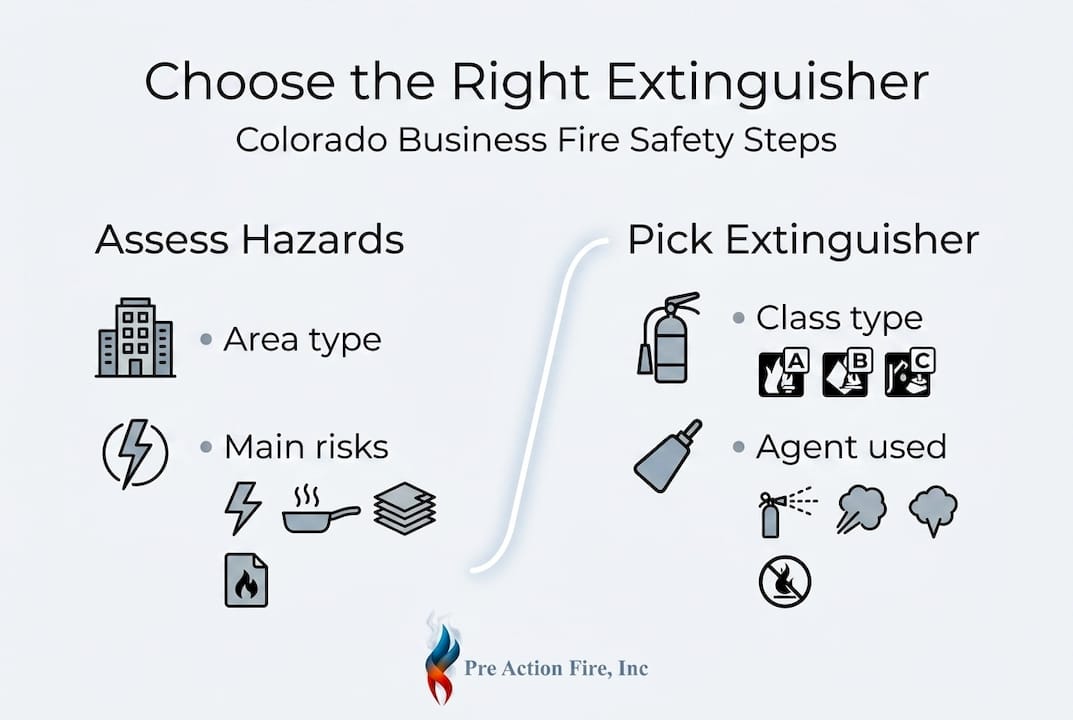
Before you order a single extinguisher, you need to understand exactly what you are protecting against. A fire protection planning guide confirms that the first step is always to identify fuels, processes, and occupancy type. Skipping this step is how facilities end up with the wrong equipment.
A hazard assessment is not optional. NFPA 10 and the International Fire Code both require it as part of a documented fire protection plan. Think of it as the blueprint that drives every other decision, from where extinguishers are mounted to which agents are used.
Here are the key questions to ask during your assessment:
- What combustible materials are stored or used on-site? (paper, wood, flammable liquids, metals)
- Are there cooking operations, chemical processes, or electrical equipment present?
- What is the building’s square footage and how is it divided into occupancy zones?
- Are there areas where employees cannot quickly access an extinguisher within 75 feet of travel?
- Does any part of the facility handle materials that react with water, such as lithium or magnesium?
Once you have those answers, you can build a simple hazard inventory. Here is an example of how common facility hazards map to extinguisher classes:
| Facility area | Primary hazard | Recommended class |
|---|---|---|
| Office space | Paper, furniture, electrical equipment | A, C |
| Commercial kitchen | Cooking oils and fats | K |
| Warehouse with chemicals | Flammable liquids | B |
| Server or data room | Electrical equipment | C |
| Metal fabrication shop | Combustible metals | D |
| Parking garage | Fuel, oil, ordinary combustibles | A, B, C |
For most standard commercial buildings, an ABC-rated multipurpose extinguisher covers the majority of zones. Industrial environments are where the complexity increases.
Pro Tip: If your facility handles more than one type of special hazard, such as both cooking operations and chemical storage, bring in a certified technician to review the full layout. A professional assessment takes roughly two hours and can prevent years of compliance headaches.
Local code matters: Colorado does not have a single statewide fire code. Your authority having jurisdiction (AHJ), which is typically your city or county fire marshal, determines which version of the IFC or NFPA 10 is currently enforced. Always verify with them before finalizing your extinguisher plan.
Match extinguisher types to fire classes
Once hazards are identified, the next step is matching them with the correct extinguisher types. Fire classes were created specifically so that facilities could systematically pair the right suppression agent to each risk. Extinguishers must be selected based on the fire classes that are actually present in each area.
Here is a quick reference for commercial facilities:
| Fire class | What burns | Suitable extinguisher agent |
|---|---|---|
| A | Wood, paper, cloth, plastics | Water, ABC dry chemical, foam |
| B | Flammable liquids, gases | CO2, dry chemical, foam |
| C | Electrical equipment, wiring | CO2, dry chemical (non-conductive) |
| D | Combustible metals (magnesium, lithium) | Dry powder (specific to the metal) |
| K | Cooking oils and fats | Wet chemical |
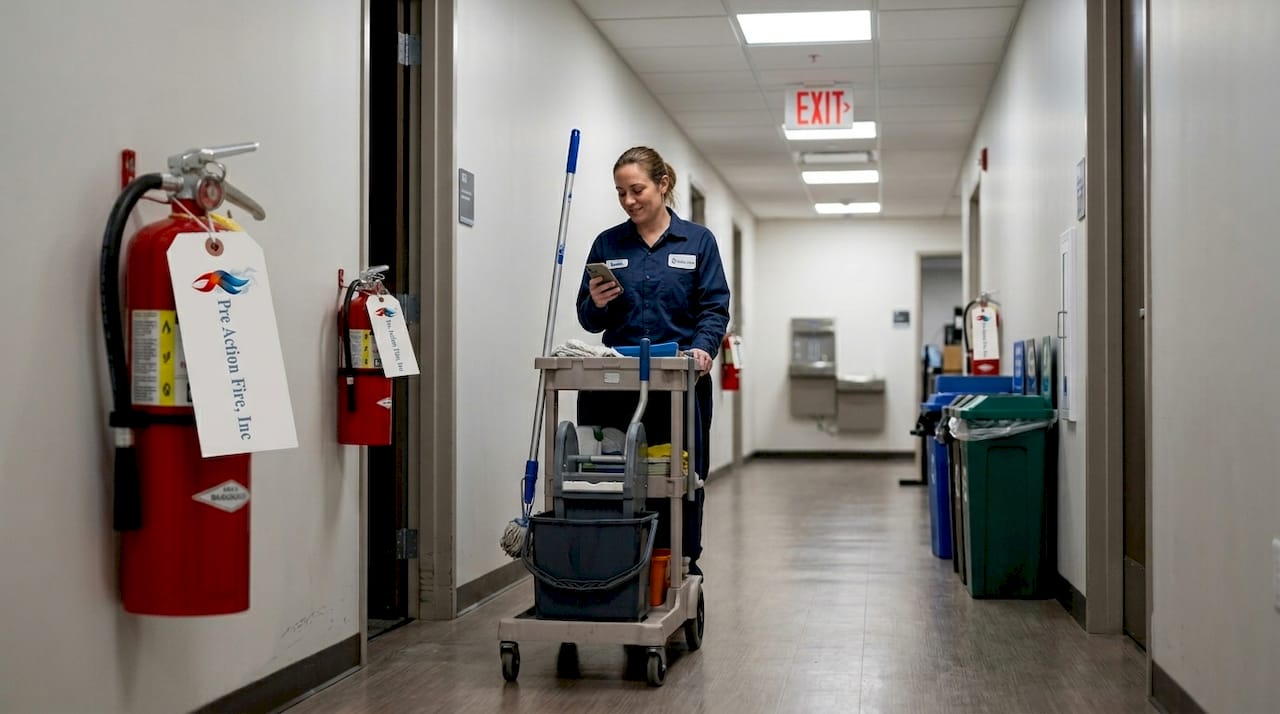
The most common choice for general commercial buildings is the ABC multipurpose dry chemical extinguisher. It covers Classes A, B, and C in a single unit. However, relying on multipurpose units everywhere is a mistake in facilities that have specialty hazards. A Class K wet chemical extinguisher is mandatory in commercial kitchens, and a Class D unit must be matched to the exact metal it will suppress.
Learn more about the full range of types of fire extinguishers and their ratings before making final purchasing decisions.
Follow these steps to match extinguisher types to your specific areas:
- List every distinct zone in your building (kitchen, server room, warehouse bay, office floor, parking area).
- Assign the dominant fire class to each zone based on your hazard assessment.
- Select the appropriate agent for each zone from the table above.
- Cross-reference with the manufacturer’s rating (look for the UL listing label on the unit).
- Confirm placement so that no employee must travel more than 75 feet to reach the correct unit.
Pro Tip: Use colored zone markers or floor plan labels that correspond to each extinguisher type. When inspectors visit or new staff are onboarded, this visual system makes training faster and reduces the chance that someone grabs the wrong unit in an emergency. You can read more about fire extinguisher roles in commercial settings to support your staff training.
Understand Colorado codes and compliance standards
Having selected the right extinguishers, it is essential to ensure your decisions comply with the overlapping Colorado and national fire codes. The regulatory landscape here is more nuanced than most business owners expect.
Colorado has no single statewide fire code. Instead, local jurisdictions adopt IFC/NFPA standards, with cities like Denver, Aurora, and Colorado Springs each specifying which edition they enforce. This means a building in Denver could face a different inspection checklist than an identical building in Lakewood.
The key standards you must know:
- NFPA 10: The national standard for portable fire extinguishers. Covers selection, placement, inspection intervals, and maintenance. This is the most referenced document during commercial inspections in Colorado.
- OSHA 1910.157: Applies specifically to employee access and training in workplaces. If your employees may be expected to use an extinguisher, OSHA mandates annual training and specific placement requirements.
- International Fire Code (IFC): Most Colorado municipalities adopt the IFC, which references NFPA 10 for extinguisher specifics.
- Local amendments: Your AHJ may add or modify requirements. Always request the current local ordinance.
One practical distinction worth understanding is prescriptive vs. performance-based compliance. Prescriptive compliance means following specific rules: this many extinguishers, this spacing, this rating. Performance-based compliance allows alternative designs if you can demonstrate equivalent safety outcomes through engineering analysis.
Recommendation for most Colorado commercial facilities: Choose prescriptive compliance. It is faster, cheaper, and far easier to verify during inspections. Performance-based approaches are best reserved for unique industrial buildings where standard placement rules create physical conflicts.
To verify compliance ahead of an inspection, review your NFPA compliance inspection documentation, confirm that all units are UL-listed and appropriate for their zones, and ensure your records reflect the required inspection intervals.
Ensure proper maintenance and inspection practices
Beyond initial selection, ongoing safety hinges on reliable inspection and maintenance routines. An extinguisher that was correct at installation can become a liability if maintenance is deferred.
Here are the required maintenance intervals under OSHA 1910.157 and NFPA 10:
- Monthly visual inspection: Check that the unit is in its designated location, the pin and tamper seal are intact, the pressure gauge reads in the green zone, and there is no visible damage.
- Annual professional inspection: A certified technician examines the internal components, checks the agent charge, and tags the unit with the inspection date.
- Six-year internal examination: Dry chemical extinguishers require a complete internal examination and recharge every six years.
- Hydrostatic testing: Depending on the type, hydrostatic tests are required every 5 to 12 years to verify cylinder integrity under pressure.
Documentation is not optional. NFPA 10 requires that all inspections, maintenance, and testing be recorded and retained. Inspectors will ask for these records. Missing paperwork is treated the same as a missed inspection.
Here are the key points for managing your records and training:
- Keep inspection tags on each unit and maintain a master log in a centralized location.
- Store digital records in a cloud-based system so they cannot be lost in a building emergency.
- Train all employees annually on extinguisher locations, fire classes, and the PASS technique (Pull, Aim, Squeeze, Sweep).
- Designate a specific staff member as the fire safety coordinator to own the inspection calendar.
The updated 2026 NFPA 10 now allows electronic monitoring and automated inspection tracking. This means sensor-equipped extinguishers can report status in real time, reducing missed monthly checks. If you manage multiple buildings across Colorado, this technology can dramatically reduce oversight gaps.
Pro Tip: Set calendar reminders 30 days before each required inspection is due, not on the due date. This gives you time to schedule a certified technician without rushing. Explore electronic inspection options and check the full range of fire safety inspections available in the Denver Metro Area.
A practical approach most miss: People and process matter
After all the technical steps, there is one factor that determines the actual outcome in an emergency: whether the people in the building know what to do.
We have seen facilities in the Denver Metro Area that had perfectly rated extinguishers mounted in compliant locations, yet staff had never touched one. When a small kitchen fire broke out, two employees ran past three extinguishers looking for a phone. The fire doubled in size before anyone acted.
Compliance gets you the right equipment. Culture gets you the right response. The businesses that consistently perform well during emergencies share a few behaviors: they integrate extinguisher training into onboarding, not just annual safety meetings. They post visible floor maps showing every unit’s location. And leadership treats fire safety culture as an operational priority, not a checkbox.
Transparent recordkeeping matters too. When every employee can see that inspections are current and leadership cares enough to maintain the system, safety becomes a shared value rather than a compliance burden. That shift in mindset is what separates facilities that contain small fires from those that make insurance claims.
Connect with fire safety experts for tailored solutions
Navigating extinguisher selection, Colorado code compliance, and ongoing inspection requirements is a lot to manage alongside running a business. Getting expert guidance means you do not have to interpret NFPA 10 alone or guess which version of the IFC your city has adopted.
Pre Action Fire, Inc. has served the Denver Metro Area since 2009 with NICET-certified technicians who specialize in commercial and industrial fire protection. From helping you choose fire extinguisher types that match your facility’s specific hazards to scheduling professional fire extinguisher inspections, the team provides practical, code-backed solutions. Explore fire safety education resources or contact us directly to schedule a compliance review. Getting a professional set of eyes on your facility is the most efficient way to close any gaps before your next inspection.
Frequently asked questions
What is the best type of fire extinguisher for an office in Colorado?
An ABC multipurpose extinguisher is typically best since it handles the most common office hazards, including paper, furniture, and electrical equipment, in a single unit.
How many fire extinguishers are required in a commercial building?
The number depends on square footage, occupancy type, and layout. Under NFPA 10 placement rules, one unit is generally required within 75 feet of travel distance in any direction for Class A hazards.
How often do fire extinguishers need to be inspected in Colorado?
Monthly visual checks and annual professional inspections are the baseline. Additional periodic tests such as six-year internal examinations and hydrostatic testing are also required depending on the extinguisher type.
Do Colorado fire codes differ by city?
Yes. Because there is no statewide Colorado code, each city or county adopts its own version of the IFC or NFPA standards. Always confirm requirements directly with your local fire authority.
Can I automate fire extinguisher inspections in 2026?
Yes. The updated NFPA 10 now permits electronic monitoring and automated inspection tracking, which is especially useful for facilities managing extinguishers across multiple locations.