

TL;DR:
- Fire alarm retrofitting involves upgrading specific components within an existing system to maintain safety and compliance. It avoids full replacement unless the system is at or beyond its end-of-life, which can be more costly and disruptive. Proper planning, understanding AHJ requirements, and timely assessment help ensure cost-effective, compliant fire alarm maintenance.
Most facility managers hear “fire alarm retrofit” and immediately picture a full system tear-out, weeks of disruption, and a six-figure invoice. That assumption stops a lot of necessary safety work from happening. Fire alarm retrofitting is actually a targeted process of upgrading specific components within an existing system rather than replacing everything at once. It keeps your building compliant, your occupants safe, and your budget intact. This guide breaks down exactly what is fire alarm retrofitting, when it applies, and how to approach it strategically.
Table of Contents
- Key takeaways
- What is fire alarm retrofitting and when does it apply?
- Technical and regulatory considerations
- Retrofit vs. full replacement: which makes sense?
- Planning a fire alarm retrofit the right way
- My perspective on retrofitting done right
- Fire alarm retrofitting services from Preactionfire
- FAQ
Key takeaways
| Point | Details |
|---|---|
| Retrofit vs. replacement | Retrofitting upgrades specific components; full replacement swaps the entire system. |
| Code compliance is the driver | NFPA 72 compliance, occupancy changes, and aging hardware are the most common retrofit triggers. |
| AHJ negotiation is possible | Building owners can often negotiate phased or partial retrofits with the Authority Having Jurisdiction. |
| Testing is mandatory | A 100% functional test is required after any major system modification. |
| Proactive planning saves money | Waiting for a panel failure creates emergency costs. Scheduled retrofits are significantly cheaper. |
What is fire alarm retrofitting and when does it apply?
Fire alarm retrofitting is the process of modifying or replacing specific components of an existing fire alarm system to restore performance, meet current code requirements, or extend the system’s operational life. It is not the same as installing a brand-new system. Retrofitting works within the existing infrastructure wherever possible, targeting only the parts that are failing, obsolete, or non-compliant.
The distinction matters because a lot of property owners treat retrofitting and full replacement as interchangeable terms. They are not. A retrofit might mean swapping an aging fire alarm control panel, upgrading your communication pathway from an old analog phone line to a cellular or IP connection, or adding visual notification devices to meet ADA requirements. The bones of the system stay intact.
Several specific triggers make retrofitting necessary or advisable:
- Aging control panels. Fire alarm control panels typically last 15 to 20 years. Once a panel reaches that range, finding replacement parts gets difficult and repair costs climb fast.
- High repair costs. When repair costs exceed 40 to 50% of replacement cost, a targeted retrofit becomes the smarter financial move.
- Failed inspections or tests. A system that can no longer pass NFPA 72 inspections is a liability and a compliance failure.
- Occupancy or use changes. Converting a warehouse to a mixed-use space, for example, almost always triggers code updates under NFPA 101 and local building codes.
- Communication pathway obsolescence. Thousands of older systems still rely on traditional phone lines (POTS lines) for monitoring. As phone carriers phase out analog service, those systems lose their supervisory signal path and go out of compliance.
- New code adoptions. When a jurisdiction adopts a new edition of NFPA 72 or local amendments to the International Fire Code, existing systems may require upgrades to meet the updated standards.
Pro Tip: Document the age and service history of your fire alarm control panel right now. If it was installed before 2010, you are likely within the window where proactive planning can save you from a costly emergency replacement down the line.
The Authority Having Jurisdiction, commonly called the AHJ, plays a central role in determining what your system actually needs. Your local fire marshal or building official reviews the condition of your system against the current adopted code and decides what level of upgrade is required. Their interpretation matters more than the code text alone.
Technical and regulatory considerations
Understanding the regulatory side of retrofitting fire alarms prevents expensive surprises. NFPA 72 is the national standard governing fire alarm system design, installation, testing, and maintenance. It does not set a fixed age at which a system must be replaced. The standard is condition-based, which is actually good news for facility managers who maintain their systems well.
Here is what NFPA 72 and AHJ protocols require when you modify a fire alarm system:
- Component documentation. Any replaced or modified component must be documented with the part number, installation date, and test results.
- 100% functional testing. A full functional test is required after major modifications such as CPU or motherboard replacement to verify that every initiating device, notification appliance, and supervisory signal works correctly.
- AHJ approval. The Authority Having Jurisdiction must approve the retrofit scope before work begins. Some AHJs treat panel replacement as a new installation, which changes the code requirements that apply. Others allow phased upgrades. You need to know which category your jurisdiction falls into before you commit to a plan.
- Permitting and inspection. A permit is required for significant retrofitting work in virtually every jurisdiction. Inspections follow completion.
“Building owners can make a strong case to AHJs for targeted, code-compliant retrofits rather than a full system overhaul. The goal is life safety, and there are often multiple compliant paths to reach it.”
The components most commonly addressed in a fire safety retrofit include the main fire alarm control panel, initiating devices such as smoke detectors and heat detectors, notification appliances including horn/strobes and speaker/strobes, and communication pathways. Common upgrades involve replacing outdated Dual Alarm Communication Transmitters (DACTs) with cellular or IP communicators, adding visual notification devices to meet ADA requirements, and updating smoke detectors that can no longer meet sensitivity standards.
NFPA 72 requires smoke detector sensitivity testing every one to two years and battery replacement every three to five years. When detectors consistently fail sensitivity tests, they become strong candidates for replacement as part of a broader fire alarm system upgrade plan.
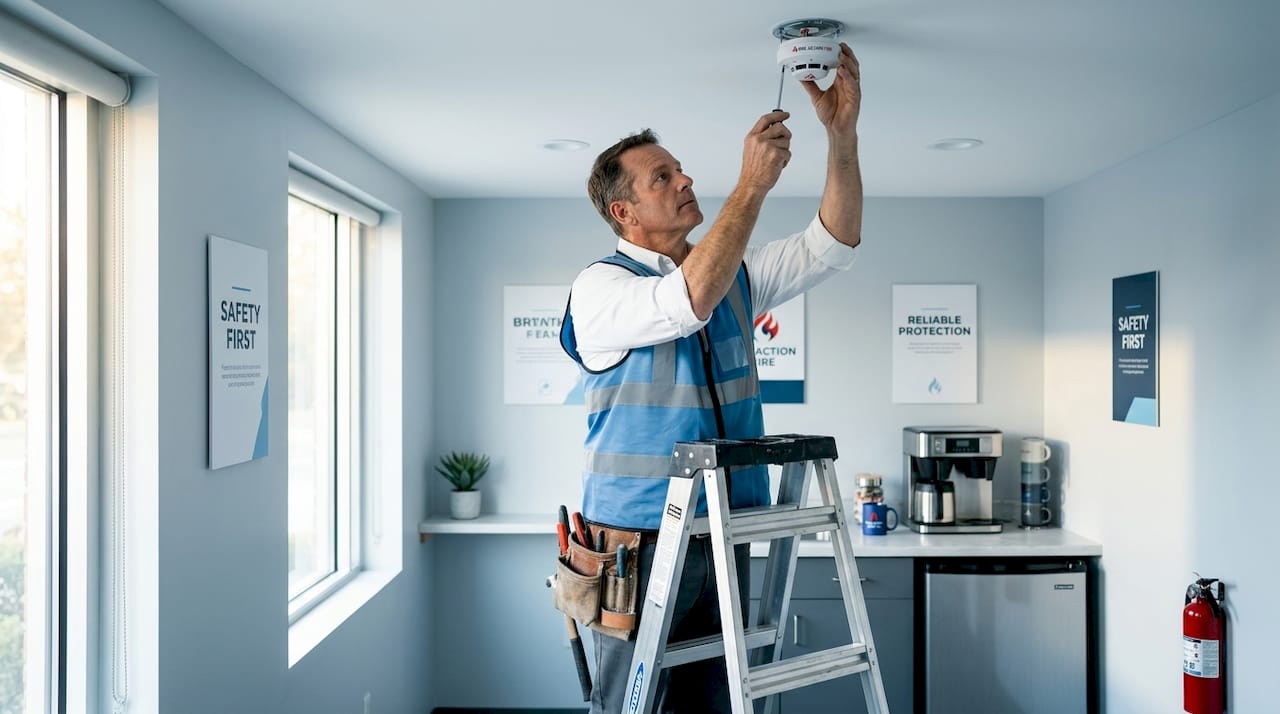
The key point here: fire alarm systems require licensed professionals for design, installation, and inspection under NFPA 72 Chapters 12 and 13. Do not attempt to manage a retrofit without qualified personnel. The post-retrofit functional test alone requires proper documentation to satisfy both your insurance carrier and the AHJ.
Retrofit vs. full replacement: which makes sense?
This is the decision most facility managers actually need help making. Retrofitting and full system replacement each have a legitimate place, and the right answer depends on your system’s age, condition, and the scope of changes the AHJ requires.
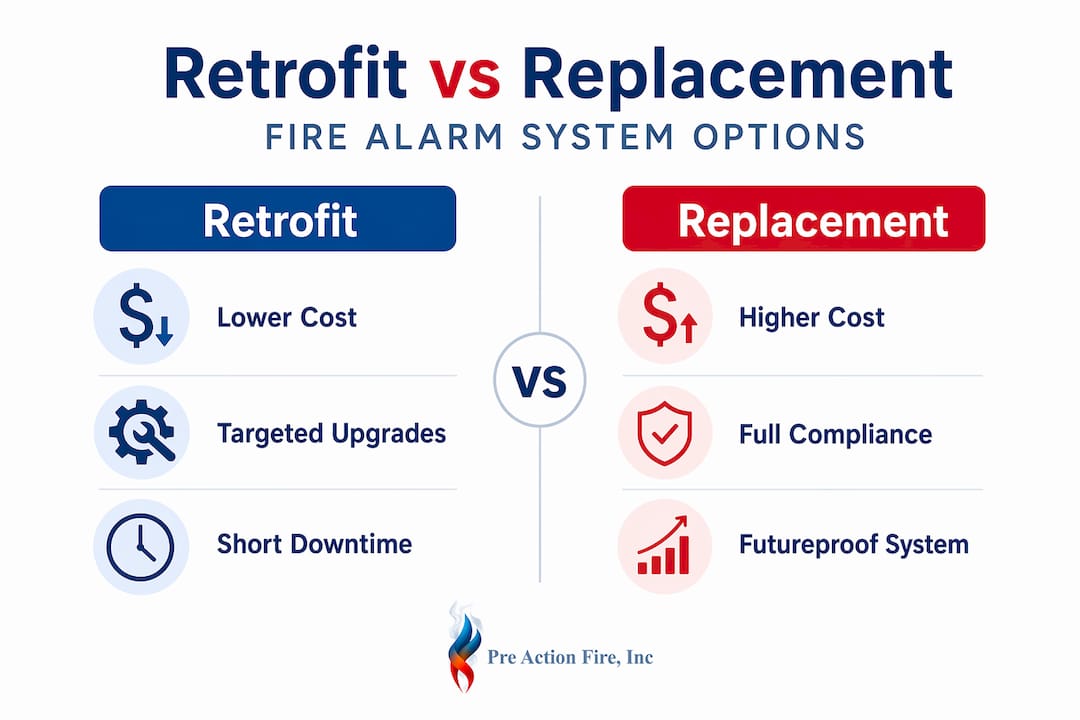
| Factor | Retrofit | Full Replacement |
|---|---|---|
| Cost | Lower upfront cost, targeted spend | Higher initial investment |
| Disruption | Minimal, work proceeds in phases | Significant downtime during installation |
| Best for | Aging but functional systems, single-component failures | End-of-life systems, major occupancy changes |
| Code complexity | Can be negotiated with AHJ | Typically triggers full current-code compliance |
| Future-proofing | May require additional upgrades later | Built to current standards from day one |
| Timeline | Shorter, phase-by-phase work | Longer full installation process |
The financial threshold is straightforward: when repair costs exceed 40 to 50% of what full replacement would cost, a retrofit becomes the better investment. Below that threshold, targeted repairs are usually sufficient. Above it, you’re paying for diminishing returns on aging hardware.
Where retrofitting gets complicated is compatibility. Older panels sometimes cannot communicate cleanly with newer addressable devices or modern network communicators. If your existing panel cannot support the components you need to add, the retrofit cost rises quickly and may approach replacement territory.
Pro Tip: Before committing to either path, get a written assessment from a qualified fire alarm contractor that includes a component-by-component condition report and a cost comparison between targeted retrofitting and full replacement. That document is also useful when presenting options to an AHJ.
Replacing fire alarm control panels may or may not constitute a new installation depending on AHJ interpretation. In jurisdictions where panel replacement triggers new-installation status, you could end up needing to bring the entire system up to the current code edition. In other jurisdictions, a panel swap is treated as a component-level retrofit. That difference can mean tens of thousands of dollars, which is why the AHJ conversation must happen before any contract is signed.
Planning a fire alarm retrofit the right way
Execution matters as much as the decision to retrofit. A well-planned project causes minimal disruption, stays on budget, and passes inspection the first time. A poorly planned one creates the very emergency costs you were trying to avoid.
Start with a thorough assessment of your existing system:
- Pull your system’s as-built drawings and compare them to the installed equipment. Discrepancies between documentation and reality are common in older buildings and must be resolved before new work begins.
- Review your last three years of inspection and testing reports to identify recurring failures or repeated repairs on the same components.
- Confirm which edition of NFPA 72 and which local amendments your jurisdiction has currently adopted.
- Contact your AHJ early. Explain the scope of work you are planning and ask specifically whether a panel replacement in your situation would be classified as a new installation.
Once the assessment is complete, select a contractor with verifiable credentials. Fire alarm installation requirements under NFPA 72 mandate licensed and qualified professionals. Look for NICET-certified technicians specifically. NICET certification is the recognized industry credential for fire alarm system personnel and signals genuine technical competency.
Failing to plan for end-of-life panel replacement leads to emergency upgrades that increase costs and force building downtime at the worst possible time. Manufacturers typically stop supporting legacy panels after 15 to 20 years, making parts increasingly scarce and expensive.
Pro Tip: Schedule your retrofit during lower-occupancy periods where possible. If your building has seasonal patterns or weekend closures, those windows significantly reduce the operational impact of testing and installation work.
After the retrofit is complete, post-retrofit maintenance is not optional. Your contractor should provide updated as-built drawings reflecting every change made. Maintain those records on file alongside your inspection reports. Your AHJ and insurance carrier may request them at any time.
My perspective on retrofitting done right
I’ve watched facility managers spend months agonizing over a retrofit decision while their aging panel quietly moves closer to failure. Here’s what I’ve consistently found: the anxiety is usually disproportionate to the actual complexity of the project.
The misconception that retrofitting fire alarms always requires a full system overhaul causes real harm. It makes property owners delay necessary work, which turns a manageable upgrade into an emergency replacement. Building owners have more flexibility than they realize, and a skilled contractor who understands how to work with the AHJ can find code-compliant solutions that protect life safety without replacing everything.
What I’ve also learned is that the AHJ relationship matters enormously. These officials want compliant buildings. They are not looking for reasons to force expensive full replacements. If you come to a pre-project meeting with a clear scope, qualified contractors, and a plan for post-retrofit testing, most AHJs will work with you on a phased approach.
My strongest recommendation: start planning the moment your system hits the 12-year mark. That gives you time to budget properly, select the right contractor, and have unhurried conversations with your AHJ. The facility managers I’ve seen get this right are the ones who treated retrofitting as routine asset management, not crisis response.
— Preactionfire
Fire alarm retrofitting services from Preactionfire
If your fire alarm system is aging, failing inspections, or simply due for a compliance review, Preactionfire can help you understand your options clearly. Serving the Denver Metro Area since 2009, Preactionfire’s NICET-certified technicians specialize in fire alarm system safety and compliance for commercial and industrial properties. Whether you need a targeted component upgrade, a full system assessment, or help navigating Denver fire alarm regulations, the team provides honest guidance grounded in real field experience. Preactionfire also handles permitting, inspection coordination, and post-retrofit documentation so nothing falls through the cracks. Contact Preactionfire today to schedule a no-obligation consultation on your building’s fire alarm retrofit needs.
FAQ
What is fire alarm retrofitting in simple terms?
Fire alarm retrofitting means upgrading specific components of an existing fire alarm system to improve performance, meet code requirements, or extend the system’s life without replacing the entire system. Common retrofits include swapping outdated control panels, replacing old communication pathways, or adding compliant notification devices.
How do I know if my fire alarm system needs retrofitting?
If your fire alarm control panel is more than 15 years old, repair costs are rising, your system fails inspections, or your building has undergone an occupancy change, those are strong indicators that a fire safety retrofit assessment is overdue.
Does retrofitting require a full system replacement?
Not typically. Retrofitting targets specific failing or non-compliant components rather than the entire system. However, some AHJs classify panel replacement as a new installation, which can trigger broader code requirements. Always confirm your jurisdiction’s interpretation before starting any work.
What does NFPA 72 require after a fire alarm retrofit?
NFPA 72 mandates a 100% functional test of the fire alarm system after any major modification, including CPU or motherboard replacement. All changes must be documented and may require AHJ sign-off and a formal inspection before the system is returned to full service.
How much does fire alarm retrofitting cost compared to full replacement?
Retrofitting is almost always less expensive upfront than full replacement because it targets only specific components. A general rule is that if repair costs exceed 40 to 50% of total replacement cost, a retrofit or full upgrade becomes the more cost-effective long-term choice.