
TL;DR:
- Pre-action fire suppression systems keep piping dry until a fire is confirmed, preventing accidental flooding. They are ideal for sensitive environments like data centers, museums, and medical facilities due to their verification process. Their complex design and maintenance demands require specialized expertise to ensure reliable operation and compliance.
If you manage a commercial facility and assume all fire sprinkler systems work the same way, that assumption could cost you significantly. Knowing what is a pre action system separates reactive facility managers from those who make deliberate, strategic fire protection decisions. A pre-action fire suppression system holds water out of the piping until a separate detection event confirms a real fire threat, creating a deliberate verification step that prevents accidental flooding that wet-pipe systems cannot offer. For buildings housing servers, archives, or irreplaceable equipment, that distinction matters enormously.
Table of Contents
- Key takeaways
- What is a pre action system and how it works
- The three types of pre-action systems
- Where pre-action systems make the most sense
- Design, installation, and maintenance realities
- My take on pre-action systems after years in the field
- Get professional pre-action system support in Denver
- FAQ
Key takeaways
| Point | Details |
|---|---|
| Pre-action systems keep piping dry | Water only enters pipes after a separate fire detection event confirms a genuine threat. |
| Three system types exist | Single-interlock, double-interlock, and non-interlock each balance response speed against false discharge risk differently. |
| Ideal for water-sensitive spaces | Data centers, museums, and medical archives benefit most from the added layer of protection. |
| Maintenance is more demanding | More components mean stricter inspection schedules compared to standard wet-pipe systems. |
| NFPA compliance is non-negotiable | Design must satisfy both NFPA 13 and NFPA 72 for sprinkler and detection integration. |
What is a pre action system and how it works
A pre-action system, known in the fire protection industry as a preaction sprinkler system, is a type of automatic fire suppression system where the distribution piping remains dry under supervised air or nitrogen pressure during normal operation. Unlike a wet-pipe system, where pressurized water sits permanently in the pipes ready to discharge the moment a sprinkler head activates, a preaction system requires a separate detection event before water is ever admitted to the piping.
Here is the basic sequence of events:
- A fire detection device (smoke detector, heat detector, or flame detector) activates and sends a signal to the pre-action control panel.
- The panel triggers the pre-action valve, also called a deluge valve, to open and allow water to fill the previously dry piping.
- Individual sprinkler heads, still sealed until heat from the fire reaches them, then activate to discharge water directly onto the fire.
This two-stage process means a broken sprinkler head, a mechanical fault, or an accidental bump cannot flood a room on its own. The fire detection system must independently confirm a threat first. That is the core protection logic that sets pre action fire systems apart from simpler alternatives.
The pre-action valve itself is the mechanical heart of the system. It controls water flow and is held closed by air or nitrogen pressure in the piping. When the detection event occurs, the valve releases, pressure drops, and water advances into the system. Design and installation of these systems must comply with NFPA 13 and NFPA 72, the codes governing sprinkler installation and fire alarm system coordination respectively.
Pro Tip: When specifying a preaction system, confirm that your fire alarm contractor and sprinkler contractor coordinate their designs from day one. Misaligned detection logic and sprinkler layout is one of the most common commissioning failures on these projects.
The three types of pre-action systems
Understanding how does a pre action system work at a functional level requires knowing which of the three configurations you are dealing with. Each type has a distinct operating logic, and the right choice depends on how much water damage risk your facility can tolerate versus how quickly the system must respond.
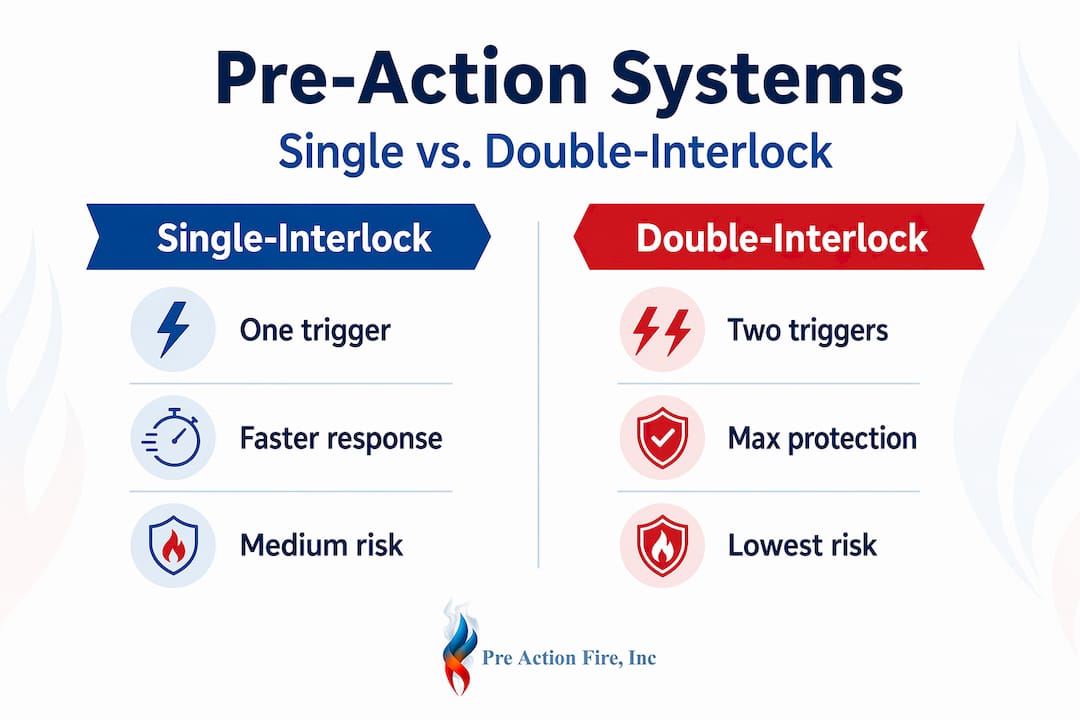
Single-interlock
In a single-interlock configuration, one trigger event fills the piping with water. When the detection system activates, the pre-action valve opens and water floods into the pipes. From that point, any individual sprinkler head that reaches its activation temperature will discharge. This type responds faster than a double-interlock system because water is already staged in the pipes waiting for a sprinkler to open.
Single-interlock systems suit environments where speed of response is a higher priority and the accidental discharge risk from a single failure is acceptable.
Double-interlock
The double-interlock type requires two independent events before water is admitted to the piping. Both the detection system activation and the loss of supervisory air or nitrogen pressure from a sprinkler head opening must occur before the deluge valve will open. This makes accidental flooding nearly impossible because neither a detector fault nor a broken sprinkler head alone can trigger water flow.

Double-interlock systems are especially well-suited for highly water-sensitive environments precisely because of this dual-trigger safeguard. The trade-off is a slightly slower response compared to single-interlock, since two conditions must be satisfied before water moves.
Non-interlock
Non-interlock systems admit water to the piping when either the detection system activates or a sprinkler head opens, rather than requiring both. This configuration is rarely specified because it offers minimal protection against accidental discharge. You will typically see it only in very specific legacy applications or in situations where maximum speed of water delivery is the overriding concern.
The table below summarizes the key differences to help you evaluate which configuration fits your facility:
| System type | Water admission trigger | Accidental discharge risk | Best for |
|---|---|---|---|
| Single-interlock | Detection activation only | Low | Server rooms, archives needing fast response |
| Double-interlock | Detection + sprinkler head activation | Very low | Data centers, museums, cold storage |
| Non-interlock | Either detection or sprinkler activation | Moderate to high | Rare legacy applications |
Pro Tip: For a facility type comparison between single and double interlock, consider your tolerable failure modes first. If accidental flooding is catastrophic, specify double-interlock. If delayed suppression is the greater risk, single-interlock is the stronger choice.
Where pre-action systems make the most sense
The benefits of pre action systems become concrete when you match the technology to the right environment. These systems are not universally necessary for every commercial building. They exist because certain spaces cannot tolerate even a small volume of water from a false discharge.
The most common applications include:
- Data centers and server rooms, where a single wet-pipe false discharge can destroy millions of dollars in equipment and create days of unplanned downtime.
- Museums and archival storage, where water exposure can permanently destroy irreplaceable cultural artifacts or legal documents.
- Medical facilities and laboratories, where sensitive diagnostic or research equipment represents both a financial and a patient safety concern.
- Cold storage and freezer warehouses, where wet-pipe systems would freeze and become inoperable.
- Historic buildings and high-value commercial interiors, where water damage to finishes and structural elements would be disproportionately costly.
What is pre action fire protection at its core? It is reduced accidental discharge risk through a verification step that forces the system to confirm a real fire before committing water to the pipes. For any of the environments listed above, that verification step translates directly into business continuity. A false discharge in a data center is not just a cleanup problem. It is an insurance claim, a business interruption event, and a regulatory investigation.
Pre-action systems also provide a pre-alarm capability that wet-pipe systems simply cannot match. Because the detection system activates before water enters the piping, facility staff receive an early warning. That window, even if only seconds to minutes, allows personnel to investigate, confirm the alarm, and take preliminary action before suppression begins. Learn more about how commercial sprinkler installations support business continuity beyond just fire suppression.
Design, installation, and maintenance realities
Selecting the right system type is only the first decision. Facility managers who underestimate the design and maintenance requirements of pre action fire systems often face costly surprises after installation.
From a design standpoint, the key coordination requirements are:
- Fire alarm integration: The detection devices, control panel, and pre-action valve must be engineered as a coordinated system. NFPA 13 governs the sprinkler system design while NFPA 72 governs detection and signaling. A split between two separate contractors who do not communicate during design creates significant risk.
- Supervisory pressure monitoring: The air or nitrogen pressure in the dry piping must be continuously supervised. Pressure loss triggers alarms and, depending on the system type, may affect whether the deluge valve opens correctly. This requires a dedicated supervisory air compressor or nitrogen supply with automatic fault alarming.
- Commissioning and acceptance testing: Preaction systems require full functional testing of every interlock, detection device, and valve during commissioning. This process is more complex than wet-pipe commissioning and must be fully documented.
- Ongoing inspection frequency: Due to the higher component count, including detection devices, control panels, valves, and supervisory switches, inspection and testing schedules are more rigorous. NFPA standards require quarterly, semi-annual, and annual inspection tasks that go beyond what a wet-pipe system demands.
- Pre-pack assemblies: Factory-assembled pre-pack units can reduce on-site installation time significantly. However, they still require thorough integration with your building’s fire alarm and water control systems, and must comply with applicable codes. They are not a shortcut around proper system design.
Pro Tip: Schedule Denver compliance inspections with a NICET-certified technician at least annually. Preaction systems with deferred maintenance or undocumented modifications are the most common reason facilities fail fire marshal inspections.
A common pitfall is treating these systems as “install and forget.” The supervisory pressure system, in particular, needs periodic attention. Slow leaks in older piping can cause gradual pressure loss, which triggers nuisance alarms and, in a double-interlock setup, can interfere with correct valve operation during an actual fire event.
My take on pre-action systems after years in the field
I’ve watched facility managers make the same mistake repeatedly. They invest in a double-interlock preaction system to protect a data center or archive, pay for a solid installation, and then cut corners on the ongoing maintenance contract. Within two or three years, the supervisory pressure is drifting, the detection devices haven’t been tested in eighteen months, and the system that was designed to prevent accidental flooding is now a liability.
What I’ve learned is that the technology itself is sound. The gap is almost always in the operational discipline around it. Pre-action systems are genuinely excellent tools for the right environments, but they demand more respect than a wet-pipe system does. The extra complexity that makes them safer against false discharges is the same complexity that requires more thorough, more frequent attention from qualified technicians.
My honest recommendation to any facility manager evaluating these systems: if you cannot commit to a rigorous maintenance program, a wet-pipe system with a properly designed detection system may serve you better than a preaction system that goes unmaintained. The right system poorly maintained is worse than a simpler system well maintained. Choose based on both your technical requirements and your operational capacity to support the system long-term.
— Preactionfire
Get professional pre-action system support in Denver
Pre Action Fire protection systems are among the most technically demanding fire suppression solutions in commercial buildings. Getting the design, installation, and maintenance right requires specialists who understand both sprinkler engineering and fire alarm integration at a code-compliant level. Preactionfire has served the Denver Metro Area since 2009, with NICET-certified technicians who specialize in exactly these systems for commercial and industrial properties.
Whether you are evaluating a new installation, upgrading an existing system, or need a compliance inspection for your facility, Preactionfire provides expert guidance at every stage. Explore Arvada fire sprinkler installation services or get in touch to discuss your specific building requirements. For facilities requiring coordinated fire alarm and sprinkler system design, Preactionfire’s Denver fire alarm services cover the full scope of what preaction systems demand. Contact the team today for a consultation tailored to your building and occupancy type.
FAQ
What is the main difference between pre-action and wet-pipe systems?
A wet-pipe system keeps water permanently pressurized in the pipes and discharges the moment a sprinkler head activates. A pre-action system holds the pipes dry and requires a separate fire detection event before water is admitted, adding a protective verification step against accidental discharge.
How does a double-interlock pre-action system work?
A double-interlock system requires two independent events simultaneously: the fire detection system must activate and a sprinkler head must open, causing loss of supervisory air pressure. Both conditions must be met before the deluge valve opens and water enters the piping.
What types of buildings use pre-action fire protection?
Pre-action fire protection is most common in data centers, server rooms, museums, archival storage, medical laboratories, and cold storage facilities, where accidental water discharge from a false alarm would cause severe damage to equipment, inventory, or irreplaceable materials.
Are pre-action systems harder to maintain than wet-pipe systems?
Yes. Because preaction systems include fire detection devices, supervisory air or nitrogen pressure monitoring, control panels, and multiple valve components, they require more frequent and more complex inspections than wet-pipe systems, as required by NFPA standards.
Which pre-action system type is best for a data center?
Double-interlock systems are generally the best choice for data centers because they require both detection activation and a sprinkler head to open before any water enters the piping, making accidental flooding nearly impossible even if one component fails.