
TL;DR:
- Regular fire hazard checks involve a scheduled process that includes daily equipment checks, monthly self-audits, and quarterly or annual contractor inspections to ensure compliance. Proper documentation and fixed scheduling are essential to prevent violations and operational disruptions.
A workflow for regular fire hazard checks is a repeatable, scheduled process that identifies fire risks, triggers corrective action, and produces documentation that proves compliance to authorities having jurisdiction (AHJs). Facility managers and business owners who treat fire safety as a calendar-driven discipline rather than a reactive task avoid the two most common outcomes of poor fire risk management: failed inspections and preventable losses. This article lays out the full fire safety inspection process, from daily checks through annual contractor-led tests, with the tools, scheduling logic, and documentation practices that hold up under scrutiny.
What does a workflow for regular fire hazard checks require?
A fire hazard check workflow has three core layers: a schedule, a systematic inspection process, and a documentation system. Each layer depends on the one before it. Without a fixed schedule, inspections happen inconsistently. Without a systematic process, inspectors miss hazards. Without documentation, completed work cannot be verified by an AHJ or an insurance carrier.
The industry term for this process is a fire risk management workflow. The phrase covers everything from daily equipment status checks to annual contractor-led flow tests. Facility managers who understand this full scope build programs that satisfy NFPA 25, NFPA 72, and local fire codes simultaneously.
Calendar-based scheduling prevents compliance failure better than event-based scheduling triggered by malfunctions. That finding matters because most facilities that fail AHJ reviews did not skip inspections entirely. They simply scheduled them in response to problems rather than in advance of deadlines.
What tools and resources do you need before you start?
The right tools make the difference between a fire hazard evaluation checklist that gets completed and one that gets skipped. Equip your team before the first walk-through.
Core tools for every inspection cycle:
- Digital inspection apps: Platforms like Oxmaint and eAuditor let technicians complete checklists on a mobile device, attach photos, and generate reports automatically. Paper checklists work but create filing and retrieval problems during AHJ reviews.
- Printable backup checklists: Keep a laminated reference copy on-site for power outages or system failures. A 47-point self-audit checklist covers the most common commercial property hazards.
- Work order system: Every deficiency needs a work order with an assigned owner and a firm deadline. A spreadsheet works for small facilities. Larger properties benefit from a computerized maintenance management system (CMMS) like Fiix or UpKeep.
- Photo documentation tools: A smartphone camera is sufficient. The requirement is before-and-after photos attached to the checklist entry, not professional photography.
- Scheduling calendar: Google Calendar, Outlook, or any facility management platform with recurring task alerts. Set reminders 30–45 days before contractor-led inspections.
| Inspection tier | Recommended tool | Primary output |
|---|---|---|
| Daily/weekly checks | Mobile app or paper log | Equipment status log |
| Monthly self-audit | Digital checklist app | Pass/fail report with photos |
| Quarterly/annual | Contractor + CMMS work order | Signed inspection report |
Pro Tip: Set your scheduling calendar to trigger contractor outreach 45 days before every quarterly and annual deadline. Contractor availability tightens significantly in spring and fall, and a late booking can push your inspection past the NFPA 25 grace period.
How to conduct a systematic monthly fire hazard walk-through
The monthly self-audit is the backbone of any fire prevention protocol. NFPA 25 §13.1 mandates weekly visual checks and daily equipment status confirmation as prerequisites. Complete those before the monthly walk-through begins.

A well-run monthly inspection takes 60 minutes and follows a binary pass/fail format. Every item either passes or fails. There is no “needs monitoring” category. That ambiguity is where hazards survive from one inspection to the next.
Step-by-step monthly walk-through process:
- Start at the building perimeter. Check all exterior exit doors, exit signage, and emergency lighting. Confirm that egress paths are clear of debris, vehicles, and stored materials.
- Move to mechanical and electrical rooms. Verify that clearance around electrical panels is maintained. Check for combustible storage within 18 inches of heat sources.
- Inspect sprinkler heads and control valves. Look for corrosion, paint overspray, or physical damage. Confirm control valves are in the open position and locked.
- Check fire extinguisher stations. Monthly extinguisher visual inspections are required by NFPA codes. Confirm pressure gauges are in the green zone, seals are intact, and units are mounted and accessible.
- Test emergency lighting. Press the test button on each unit. A unit that fails to illuminate is a same-day corrective action item.
- Log every finding immediately. Record pass or fail for each item. Attach a photo of every failed item and a follow-up photo after the fix is made.
- Fix low-cost hazards on the spot. Replacing a missing fire extinguisher sign or clearing a blocked exit takes minutes. Do it during the walk-through and photograph the corrected condition.
- Create a work order for every deficiency you cannot fix immediately. Assign an owner and a deadline before you leave the building.
- Blocked exits are the most common finding in monthly self-audits and the easiest to correct.
- Sprinkler head damage from forklift contact is a frequent issue in warehouse environments.
- Missing or expired extinguisher tags are a top citation during AHJ reviews.
Pro Tip: When a monthly walk-through reveals a deficiency that requires a licensed contractor, such as a damaged sprinkler head or a malfunctioning fire alarm panel, call the contractor the same day. Waiting until the next scheduled quarterly inspection turns a minor repair into a compliance violation.
For a detailed look at fire exit maintenance procedures, Preactionfire publishes a step-by-step guide built specifically for property managers.
What is involved in quarterly and annual fire safety checks?
Quarterly and annual inspections require licensed contractors and follow NFPA standards precisely. These are not self-audits. They produce signed reports that become part of your compliance record.
Quarterly tasks (contractor-led):
- Wet pipe sprinkler system inspection per NFPA 25
- Fire alarm panel functional test per NFPA 72
- Fire pump weekly churn test review and quarterly flow verification
- Kitchen hood suppression system inspection where applicable
- Backflow preventer visual inspection
Annual tasks (contractor-led):
- Full sprinkler flow test and standpipe test
- Fire alarm full-system test including all initiating devices
- Emergency lighting 90-minute battery discharge test per NFPA codes
- Fire extinguisher annual maintenance and tagging
- Annual fire safety inspection per local AHJ requirements
Scheduling contractor-led inspections requires 30–45 days of lead time to avoid NFPA 25 grace period violations. That window accounts for contractor availability, permit requirements, and building access coordination.
| Inspection type | Frequency | Lead time needed | Governing standard |
|---|---|---|---|
| Sprinkler system | Quarterly/Annual | 30–45 days | NFPA 25 |
| Fire alarm system | Quarterly/Annual | 30–45 days | NFPA 72 |
| Emergency lighting | Monthly/Annual | N/A (self) / 30 days | NFPA 101 |
| Kitchen hood suppression | Semi-annual | 30 days | NFPA 17A |
Clustering related inspections reduces contractor mobilization costs and building disruption. Pairing your annual sprinkler test with your annual fire alarm test in the same contractor visit cuts scheduling overhead and minimizes tenant or operational impact.
Pro Tip: Book your annual inspections in late summer for a fall completion. Spring and early summer are peak seasons for fire protection contractors in Colorado, and availability drops sharply. A fall inspection cycle also gives you time to address deficiencies before the winter heating season increases fire risk.
For Colorado-specific requirements, Preactionfire covers annual inspection requirements in detail, including what AHJs in the Denver Metro Area expect from commercial properties.
How do you document, track, and manage fire hazard check results?
Documentation is as critical as the inspection itself. Lack of 12-month consecutive logs is one of the top compliance failure causes during AHJ reviews. A completed inspection with no record is legally equivalent to an inspection that never happened.
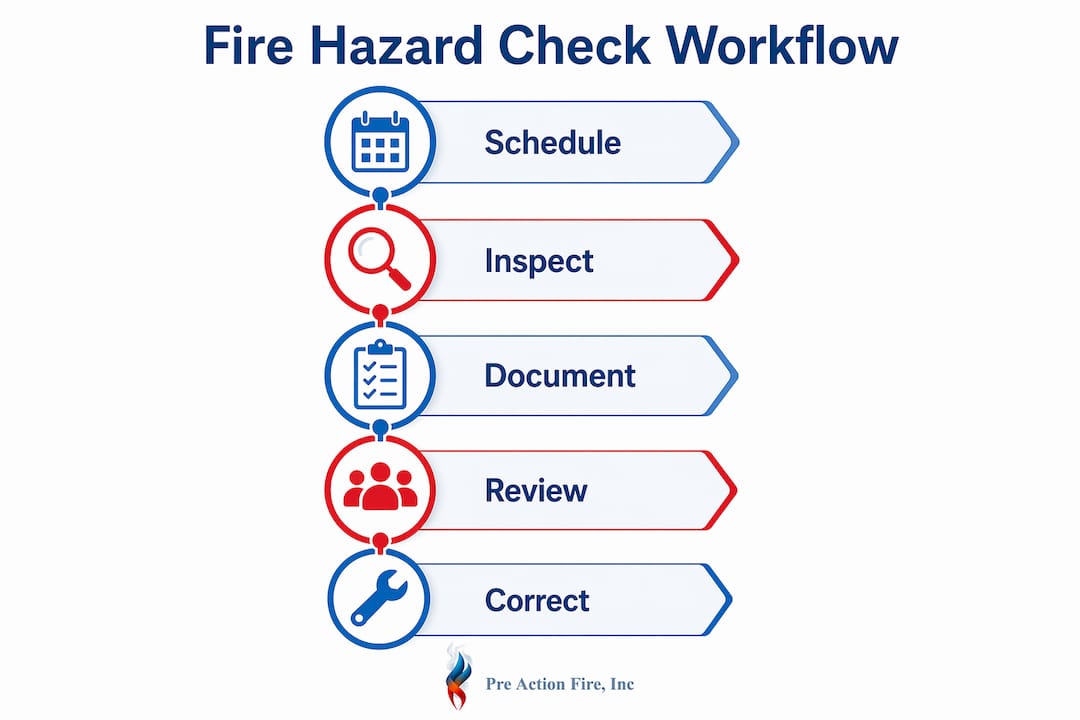
Every inspection record must include the date, the technician’s initials, the specific items checked, the pass/fail result for each item, and photos of any deficiencies and their corrections. Vague entries like “sprinklers OK” do not satisfy AHJ reviewers. Specific entries like “Sprinkler head at Grid C-4, no damage, control valve open and locked, photo attached” do.
Documentation best practices:
- Store all records in a single location, either a physical binder kept on-site or a cloud-based folder accessible to your team and your contractors.
- Date-stamp every entry. Digital apps do this automatically. Paper logs require a written date and time.
- Link every deficiency to a work order. Deficiencies without corrective action demonstrate reactive rather than proactive compliance, which AHJs treat as a pattern of neglect.
- Review your full risk assessment annually. Facility changes like new equipment, renovated spaces, or increased occupancy create new hazards that your existing checklist may not cover.
- Keep 12 months of consecutive, signed logs available at all times for AHJ access.
| Record type | Minimum retention | Storage format |
|---|---|---|
| Monthly self-audit logs | 12 months consecutive | Digital or physical binder |
| Contractor inspection reports | 3 years minimum | Digital preferred |
| Work orders and corrective actions | Life of the deficiency + 1 year | CMMS or folder |
| Risk assessment updates | Current version always on file | Digital |
Pro Tip: Assign one person as the documentation owner for your facility. When multiple people file records in different locations, logs become incomplete and retrieval during an AHJ review turns into a crisis. One owner, one location, one system.
Preactionfire’s guide on fire risk assessment walks through how to structure your risk documentation from the ground up.
Key Takeaways
A fire hazard check workflow succeeds only when scheduling, systematic inspection, and thorough documentation operate together as a single, calendar-driven system.
| Point | Details |
|---|---|
| Use calendar-based scheduling | Set fixed recurring dates for all inspection tiers to prevent compliance gaps. |
| Complete monthly self-audits in 60 minutes | Use a binary pass/fail format and attach before-and-after photos for every deficiency. |
| Book contractors 30–45 days early | Lead time prevents NFPA 25 grace period violations and secures contractor availability. |
| Cluster annual inspections | Pair sprinkler and alarm tests in one contractor visit to cut costs and disruption. |
| Maintain 12 months of consecutive logs | Signed, dated records are the primary evidence of compliance during AHJ reviews. |
What I’ve learned from watching facilities get this wrong
Most compliance failures I see are not caused by ignorance of NFPA standards. They are caused by scheduling habits. A facility manager who books a contractor after receiving a violation notice is already in a reactive posture. The AHJ has seen that pattern before, and it signals a program without structure.
The facilities that consistently pass reviews share one habit: they treat fire safety inspections exactly like rent payments. The date is fixed, the action is automatic, and missing it is not an option. Calendar-based triggers, not event-based ones, are what separate compliant facilities from ones that scramble every inspection cycle.
Clustering inspections is the second habit that separates efficient programs from expensive ones. I have watched facility managers pay two separate contractor mobilization fees for inspections that could have been completed in the same visit. That is not a minor inefficiency. Over a three-year period, it adds up to a meaningful budget waste that also doubles the operational disruption.
The documentation piece is where I see the most avoidable failures. A facility can run excellent inspections for 11 months and then miss one monthly log. That gap breaks the 12-month consecutive record requirement and creates a compliance problem that a year of good inspections cannot fix retroactively. One owner, one system, no exceptions.
— Results
How Preactionfire supports your fire safety inspection process
Pre Action Fire has served the Denver Metro Area since 2009, and the team’s NICET-certified technicians handle the contractor-led inspections that your internal workflow cannot cover alone. From quarterly sprinkler system checks to full fire alarm system testing and maintenance, Preactionfire delivers signed, compliant inspection reports that satisfy NFPA 25, NFPA 72, and local AHJ requirements. Their professional fire safety inspections are designed specifically for commercial and industrial facilities in Colorado, with scheduling support that keeps your compliance calendar on track. Contact Preactionfire to schedule your next inspection and get the documentation your facility needs.
FAQ
What is a workflow for regular fire hazard checks?
A workflow for regular fire hazard checks is a scheduled, repeatable process that covers daily equipment checks, monthly self-audits, and quarterly and annual contractor-led inspections, each producing documented records for AHJ compliance.
How often should fire hazard inspections be conducted?
Fire hazard inspections occur at four frequencies: daily equipment status checks, weekly visual checks per NFPA 25, monthly self-audits, and quarterly or annual contractor-led tests depending on the system type.
What records do I need to keep for fire safety compliance?
You need 12 months of consecutive, date-stamped, initialed inspection logs plus contractor-signed reports and work orders for every deficiency. Missing even one monthly log breaks the consecutive record requirement.
How far in advance should I schedule a fire safety contractor?
Schedule contractor-led inspections 30–45 days before the deadline. That window accounts for contractor availability, permit coordination, and building access logistics, and it prevents NFPA 25 grace period violations.
What is the difference between a monthly self-audit and a quarterly inspection?
A monthly self-audit is a 60-minute pass/fail walk-through conducted by facility staff. A quarterly inspection is a contractor-led technical test of specific systems, such as sprinklers or fire alarms, that produces a signed compliance report.