
TL;DR:
- A fire risk assessment systematically identifies hazards, evaluates risks, and determines necessary safety measures for buildings. It is a legal obligation that, if done correctly, protects lives, ensures compliance, and minimizes liability, whereas poor implementation can lead to enforcement actions. Ongoing review, site-specific evidence, and a strong safety culture are essential for effective fire safety management.
A fire risk assessment is a systematic examination of a building to identify fire hazards, evaluate risks to people present, and determine the measures needed to reduce those risks to an acceptable level. For property managers, business owners, and safety compliance officers, this process is both a legal obligation and the foundation of every fire safety decision you make. Getting it right protects lives, limits liability, and keeps your premises compliant with current fire safety standards. Getting it wrong can result in enforcement action, prosecution, or worse.
What is fire risk assessment and what does it involve?
A fire risk assessment is the legally required evaluation that identifies fire hazards in non-domestic premises, determines who is at risk, and establishes what fire precautions are necessary to reduce that risk to as low as reasonably practicable. The standard term used in UK fire safety law is “suitable and sufficient” assessment, and that phrase carries real legal weight. In the United States, the equivalent process is governed by NFPA 1 (Fire Code) and local jurisdiction requirements, though the core methodology is nearly identical.
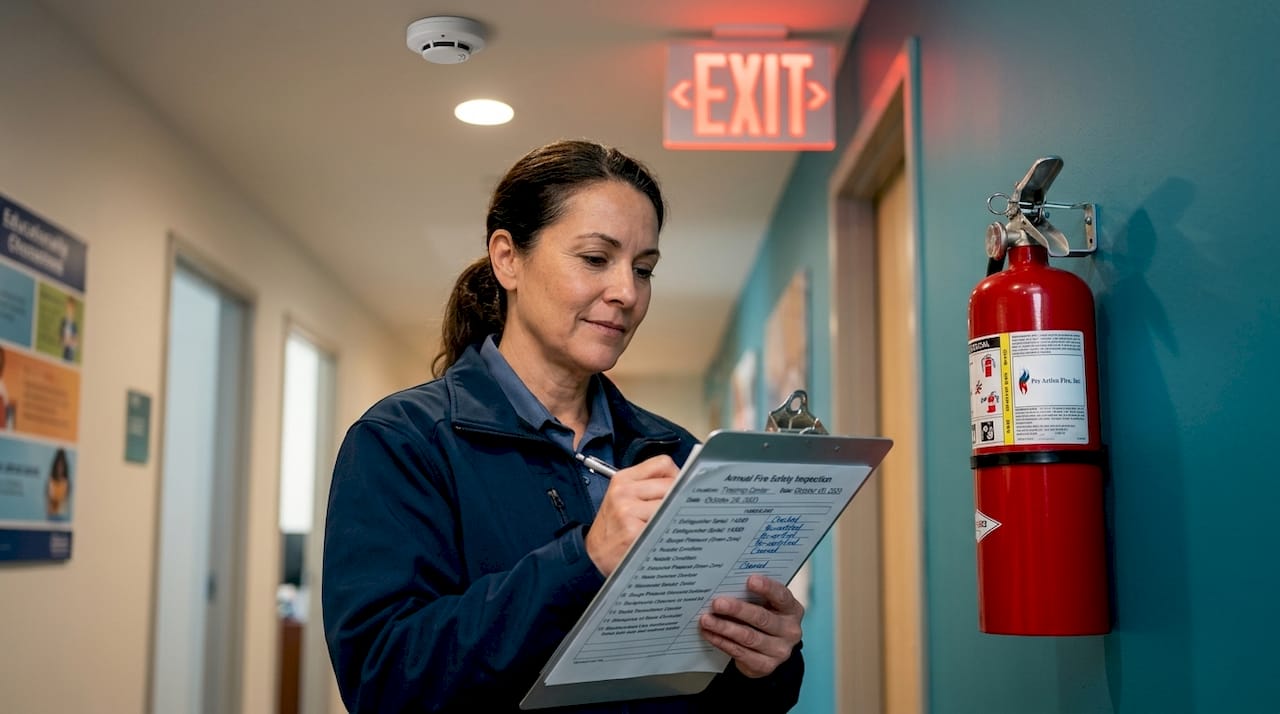
The process goes well beyond checking whether a fire extinguisher is mounted on the wall. It requires a structured, evidence-based review of the entire premises, covering physical hazards, human factors, and the effectiveness of existing safety controls. A thorough fire risk evaluation examines not just what could start a fire, but how quickly it could spread, who might be unable to escape, and whether your current detection and suppression systems are adequate for the specific risks present.
Property managers overseeing multiple buildings often underestimate how site-specific this process must be. A generic template applied across a warehouse, a retail unit, and an office block will satisfy no one, least of all a fire marshal conducting an enforcement inspection.
What are the main steps in a fire risk assessment?
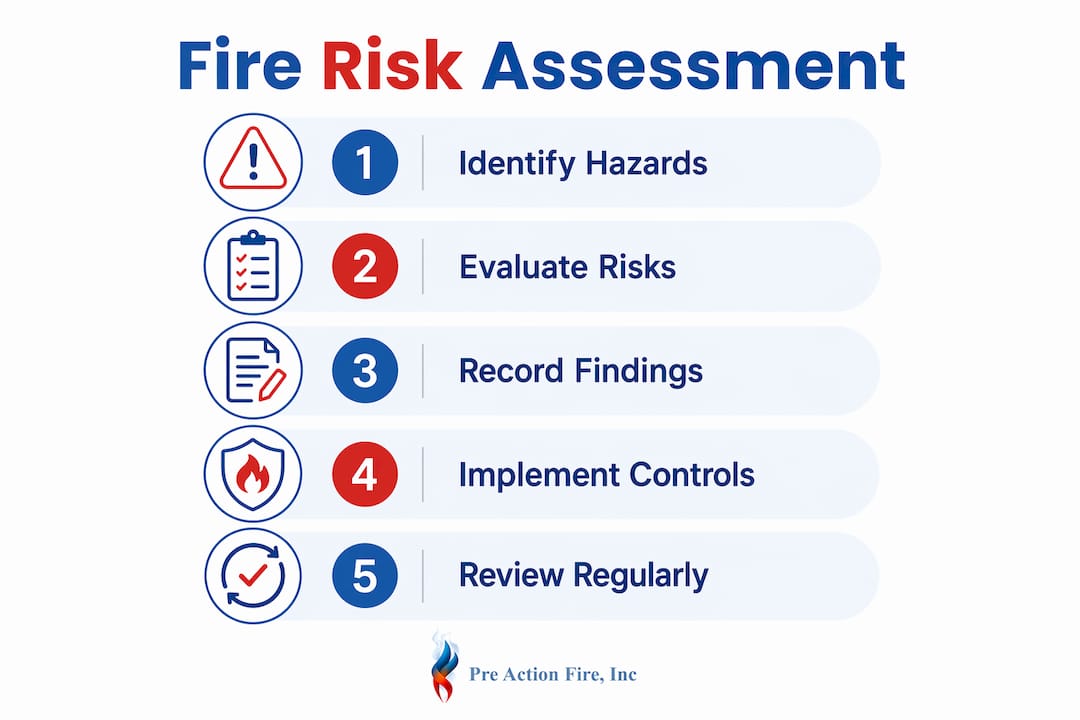
The fire safety assessment process follows five core stages, each building on the last. Skipping or shortcutting any one of them creates gaps that enforcement officers and insurance adjusters will find.
- Identify fire hazards. This means cataloging ignition sources (faulty wiring, cooking equipment, hot work), combustible materials (paper, wood, flammable liquids), and oxygen sources that could accelerate a fire. A fire hazard analysis at this stage should be exhaustive, not a quick walkthrough.
- Identify people at risk. Employees and regular visitors are obvious, but the assessment must also account for vulnerable groups: people with mobility impairments, those unfamiliar with the building layout, lone workers, and contractors. The more diverse your occupancy, the more complex this stage becomes.
- Evaluate, remove, or reduce risks. Once hazards and at-risk individuals are mapped, you assess the likelihood and consequence of a fire occurring and determine what controls are needed. This is where decisions about fire doors, suppression systems, and compartmentalization get made.
- Record findings and prepare an emergency plan. Documentation is not optional. Post-October 2023 in the UK, full recording is mandatory regardless of business size. Your record must include identified hazards, the people at risk, existing controls, and a clear action plan with assigned responsibilities and deadlines.
- Review and update the assessment regularly. A fire risk assessment is a living document, not a one-time task. Any significant change to the building, its use, its occupancy, or its equipment triggers a mandatory review.
Pro Tip: When documenting your findings, write the reasoning chain explicitly. Show how each identified hazard connects to a specific control measure. This “hazard-to-control” logic is exactly what enforcement inspectors look for when judging whether an assessment is truly “suitable and sufficient.”
How does a fire risk assessment help prevent fires and protect people?
The practical value of a fire risk assessment extends well beyond regulatory compliance. A well-executed assessment directly reduces the probability of a fire starting, limits how far it spreads if one does, and maximizes the chance that everyone gets out safely. Fire risk assessments are proactive tools for ongoing safety management, not just paperwork filed away in a drawer.
Here is how the assessment translates into real protection:
- Ignition source control. Identifying and eliminating unnecessary ignition sources, such as overloaded circuits or improperly stored flammable materials, directly reduces fire probability. Many commercial fires are preventable with basic housekeeping changes identified during assessment.
- Detection and alarm improvements. The assessment evaluates whether your current fire detection system matches the risk profile of the building. A storage facility with high-rack shelving has different detection needs than an open-plan office.
- Structural containment. Fire doors, compartment walls, and suppression systems are only effective if the assessment confirms they are correctly specified and maintained. Reviewing common fire hazards in your specific building type reveals gaps that generic maintenance schedules miss.
- Evacuation planning. The assessment maps escape routes against the actual population using them, including people who need assistance. This is where many businesses fail. An evacuation plan designed for able-bodied adults in a building that now houses a day care or medical clinic is a liability.
- Staff training alignment. The assessment identifies what training staff need based on the specific risks present, not a generic fire safety video.
Pro Tip: After completing an assessment, run a timed evacuation drill using the routes and procedures the assessment specifies. The results will tell you more about real-world readiness than any document review.
What are the legal requirements governing fire risk assessments?
The legal framework for fire risk assessments places clear obligations on the “Responsible Person,” defined as the employer, building owner, or the person with control of the premises. This individual cannot delegate legal accountability, even when they hire an external assessor. Responsible Persons remain legally accountable for the quality and compliance of the assessment regardless of who conducts it.
The “suitable and sufficient” standard requires that the chain of reasoning from hazard identification through to implemented controls be transparent and defensible. Vague conclusions or missing evidence will not survive enforcement scrutiny.
| Requirement | Details |
|---|---|
| Who must assess | The Responsible Person: employer, owner, or premises controller |
| Documentation standard | Full written record mandatory for all premises (post-October 2023 in the UK) |
| Assessor competence | Recognized qualifications (FPA, NEBOSH, IFE) and scheme registration (BAFE SP205, NFRAR) required |
| Review triggers | Building changes, occupancy shifts, new equipment, fire incidents, or updated legislation |
| Applicable standards | PAS 79-1:2020, BS 9792:2025 (UK); NFPA 1 and local codes (US) |
Recent UK standards, including PAS 79-1:2020 and BS 9792:2025, provide structured methodologies adjusted by building type and occupancy, incorporating lessons from major fire incidents including Grenfell Tower. These standards are increasingly referenced by enforcement bodies as the benchmark for what “competent” looks like. For Colorado-based property managers, NFPA 1 and local Denver fire codes set equivalent expectations, and Preactionfire’s NICET-certified technicians work within those frameworks daily.
How to conduct an effective fire risk assessment
Knowing how to conduct a fire risk assessment effectively separates properties that pass inspections from those that generate enforcement notices. The following guidance is built for property managers and business owners who either perform assessments themselves or manage the process with external help.
- Decide whether to assess in-house or hire a competent professional. Small, low-risk premises with a knowledgeable manager can often conduct a defensible assessment internally. Complex buildings, high-occupancy facilities, or properties with specialized hazards require a qualified fire risk assessor with credentials such as FPA, NEBOSH, or IFE certification and registration on schemes like BAFE SP205.
- Gather site-specific evidence before you start. Floor plans, previous assessment records, maintenance logs, incident reports, and occupancy data all inform the assessment. A site-specific assessment with documented evidence is far more defensible than one based on memory or generic templates.
- Avoid the generic template trap. Templates are useful starting points, but an assessment that does not reference the specific hazards, layout, and occupants of your building will fail enforcement scrutiny. Every conclusion must be supported by premises-specific observations.
- Coordinate with other building operators. In multi-tenanted buildings, fire risk management requires coordination between all parties. Shared escape routes, common areas, and interconnected systems mean one tenant’s hazard is everyone’s problem. Review Colorado compliance practices to understand how shared-building obligations are handled locally.
- Use technology to support ongoing monitoring. Digital fire safety management platforms allow you to track action plan completion, schedule reviews, and log maintenance records in one place. This creates an audit trail that demonstrates ongoing compliance rather than point-in-time box-ticking.
- Schedule reviews proactively, not reactively. Annual reviews are the minimum for most premises. Higher-risk buildings warrant more frequent checks. Do not wait for an incident or a change in legislation to trigger a review.
How do different types of fire risk assessments compare?
Fire risk assessments are not one-size-fits-all. The type of assessment required depends on the building’s size, complexity, occupancy type, and risk profile.
| Assessment type | Best suited for | Key characteristics |
|---|---|---|
| Basic assessment | Small, low-risk premises | Single occupancy, simple layout, limited hazards |
| Detailed assessment | Complex or high-risk buildings | Multi-story, high occupancy, specialized hazards |
| Residential assessment | Purpose-built residential blocks | Focus on common areas, escape routes, resident vulnerability |
| Commercial assessment | Offices, retail, industrial units | Operational hazards, staff training, equipment risks |
| Multi-occupied building assessment | Mixed-use or shared buildings | Coordination between Responsible Persons, shared systems |
The distinction between a basic and detailed assessment is not just about thoroughness. It reflects the actual risk profile of the building. A five-person accountancy office and a 200-bed hotel both need fire risk assessments, but the methodology, depth of investigation, and resulting action plan will look completely different. Customizing the assessment to the building’s actual use and occupancy is not optional. It is the definition of “suitable and sufficient.”
Key takeaways
A fire risk assessment is the single most important document in your fire safety program, and its quality determines whether your building is genuinely protected or just technically compliant.
| Point | Details |
|---|---|
| Core definition | A fire risk assessment identifies hazards, evaluates risks to people, and determines required fire precautions. |
| Five-stage process | Hazard identification, people at risk, risk evaluation, documentation, and regular review form the complete process. |
| Legal accountability | The Responsible Person remains legally liable for assessment quality even when an external assessor is hired. |
| Site-specific evidence | Generic templates fail enforcement scrutiny. Every conclusion must be supported by premises-specific observations. |
| Ongoing management | Reviews triggered by building changes, incidents, or new legislation keep the assessment current and defensible. |
Why fire risk assessments deserve more than a checkbox
After years of working in fire protection, the pattern I see most often is not outright negligence. It is complacency dressed up as compliance. A business owner gets an assessment done, files the report, and considers the job finished until the next scheduled review. That approach misses the entire point.
A fire risk assessment is only as good as the actions it generates and the culture it reflects. I have seen beautifully formatted assessment documents in buildings where the fire doors were propped open daily, the alarm panel had unacknowledged faults for weeks, and staff could not locate a fire extinguisher under pressure. The document said “compliant.” The building was not.
The regulatory updates following Grenfell Tower, including the Building Safety Act 2022 and the shift to mandatory full recording regardless of business size, are not bureaucratic overreach. They are a direct response to what happens when fire safety becomes a paper exercise. The practical impact for property managers is clear: you now need to demonstrate ongoing, active management of fire risk, not just a dated report in a filing cabinet.
The most effective approach I have seen combines a competent external assessor for the formal assessment with an internal safety culture that treats fire risk as a daily operational concern. That means regular walkthroughs, prompt action on identified issues, and staff who actually understand the emergency plan. The assessment tells you what to do. The culture determines whether it gets done.
— Preactionfire
How Preactionfire supports your fire safety compliance
Pre Action Fire has served the Denver Metro Area since 2009, providing fire protection services built around the specific requirements of commercial and industrial properties. Whether your fire risk assessment has identified gaps in your detection systems, flagged equipment that needs inspection, or revealed that your current setup no longer matches your building’s use, Preactionfire’s NICET-certified technicians can help you close those gaps efficiently.
From fire alarm installation and maintenance to fire extinguisher inspections and full compliance reviews, Preactionfire delivers solutions aligned with NFPA standards and Colorado fire codes. Contact Preactionfire directly to discuss a tailored fire safety plan for your property.
FAQ
What is a fire risk assessment in simple terms?
A fire risk assessment is a structured review of a building that identifies what could cause a fire, who could be harmed, and what measures are needed to reduce that risk. It is both a legal requirement for non-domestic premises and the foundation of effective fire safety management.
How often does a fire risk assessment need to be reviewed?
Annual reviews are the standard minimum for most premises, with more frequent checks required for higher-risk buildings. Reviews are also mandatory after significant changes to the building, its occupancy, its equipment, or following a fire incident.
Who is legally responsible for a fire risk assessment?
The Responsible Person, defined as the employer, building owner, or person with control of the premises, holds legal accountability for the assessment. This duty cannot be transferred to an external assessor, even when one is hired to conduct the work.
What makes a fire risk assessment “suitable and sufficient”?
A suitable and sufficient assessment documents a clear, defensible chain of reasoning from each identified hazard through to the control measures implemented. Generic templates without premises-specific evidence do not meet this standard and will not withstand enforcement inspection.
Do small businesses need a written fire risk assessment?
Yes. Post-October 2023 in the UK, full written documentation is mandatory regardless of business size or number of employees. In the United States, NFPA 1 and local fire codes set equivalent documentation requirements for commercial premises.