
TL;DR:
- Smoke detection technology uses sensors to identify airborne smoke particles and provide early fire warnings. Photoelectric sensors detect smoldering fires, while ionization sensors respond faster to flaming fires but are declining in use due to disposal concerns and false alarms. Multi-sensor and aspirating systems enhance fire detection accuracy and are ideal for complex or mission-critical environments.
Smoke detection technology is defined as the use of specialized sensors to identify airborne smoke particles and trigger early fire warnings before flames spread. The two dominant sensing methods are photoelectric detection, which uses light scattering, and ionization detection, which relies on Americium-241 to monitor disrupted electrical current. Brands like First Alert and Kidde have built product lines around both technologies, while NFPA standards govern how these systems are installed and maintained. Understanding which sensor type fits your building, fire risk profile, and operational environment is the difference between a system that protects and one that merely complies.
What is smoke detection technology and how does it work?
Smoke detection technology is the science of identifying combustion byproducts in air using sensor-based systems that trigger alarms before a fire becomes life-threatening. The field divides into two foundational sensing methods, each optimized for a different fire type.
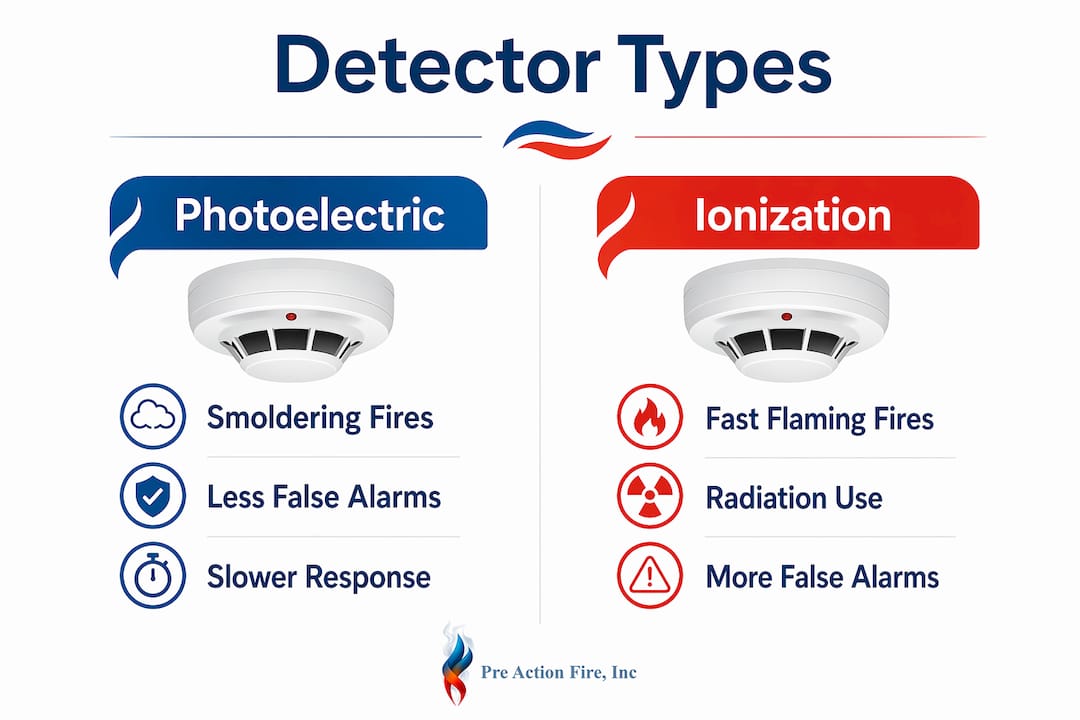
Photoelectric and ionization detectors represent the two primary classifications in smoke sensing technology. Photoelectric sensors project a light beam inside a detection chamber. When smoke particles enter, they scatter the beam onto a photosensor, triggering the alarm. This method excels at detecting slow-burning, smoldering fires that produce large, visible smoke particles.
Ionization detectors work differently. They use a small amount of Americium-241 to ionize the air between two electrically charged plates, creating a steady current. When smoke enters the chamber, it disrupts that current and activates the alarm. This design responds faster to fast-flaming fires with smaller combustion particles.
Pro Tip: If you manage a mixed-use commercial building in Denver, never rely on a single sensor type. A smoldering electrical fire in a server room and a fast-flaming grease fire in a break room require different detection responses.
Multi-sensor and aspirating detection systems
Multi-sensor detectors combine photoelectric and ionization methods, or add heat and carbon monoxide sensing, into a single unit. Multi-sensor technology uses onboard algorithms to weigh inputs from multiple sensors simultaneously, which significantly reduces nuisance alarms compared to single-sensor units. This matters in commercial buildings where false alarms trigger costly evacuations and erode occupant trust in the system.
Aspirating smoke detection (ASD) takes sensitivity to another level entirely. ASD systems draw air samples continuously through a network of pipes, analyzing them for trace smoke particles before any visible smoke is present. These systems can maintain up to 30,000 event and alarm records, making them the standard choice for data centers, clean rooms, and other mission-critical facilities where even a brief fire event causes catastrophic loss.
| Detector Type | Best For | Key Limitation |
|---|---|---|
| Photoelectric | Smoldering fires, bedrooms | Slower on fast-flaming fires |
| Ionization | Fast-flaming fires | Nuisance alarms, disposal concerns |
| Multi-sensor | Mixed environments, commercial | Higher upfront cost |
| Aspirating (ASD) | Data centers, clean rooms | Complex installation |
What are the benefits and limitations of each detection method?
Photoelectric sensors carry a clear advantage in reducing nuisance alarms. Cooking smoke, steam from bathrooms, and dust particles are less likely to scatter light in the same pattern as actual fire smoke. That reliability matters in occupied commercial spaces where a false alarm means stopping operations.
Ionization detectors are declining in preference for two reasons. First, Americium-241 disposal requires careful handling, and while the EPA confirms no radiation health risk when the device remains intact, improper disposal remains a concern for facility managers. Second, ionization units generate more nuisance alarms in kitchens and dusty environments, which leads occupants to disable them. A disabled detector is worse than no detector at all.
The industry shift toward photoelectric and multi-sensor detectors reflects both safety improvements and environmental responsibility. Multi-sensor units with onboard processing algorithms deliver superior false alarm rejection. They also reduce the liability exposure that comes with repeated false evacuations in commercial properties.
Heat detectors serve a specific supporting role. They do not detect smoke at all. Instead, they respond to temperature rise above a fixed threshold or to rapid rate-of-rise conditions. Facilities with high dust or steam levels, such as industrial kitchens or manufacturing floors, often pair heat detectors with photoelectric units to cover both fire signatures without triggering constant false alarms.
Pro Tip: In environments with heavy dust or steam, such as Denver-area food processing facilities, specify heat detectors for the production floor and photoelectric units for adjacent office areas. Matching detector type to zone conditions cuts false alarm rates dramatically.
- Photoelectric sensors: lower false alarm rates, better for smoldering fires, preferred in residential and commercial spaces
- Ionization sensors: faster on flaming fires, declining in use due to disposal concerns and nuisance alarm frequency
- Multi-sensor detectors: best false alarm rejection, suited for complex or mixed-occupancy buildings
- Heat detectors: no smoke detection capability, but reliable in high-contamination zones
- ASD systems: highest sensitivity, required in mission-critical facilities, not practical for standard commercial use
How is smoke detection applied across different settings?
Residential, commercial, and industrial deployments each follow different rules and require different equipment choices. Getting this wrong creates compliance gaps and real safety failures.
Residential and light commercial applications
In residential settings, the National Fire Protection Association’s NFPA 72 standard requires detectors in every sleeping room, outside each sleeping area, and on every level of the home. Photoelectric detectors are the preferred choice for bedrooms and hallways. Combination units that include carbon monoxide sensing add value in homes with gas appliances. For Denver homeowners and property managers, proper smoke alarm installation follows specific placement rules that affect both performance and code compliance.
Commercial building configurations
Commercial buildings require a more structured approach. Fire alarm control panels connect individual detectors across the building into a single monitored network. Selecting the right detectors for a Colorado commercial property means accounting for ceiling height, HVAC airflow patterns, occupancy type, and local authority having jurisdiction (AHJ) requirements. Open-plan offices with high ceilings need beam detectors or closely spaced point detectors. Warehouses with heavy dust require heat detectors or ASD systems.
Critical and industrial environments
Data centers, pharmaceutical clean rooms, and telecommunications facilities demand the earliest possible warning. ASD systems are the standard in these environments because they detect smoke at concentrations far below what a standard point detector can register. Effective smoke detection in these settings relies on building-wide alarm systems connected to 24/7 monitoring services. Installing detectors without professional monitoring leaves a critical gap. An alarm that no one responds to provides no protection.
The advantages of professional fire monitoring extend beyond simple notification. Monitored systems log every alarm event, support maintenance scheduling, and provide documentation for insurance and regulatory compliance.
| Setting | Recommended Detector | Key Consideration |
|---|---|---|
| Residential bedroom | Photoelectric or combination | NFPA 72 placement rules |
| Commercial office | Multi-sensor | False alarm management |
| Industrial kitchen | Heat detector | Steam and grease interference |
| Data center | Aspirating (ASD) | Earliest possible detection |
| Warehouse | Heat or beam detector | Ceiling height and dust |
What innovations are shaping the future of smoke sensing technology?
The hardware inside smoke detectors has changed significantly in the past decade. The most important shift is the move away from phototransistors toward Si PIN photodiodes in optical detection chambers. Phototransistors suffer from unstable gain across temperature ranges and over time, which causes false alarms. Si PIN photodiodes deliver consistent, stable output across the detector’s lifespan.
Modern optical chambers pair narrow-angle infrared LEDs operating at 850nm or 940nm with Si PIN photodiodes fitted with daylight filters. This combination blocks ambient light interference and improves detection sensitivity without increasing false alarm rates. The engineering precision behind this design is why modern photoelectric detectors outperform units from ten years ago.
Algorithm-driven multi-criteria detection is the other major advance. Multi-criteria detectors use onboard processing to weigh smoke, heat, and CO sensor inputs against each other before triggering an alarm. A single elevated reading from one sensor does not trigger the alarm. The algorithm requires a pattern consistent with actual fire conditions. This approach cuts nuisance alarms while maintaining fast response to genuine threats.
- Si PIN photodiodes replace phototransistors for stable, long-term optical detection
- Infrared LEDs at 850nm or 940nm improve sensitivity with daylight filtering
- Multi-criteria algorithms weigh combined sensor inputs before alarm activation
- CO and heat sensor integration adds detection layers without added hardware complexity
- Wireless smoke detection networks allow retrofit installations without conduit runs
Wireless smoke detection deserves specific attention for retrofit projects. Older commercial buildings in Denver often lack the conduit infrastructure for hardwired systems. Wireless detectors using encrypted radio protocols now meet NFPA 72 requirements and integrate with modern fire alarm control panels. This removes the cost barrier for upgrading legacy buildings to current detection standards.
Pro Tip: When specifying detectors for a retrofit project, confirm that the wireless protocol used by the detector is compatible with your existing fire alarm control panel before purchasing. Incompatible protocols require a full panel replacement, which changes the project budget entirely.
Key takeaways
Smoke detection technology works best when the sensor type, environment, and monitoring infrastructure are matched deliberately rather than selected by default.
| Point | Details |
|---|---|
| Two core sensor types | Photoelectric suits smoldering fires; ionization suits fast-flaming fires. |
| Multi-sensor superiority | Onboard algorithms reduce false alarms better than any single-sensor design. |
| Environment drives choice | Dust, steam, and ceiling height determine which detector type performs reliably. |
| Monitoring is non-negotiable | Detectors without 24/7 monitoring leave a critical gap in fire response. |
| Hardware advances matter | Si PIN photodiodes and IR LEDs deliver stable detection that older components cannot match. |
Why detector selection is more consequential than most managers realize
After working in fire protection across Denver Metro commercial properties for years, the pattern I see most often is this: a building gets detectors installed to pass inspection, and nobody revisits the choice until a false alarm problem becomes unmanageable or an incident exposes a gap.
The decision between photoelectric, ionization, and multi-sensor technology is not a commodity choice. A multi-tenant office building with a shared kitchen, server room, and open warehouse space has three distinct fire risk profiles under one roof. Treating them identically is a compliance checkbox, not a safety strategy.
The shift away from ionization-only detectors is the right direction, but the real gain comes from matching detector type to fire risk at the zone level, not the building level. I have seen facilities cut false alarm rates by more than half simply by replacing ionization units near HVAC returns with photoelectric models and adding heat detectors in kitchen zones.
The other thing most managers underestimate is monitoring. The sensor is only the first link in the chain. Without a monitored connection to a response center, even a perfect detection event produces no outcome. The hardware investment only pays off when the full system, from sensor to panel to monitoring service, functions as a single integrated unit.
— Preactionfire
Fire alarm systems built for Denver commercial compliance
Denver commercial properties face specific NFPA 72 requirements, local AHJ expectations, and insurance documentation demands that generic fire alarm solutions do not address. Pre Action Fire has served the Denver Metro Area since 2009 with NICET-certified technicians who design, install, and maintain detection systems matched to each building’s actual risk profile.

Whether you manage a single-tenant office, a multi-story mixed-use building, or an industrial facility, Preactionfire delivers fire alarm systems for Denver businesses built around safety, code compliance, and long-term reliability. Contact Preactionfire directly to schedule a site assessment and get a detection strategy that fits your building, not just your budget.
FAQ
What is the difference between photoelectric and ionization smoke detectors?
Photoelectric detectors use light scattering to identify large smoke particles from smoldering fires, while ionization detectors use Americium-241 to detect smaller particles from fast-flaming fires. Most fire safety professionals now recommend multi-sensor or photoelectric units for general use.
How does aspirating smoke detection work?
Aspirating smoke detection draws air samples continuously through a pipe network and analyzes them for trace smoke particles, providing earlier warning than standard point detectors. ASD systems are standard in data centers, clean rooms, and other mission-critical environments.
Why are ionization smoke detectors being phased out?
The industry is moving away from ionization-only detectors due to nuisance alarm frequency in dusty or steamy environments and concerns about Americium-241 disposal. Photoelectric and multi-sensor technologies now offer better performance with fewer false alarms.
How do multi-sensor detectors reduce false alarms?
Multi-sensor detectors use onboard algorithms to weigh inputs from photoelectric, heat, and sometimes CO sensors simultaneously. The alarm only activates when the combined pattern matches actual fire conditions, not a single elevated reading from one sensor.
What smoke detection system is right for a commercial building?
The right system depends on ceiling height, occupancy type, HVAC configuration, and local code requirements. A comprehensive fire detection assessment from a NICET-certified technician is the most reliable way to match detector types to your building’s specific risk profile.