
TL;DR:
- Effective fire prevention requires a risk-informed, accountable strategy that evolves with building operations and hazards.
- Denver’s fire code mandates regular inspections and updates to life-safety systems and emergency plans to ensure safety compliance.
If you manage a commercial property or run a business in the Denver Metro Area, you already know that fire safety involves more than mounting extinguishers on walls. But understanding what is fire prevention strategy at a deeper level — and what it actually requires of you legally and operationally — is where most property managers fall short. This guide walks you through the formal definition, OSHA requirements, Denver fire code obligations, and the practical steps that turn a written plan into a working system that protects your tenants, your assets, and your license to operate.
Table of Contents
- What is a fire prevention strategy? Defining its role and components
- Workplace fire prevention plans under OSHA: Minimum requirements for Denver businesses
- Denver fire code requirements: Emergency planning, evacuation, and system inspections
- Translating strategy into practice: Assigning responsibilities and integrating fire prevention controls
- Maintaining and adapting your fire prevention strategy for ongoing compliance and safety
- Why many fire prevention strategies fail in practice: Owning accountability and aligning operations
- How Pre Action Fire supports Denver property managers with fire prevention compliance
- Frequently asked questions
Key Takeaways
| Point | Details |
|---|---|
| Fire prevention strategy defined | It is a targeted, evidence-based plan aligned with community risk management and led by a designated prevention lead. |
| OSHA fire prevention plan | Must be written, identify hazards, assign responsibilities, and inform employees to ensure workplace safety. |
| Denver fire code mandates | Require emergency plans, evacuation and lockdown protocols, plus inspections of life-safety systems after installation. |
| Assign clear responsibilities | Specific job titles must control ignition/fuel hazards and maintain safeguards to ensure accountability. |
| Adapt strategy continuously | Use data and feedback from incidents and inspections to evolve prevention plans and improve safety outcomes. |
What is a fire prevention strategy? Defining its role and components
A fire prevention strategy is not a checklist. It is a structured, risk-informed approach that connects your prevention activities directly to the hazards present in and around your building. According to Fire Standards Board guidance, a fire prevention strategy is “the approach used to deliver targeted fire prevention activities aligned to community risk plans with a named lead for prevention.” That last part matters more than most people realize.
“Named lead” means your strategy requires a specific person accountable for prevention efforts, not just a department or a general policy. When everyone is responsible, nobody is.
A well-built strategy includes several non-negotiable components:
- Risk alignment: Prevention activities must directly address identified risks in your building type, occupancy profile, and operational context.
- Named accountability: One individual or job title must lead and own the prevention program.
- Adaptability: Plans must evolve as data from prevention activities, incident reports, and inspections comes in.
- Inclusivity: The highest-risk occupants, whether they are elderly residents, workers handling hazardous materials, or high-density tenant populations, must be addressed specifically and not treated as an afterthought.
“A fire prevention strategy is only as strong as the data and accountability structures behind it. A document that sits in a binder without a named owner and a review schedule is not a strategy. It is a liability.”
Strategies for fire safety that work in practice are those designed around real risk data and real people. For Denver property managers, this means aligning your internal prevention program with both OSHA federal standards and Denver’s locally adopted fire codes.
Workplace fire prevention plans under OSHA: Minimum requirements for Denver businesses
Federal law sets the floor, not the ceiling. OSHA 29 CFR 1910.39 requires written fire prevention plans that list major hazards, waste control procedures, maintenance safeguards, and assign job titles for control responsibility. If you employ more than 10 people, this plan must be written and physically available at the workplace. For 10 or fewer employees, oral communication is permitted, but written documentation is still best practice.
Here is what OSHA requires your fire prevention plan to address:
- A list of all major fire hazards in the workplace, including flammable and combustible materials, hazardous chemical properties, and potential ignition sources.
- Proper handling and storage procedures for all hazardous materials on site.
- Control procedures for ignition sources such as welding, cutting equipment, open flames, and electrical heat-producing equipment.
- Maintenance requirements for equipment designed to prevent or control ignition sources and fires.
- Procedures for managing flammable waste accumulation, including frequency of waste removal and responsible roles.
- Designated job titles responsible for maintaining each type of equipment and controlling each category of hazard.
- Employee training on the fire hazards specific to their work assignment, completed before they begin work.
The separation of control responsibilities by job title is the element most businesses get wrong. Listing “facilities manager” as responsible for everything creates a single point of failure. Strong building fire risks for Colorado managers require granular role assignments tied to specific hazard categories.
Pro Tip: Draft a one-page hazard-to-role matrix and attach it to your written plan. When staff turnover happens, which it will, this matrix makes it immediately clear who assumes which responsibilities. Update it every time a role changes.
Denver fire code requirements: Emergency planning, evacuation, and system inspections
Denver does not simply adopt OSHA’s standards and stop there. The Denver Fire Code 2025 edition requires emergency planning documentation, including evacuation and lockdown plans, with inspections verifying that life-safety system installations are fully functional before occupancy.
Your emergency plan must cover:
- Evacuation routes and assembly points that account for building layout and occupancy type.
- Lockdown protocols for scenarios where evacuation is not the safest response.
- Emergency communication procedures for notifying occupants, staff, and first responders.
- Coordination instructions between building systems and emergency personnel.
After you install life-safety systems, Denver Fire Prevention personnel inspect system functionality and code compliance before you can occupy the building. This is not a formality. Inspectors verify that alarms, sprinklers, smoke and CO detectors, emergency communication systems, and suppression systems all operate correctly under real conditions.
| Life-safety system | Required inspection trigger | Primary code reference |
|---|---|---|
| Fire alarm systems | Post-installation, pre-occupancy | Denver Fire Code 2025 |
| Sprinkler systems | Post-installation, periodic | NFPA 13 / Denver Fire Code |
| Smoke and CO detectors | Post-installation, annual testing | Denver Fire Code 2025 |
| Emergency communication | Post-installation, pre-occupancy | Denver Fire Code 2025 |
| Suppression systems | Post-installation, annual | NFPA 17 / Denver Fire Code |
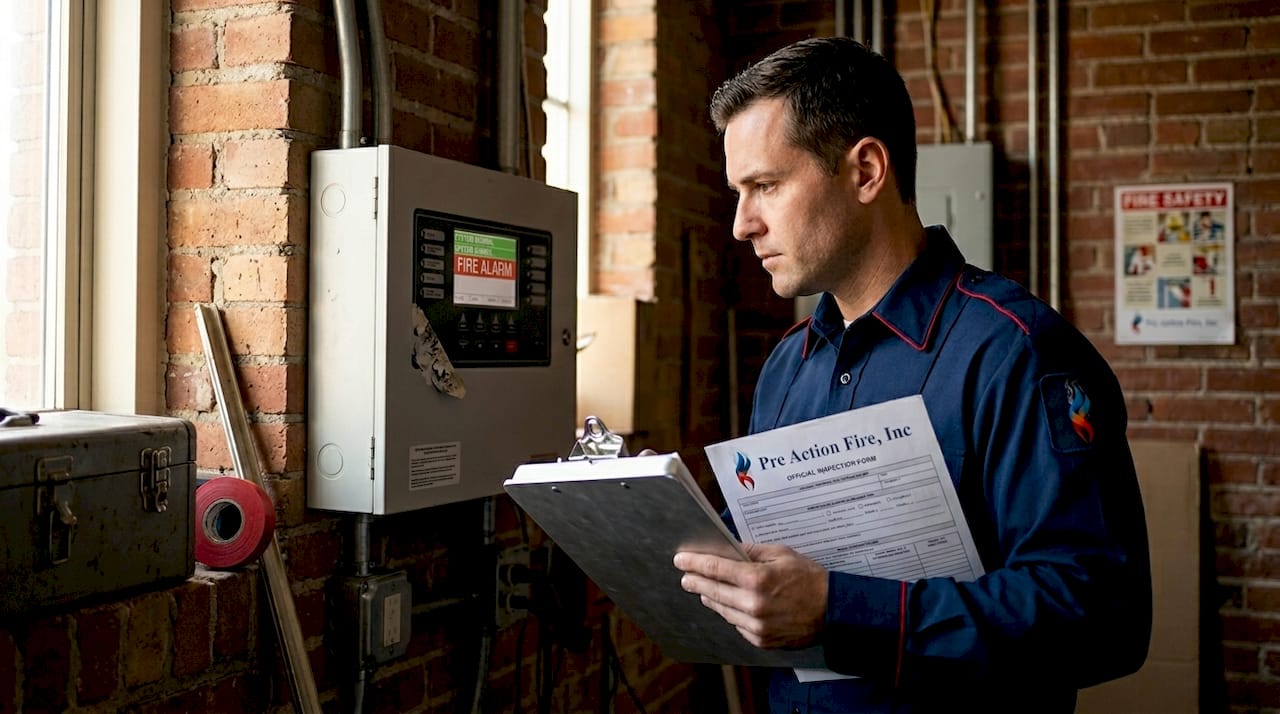
What most property managers overlook: inspection fees and pre-testing procedures directly affect your project timeline. Budget for them upfront. Systems that fail inspection require retesting, which adds weeks and costs you did not plan for. Your fire equipment readiness guide should include a pre-inspection checklist so your contractor confirms functionality before the official Denver Fire inspection.
Pro Tip: Treat your emergency plan as a living document. Every time a system is upgraded, a floor is re-tenanted, or an occupancy profile changes, your evacuation routes and lockdown procedures need to be reviewed and potentially revised. A plan written for a half-empty office building does not automatically work for a fully occupied mixed-use space.
Review your approach to fire safety prioritization in Colorado alongside any major building changes to ensure your strategy stays current.
Translating strategy into practice: Assigning responsibilities and integrating fire prevention controls
Writing a fire prevention plan and actually running one are two different things. The practical gap between them is where compliance failures happen. OSHA requires naming job titles responsible for ignition source and fuel hazard controls so that accountability exists when conditions change. When a supervisor leaves, that role’s fire prevention responsibilities must transfer clearly and immediately to whoever steps in.
Here is how effective fire hazard mitigation looks in practice for a Denver commercial property:
| Fire hazard category | Specific control measure | Responsible role |
|---|---|---|
| Flammable liquid storage | Approved containers, separated storage area | Facilities manager |
| Electrical heat-producing equipment | Monthly inspection, annual servicing | Maintenance technician |
| Combustible waste accumulation | Daily removal schedule, documented logs | Building operations lead |
| Welding and hot work | Hot work permit system, fire watch protocol | Safety officer |
| HVAC and ductwork | Quarterly cleaning, filter replacement | Contracted HVAC vendor |
Maintenance procedures for heat-producing equipment deserve special attention. Overheated electrical panels, neglected HVAC systems, and improperly stored cleaning solvents are among the most common ignition sources in commercial buildings across Colorado. These are not dramatic risks. They are boring, predictable, and entirely preventable with scheduled maintenance.
Denver’s prevention strategy and life-safety system readiness are inseparable. Many owners fail to coordinate their prevention narrative with the installation and inspection workflow, which leads to situations where the written plan describes systems that have not yet been inspected or tested to code standards.
Use a fire risk assessment process to map every identified hazard to a specific control, a maintenance schedule, and a named responsible title. This creates clarity and removes the ambiguity that causes gaps during audits or emergencies.
Pro Tip: Develop a job-hazard-to-responsibility matrix and review it quarterly. Make it a standing agenda item at your facilities or operations meeting, not something buried in a binder until an inspector asks for it.
Maintaining and adapting your fire prevention strategy for ongoing compliance and safety
How to prevent fires effectively over the long term is not about the plan you write today. It is about the system you build to keep that plan accurate and actionable as your building, your staff, and your risk environment change.
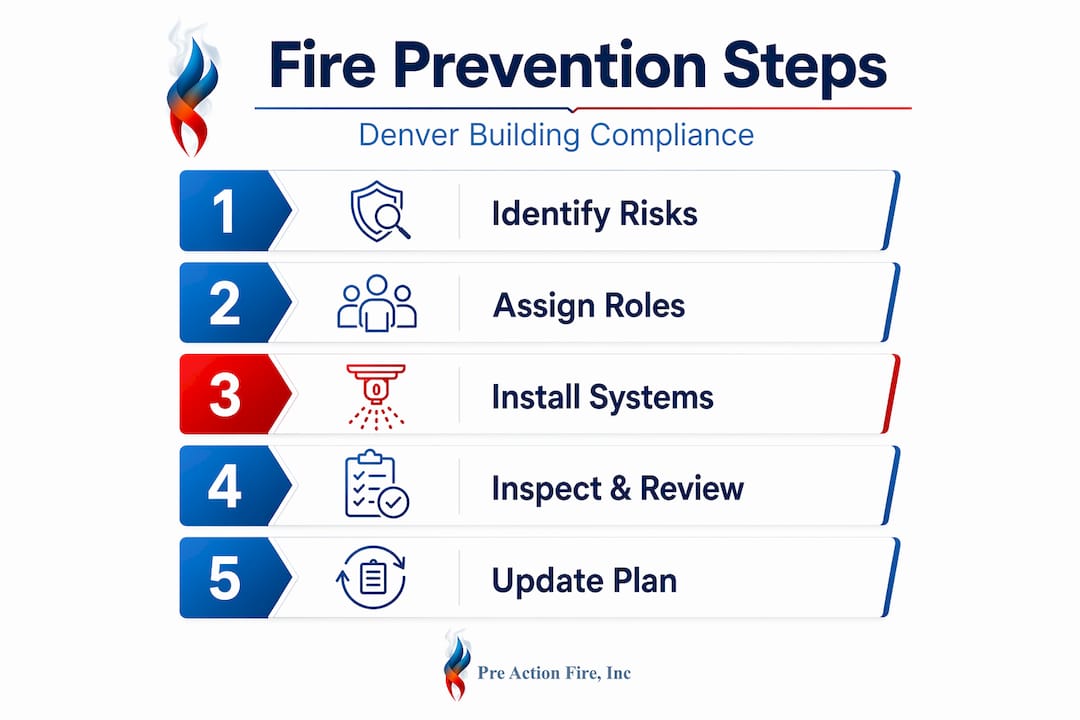
Effective prevention strategies adapt over time using findings from prevention activities, supported by accurate data and stakeholder collaboration. That means you need feedback loops built into your system.
Best fire prevention practices for maintaining an adaptive strategy include:
- Incident debriefs: After every fire alarm activation, near-miss, or emergency response, document what happened, what worked, and what did not.
- Inspection findings review: Use every inspection report as a source of intelligence on where your prevention controls are underperforming.
- Employee reporting channels: Give staff a simple way to report fire hazards they notice. The person who works near the electrical panel every day knows more about its quirks than any inspector who visits once a year.
- Community and agency collaboration: Denver Fire Department resources and local code updates should feed directly into your strategy review cycle.
- Scheduled strategy reviews: At minimum, review your written prevention plan annually and after any significant building or operational change.
“A fire prevention strategy that has not been updated in three years is not protecting anyone. It is a document that describes a building and a workforce that no longer exists.”
Fire safety prioritization means putting your review resources where the risk is highest, not simply checking boxes on the same schedule every year regardless of what has changed.
Pro Tip: Schedule a formal strategy review every January. Use the prior year’s inspection findings, any incident reports, and any changes to Denver fire code as your input documents. Assign someone to own this review by name.
Why many fire prevention strategies fail in practice: Owning accountability and aligning operations
Here is what 15-plus years of working with Denver property managers actually looks like. Most buildings have documentation. Some of it is even good. What is almost universally missing is the operational integration that makes documentation real.
The most common failure is not a missing extinguisher or an expired inspection tag. It is a written plan that describes accountability structures that do not match how the building actually operates. The plan says the maintenance supervisor is responsible for heat-producing equipment. That supervisor left eight months ago. Nobody updated the plan. Now there is no one formally accountable.
Treating evacuation and lockdown plans as static documents is a close second. Many prevention failures in Denver stem from disconnects between written plans and actual life-safety system readiness and inspection workflows. Your emergency plan is supposed to describe how your building’s systems support evacuation. If those systems have been modified and the plan has not, you are giving occupants outdated instructions during the moment when accurate information matters most.
Common pitfalls and corrective actions for Denver property managers:
- Pitfall: Generic job titles with no individual owner. Fix: Assign a primary and backup contact for every hazard category.
- Pitfall: Plans written at occupancy and never revisited. Fix: Formalize an annual review with a sign-off requirement.
- Pitfall: Life-safety systems installed but prevention plan not updated to reflect them. Fix: Trigger a plan review every time a new system is permitted and inspected.
- Pitfall: Employee training completed at onboarding but never refreshed. Fix: Conduct fire hazard briefings at least annually and when hazard conditions change.
- Pitfall: No feedback mechanism for reporting hazards. Fix: Create a simple reporting process and communicate it to all staff.
Your Denver fire equipment compliance guide is a practical starting point for auditing your current system readiness against these common gaps.
The uncomfortable truth is that effective fire prevention is an operations discipline, not a compliance exercise. Properties that treat it as the latter tend to find out the hard way which parts of their plan were theoretical.
How Pre Action Fire supports Denver property managers with fire prevention compliance
Building a fire prevention strategy that holds up under Denver Fire Department scrutiny takes more than good intentions. It takes systems that work, plans that reflect reality, and inspections that confirm functionality before problems become violations.
Pre Action Fire has worked with commercial and industrial properties across the Denver Metro Area since 2009. Their NICET-certified technicians design and install fire alarm systems aligned with Denver’s current code requirements and NFPA standards. Their fire safety inspections service keeps your life-safety systems documented, tested, and ready for both routine audits and post-installation Fire Department review. And their equipment readiness checks help you close the gap between what your written plan says and what your building actually has in place.
Services tailored for Denver property managers and business owners include:
- Fire alarm system design, installation, and code-compliant documentation
- Sprinkler system installation and scheduled maintenance
- Post-installation inspections and pre-test coordination with Denver Fire Prevention
- Emergency plan review support, including evacuation and lockdown protocol alignment
- Fire extinguisher supply, placement, and annual inspection services
Frequently asked questions
What are the main components of a fire prevention strategy in Denver?
A fire prevention strategy in Denver includes a risk-informed prevention plan, named accountability for hazard controls, emergency evacuation and lockdown procedures, and life-safety system inspections that confirm functional installation before occupancy.
Do small businesses need a written fire prevention plan under OSHA?
Yes, employers with more than 10 employees must have a written fire prevention plan accessible at the workplace. Those with 10 or fewer employees may communicate the plan orally, though written documentation remains the safer practice.
How often must life-safety systems be inspected after installation in Denver?
Denver requires post-installation inspections by Fire Prevention personnel before occupancy, with ongoing maintenance and re-inspection intervals determined by system type and Denver fire code requirements.
What is the role of employee training in fire prevention plans?
Employee training is mandatory under OSHA to inform workers about the specific fire hazards in their work area and the parts of the prevention plan relevant to their self-protection, completed before they begin their initial assignment.