
TL;DR:
- Sprinkler head selection depends on orientation, response time, temperature rating, and K-factor to ensure system compliance and fire protection. Mixing response types or installing heads out of specified orientation or temperature range can invalidate NFPA 13 standards and compromise safety. Proper survey, verification, and adherence to manufacturer listings are essential for reliable and compliant sprinkler system design.
Sprinkler head types are defined by four independent classification factors: orientation, response time, temperature rating, and K-factor. Each factor determines where a head can be installed, how fast it activates, and how much water it delivers. Get any one of them wrong, and your system may fail inspection or, worse, fail during a fire. This guide covers all four classifications with the specificity property owners, facility managers, and NFPA 13 compliance teams need to make the right call.
Sprinkler head types explained: orientation and applications
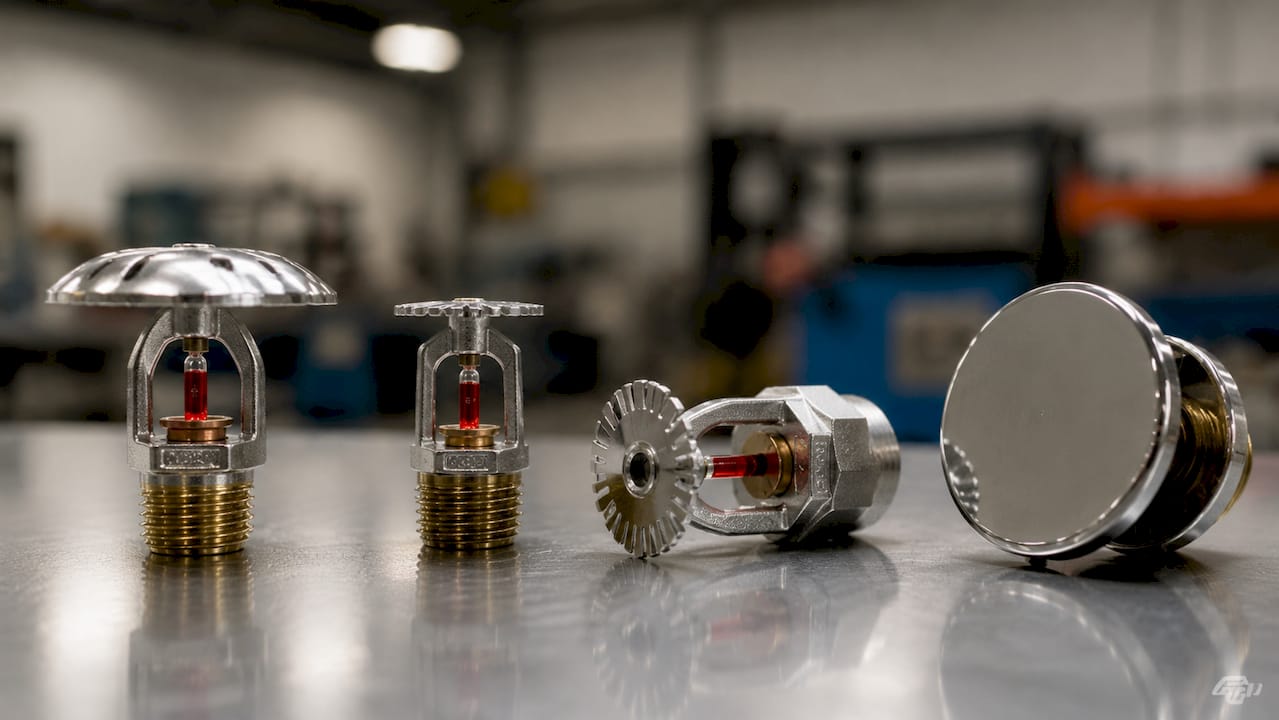
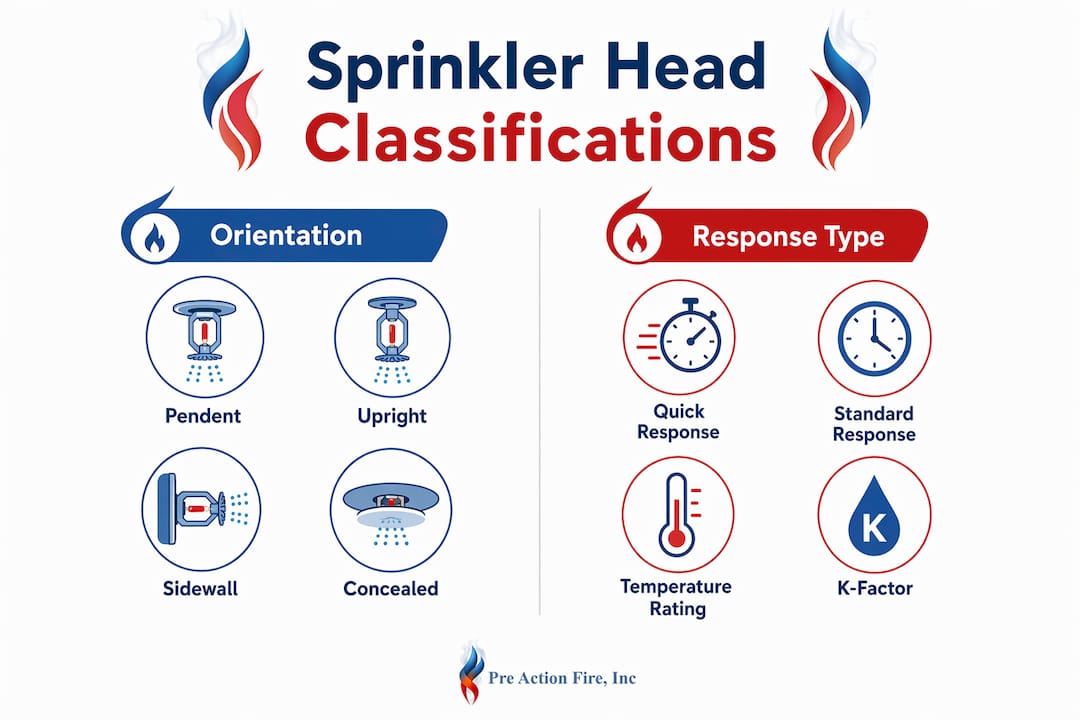
Sprinkler head orientation is the first decision in any selection process, and it is non-negotiable. The four primary orientations are pendent, upright, sidewall, and concealed or recessed. Each has a specific deflector geometry that controls the spray pattern. Swapping orientations breaks the manufacturer’s listing and invalidates the hydraulic design, even if the head physically fits the fitting.
| Orientation | Typical Application | Key Installation Note |
|---|---|---|
| Pendent | Concealed ceilings, commercial offices | Hangs downward from branch pipe; most common type |
| Upright | Exposed pipe, dry-pipe systems, warehouses | Sprays upward; deflector redirects water outward and down |
| Sidewall | Corridors, hotel rooms, spaces without ceiling piping | Mounts on wall; one-directional spray pattern |
| Concealed/Recessed | Lobbies, healthcare, high-aesthetic spaces | Cover plate hides mechanism; not listed for dry or pre-action systems |
NFPA 13 orientation requirements specify that pendent heads hang from branch pipes for concealed ceilings, upright heads spray upward for dry-pipe or exposed-pipe configurations, and sidewall heads mount on walls where ceiling piping is impractical. The deflector geometry is what differentiates performance. A pendent head installed upright will not produce the correct spray pattern, regardless of its temperature rating or K-factor.
Sidewall heads deserve special attention. They are the right choice for narrow corridors and hotel rooms where running branch piping across the ceiling is structurally or aesthetically impractical. Their one-directional spray pattern is engineered specifically for that geometry. Using a pendent head in the same space would leave coverage gaps that no amount of pressure adjustment can fix.
Pro Tip: Always verify the orientation listing on the head’s data sheet before installation. A head that physically threads into the fitting is not automatically listed for that orientation. Manufacturers list heads for specific orientations, and mixing them voids compliance.
How do quick response and standard response heads differ?
Response type is the classification most often misunderstood in the field. Quick response (QR) heads use a 3 mm glass bulb with a response time index (RTI) at or below 50 (m·s)^½. Standard response (SR) heads use a 5 mm glass bulb with an RTI above 80. That difference in bulb size means QR heads activate approximately twice as fast as SR heads under identical fire conditions.
Why does activation speed matter? QR heads limit fire growth before the system reaches full activation. This is especially significant in light hazard occupancies like offices, schools, and hotels, where NFPA 13 mandates QR heads for wet-pipe systems. SR heads are required in dry-pipe, pre-action, ordinary hazard, and extra hazard systems, where the slower activation is part of the hydraulic design assumption.
The most critical rule governing response types:
- Never mix QR and SR heads in the same compartment. Hydraulic calculations assume uniform activation behavior across all heads in a zone.
- Mixing response types produces unpredictable activation sequences that invalidate the system design.
- NFPA 13 treats this as a noncompliance condition requiring corrective action.
- QR heads in light hazard occupancies provide measurable fire control advantages by limiting fire growth before full system activation.
Pro Tip: Field identification of QR vs SR heads is most reliable via model markings and glass bulb size, not temperature rating alone. A 3 mm bulb is QR; a 5 mm bulb is SR. Check the model number against the manufacturer’s data sheet if the bulb has already activated.
What are sprinkler temperature ratings and how do you choose?
Temperature rating is the classification that prevents two opposite failures: nuisance activations from heads set too low, and delayed activation from heads set too high. NFPA 13 temperature classifications range from ordinary at 68°C (155°F) up to ultra-high at 260°C (500°F). The rule for selection is straightforward: the maximum ambient temperature at the deflector location must be at least 38°F below the head’s activation temperature.
| Temperature Class | Activation Temp (°F) | Max Ambient Ceiling Temp (°F) | Typical Application |
|---|---|---|---|
| Ordinary | 135–170 | 100 | Offices, hotels, schools |
| Intermediate | 175–225 | 150 | Attics, skylights, near unit heaters |
| High | 250–300 | 225 | Commercial kitchens, boiler rooms |
| Extra High | 325–375 | 300 | Drying ovens, process areas |
| Ultra High | 400–475 | 375 | High-heat industrial environments |
Most occupied commercial spaces use ordinary-class heads. Kitchens and boiler rooms require high-class heads rated at 250–300°F. The mistake that generates the most service calls is installing ordinary-class heads in spaces where summer ceiling temperatures routinely exceed 100°F. Attics, skylights, and spaces near unit heaters are the most common offenders.
Temperature surveys at the deflector location are the correct method for selecting ratings. General ceiling temperature measurements are not sufficient. Heat stratifies, and the deflector sits in the hottest zone of the space. A survey that measures ambient air at 5 feet will underestimate the actual temperature the head experiences.
How do k-factors affect hydraulic performance?
K-factor measures a sprinkler head’s discharge rate using the hydraulic formula Q = K × √P, where Q is flow in gallons per minute and P is pressure in psi. Common commercial K-values include K=80 and K=115, with higher values delivering more water at the same pressure. Selecting the wrong K-factor means your system either under-suppresses a fire or requires pressure levels the supply cannot deliver.
Here is what K-factor selection looks like in practice:
- K=56 (standard residential): Suited for light hazard residential and small commercial spaces with low ceiling heights.
- K=80 (standard commercial): The most common choice for light-to-ordinary hazard commercial occupancies.
- K=115 (large orifice): Used in ordinary and high hazard occupancies where higher flow rates are needed without excessive pressure.
- K=160 and above (extended coverage): Applied in large open spaces like warehouses and distribution centers where wider spacing is required.
Higher hazard occupancies and large open spaces require heads with larger K-factors for effective suppression without demanding excessive system pressure. A K=80 head in a high-piled storage warehouse will not deliver adequate flow at typical system pressures. The hydraulic model will show this failure during design review, but only if the correct K-factor is entered. Using the wrong value in the model produces a design that looks compliant on paper but fails in the field.
What compatibility issues must you address when selecting heads?
Four independent decisions govern every sprinkler head selection: orientation, response type, temperature rating, and K-factor. All four must align with NFPA 13 requirements for the specific occupancy and system type. Mixing incompatible features risks hydraulic failure and noncompliance. The compatibility issues that generate the most costly errors fall into three categories.
System type compatibility is the first check. Concealed and recessed heads are not listed for dry-pipe or pre-action systems. Dry and pre-action systems require upright or dry-type pendent heads because water is not present in the pipe until activation. Installing a concealed head in a pre-action system is a listing violation, regardless of how it looks aesthetically.
Obstruction clearance is the second check. NFPA 13 requires a minimum 18-inch clearance below the deflector to avoid spray pattern interference. Beams, ducts, and storage racks that intrude into this zone require additional heads or repositioning. Hydraulic modeling must account for obstructions, and field conditions often differ from the design drawings.
Uniform response type within compartments is the third check. This point cannot be overstated. A single SR head installed among QR heads in a light hazard office invalidates the hydraulic design for the entire compartment.
Follow this selection checklist before specifying any head:
- Confirm system type: wet, dry, or pre-action.
- Verify orientation listing matches the installation position.
- Select response type per NFPA 13 occupancy classification.
- Confirm temperature rating against deflector-location ambient survey.
- Verify K-factor against hydraulic design requirements.
- Check that all heads in a compartment share the same response type.
Pro Tip: Physical fit is not the same as listing compliance. A pendent head will thread into an upright fitting. A concealed head will install in a pre-action system. Neither is compliant. Always verify the listing on the manufacturer’s data sheet, not just the physical connection.
For Denver-area compliance requirements, local amendments to NFPA 13 can add requirements beyond the base standard. Verify with your authority having jurisdiction before finalizing head specifications.
Key takeaways
Correct sprinkler head selection requires matching all four classification factors to the specific system type, occupancy, and ambient conditions.
| Point | Details |
|---|---|
| Orientation is non-negotiable | Pendent, upright, sidewall, and concealed heads are listed for specific positions; swapping them voids compliance. |
| Never mix QR and SR heads | Mixing response types in one compartment invalidates hydraulic calculations and violates NFPA 13. |
| Temperature rating needs a survey | Measure ambient temperature at the deflector location, not general ceiling height, to select the correct class. |
| K-factor drives flow rate | Use Q = K × √P to confirm the head delivers adequate flow at available system pressure for the hazard level. |
| Concealed heads have system limits | Concealed and recessed heads are not listed for dry-pipe or pre-action systems; use upright or dry-type heads instead. |
What i’ve learned after years of sprinkler head specifications
The single most common error I see in the field is treating sprinkler head selection as a one-decision process. A facility manager picks a concealed head because it looks clean in a lobby, and nobody checks whether the building has a pre-action system. The head installs, passes a visual inspection, and sits there as a noncompliant fixture until the next NFPA 13 inspection catches it.
The second pattern I see constantly is response type mixing during maintenance. A QR head activates and gets replaced with whatever is in the parts cabinet. If that replacement is SR, the compartment is now noncompliant. Field identification using glass bulb size is the fastest way to catch this. A 3 mm bulb is QR; a 5 mm bulb is SR. That 2 mm difference is the difference between a compliant system and one that needs a full compartment audit.
Temperature rating errors are subtler but just as consequential. The spaces that cause the most nuisance activations are not kitchens or boiler rooms. They are attics and spaces near skylights in Colorado, where summer ceiling temperatures at the deflector can exceed 100°F without anyone realizing it. An ordinary-class head rated at 135°F in a space that reaches 110°F at the deflector is a nuisance activation waiting to happen.
My honest recommendation: treat the sprinkler coverage standards for your jurisdiction as the floor, not the ceiling. The four-factor selection process takes an extra hour during design. Fixing a noncompliant installation takes days and costs significantly more.
— Preactionfire
Get expert sprinkler installation and inspection in denver
Selecting the right sprinkler head type is only half the job. Correct installation, system commissioning, and regular inspection are what keep your building compliant and your occupants protected.
Pre Action Fire has served the Denver Metro Area since 2009 with NICET-certified technicians who specialize in NFPA 13-compliant sprinkler systems for commercial and industrial properties. Whether you need a new installation, a system upgrade, or a compliance inspection, the team brings the technical depth this work demands. Contact Preactionfire for professional sprinkler installation tailored to your occupancy type and local code requirements. You can also review fire safety inspection services to keep your system performing as designed year after year.
FAQ
What are the four types of sprinkler head orientations?
The four orientations are pendent, upright, sidewall, and concealed or recessed. Each is listed for specific installation positions and system types per NFPA 13.
Can you mix quick response and standard response heads in one system?
No. NFPA 13 prohibits mixing QR and SR heads within the same compartment because hydraulic calculations assume uniform activation behavior across all heads in the zone.
How do you identify a quick response sprinkler head in the field?
A QR head uses a 3 mm glass bulb with an RTI at or below 50 (m·s)^½. Check the glass bulb size and verify against the model number on the manufacturer’s data sheet.
What temperature rating should i use for a commercial kitchen?
Commercial kitchens require high-class heads with activation temperatures between 250°F and 300°F. The maximum ambient temperature at the deflector must be at least 38°F below the head’s activation temperature.
Are concealed sprinkler heads allowed in dry-pipe systems?
No. Concealed and recessed heads are not listed for dry-pipe or pre-action systems. These system types require upright or dry-type pendent heads per NFPA 13 listing requirements.