
TL;DR:
- Colorado commercial properties must comply with strict fire codes including wildfire-specific requirements in WUI zones.
- A five-step risk assessment identifies hazards, people at risk, controls, and promotes ongoing review.
- Proper documentation and regular updates are essential for maintaining compliance, insurance, and safety.
Colorado commercial property owners face a fire risk environment unlike almost anywhere else in the country. Between strict International Fire Code requirements, Denver-specific amendments, and the growing wildfire threat in wildland-urban interface (WUI) zones, the stakes for getting fire risk assessment right are high. A missed compliance item can mean fines, voided insurance, or worse. This article walks you through the key codes to know, a practical five-step assessment framework, the controls that matter most, wildfire-specific requirements, and how to build a documentation trail that protects you when it counts.
Table of Contents
- Understand Colorado fire codes and compliance essentials
- Spot hazards: The practical 5-step risk assessment framework
- Prioritize controls: Key safety measures and must-check systems
- Wildfire risk: Defensible space, building hardening, and insurance impact
- Documentation and review: Building a defensible audit trail
- Our take: What most fire risk assessments in Colorado get wrong
- Ensure compliance and safety peace of mind with expert help
- Frequently asked questions
Key Takeaways
| Point | Details |
|---|---|
| Know the codes | Local and state fire codes, including wildfire rules, dictate what you must do to stay compliant and protected. |
| Assess with a framework | A structured 5-step approach uncovers the full range of hazards and keeps your facility audit-ready. |
| Upgrade controls | Prioritize, check, and routinely maintain your alarms, extinguishers, and exits to prevent and manage fires effectively. |
| Document everything | Robust records of assessments, follow-up actions, and updates will defend you in compliance checks and insurance disputes. |
Understand Colorado fire codes and compliance essentials
Before you can assess risk effectively, you need to know what regulators expect. Colorado commercial properties must comply with the International Fire Code (IFC) as amended locally, and Denver adds its own layer of requirements on top of the state baseline. If your property sits in or near a WUI zone, you also have to meet wildfire-specific rules under the Wildfire Resiliency Code, which covers everything from exterior materials to vegetation management.
When inspectors visit a commercial building in Colorado, they typically check:
- Smoke and carbon monoxide detectors (placement, function, interconnection)
- Fire extinguisher type, placement, and service tags
- Sprinkler system coverage and condition
- Fire doors, exit signage, and emergency lighting
- Storage of flammable and combustible materials
- Site access for fire apparatus
- WUI hardening measures where applicable
One of the most common compliance mistakes we see is treating fire safety as a one-time setup rather than an ongoing obligation. Codes get updated, building uses change, and tenant modifications can quietly create new hazards. Failing a fire inspection in Denver can trigger re-inspection fees, mandatory corrective orders, and in serious cases, occupancy restrictions.
Pro Tip: Before your next scheduled inspection, request a pre-inspection walkthrough with your local fire authority having jurisdiction (AHJ). Most will flag issues informally, giving you time to correct them before it becomes a formal violation.
Good fire protection planning starts with knowing exactly which code version applies to your building, your occupancy type, and your location. When in doubt, call your AHJ directly.
Spot hazards: The practical 5-step risk assessment framework
With compliance basics covered, the next move is putting a robust framework into action for real-world risk identification. The standard five-step methodology used by fire safety professionals gives you a repeatable, defensible process.
- Identify fire hazards. Walk the property looking for ignition sources (faulty wiring, heating equipment, open flames), fuel sources (paper, flammable liquids, combustible storage), and oxygen sources that could accelerate a fire.
- Identify people at risk. Consider employees, visitors, contractors, and anyone with limited mobility or unfamiliarity with evacuation routes.
- Evaluate existing controls. Review what protections are already in place and whether they are adequate for the hazards you found. Look for gaps.
- Record findings and create an action plan. Document every hazard, who is at risk, what controls exist, and what additional steps are needed. Set clear priorities and deadlines.
- Review and update regularly. A risk assessment is only useful if it reflects current conditions. Schedule reviews at least annually and after any significant changes.
For Colorado commercial properties specifically, common hazards include electrical panel issues in older buildings, improper flammable liquid storage in warehouses, blocked emergency exits due to inventory overflow, and inadequate ember-resistant features in WUI-adjacent facilities. Industrial dust accumulation is a serious but often overlooked hazard in manufacturing and agricultural settings.
“A proper risk assessment isn’t optional; it’s your best defense against liability.”
Pro Tip: Use a qualified assessor, ideally someone with NFPA fire risk guidance training, and document everything digitally. A timestamped digital record is far more defensible in a liability claim than a paper binder that may go missing.
Prioritize controls: Key safety measures and must-check systems
Now that you know how to uncover risks, let’s rank and review the essential safety controls every facility should optimize. Not all controls carry equal weight. Some prevent a fire from starting; others limit how far it spreads or how quickly people can escape.
| Control system | Primary hazard addressed | Common deficiency to watch for |
|---|---|---|
| Smoke and CO detectors | Early warning, occupant alert | Dead batteries, outdated units, wrong placement |
| Fire extinguishers | Small fire suppression | Wrong class for hazard, expired service tags |
| Sprinkler systems | Fire spread containment | Obstructed heads, pressure issues, no recent test |
| Fire doors | Compartmentalization | Propped open, damaged seals, missing hardware |
| Exit signs and lighting | Safe evacuation | Burned-out bulbs, blocked pathways |
| Flammables storage | Ignition risk reduction | Improper containers, inadequate ventilation |
Key compliance and risk controls to verify in your facility include:
- Smoke and CO detectors installed and tested per NFPA 72
- Fire safety inspections completed on schedule with records on file
- Sprinkler heads clear of obstructions and within their rated coverage area
- Fire doors closing and latching fully without manual assistance
- Exit routes free of storage, equipment, or any obstruction
Critical deficiencies like blocked exits or non-functioning alarm systems require immediate correction, not a spot on next quarter’s to-do list. These are the items most likely to result in occupancy violations and, more importantly, the ones most likely to cost lives.
Pro Tip: Don’t wait for the annual inspection to test your systems. Schedule quarterly functional tests on alarms and monthly visual checks on extinguishers and exit lighting. Small issues caught early are far cheaper to fix than emergency repairs after a failed inspection.
Wildfire risk: Defensible space, building hardening, and insurance impact
General fire controls matter everywhere, but for at-risk locations, wildfires add a new layer of urgency and distinctive requirements. Colorado’s Wildfire Resiliency Code applies to properties in designated WUI zones and sets specific standards for construction materials, vegetation management, and ember-resistant features.
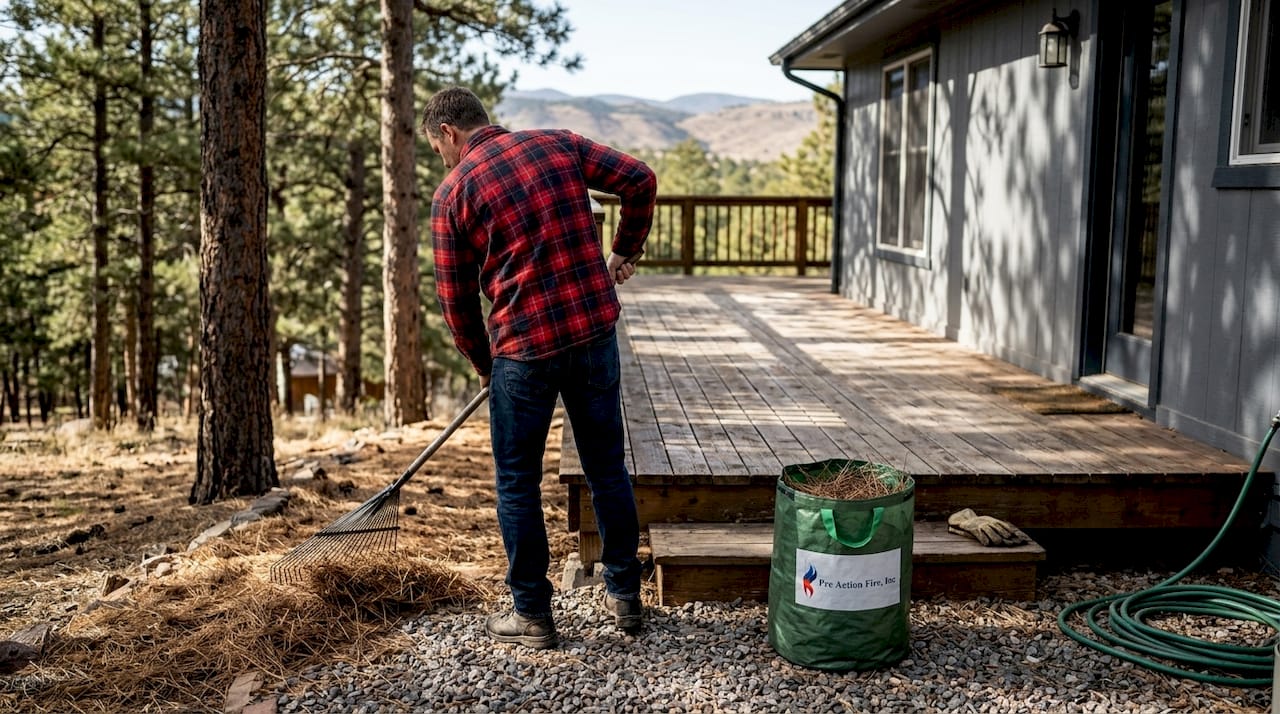
Under Colorado HB25-1182, insurers are now required to provide property owners with a wildfire risk score on a scale of 1 to 5 and to offer mitigation discounts when owners take qualifying steps to reduce that score. This is a significant shift. Your risk score now directly affects your premium and your ability to secure coverage at all.
| Mitigation measure | Insurance impact | Code requirement |
|---|---|---|
| Defensible space (0-30 ft cleared) | Potential premium reduction | Required in WUI zones |
| Class A fire-rated roofing | Lowers risk score | Required for new WUI construction |
| Ember-resistant vents | Reduces ignition pathways | Wildfire Resiliency Code standard |
| Non-combustible siding | Lowers risk score | Encouraged, required in some zones |
| Vegetation management beyond 30 ft | Further premium benefit | Recommended best practice |
For WUI-zone commercial properties, prioritize these steps:
- Clear combustible vegetation within 30 feet of all structures.
- Extend a reduced-fuel zone from 30 to 100 feet where site conditions allow.
- Replace or retrofit vents with ember-resistant models.
- Audit roofing and siding materials against current Wildfire Resiliency Code standards.
- Document every mitigation action with photos and dates for your insurer.
Insurance premiums in high-risk Colorado counties have risen sharply in recent years, and some carriers have exited the market entirely. Proactive mitigation is no longer just a safety measure. It is a financial strategy.
Documentation and review: Building a defensible audit trail
With practical mitigation in place, maintaining a solid documentation system is your strongest tool in demonstrating due diligence and keeping your risk management up to date. Regulators, insurers, and courts all want to see evidence that you took fire risk seriously and acted on what you found.
At minimum, your fire risk documentation should include:
- Assessment reports with date, assessor name, hazards identified, and risk ratings.
- Corrective action logs showing what was fixed, by whom, and when.
- Inspection and testing records for all fire protection systems.
- Maintenance logs for sprinklers, alarms, extinguishers, and fire doors.
- Review schedule confirming when the next full assessment is due.
The NFPA compliance records standard requires that these records be retained and available for inspection. Missing or incomplete records are treated the same as missing controls by most inspectors and insurers.
Pro Tip: Move away from paper binders. Digital platforms that allow photo uploads, task assignment, and automatic reminders make it far easier to maintain a complete, timestamped audit trail. When an insurer or inspector asks for your fire risk history, you want to pull it up in seconds, not search through filing cabinets.
Reviewing your assessment regularly and after changes is not just good practice. It is a regulatory expectation in Colorado. Any renovation, change in occupancy, new tenant, or significant process change should trigger an immediate review.
Our take: What most fire risk assessments in Colorado get wrong
Here is something we have seen repeatedly over more than 15 years serving the Denver Metro Area: most fire risk failures are not caused by ignorance of the code. They are caused by treating the assessment as a one-time event.
A facility passes its inspection, files the paperwork, and moves on. Then a tenant modifies a storage area, a staff member props a fire door open because it is inconvenient, or a sprinkler head gets painted over during a renovation. None of these changes get documented. None trigger a reassessment. And suddenly the building that passed inspection two years ago has three critical deficiencies.
The other blind spot we see constantly is compliance gaps specific to Colorado’s wildfire exposure. Property owners in WUI zones often complete the standard commercial assessment and assume they are covered. They are not. Wildfire risk requires its own evaluation layer, its own mitigation plan, and its own documentation trail for insurers.
Our honest advice: assign a named person to own fire risk management in your facility. Give them authority to act, a budget for corrections, and a calendar reminder for quarterly reviews. A living process beats a perfect binder every time.
Ensure compliance and safety peace of mind with expert help
Navigating Colorado’s fire codes, WUI requirements, and insurance documentation demands real expertise. Getting it right the first time is always less expensive than correcting violations under pressure.
At Pre Action Fire, Inc, our NICET-certified technicians have been helping Denver Metro commercial properties stay compliant and protected since 2009. Whether you need a thorough fire safety inspection, a new fire sprinkler installation, or guidance on building a complete fire protection plan, we bring the technical depth and local code knowledge your facility needs. Visit our website to schedule a consultation or request an inspection today.
Frequently asked questions
What are the most common fire hazards in Colorado commercial buildings?
Common hazards in Colorado commercial settings include electrical faults, improper flammable material storage, blocked exit routes, poor housekeeping, and for WUI-zone properties, wildfire ember intrusion through unprotected vents and openings.
How often should fire risk assessments be reviewed or updated?
Assessments should be reviewed annually at minimum, and immediately after any significant change to the building, its occupancy, processes, or staffing.
What documentation is required for fire risk assessments in Colorado?
You must record all identified risks, the controls in place, corrective action plans with priorities, and a schedule for future reviews to satisfy local code and insurance requirements.
How does wildfire risk impact commercial fire risk assessment?
Properties in WUI zones require a separate assessment layer covering defensible space, building hardening, and ember-resistant features, all of which directly affect insurance risk scores and premium rates under Colorado law.