
Outdated fire sprinkler systems put your property, your tenants, and your business at serious risk. Regulatory fines for non-compliance with codes like NFPA 13 can reach thousands of dollars, and liability exposure from a preventable fire can be far worse. Colorado property managers face a clear choice: upgrade proactively or wait for an inspector to force the issue. The 2025 Denver Fire Code brought significant changes that affect how systems must be designed, documented, and maintained. This guide walks you through every step, from initial assessment to long-term compliance.
Table of Contents
- Assessing your current fire sprinkler system
- Understanding Colorado codes and regulations
- Planning and permitting your upgrade
- Executing the upgrade: Installation and commissioning
- Maintaining your upgraded system for compliance
- Expert perspective: What most owners overlook in fire sprinkler upgrades
- Next steps: Upgrade your fire protection confidently
- Frequently asked questions
Key Takeaways
| Point | Details |
|---|---|
| Assessment first | Always start your upgrade by thoroughly evaluating your current system for deficiencies and compliance gaps. |
| Codes matter | Stay up to date with Colorado’s regulation changes, especially NFPA 13 2025 and Denver-specific amendments. |
| Certified contractors | Only hire registered fire suppression contractors for upgrades to meet legal and safety standards. |
| ITM schedules | Follow inspection, testing, and maintenance routines to keep your system compliant and reliable. |
| Safety over minimums | Prioritize upgrades that exceed the bare minimum for true fire protection and peace of mind. |
Assessing your current fire sprinkler system
Before you spend a dollar on new pipe or hardware, you need a clear picture of what you already have. Upgrading a commercial system starts with a thorough assessment to identify deficiencies. Skipping this step is like remodeling a building without checking the foundation first.
Start by pulling every inspection report you can find. Look for patterns: recurring leaks, repeated valve failures, or notes about inadequate coverage. These patterns tell you more than a single snapshot inspection ever could.
Common deficiencies to look for:
- System age over 25 years with original components
- Corroded or leaking pipe joints and fittings
- Sprinkler heads that are painted, loaded, or obstructed
- Coverage gaps caused by building renovations or additions
- Missing or incomplete as-built drawings and documentation
- Control valves that are improperly positioned or unsecured
Once you have your deficiency list, compare your system against current code expectations. The table below shows the key differences between an outdated system and a code-compliant one.
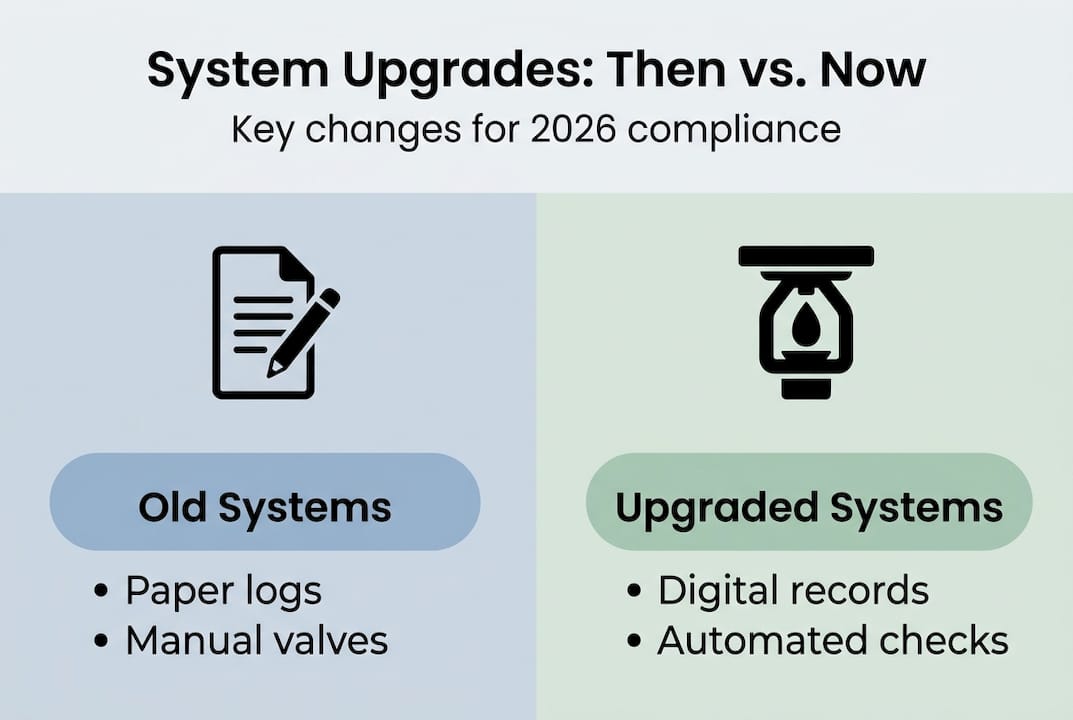
| Feature | Outdated system | Code-compliant system |
|---|---|---|
| Documentation | Paper records, often missing | Mandatory documentation cabinet |
| Coverage design | Original layout, pre-renovation | Updated to reflect current floor plan |
| Pipe condition | Corrosion, scale buildup | Clean, obstruction-tested every 5 years |
| Sprinkler heads | Older listed models, some painted | Current listed heads, unobstructed |
| Valve monitoring | Manual checks only | Supervised, tamper-alarmed valves |
| ITM schedule | Irregular or undocumented | Per NFPA 25 frequencies |
NFPA 25 defines ITM as Inspection, Testing, and Maintenance, the structured program that keeps your system ready to perform. Inspection frequencies are clearly defined: weekly for valves and gauges, quarterly for alarms and pumps, annually for sprinklers and piping, and every five years for internal pipe and obstruction checks.
For a broader view of how assessment fits into your overall safety strategy, the fire protection planning guide for commercial properties is a useful starting point.
Pro Tip: Pull your archived inspection reports before scheduling any contractor visit. Recurring issues flagged across multiple reports are your highest-priority upgrade targets and will save you time during the assessment conversation.
Understanding Colorado codes and regulations
Knowing which codes apply to your building is not optional. It is the foundation of every decision you make during an upgrade.
The 2025 Denver Fire Code adopted the latest NFPA 13 updates, which include larger system area limits, new rules for high and sloped ceilings, requirements for vapor corrosion inhibitors, vacuum systems for dry-pipe applications, and a mandatory documentation cabinet for every protected building. These are not minor tweaks. They represent a meaningful shift in how systems must be designed and documented.
Key documentation requirements under current code:
- Approved permit copies stored on-site
- As-built system design drawings
- Hydraulic calculation records
- Current inspection and test reports
- Contractor certification and registration records
One statistic that should get your attention: 59% of sprinkler failures are linked to systems where a shut-off valve was closed, something entirely preventable with routine checks. That number reflects a maintenance culture problem, not a technology problem.
The table below summarizes the ITM schedule your upgraded system must follow under NFPA 25.
| Frequency | Tasks |
|---|---|
| Weekly | Inspect control valves and gauges |
| Quarterly | Test alarms, check fire pumps |
| Annually | Inspect sprinklers, piping, main drain test |
| Every 5 years | Internal pipe inspection, obstruction investigation |
One important note: code adoption varies by jurisdiction. Denver follows the 2025 Denver Fire Code, but other Colorado municipalities may be on different adoption cycles. Always confirm with your local Authority Having Jurisdiction, commonly called the AHJ, before finalizing your upgrade plans. Your AHJ is the official body with final say on what is required in your specific location.
For detailed guidance on staying current with annual sprinkler inspections in Colorado, that resource covers what inspectors look for and how to prepare.
Planning and permitting your upgrade
Planning is where most property managers lose time. The permitting process has specific steps, and missing any one of them can delay your project by weeks.
Obtaining permits from local authorities like the Denver Fire Department or Boulder County is a required step, not a formality. You also need to hire a contractor who is registered with Colorado’s Fire Suppression Program. As of fiscal year 2023 to 2024, 763 contractors held that registration statewide. Working with an unregistered contractor puts your permit and your certificate of occupancy at risk.
Numbered sequence from assessment to permit approval:
- Complete your system assessment and document all deficiencies
- Hire a registered fire suppression contractor for design work
- Prepare hydraulic calculations and updated as-built drawings
- Submit permit application to your local AHJ with full plan set
- Respond to any plan review comments and resubmit if required
- Receive permit approval before any physical work begins
- Schedule required inspections with the AHJ during installation
- Obtain final approval and update your documentation cabinet
Required documents for permit submission:
- Completed permit application form
- System design drawings stamped by a qualified designer
- Hydraulic calculations
- Contractor registration certificate
- Proof of insurance
AHJ approval is not just a legal box to check. It is the mechanism that confirms your system will actually work as designed in your specific building. Never begin installation without it.
For a closer look at what the Denver fire safety inspections process involves, that page outlines what inspectors evaluate at each stage. The 2025 Denver Fire Code is also publicly available if you want to review the specific language before your contractor meeting.
Executing the upgrade: Installation and commissioning
With permits in hand, the physical work can begin. Installation on a commercial system is not a weekend project. It requires coordination, sequencing, and a clear commissioning plan before the system goes live.
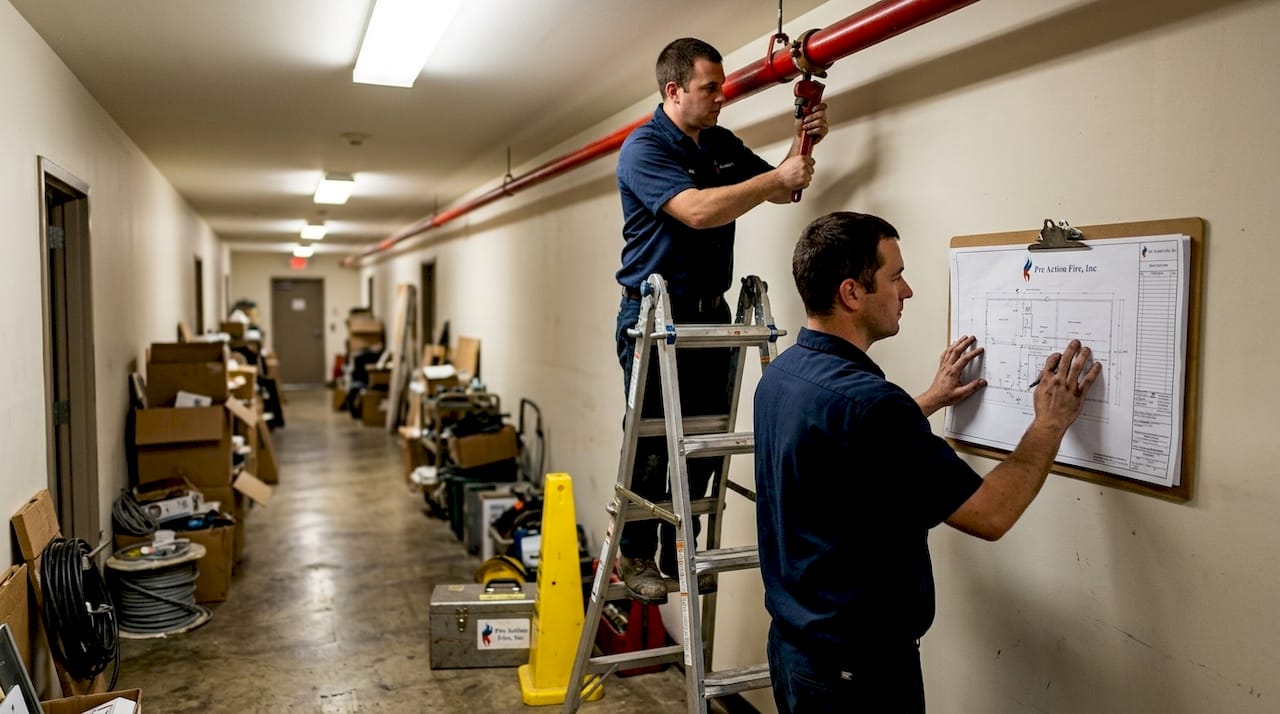
Installation must be performed by certified contractors and coordinated with any ongoing renovations. The new system must meet NFPA 13 and pass all commissioning tests before it is considered operational.
Typical upgrade sequence:
- Isolate and drain the existing system section by section
- Remove outdated pipe, heads, and control components
- Install new pipe runs per approved design drawings
- Mount updated sprinkler heads at correct spacing and orientation
- Connect new control valves and alarm check valves
- Flush the system to remove debris before final connection
- Conduct a full flow test to verify hydraulic performance
- Test all alarms, supervisory signals, and valve tamper switches
- Complete final documentation and submit to AHJ for sign-off
Pro Tip: If your building has a renovation scheduled in the next 12 to 18 months, align your sprinkler upgrade with that timeline. Coordinating both projects cuts labor costs significantly and reduces the number of days your operations are disrupted.
Commissioning is the final verification stage. It confirms that everything installed in the field matches the approved design. Testing and commissioning are required by code, and the results must be documented. After commissioning, your contractor should hand over a complete record set including test reports, as-built drawings, and the commissioning checklist.
For more detail on what a proper fire sprinkler installation involves in a commercial setting, that resource covers scope, timelines, and what to expect from your contractor.
Maintaining your upgraded system for compliance
Installing a new system is only half the job. Staying compliant means following a structured ITM program from day one.
NFPA 25 requires weekly valve and gauge inspections, quarterly alarm and pump tests, annual sprinkler and piping inspections, and five-year internal pipe checks. There is no grandfathering provision. Building owners are fully responsible for maintaining compliance with the current standard, regardless of when the system was installed.
Ongoing maintenance tasks to schedule:
- Weekly visual check of all control valves and pressure gauges
- Quarterly functional test of water flow alarms and fire pumps
- Annual inspection of all sprinkler heads, pipe hangers, and main drain
- Annual review and update of your documentation cabinet contents
- Five-year internal pipe inspection and obstruction investigation
- Immediate follow-up on any impairment notices or failed test results
Documentation is where many owners fall short. The 2025 code changes made the on-site documentation cabinet a formal requirement, not a best practice. Every inspection report, test result, and contractor certificate needs to live in that cabinet, accessible to inspectors at any time.
For practical guidance on preparing for annual inspection tips in Colorado facilities, that page covers what to have ready and how to avoid common citation triggers.
Pro Tip: Set calendar reminders for every ITM interval the moment your system passes commissioning. Weekly, quarterly, and annual tasks are easy to defer when business gets busy. A missed inspection is a compliance violation, and violations create liability.
Expert perspective: What most owners overlook in fire sprinkler upgrades
After working with commercial properties across the Denver Metro Area, the pattern we see most often is not a lack of willingness to comply. It is a lack of strategic timing and a misunderstanding of what compliance actually demands long-term.
Most owners treat a sprinkler upgrade as a one-time event. They get the permit, complete the installation, pass the final inspection, and consider the job done. But building owners are responsible for ongoing ITM with no grandfathering, meaning the work never really stops.
The other thing owners consistently underestimate is the documentation burden. The 2025 code changes formalized what good operators were already doing, but many properties are still catching up. An inspector who finds a missing test report does not care that the physical system is in perfect condition.
There is also a broader tension worth acknowledging. In Summit County, builders have opposed stricter sprinkler codes on cost grounds, but the safety case is clear. Minimum compliance protects you legally. Proactive upgrades protect lives and property.
The smartest move is to use the upgrade planning guide to align your fire protection improvements with your broader renovation schedule. That single decision can cut your total project cost and eliminate most of the operational disruption.
Next steps: Upgrade your fire protection confidently
You now have a clear roadmap from assessment through long-term maintenance. The next step is working with a local team that knows Colorado codes, has the certifications to back it up, and can manage every phase of your upgrade without you having to coordinate multiple vendors.
Pre Action Fire, Inc has served the Denver Metro Area since 2009, and our NICET-certified technicians handle everything from initial assessment to Denver sprinkler installation and ongoing NFPA compliance inspections. Whether you need a full system replacement or targeted upgrades to meet the 2025 code changes, we provide the documentation, permitting support, and fire safety inspections your property requires. Contact us today to schedule your assessment.
Frequently asked questions
What permits are required for upgrading a fire sprinkler system in Colorado?
You need approval from your local Authority Having Jurisdiction, such as the Denver Fire Department, and must submit plans for review before any work begins. Local permit approval is a non-negotiable step regardless of project size.
Who can perform fire sprinkler upgrades in Colorado?
Only contractors registered with Colorado’s Fire Suppression Program are legally authorized to perform upgrades, ensuring the work meets state safety and licensing standards.
How often should my upgraded sprinkler system be inspected?
Follow NFPA 25 ITM schedules: weekly for control valves, quarterly for alarms and pumps, annually for sprinklers and drains, and every five years for internal pipe condition checks.
What new documentation is required after the 2025 code changes?
The 2025 NFPA 13 updates now require a mandatory on-site documentation cabinet holding permits, inspection logs, hydraulic calculations, and design records for every protected building.
Does Colorado allow old systems to be grandfathered after an upgrade?
No. Grandfathering is not permitted for fire sprinkler systems in Colorado, and all building owners must maintain their systems in compliance with the current applicable standard.
Recommended
- Why annual sprinkler inspections matter for Colorado facilities
- Expert Fire Sprinkler Installation in Denver – Pre Action Fire, Inc
- Building fire safety in Colorado: compliance and risk reduction
- Fire protection planning guide for commercial properties
- Engineering Services in Colorado | Inspections, Plans & Permits | Colorado Licensed Engineers
- Suppression System Repairs | Security & Life Integrations
- Denver Commercial Fire Protection