
A long-term fire protection strategy is a documented, NFPA-aligned lifecycle plan covering system design, inspection, testing, maintenance (ITM), monitoring, staff training, and capital replacement. Under Denver building code and NFPA 25, that responsibility belongs to the building owner. You can delegate the work to a qualified contractor like Preactionfire, but you cannot delegate the legal obligation.
Your immediate next step: confirm which NFPA edition your Authority Having Jurisdiction (AHJ) has adopted, then appoint an ITM coordinator or hire a licensed contractor to run your program. The Denver Fire Department enforces Chapter 9 of the Denver Fire Code, which requires systems to be maintained operative at all times.
This guide covers:
- The six core components of an NFPA-compliant strategy
- Component-level inspection and testing frequencies per NFPA 25
- How to customize protection by occupancy, height, and hazard
- Budgeting and lifecycle replacement planning
- Contractor qualifications and documentation to require
- Monitoring, recordkeeping, and a 6–12 month implementation checklist
Table of Contents
- What do long-term fire protection strategies actually require?
- What does NFPA 25 require you to inspect, test, and when?
- How should you adapt your plan to your building’s occupancy and hazard?
- How do you budget for replacements and long-cycle capital costs?
- What credentials should you require from a Denver fire protection contractor?
- How does 24/7 monitoring fit into your long-term plan?
- What records do Denver inspectors expect to see?
- Your 6–12 month implementation checklist
- Key Takeaways
- What working in Denver has taught us about fire protection planning
- Preactionfire: NFPA-aligned fire protection for Denver commercial properties
- Useful sources
What do long-term fire protection strategies actually require?
Six program-level components form the backbone of any compliant, durable fire protection plan. Miss one and the others carry more risk than they should.
System design and acceptance documentation
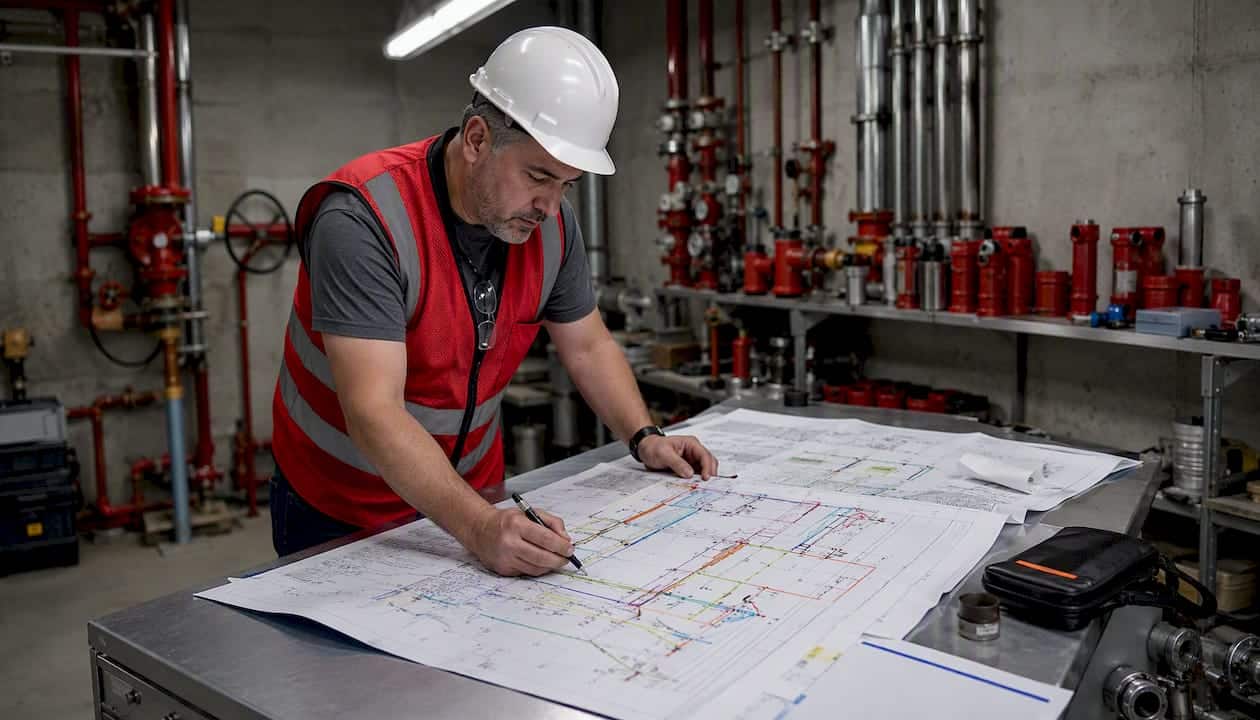
Every strategy starts with accurate as-built drawings, hydraulic calculations, and acceptance test records. When a system is modified or a tenant changes use, those documents must be updated. Without them, your contractor cannot verify that the system still meets the design intent, and your AHJ cannot confirm compliance. For a detailed look at what Colorado design documentation requires, Preactionfire’s fire system design guide covers the specifics.
ITM program per NFPA 25
NFPA 25 is the governing standard for water-based systems. It assigns inspection, testing, and maintenance frequencies to every component: sprinkler heads, control valves, gauges, fire pumps, standpipes, and storage tanks. The owner must keep ITM records on site and designate qualified inspectors.
Monitoring and central station connection
NFPA 72 requires that waterflow alarm signals and supervisory signals transmit to a listed central station. Owners must verify that the monitoring contract is current, that signal transmission is tested, and that the central station has current contact lists and response protocols. A 24/7 monitored connection is not optional under Denver’s code.
Impairment management and redundancy
Any time a system goes out of service, an impairment program kicks in. That means notifying the AHJ and monitoring company, posting impairment tags, establishing a fire watch if required, and setting a documented return-to-service deadline. Skipping this step is one of the fastest ways to trigger an enforcement action.
Lifecycle replacement planning
Sprinkler heads, fire pumps, backflow preventers, and storage tanks all have NFPA-defined sample-test triggers and useful-life benchmarks. Planning for those replacements in advance keeps capital costs predictable and prevents deferred maintenance from compounding into a system failure.
Staff training and emergency coordination
Occupants and facility staff need to know evacuation routes, alarm signal meanings, and who to call. That coordination should be documented, tested annually, and aligned with the building’s emergency action plan and the local fire department’s pre-incident survey.
Pro Tip: NFPA 72 alarm monitoring requirements are directly tied to your sprinkler waterflow devices. If your monitoring contract lapses or a signal path fails, you may be out of compliance on both standards simultaneously. Verify signal transmission at every annual test.
What does NFPA 25 require you to inspect, test, and when?
NFPA 25 sets the baseline frequencies; Denver enforces “continuous maintenance” and assigns ultimate responsibility to the owner. The table below maps common commercial components to their required activity and interval.
| Component | Activity | Frequency |
|---|---|---|
| Sprinkler heads (visual) | Inspection | Annually |
| Control valves | Inspection / position verification | Weekly (sealed/locked) or monthly |
| Gauges | Inspection vs. calibrated reference | Monthly; replaced or recalibrated periodically as recommended |
| Waterflow alarm devices | Test | Quarterly |
| Valve supervisory signal devices | Test | Quarterly |
| Main drain | Test | Annually (or per Chapter 13) |
| Fire pump | Churn test / flow test | Weekly (churn); annually (flow) |
| Dry-pipe valve | Partial trip test | Annually |
| Dry-pipe valve | Full-flow trip test | Every 3 years |
| Sprinkler sample test (standard response) | In-place sample | 50 years (retest every 10 years) |
| Sprinkler sample test (fast-response, non-ESFR/CMSA) | In-place sample | 25 years |
| Sprinkler sample test (ESFR/CMSA and dry) | In-place sample | 20 years |
| Sprinkler sample test (high-temperature) | In-place sample | 75 years |
| Antifreeze solution | Test | Annually |
| Backflow preventer | Test | Annually |
| Standpipe | Hydrostatic / flow test | Every 5 years |
A note on the 2023 NFPA 25 edition: it introduced a self-testing provision for waterflow alarms. An annual self-test is permitted, but a physical flowing-water test is still required every 3 years. Dry-valve cadences were also clarified. Confirm which edition your AHJ has adopted before building your ITM calendar, because the Denver AHJ may be on a different adoption cycle.
Owner liability: Denver code treats a system that is not maintained to code as if it does not exist for enforcement purposes. That is not a technicality — it means full owner liability in the event of a fire loss.
Tasks trained building staff can typically handle: monthly gauge checks, visual sprinkler inspections, and control-valve position verification. Tasks that require a licensed contractor: main drain tests, pump flow tests, full waterflow device tests, and any work that takes a system out of service.
How should you adapt your plan to your building’s occupancy and hazard?
Protection level is not a single setting. Under Denver’s Commercial Building Code Chapter 9, occupancy type, building height, and floor area drive which systems are required and how they must be tested. A light-hazard office building and a high-pile storage warehouse are not on the same plan.
Ask these questions to determine where your building sits:
- What is the primary occupancy classification, and does any tenant use create a mixed or higher-hazard condition?
- Does the building exceed the height threshold that triggers standpipe zoning or high-rise integrated testing?
- Is there high-pile storage, a commercial kitchen hood suppression system, or a special-hazard suppression agent (clean agent, CO₂, dry chemical)?
- Has any tenant fit-out changed the combustible loading or the ceiling configuration since the last hydraulic calculation?
For high-rise and smoke-control buildings, Denver’s code requires integrated testing per NFPA 4 at intervals not exceeding 10 years. That test coordinates sprinklers, alarms, smoke control, and elevator recall in a single sequence. It is a significant planning and budget item that many owners discover late.
Pro Tip: When a tenant changes use — say, a storage tenant moves into a space previously occupied by an office — update your fire protection strategy before the certificate of occupancy is issued for the new use. A use change can shift the hazard classification and invalidate the existing hydraulic design.
Preactionfire’s occupancy type guide walks through how classification changes affect system requirements under current Denver code.
How do you budget for replacements and long-cycle capital costs?
Budget for two categories: recurring ITM (annual and quarterly tests) and long-cycle capital replacements triggered by NFPA sample-test intervals and component useful life. Treating them as one line item is how deferred maintenance accumulates.
| Component | NFPA Trigger / Useful Life | Budget Class |
|---|---|---|
| Sprinkler heads (standard response) | Sample test at 50 years, retest every 10 years | Capital (replacement if failed) |
| Sprinkler heads (fast-response, non-ESFR/CMSA) | Sample test at 25 years | Capital |
| Sprinkler heads (ESFR/CMSA, dry) | Sample test at 20 years | Capital |
| Fire pump | Annual flow test; rebuild or replace per condition | Capital |
| Backflow preventer | Annual test; replace per condition | O&M / Capital |
| Gauges | Recalibrate or replace every 5 years | O&M |
| Standpipe | 5-year hydrostatic test | O&M (test); Capital (if repairs needed) |
| Dry-pipe valve | Annual partial trip; 3-year full trip | O&M |
For reserve funding strategy, Upchurch Inspection’s capital reserve planning guide provides a practical framework for commercial buildings that maps replacement costs to funding schedules.
Near-term (6–12 months): schedule all overdue tests, collect as-builts, and establish monitoring contracts. Years 1–5: fund O&M tests and minor repairs. Years 5–20: budget for pump rebuilds, sprinkler sample tests, and standpipe work based on system age and component type.
Insurers and AHJs both expect documented repair timelines for any deficiency. A written remediation schedule with target dates is the difference between a notice of violation and a compliance extension.
What credentials should you require from a Denver fire protection contractor?
Always require NICET-certified technicians for design and ITM work, proof of Colorado state licensure, current insurance and bonding, and documented NFPA 25 experience on similar occupancy types. Those are the floor, not the ceiling.
Before signing any contract, request:
- Copies of NICET certifications (level and discipline)
- Sample inspection reports and ITM logs from comparable buildings
- A written impairment management program
- References from owners of similar occupancy types
- Contract language specifying response times for emergency repairs and planned outage notifications
The AHJ and your insurer will ask for ITM records retained on site, hydraulic calculations for any system modifications, and impairment notifications. If your contractor cannot produce those on request, that is a gap in your compliance posture.
Pro Tip: Include contract language requiring your contractor to notify both the alarm monitoring company and the AHJ before taking any system out of service for testing or repair. That notification is a code requirement, and it protects you if something goes wrong during a planned outage.
For a contractor selection checklist aligned to Colorado requirements, Preactionfire’s code-compliant installation guide covers the documentation standards contractors should meet.
How does 24/7 monitoring fit into your long-term plan?
Monitored signals and tested transmission are part of code compliance, not an add-on. NFPA 72 and Denver’s fire code both require that waterflow and supervisory signals reach a listed central station. Owners must verify that the connection is active, tested, and documented.
Monitoring checks and tests to schedule:
- Quarterly: waterflow alarm device tests and valve supervisory signal checks
- Annually: full signal transmission test to the central station; verify contact lists and response protocols are current
- Every 3 years: physical flowing-water test (if using the self-test provision for annual checks)
- Before any planned outage: notify the monitoring company and AHJ; document the notification
Before a planned system outage, verify that non-latching exterior waterflow devices are accounted for, that monitored zones are documented, and that the central station has the current emergency contact list. After the outage, confirm signal restoration before closing the impairment.
Monitoring also ties directly into your facility emergency plan. The central station’s response protocol should align with the building’s evacuation procedures and the local fire department’s pre-incident plan. For Denver-specific alarm monitoring requirements, Preactionfire’s Denver fire alarm compliance guide covers signal types and AHJ expectations in detail.
What records do Denver inspectors expect to see?
NFPA 25 requires records to be kept on site and retained for defined cycles: inspection and test records until at least one year after the next identical activity; 5-year cycle records until one year after the next 5-year cycle.
| Field | What to Record |
|---|---|
| Date | Exact date of inspection or test |
| System / Component | Specific system, zone, or component tested |
| Activity | Type of inspection, test, or maintenance performed |
| Result | Pass, fail, or deficiency noted |
| Inspector / Contractor | Name, company, NICET certification number |
| Deficiencies | Description and severity |
| Corrective Action | Action taken, date completed, contractor |
| Retention Period | Per NFPA 25 cycle requirements |
Document checklist for AHJ or insurer audits: acceptance records and as-builts, hydraulic calculations, impairment tags and program documentation, NICET and contractor credentials, and the current monitoring contract.
Practical note: A digital recordkeeping system that generates a single audit-ready PDF saves hours when an inspector arrives unannounced. Organize records by system, then by date, with deficiency and remediation records attached to the relevant inspection report.
Your 6–12 month implementation checklist
Follow this prioritized sequence to convert a gap assessment into a documented ITM and capital planning program.
- Confirm AHJ-adopted NFPA edition — (owner / facility manager, Month 1) — contact Denver Fire Department to verify which NFPA 25 and NFPA 72 editions are enforced.
For any deficiency that impairs the system, the sequence is: immediate repair or temporary compensating measure, AHJ notification, documented return-to-service date. Do not wait for the next scheduled inspection cycle.
Key Takeaways
A compliant long-term fire protection strategy requires documented ITM, NFPA 25-aligned replacement planning, 24/7 monitored signals, and owner-held legal responsibility that cannot be delegated.
| Point | Details |
|---|---|
| Owner responsibility is non-negotiable | Denver code treats an unmaintained system as nonexistent; the owner bears full enforcement liability. |
| NFPA 25 drives your ITM calendar | Component-specific intervals range from quarterly (waterflow alarms) to 50+ years (sprinkler sample tests). |
| Confirm your AHJ’s adopted edition | The 2023 NFPA 25 self-test provision and revised dry-valve cadences apply only if your AHJ has adopted that edition. |
| Budget for long-cycle capital costs | Sprinkler sample tests, pump rebuilds, and standpipe work are capital events; plan for them 5–20 years out. |
| Preactionfire delivers local ITM programs | Preactionfire has served Denver Metro commercial properties since 2009 with NICET-certified technicians and documented inspection packages. |
What working in Denver has taught us about fire protection planning
Most owners understand that fire protection systems need annual inspections. What they consistently underestimate is the gap between “inspected” and “maintained.” An inspection that identifies deficiencies but produces no remediation timeline is not compliance. Denver building officials treat it the same way: a system with unresolved deficiencies is functionally a non-compliant system, regardless of how recently it was inspected.
The other thing that catches owners off guard is the sample-test trigger. Many assume the “50-year rule” applies to all sprinklers. It does not. Fast-response heads (non-ESFR/CMSA) require a sample test at 25 years, ESFR/CMSA and dry heads at 20 years, and high-temperature heads at 75 years. A building installed in 2005 could be approaching that window now. Owners who have not mapped their sprinkler types to the correct NFPA 25 interval are carrying a compliance risk they do not know about.
Preactionfire, Inc has been building NFPA-aligned lifecycle strategies for Denver commercial and industrial properties since 2009. The team includes NICET-certified technicians who work directly with local AHJs and coordinate integrated testing for high-rise and complex systems. That local experience matters when an inspector arrives with a specific question about a Denver code adoption or a Chapter 9 requirement.
Preactionfire: NFPA-aligned fire protection for Denver commercial properties
Denver commercial property owners who need a documented ITM program, NICET-certified inspections, and 24/7 central station monitoring get all of it from one contractor with Preactionfire. No coordinating between three separate vendors for design, inspection, and monitoring.
Pre Action Fire has served the Denver Metro Area since 2009, covering fire alarm systems, sprinkler installation and inspection, suppression systems, fire pumps, backflow testing, and extinguisher services. Every inspection package produces the documentation your AHJ and insurer will ask for: signed inspection reports, deficiency logs, remediation timelines, and NICET credentials on file.
For fire alarm system design and monitoring or a full fire safety inspection for your Denver property, contact Preactionfire to schedule an ITM audit and get a documented compliance plan in place.
Useful sources
Primary references used for this guide:
- NFPA 25: Sprinkler Inspection, Testing & Maintenance Requirements — governing standard for ITM frequencies, owner responsibility, and component-specific sample-test triggers
- Denver Fire Code 2025, Chapter 9 (UpCodes) — Denver-adopted fire protection system requirements, integrated testing obligations, and occupancy-based triggers
- Denver Building & Fire Code — City and County of Denver — official code adoption documents and commercial permitting guidance
- Maintenance Required — UpCodes — owner obligation language and enforcement treatment of unmaintained systems
- Denver Commercial Building Code 2025, Chapter 9 (UpCodes) — occupancy, height, and area requirements for active fire protection systems
- Quick Guide for Fire Sprinkler Inspection Requirements (NFSA) — field reference for NFPA 25, 13, and 72 inspection requirements