
TL;DR:
- Supervised sprinkler systems continuously monitor key components for off-normal conditions, ensuring readiness.
- Proper signals from supervisory devices must be transmitted to permitted central stations for compliance.
- Regular testing, documentation, and jurisdiction-specific knowledge are essential for system reliability and code adherence.
Most commercial property owners in Colorado assume their sprinkler system is doing its job simply because the pipes are full of water and the heads are in place. That assumption is costly. Colorado fire codes, including Denver’s 2025 Fire Code, mandate that critical sprinkler components be electronically monitored at all times, not just when a fire breaks out. This guide walks you through exactly what a supervised sprinkler system is, which components must be monitored, how signals reach central stations, what local code requires, and the practical pitfalls that trip up even experienced facility managers.
Table of Contents
- Understanding supervised sprinkler systems
- Key components and supervisory conditions
- How supervision integrates with fire alarm and receiving stations
- Colorado code requirements and best practices for supervised systems
- What most Colorado facility managers miss about supervised sprinkler systems
- Get expert help with your Colorado supervised sprinkler system
- Frequently asked questions
Key Takeaways
| Point | Details |
|---|---|
| System supervision definition | Supervised sprinkler systems use electronic monitoring for all key non-waterflow components and connect to fire alarms for real-time alerts. |
| Critical components monitored | Valves, pressure switches, tanks, and pumps are overseen to ensure your fire suppression is ready in an emergency. |
| Colorado code complexity | Denver and various Colorado cities have unique permitting and compliance requirements for sprinkler supervision. |
| Best practices for compliance | Regular inspection, updated permits, and comprehensive records are essential for safe, code-compliant operations. |
Understanding supervised sprinkler systems
Not all sprinkler systems are created equal. A basic, unsupervised system will activate when heat triggers a sprinkler head, but nobody knows if a control valve was accidentally closed, if pressure has dropped overnight, or if a pump has failed until the moment water is desperately needed and nothing comes out. That gap between “installed” and “actually ready” is exactly what supervision closes.
Per industry compliance guidance, a supervised sprinkler system is an automatic sprinkler system whose non-waterflow components are monitored for integrity and off-normal conditions, and connected to a fire alarm system that annunciates a distinct supervisory condition. The word “distinct” matters here. A supervisory signal is not a fire alarm and not a trouble signal. It is its own category, telling responders that something is wrong with the system’s ability to function, before a fire ever starts.
The connection between sprinkler supervision and fire alarm systems compliance is tight. The fire alarm control panel serves as the brain. Supervisory devices throughout the sprinkler system send status signals to that panel continuously. If anything drifts out of normal range, the panel flags it immediately.
Here is a quick overview of the core components typically monitored in a supervised system:
| Component | What is monitored | Why it matters |
|---|---|---|
| Control valves | Open or closed position | A closed valve stops water flow entirely |
| Dry-pipe valve | Air pressure integrity | Loss of pressure signals a system breach |
| Preaction valve | Supervisory pressure | Ensures the valve is ready to operate |
| Fire pump | Power supply and running status | A failed pump means no pressure during a fire |
| Water storage tanks | Water level and pressure | Low levels reduce firefighting capacity |
| Air/pressure switches | Pressure thresholds | Detects leaks or supply problems early |
Key benefits of supervision that go beyond code compliance:
- Early warning before a fire event: You catch a closed valve on a Tuesday morning, not during a fire on a Saturday night.
- Reduced liability exposure: Documentation of continuous monitoring supports insurance claims and code inspections.
- Faster emergency response: Central stations receive signals and dispatch help without waiting for someone on site to notice a problem.
- Operational continuity: Catching a failing fire pump before it fails completely keeps your system online and your building occupied.
“A supervised sprinkler system is an automatic sprinkler system whose non-waterflow components are monitored for integrity and off-normal conditions, connected to a fire alarm system that annunciates a distinct supervisory condition.”
Key components and supervisory conditions
Now that you know the definition, let’s look at which parts of your system are constantly checked and why each one matters for keeping your building safe and code-compliant.
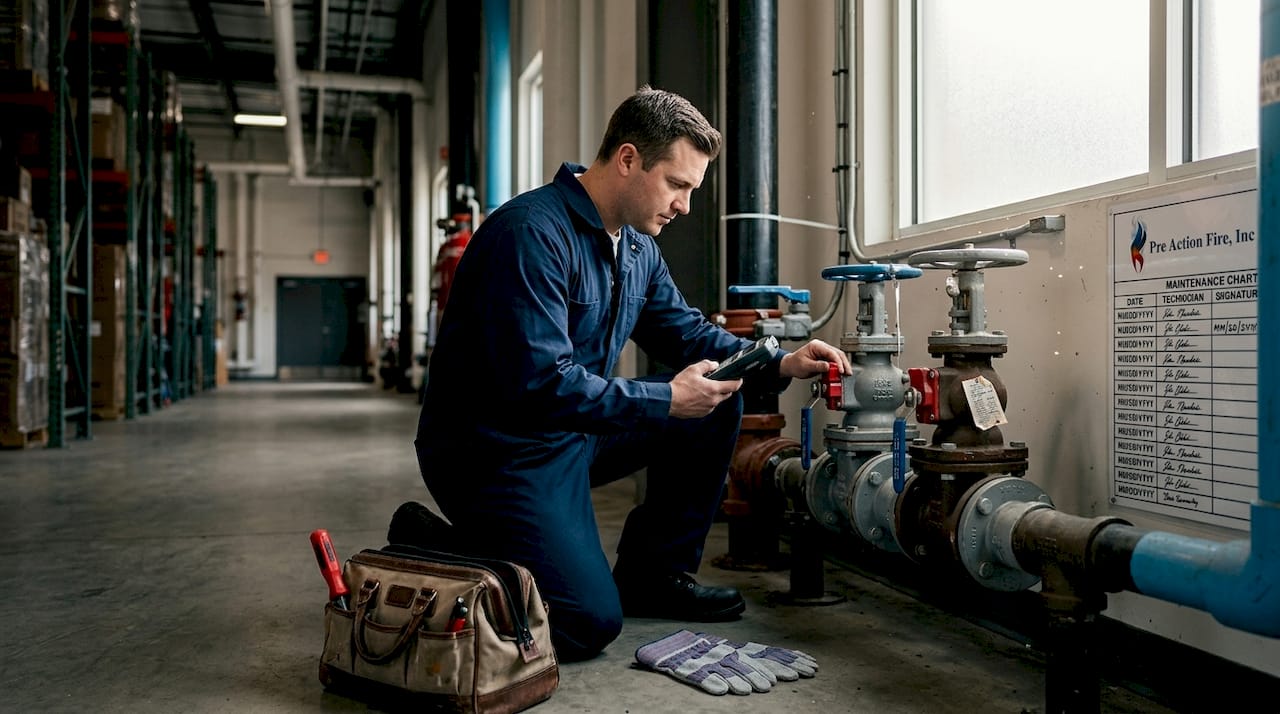
A supervisory condition is any abnormal state in a monitored component that could impair the sprinkler system’s ability to operate correctly. Supervisory attachments are referenced for abnormal conditions that could impair sprinkler operation, with signals displayed on site or at a remote receiving facility. This is fundamentally different from a waterflow alarm, which only activates when water is already moving through the pipes.
Here are the primary supervisory components and what each one watches for:
- Control valve supervisory switches: These are mounted directly on the valve stem. If a valve is turned from the fully open position, even slightly, the switch sends an immediate supervisory signal. This is the single most common supervisory condition found during inspections.
- Dry-pipe and preaction valve supervisory pressure switches: These monitor the air or nitrogen pressure that holds water back in dry-pipe and preaction systems. A slow pressure drop can indicate a small leak or a faulty compressor, both of which need attention before the system is compromised.
- Fire pump supervisory devices: These monitor whether the pump has power, whether it is running when it should not be (which can indicate an automatic start due to low pressure), and whether it has failed to start on demand. Fire pumps are the heart of high-rise and large-footprint building systems.
- Water storage tank level and pressure sensors: For buildings that rely on private water storage, tank levels must stay within design parameters. A low-level supervisory signal gives maintenance staff time to investigate and refill before the reserve is exhausted.
- Air pressure switches on preaction systems: These confirm that the supervisory air pressure in the piping is within the required range, protecting against both false trips and undetected leaks.
Comparison: supervised vs. unsupervised sprinkler monitoring
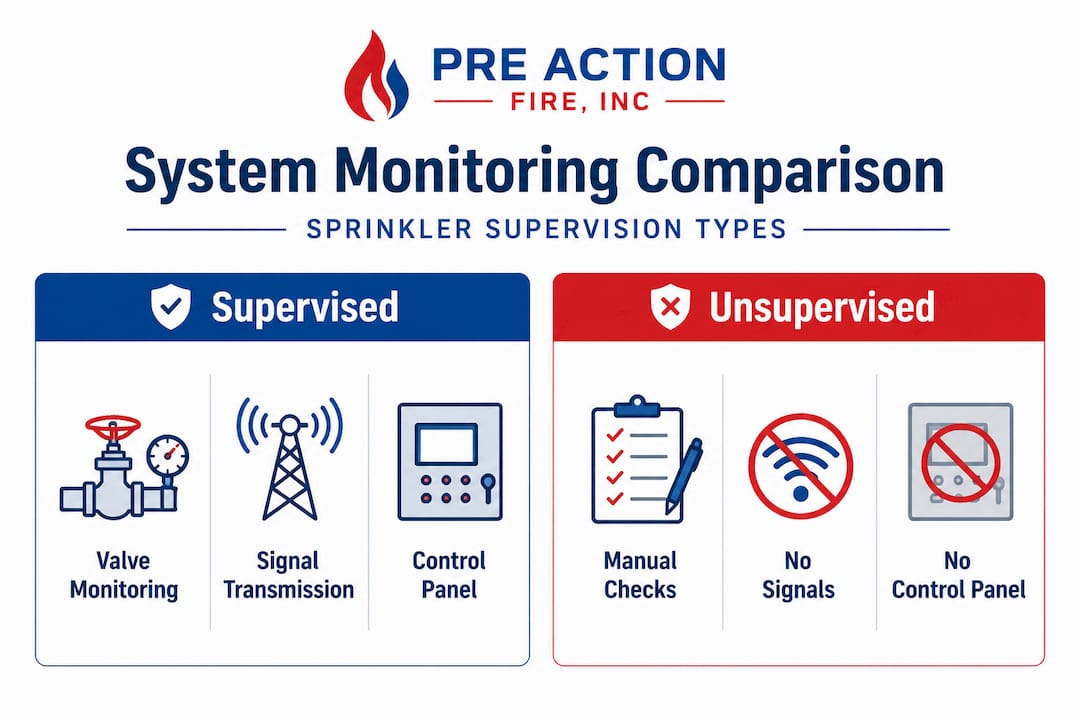
| Feature | Supervised system | Unsupervised system |
|---|---|---|
| Valve position monitoring | Yes, continuous | No |
| Pressure monitoring | Yes, continuous | No |
| Fire pump status | Yes | No |
| Off-normal alerts | Immediate signal | Not detected |
| Code compliance (CO/Denver) | Meets requirements | Typically non-compliant |
| Insurance impact | Favorable | Potentially penalized |
Pro Tip: Do not limit your testing schedule to waterflow alarms. Every supervisory device, including valve tamper switches and pressure sensors, must be tested on the schedule defined by NFPA 25. Many facilities fail inspections not because their sprinklers are broken, but because a tamper switch has never been verified to work.
The supervised fire alarm monitoring connection is what transforms a passive system into an active, communicating one. Without it, your sprinklers are silent about their own condition.
How supervision integrates with fire alarm and receiving stations
With components and conditions framed, understanding signal flow and code-specific supervision is essential for compliance in Colorado. A supervisory signal does not stay local. It travels from the field device to the fire alarm control panel, and from there, it is transmitted to a central or supervising station where trained personnel respond around the clock.
Denver’s 2025 Fire Code defines a supervising or central station as a facility that receives fire alarm signals with personnel in attendance, and it includes a formal permitting process for such stations. This is not a casual arrangement. Denver requires that stations receiving signals from protected properties operate under permit, ensuring accountability in the monitoring chain.
Here is how the signal flow works in a properly supervised Colorado commercial building:
- A supervisory device detects an off-normal condition, such as a partially closed control valve.
- The device sends a signal to the fire alarm control panel, which annunciates a distinct supervisory condition (separate from fire and trouble).
- The panel transmits the signal via a digital communicator or network path to the central station.
- Central station personnel acknowledge the signal, attempt to contact the property’s responsible party, and follow established protocols, which may include dispatching the fire department.
- The event is logged with a timestamp, creating a compliance record.
Why this matters beyond the code requirement: Studies from the fire protection industry consistently show that fires in buildings with monitored systems result in significantly lower property losses than fires in unmonitored buildings. The reason is simple. Supervised systems catch impairments before a fire starts, and when a fire does occur, the central station’s immediate notification shortens response time.
For Denver fire alarm compliance, the permitting requirement for supervising stations adds a layer of accountability that many property owners do not realize exists. If your monitoring company is not properly permitted to receive signals from Denver properties, you may be out of compliance even if your hardware is perfectly installed.
Key points for facility managers to verify:
- Confirm your central station holds the required permits for your jurisdiction.
- Verify that supervisory signals are transmitted separately from fire alarm signals and that the panel annunciates them distinctly.
- Ensure your response protocols are documented and that on-site staff know what to do when a supervisory condition is reported.
- Test the full signal path, from field device to central station, at least annually and after any system modification.
Colorado code requirements and best practices for supervised systems
With technology and code integration mapped, let’s tie it together with local requirements and practical steps for compliance and safety.
Colorado does not operate under a single statewide fire code applied uniformly to every city. Local jurisdictions may define and require how fire alarm and central or supervising stations receive signals, and Denver’s fire code specifically addresses permits for stations receiving fire alarms from protected properties. What this means for you is that what works in one Colorado city may not satisfy the authority having jurisdiction in another.
Common pitfalls that lead to compliance failures in Colorado commercial buildings:
- Missing supervisory signal permits: The monitoring company you use may not hold a current permit in your specific jurisdiction. Verify this before signing a monitoring contract.
- Neglected supervisory devices: Tamper switches, pressure sensors, and pump supervisory contacts are often overlooked during routine maintenance because they do not trigger waterflow alarms. They still need regular testing.
- Inadequate documentation: Inspectors want to see records. If you cannot produce test logs for every supervisory device, you may face enforcement action even if the devices are working correctly.
- Outdated response plans: Staff turnover means the person who knew the monitoring protocol may no longer work there. Response plans need to be reviewed and updated at least annually.
Best practices for maintaining a compliant supervised sprinkler system in Colorado:
- Conduct a jurisdiction-specific code review before installation or upgrade. Work with a licensed contractor who knows the requirements for your specific city or county, not just the state-level baseline.
- Schedule routine inspection and testing per NFPA 25. This standard defines testing frequencies for every component type. Following it protects you legally and operationally.
- Maintain detailed documentation for every device. Use a log that records the device type, location, test date, result, and technician name. Digital records are acceptable and often easier to produce during inspections.
- Develop and rehearse a supervisory response plan. When the central station calls at 2 a.m. to report a closed valve, your on-call staff needs to know exactly what to do.
- Review your monitoring contract annually. Confirm permit status, signal transmission methods, and response protocols with your monitoring provider every year.
Pro Tip: Keep a physical binder and a digital backup of all permits, inspection reports, and test logs for your supervised sprinkler system. When an inspector arrives unannounced, being able to produce complete records immediately demonstrates operational competence and often prevents enforcement escalation.
When upgrading your sprinkler system to meet current supervision requirements, the upgrade is also an opportunity to review your entire fire protection strategy. Pair the upgrade with a review of your NFPA inspection workflow tips to make sure your ongoing maintenance program matches the new system’s requirements.
What most Colorado facility managers miss about supervised sprinkler systems
After working with commercial properties across the Denver Metro Area since 2009, we have seen a consistent pattern. Facility managers invest in a supervised sprinkler system, pass their initial inspection, and then treat the system as if it runs itself. It does not. Compliance is the starting line, not the finish line.
The most common misconception we encounter is that waterflow monitoring is enough. It is not. A building can have a perfectly functioning waterflow alarm and still be in a dangerous, non-compliant state because a control valve was partially closed during a maintenance visit and nobody reset the tamper switch. The waterflow alarm will never fire because water never moved. The supervisory signal that should have fired was either ignored or, worse, the device was never tested and failed silently.
Here is the contrarian view that most compliance guides skip: trusting your control panel display is not the same as knowing your system is ready. Field devices fail. Wiring corrodes. Supervisory contacts stick. The panel shows “normal” because it has not received a signal telling it otherwise, not because everything is actually fine. Regular physical inspection of field devices is the only way to know for certain.
We have seen enforcement issues arise in Denver properties where supervisory signals were misconfigured after a system expansion. New sections of piping were added, new control valves were installed, but the supervisory contacts on those valves were never wired into the fire alarm panel. The panel showed normal. The system looked fine. During an inspection, the authority having jurisdiction discovered that an entire wing of the building had unmonitored valves. The result was a notice of violation, a mandatory upgrade, and a significant unplanned expense.
For properties like warehouses and large industrial facilities, the stakes are even higher. Fire safety tips for warehouses often focus on storage configurations and aisle widths, but the supervised sprinkler system is the backbone of protection in those environments. A failed supervisory device in a warehouse can mean an impaired system covering tens of thousands of square feet.
The practical lesson: build a culture of verification, not assumption. Test every device. Document every result. Review every permit. The supervised sprinkler system is only as reliable as the people and processes maintaining it.
Get expert help with your Colorado supervised sprinkler system
Understanding supervision requirements is one thing. Implementing them correctly across a commercial property, navigating Denver’s permitting process, and keeping everything documented and tested is another challenge entirely.
Pre Action Fire, Inc. has been serving the Denver Metro Area since 2009, and our NICET-certified technicians specialize in exactly this work. From new Arvada fire sprinkler installation to system upgrades and ongoing inspection programs, we handle the full scope of supervised sprinkler compliance for commercial and industrial properties across Colorado. Our team knows the local jurisdictional requirements, the permitting process, and the practical details that keep your system truly ready, not just technically installed. Contact us today for a site-specific assessment and find out how our fire alarm compliance services can support your building’s complete fire protection program.
Frequently asked questions
What makes a sprinkler system ‘supervised’ under Colorado fire code?
A system is supervised when its key non-waterflow components are electronically monitored and connected to a fire alarm that signals any abnormal condition on site or to a central station. Per industry guidance, a supervised system monitors for integrity and off-normal conditions and annunciates distinct supervisory conditions through the fire alarm.
What components in a sprinkler system are usually supervised?
Typical supervised components include control valves, pressure switches, water storage tank levels, and fire pumps. Supervisory attachments also cover dry-pipe valve air pressure, tank pressure and levels, and fire pump power and running conditions.
How are supervisory signals transmitted and received in Denver?
Denver requires signals to be sent to a central or supervising station with personnel in attendance and mandates a permit for those stations. The 2025 Denver Fire Code describes this facility and its permitting process explicitly, making monitoring company permit status a compliance requirement, not just a preference.
Do all jurisdictions in Colorado follow the same supervision rules?
No. Local jurisdictions may define unique requirements for supervision, permits, and receiving facilities, which means your compliance obligations in Denver may differ significantly from those in neighboring cities or counties.