
TL;DR:
- Most Colorado property owners mistakenly assume a single sprinkler standard applies statewide. Local jurisdictions heavily amend NFPA 13, making coverage requirements vary city by city. Proper compliance requires understanding local codes, AHJ interpretations, and meticulous documentation of coverage and obstructions.
Most commercial property owners in Colorado assume a single statewide sprinkler coverage rule applies to their building. That assumption leads to costly surprises at inspection. Colorado’s code landscape is fragmented: the state references NFPA 13 as its baseline, but local jurisdictions layer on amendments that change what coverage actually looks like on your property. Whether you manage a warehouse in Arvada or an office complex in Denver, the coverage standard that counts is the one your local Authority Having Jurisdiction enforces. This guide breaks down exactly how that works and what you need to do about it.
Table of Contents
- Understanding coverage standards in Colorado: Codes and authorities
- NFPA 13: What the coverage standard really requires
- Dealing with coverage edge cases: Obstructions and exceptions
- From design to ongoing compliance: Inspection regimes and best practices
- Why coverage standards are a moving target: Lessons learned from Colorado projects
- Get expert help to ensure compliance and coverage
- Frequently asked questions
Key Takeaways
| Point | Details |
|---|---|
| Local code drives coverage | Sprinkler coverage standards in Colorado depend on which local jurisdiction’s code and NFPA edition are enforced. |
| 100 percent area inclusion | NFPA 13 requires sprinklers throughout all rooms—including mechanical, electrical, and under most obstructions. |
| Edge cases matter most | Obstructions and concealed spaces trigger the highest risk of failed inspections due to coverage omissions. |
| Inspection is ongoing | Staying compliant means regular inspections and documentation, not just initial code-based design. |
Understanding coverage standards in Colorado: Codes and authorities
Colorado’s approach to fire sprinkler regulation is not a single-document system. The state sets a floor, but local jurisdictions build their own walls, ceilings, and rooms on top of it. Understanding the difference is the first step toward confident compliance.
At the state level, Colorado adopted NFPA 13 (2019 Edition) as its minimum standard, but enforcement may vary significantly by jurisdiction. That means what passes in one county may not pass in another, even if both technically reference the same national document.
Denver is a clear example. The Denver Fire Code explicitly references NFPA 13 and includes local amendments, creating meaningful differences from the state baseline. Those amendments can affect sprinkler spacing requirements, which occupancy classifications trigger mandatory systems, and how concealed spaces must be treated.
Who is the Authority Having Jurisdiction?
The Authority Having Jurisdiction, or AHJ, is the local agency responsible for interpreting and enforcing fire codes. For most commercial properties in Colorado, this is the local fire marshal’s office or fire prevention bureau. They have the final word on whether your system meets coverage requirements, regardless of what any national standard says.
Here is how coverage standards compare across two representative Colorado jurisdictions:
| Factor | State of Colorado | City of Denver |
|---|---|---|
| Code basis | NFPA 13 (2019 Ed.) | NFPA 13 + local amendments |
| Enforcement body | State fire code office | Denver Fire Prevention Bureau |
| Local amendments | Limited | Yes, multiple active amendments |
| Concealed space rules | Per NFPA 13 | May be stricter per local code |
| Permit requirement | Yes | Yes, with additional review |
Key steps to find your applicable code and AHJ:
- Contact your local fire marshal’s office and ask which edition of NFPA 13 they enforce.
- Request a copy of any local amendments that modify standard coverage requirements.
- Confirm whether your occupancy type or building age triggers additional requirements.
- Ask about the plan review process before any sprinkler design work begins.
If you are planning new Arvada sprinkler installation or scoping out a retrofit project, knowing your AHJ’s exact requirements before design begins will save you from expensive redesigns later. Similarly, understanding local code nuances affects the scope of annual inspections in Colorado because inspectors apply jurisdiction-specific criteria, not just the national standard.
NFPA 13: What the coverage standard really requires
With local codes referencing NFPA 13, what does this national standard actually ask of your sprinkler layout? The answer is more demanding than most property owners expect.
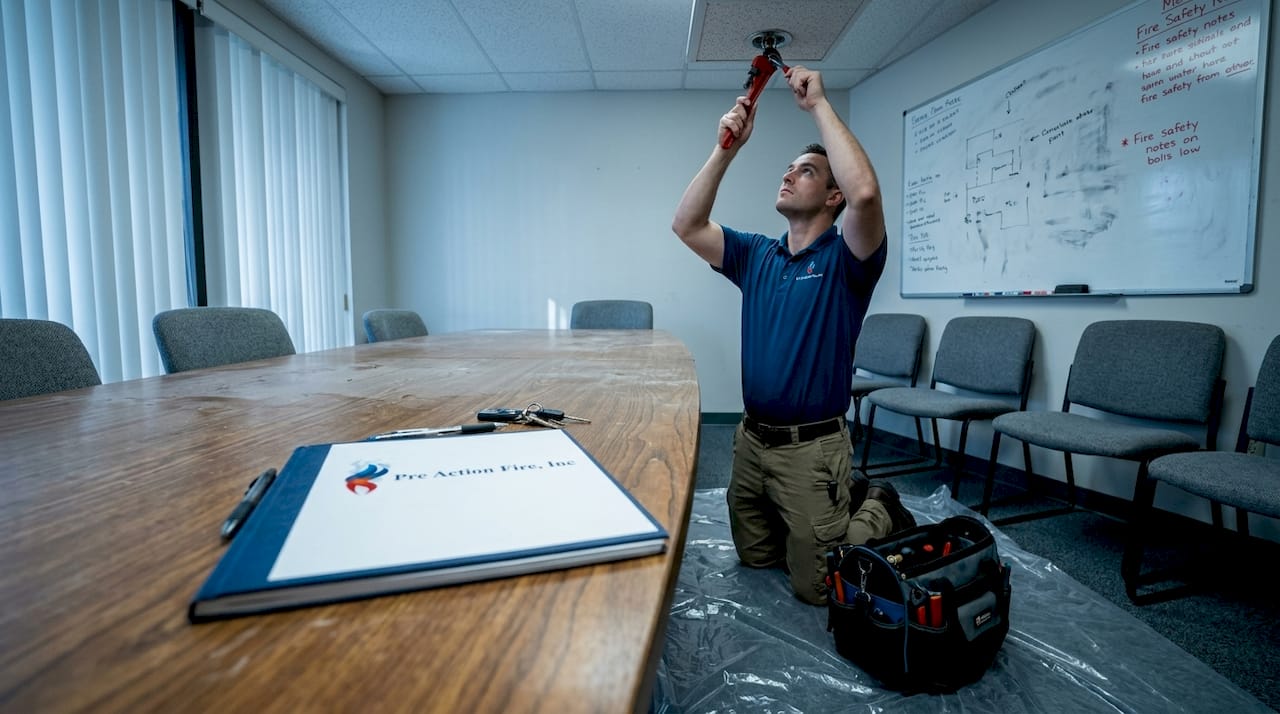
NFPA 13 requires full-area coverage throughout the building. That means 100% of building area, including electrical rooms, mechanical rooms, storage closets, and most concealed spaces, must have sprinkler coverage unless a specific written exemption applies. There is no general exemption for rooms that “feel low risk.”
Spacing requirements in practical terms
NFPA 13 defines maximum spacing between sprinkler heads based on hazard classification. For light hazard occupancies like offices, the maximum spacing is typically 225 square feet per sprinkler head. For ordinary hazard occupancies such as manufacturing or warehouses, that number drops to 130 square feet per head or lower depending on the hazard group.
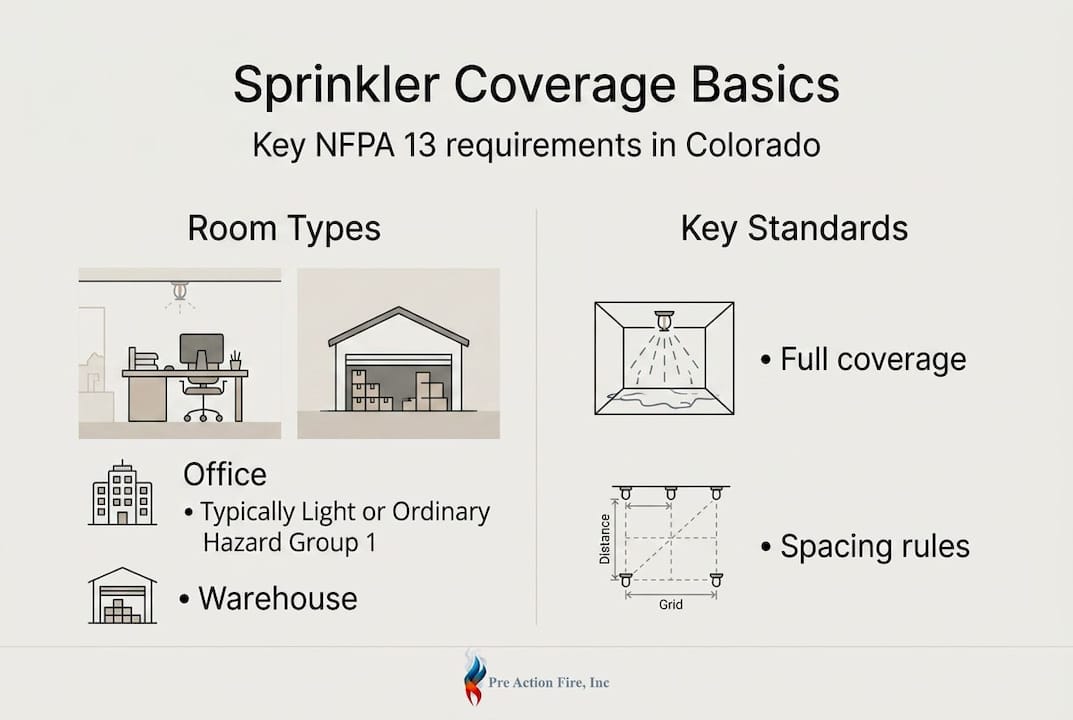
Here is how those numbers translate to a real room:
| Room type | Hazard class | Max coverage per head | 2,000 sq ft room needs |
|---|---|---|---|
| Office space | Light | 225 sq ft | ~9 heads minimum |
| Retail floor | Ordinary Group 1 | 130 sq ft | ~16 heads minimum |
| Storage warehouse | Ordinary Group 2 | 130 sq ft | ~16 heads minimum (plus rack rules) |
| Mechanical room | Ordinary Group 1 | 130 sq ft | Calculated per layout |
These are floor-level calculations. If your building has beams, ducts, or soffits, those numbers change because obstructions affect water distribution patterns and may require additional heads.
Key NFPA 13 coverage requirements to know:
- Sprinkler spacing must keep each head within the maximum coverage area for the hazard class.
- Clearance to deflector must be maintained so water spray patterns are not obstructed at the source.
- Obstructions wider than 4 feet typically require sprinklers on both sides unless the horizontal distance to the obstruction meets the standard’s exception criteria.
- Concealed spaces above drop ceilings require coverage unless the space qualifies for a specific exemption under the standard.
Pro Tip: Do not rely on a general contractor’s word that a concealed space “doesn’t need sprinklers.” That determination must come from a licensed fire protection engineer or NICET-certified designer who has reviewed the actual construction documents against your local code edition.
Understanding your inspection workflows under NFPA 13 is directly connected to design quality. Systems designed with tight documentation of spacing calculations are far easier to inspect and far less likely to generate deficiencies.
Dealing with coverage edge cases: Obstructions and exceptions
Moving from standard requirements to real-world complications, how should you handle edge cases like obstructions? This is where most commercial properties run into trouble, and where inspectors most often find deficiencies.
Sprinkler heads must be added below obstructions unless exemption criteria are clearly met. Simply leaving a gap because a duct or beam is in the way is one of the most common and most expensive mistakes to fix after a system is already installed.
Common obstructions and how NFPA 13 handles them
Ducts and pipes. When a duct or pipe is wider than 4 feet, NFPA 13 requires sprinkler heads below that obstruction. The logic is straightforward: a wide obstruction blocks the water spray cone from the ceiling-level head, leaving a shadow zone where fire can grow uncontrolled. The most coverage mistakes happen in these obstruction and concealed space scenarios.
Beams and joists. Exposed beam construction, common in older Colorado commercial buildings, creates a series of small pockets. If beams are deep enough and spaced closely enough, the standard may require heads positioned between them rather than simply below the ceiling plane.
Soffits and dropped ceiling sections. Partial ceiling drops create horizontal obstructions at the edges. Proper coverage means accounting for the vertical face of a soffit, not just the top surface.
“The gap between ‘we followed the code’ and ‘we documented why an exception applies’ is exactly where failed inspections happen. Assumptions are not exemptions.”
Key documentation and design practices to protect yourself:
- Require your designer to produce a written obstruction analysis as part of the design package, not as an afterthought.
- Confirm that any concealed space exemption is cited to the specific code section, not just noted as “exempt.”
- Keep as-built drawings updated any time mechanical systems are modified, because new ductwork can invalidate existing coverage designs.
- Request that your fire protection contractor flag all obstruction-adjacent heads on the as-built drawings for easy reference during inspection.
Pro Tip: When you modify HVAC systems in an existing building, treat it as a potential sprinkler redesign trigger. A new duct run that crosses a previously clear bay can suddenly create an obstruction that voids your current coverage design.
Reviewing a quality sprinkler upgrade guide before any renovation helps you anticipate these conflicts before construction begins, not after the walls are closed.
From design to ongoing compliance: Inspection regimes and best practices
Addressing edge cases isn’t just a design question. It connects directly to how your system will pass inspections and remain compliant over time. A well-designed system that is poorly documented or inadequately maintained will still generate costly violations.
NFPA 25 governs inspection, testing, and maintenance (commonly called ITM) for water-based fire protection systems. Your sprinkler system is subject to both initial acceptance testing under NFPA 13 and ongoing ITM requirements under NFPA 25. These are separate obligations, and both matter for continuing Colorado annual inspections.
Inspectors review 100% coverage and obstruction handling during both design reviews and field inspections, so gaps in either phase can surface at any time.
Key inspection timelines for Colorado commercial properties:
- Quarterly inspections. Required for wet pipe systems: check control valves, alarm devices, and gauges. This is also a good time to visually confirm no new obstructions have appeared from recent construction or tenant improvements.
- Annual inspections. Full internal inspection of sprinkler heads, pipe condition, and water flow testing. Inspectors compare the physical layout to the as-built drawings and design documentation.
- Five-year inspections. Internal pipe examination for corrosion, particularly important for older steel pipe systems in Colorado’s dry climate conditions, which accelerate certain corrosion patterns.
- Post-modification inspections. Any system change, including a tenant improvement that adds or removes walls, requires a review of coverage adequacy before the work is closed in.
What inspectors actually look for regarding coverage:
- Are sprinkler heads correctly positioned relative to storage heights? High-piled storage changes the effective coverage zone.
- Have heads been painted over, corroded, or physically damaged? A painted head fails to activate correctly.
- Does the current layout match the approved design documents? Unauthorized changes are an immediate deficiency.
- Are concealed space heads accessible for inspection? If they are not, that is a code violation.
Key ITM documentation to maintain:
- Original design drawings and hydraulic calculations, stored on-site or immediately accessible.
- All inspection reports, going back at least five years.
- Records of any modifications with the corresponding plan review approvals.
- Water supply test reports confirming the system still meets hydraulic design demands.
Systems with thorough ITM records consistently pass NFPA compliance inspection reviews faster and with fewer findings. The difference between a clean inspection and a long deficiency list is often just how well the documentation was maintained, not the physical condition of the system.
Why coverage standards are a moving target: Lessons learned from Colorado projects
Here is something most compliance articles will not tell you: the written code is only about 70% of what determines whether your system passes. The other 30% is your relationship with your AHJ and the quality of your documentation.
We have worked on projects where the design met every letter of NFPA 13 and the local amendment, yet still generated inspection comments because the designer’s drawings did not clearly show how a specific concealed space exemption was justified. The inspector was not wrong to ask. The documentation simply left too much to interpretation.
The facilities that consistently avoid that friction share one trait: they treat compliance as a living practice, not a one-time design event. When a tenant moves in and remodels, they pull the sprinkler drawings and check for conflicts before construction, not after. When the AHJ publishes an amendment, they ask their fire protection contractor to cross-check the existing system.
What most facilities overlook until their first failed inspection is this: the AHJ’s interpretation of an obstruction exemption may be stricter than the published code text suggests. We have seen Denver inspectors apply a narrower reading of the 4-foot duct rule than the NFPA document alone would imply, because local experience showed that fires in those shadow zones were spreading further than the standard anticipated.
Our Denver sprinkler expertise has consistently shown that adaptability, not just technical accuracy, is what separates facilities that pass inspection cleanly from those that spend months resolving deficiencies.
Get expert help to ensure compliance and coverage
If this guide has shown you anything, it is that sprinkler coverage compliance in Colorado is genuinely complex, and that complexity gets more expensive the later you catch it.
Pre Action Fire, Inc has served the Denver Metro Area since 2009 with NICET-certified technicians who know how Colorado’s local jurisdictions interpret and enforce NFPA 13. Whether you need a new compliant installation, a coverage assessment on an existing system, or a clean path through your next inspection, we are equipped to help. Our teams provide Arvada sprinkler installation services, Denver fire safety inspections, and Colorado annual sprinkler inspections across the metro area. Contact us to schedule a consultation and take the guesswork out of coverage compliance.
Frequently asked questions
Does Colorado have a single statewide sprinkler coverage standard?
No. Colorado does not have a single statewide fire code; local jurisdictions adopt and modify national model codes that reference NFPA, meaning coverage rules vary from city to city.
Do all rooms need sprinkler coverage under NFPA 13?
Generally yes. Sprinklers must be provided throughout the building, including equipment rooms and below most obstructions, unless specific and documented exceptions apply.
How do I know which code applies to my commercial property?
You must contact your local Authority Having Jurisdiction. Local jurisdictions enforce sprinkler requirements via adopted model codes and NFPA references, so coverage standards must be checked against both the AHJ and the specific NFPA edition they have adopted.
What is the biggest cause of coverage failures at inspection?
Missed spaces are the primary culprit. Obstructions and concealed spaces are where sprinkler layout most often diverges from textbook standards, making them the most frequent source of inspection failures.