
Most commercial property managers think fire safety means having a working extinguisher and a posted evacuation map. The reality is far more demanding. NFPA develops over 300 consensus-based codes and standards that govern everything from sprinkler water pressure to alarm signal timing. In Colorado, local jurisdictions adopt and enforce these standards directly, meaning your building’s compliance status is measured against a detailed, technical framework, not a simple checklist. Understanding how NFPA standards work, and how they apply to your specific property, is the foundation of real fire protection.
Table of Contents
- What is the NFPA and why does it matter?
- How NFPA standards are created and updated
- NFPA in Colorado: Codes, compliance, and enforcement
- Prescriptive vs. performance-based approaches: How NFPA adapts
- NFPA standards in action: Proven results and common pitfalls
- Expert perspectives and edge cases: Navigating complexities
- Fire protection solutions for Colorado businesses
- Frequently asked questions
Key Takeaways
| Point | Details |
|---|---|
| NFPA shapes fire safety | NFPA sets the foundational standards for fire protection in commercial properties nationwide and in Colorado. |
| Local codes enforce NFPA | Colorado cities rely on NFPA guidelines for permits, inspections, and compliance, making adherence essential. |
| Prescriptive and flexible options | NFPA standards offer both straightforward rules and customizable, performance-based alternatives for complex cases. |
| Maintenance ensures reliability | Proper upkeep and regular inspections are critical, as most failures result from neglected maintenance. |
| Expert help for edge cases | Specialized guidance is vital for unique property types like warehouses or high-rises, ensuring tailored safety solutions. |
What is the NFPA and why does it matter?
The National Fire Protection Association is a nonprofit organization founded in 1896. Its mission is straightforward: reduce fire-related deaths, injuries, and property loss through science-based codes and standards. What makes NFPA unique is that its standards are not suggestions. They become law when adopted by local governments, which most Colorado jurisdictions have done.
The NFPA’s role extends beyond writing codes to include research, training, and public safety advocacy. That combination of research and enforcement gives NFPA standards real teeth. Here is what those standards actually cover for commercial properties:
- Sprinkler system design and installation (NFPA 13)
- Fire alarm and signaling systems (NFPA 72)
- Inspection, testing, and maintenance of water-based systems (NFPA 25)
- Portable fire extinguishers (NFPA 10)
- Electrical safety in the workplace (NFPA 70E)
- Life safety and means of egress (NFPA 101)
The impact is measurable. NFPA research shows that warehouse fires have dropped by 73% since 1980, a direct result of wider sprinkler adoption and stricter code enforcement. That is not a coincidence. It is the result of consistent, evidence-driven standards applied at scale.
How NFPA standards are created and updated
NFPA standards do not appear overnight. Each one goes through a rigorous, ANSI-accredited consensus-based process involving balanced technical committees with diverse stakeholders. That means fire service professionals, building owners, engineers, manufacturers, and code enforcers all have a seat at the table.
Here is how the development cycle works:
- Committee formation: Technical committees are assembled with balanced representation from all affected groups.
- Draft development: The committee drafts or revises the standard based on current research, incident data, and field experience.
- Public input period: Anyone, including Colorado property managers, can submit comments or propose changes.
- Revision and balloting: The committee reviews all input, revises the draft, and votes on final language.
- NFPA membership vote: The full NFPA membership votes to accept or reject the standard at the annual technical meeting.
“The consensus process is designed to ensure that no single interest group dominates the outcome. Every voice, from the fire chief to the building owner, shapes the final standard.”
Update cycles typically run three to five years. That pace balances thoroughness with responsiveness. For Colorado property managers, this means the standards you are held to today reflect the best available knowledge, but you should also watch for upcoming code cycles that may affect your compliance obligations.
NFPA in Colorado: Codes, compliance, and enforcement
Colorado does not have a single statewide fire code. Instead, local jurisdictions adopt their own versions of national model codes, most of which directly reference NFPA standards. The Denver Fire Code 2025 is a clear example, incorporating NFPA requirements for sprinklers, alarms, and inspection schedules into enforceable local law.

The entity responsible for enforcement is called the Authority Having Jurisdiction, or AHJ. In most Colorado cities, that is the local fire marshal’s office. Here is what AHJ enforcement typically looks like for commercial properties:
| Enforcement action | What it means for your property |
|---|---|
| Permit review | Plans checked against NFPA standards before construction or renovation |
| Initial inspection | System tested and verified before occupancy |
| Periodic inspection | Ongoing compliance checks, often annual |
| Violation notice | Written order to correct deficiencies within a set timeframe |
| Fines or shut-down | Escalating penalties for uncorrected violations |
Non-compliance is not just a paperwork problem. Fines, forced closures, and legal liability after a fire incident are all real consequences. For fire safety tips for warehouses and other high-risk occupancies, the stakes are even higher because NFPA standards for those building types are especially detailed.
Prescriptive vs. performance-based approaches: How NFPA adapts
NFPA standards use two main compliance methods, and knowing the difference matters if your building has unusual features or complex layouts.
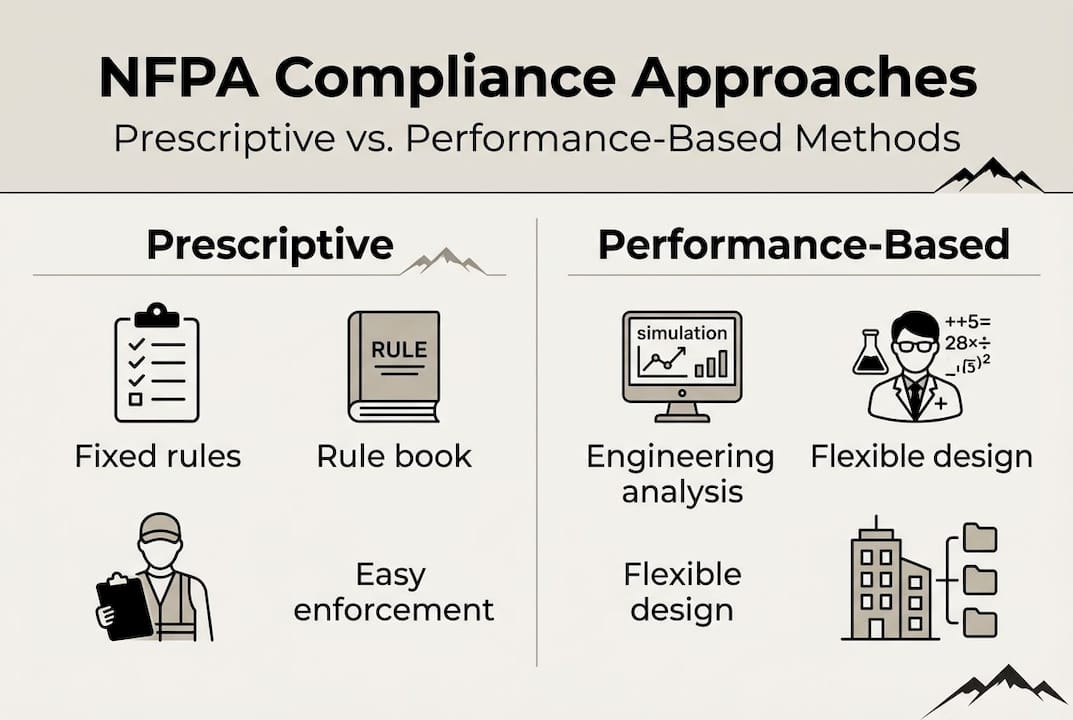
Prescriptive standards give you fixed rules. Install a sprinkler head every 130 square feet, use a specific pipe diameter, test the system annually. These rules are easy to follow and straightforward to enforce. Most standard commercial buildings in Colorado use this path.
Performance-based codes are different. Instead of following fixed rules, you demonstrate through engineering analysis that your proposed system achieves an equivalent level of safety. NFPA standards allow performance-based alternatives for edge cases where prescriptive rules do not fit the building’s design or use.
| Approach | Best for | Requires |
|---|---|---|
| Prescriptive | Standard commercial buildings | Following fixed code rules |
| Performance-based | High-rises, legacy buildings, warehouses | Licensed fire protection engineer |
Pro Tip: If your building has high-rack storage, unusual ceiling heights, or was built before modern codes, ask your fire protection contractor whether a performance-based analysis could save you money while still meeting NFPA requirements. For warehouse fire safety tips, this distinction is especially relevant.
NFPA standards in action: Proven results and common pitfalls
The numbers behind NFPA-compliant systems are striking. Sprinklers operate in 95% of fires, confine 88% of fires to the room of origin, and reduce deaths by 92.6% compared to unprotected buildings. Those are not marketing claims. They are the result of decades of incident data collected by NFPA researchers.
So what causes the rare failures? The data is clear. Failures are most often caused by shut-off valves left in the closed position, accounting for 67% of system failures, followed by lack of maintenance and physical damage. The standard itself is rarely the problem.
Common pitfalls Colorado property managers should watch for:
- Closed control valves after maintenance that were never reopened
- Corroded or obstructed sprinkler heads in older buildings
- Outdated alarm panels that no longer meet current NFPA 72 requirements
- Skipped inspection cycles due to budget pressure or scheduling gaps
- Improper storage blocking sprinkler coverage in warehouse aisles
Pro Tip: Schedule your fire pump inspection and full NFPA compliance inspection at the same time each year. Bundling these visits reduces downtime and ensures nothing falls through the cracks between service calls.
Expert perspectives and edge cases: Navigating complexities
NFPA’s consensus process is genuinely rigorous, but it is not without criticism. Industry influence can slow progress on certain standards, and the cost and complexity of compliance can be a real burden for smaller property owners. Update cycles that run three to five years can also lag behind emerging risks like lithium-ion battery storage fires, which are increasingly relevant for Colorado warehouses and commercial facilities.
For property managers dealing with edge cases, the challenges multiply. High-rack storage facilities, buildings with atrium spaces, and pre-1970s structures often fall outside the neat boundaries of prescriptive code. Performance-based alternatives require engineering analysis and documented modeling, which adds cost but can also unlock solutions that prescriptive rules would not allow.
Here is what experts recommend for navigating these complexities:
- Engage early with your AHJ before starting any renovation or change of occupancy
- Hire NICET-certified technicians who understand both the letter and intent of NFPA standards
- Participate in NFPA public input periods to advocate for standards that reflect Colorado’s specific building stock and climate
- Document everything: inspection records, maintenance logs, and corrective actions all matter if a violation or incident occurs
For warehouse edge cases in particular, NFPA 13 and NFPA 25 provide specific guidance on high-piled storage, rack storage, and commodity classification that goes well beyond what a general contractor will know. Getting specialized advice is not optional in these situations. It is the difference between a system that works and one that fails when you need it most.
Fire protection solutions for Colorado businesses
Understanding NFPA standards is one thing. Putting them into practice across a real commercial property in Colorado is another challenge entirely, especially when codes evolve, buildings age, and occupancy types change.
Pre Action Fire, Inc has served the Denver Metro Area since 2009, helping property managers and business owners stay ahead of NFPA requirements with NICET-certified technicians and customized fire protection plans. Whether you need Denver fire safety inspections, a new fire sprinkler installation in Westminster, or specialized guidance on Denver warehouse fire safety, our team brings the technical depth and local code knowledge to get it right the first time. Contact us today to schedule a consultation and build a compliance plan that fits your property.
Frequently asked questions
Which NFPA standards are most relevant for commercial properties in Colorado?
The most critical standards are NFPA 13 for sprinkler systems, NFPA 25 for inspection and maintenance, NFPA 72 for fire alarms, and NFPA 10 for extinguishers. The Denver Fire Code 2025 references all of these directly as enforceable requirements for commercial occupancies.
How often should fire protection systems be inspected to meet NFPA standards?
NFPA 25 sets inspection, testing, and maintenance schedules that vary by system component, but most require at least annual inspection. Your local AHJ may require more frequent checks depending on occupancy type, and ITM per NFPA 25 is considered the baseline for system reliability.
What happens if my property fails a fire safety inspection in Colorado?
You will receive a written violation notice with a correction deadline. Uncorrected violations can escalate to fines, mandatory system shutdowns, or even forced closure of the facility. AHJs enforce compliance through permits, inspections, and licensing authority.
Who should I consult for complex or unique fire protection challenges?
A licensed fire protection engineer with NFPA experience is your best resource for high-rack storage, atrium buildings, or legacy systems. Performance-based alternatives require documented engineering analysis that goes beyond what a standard contractor can provide.
Is NFPA compliance alone enough to protect my property?
Compliance sets the minimum standard, but it does not replace active maintenance and operational discipline. Failures most often stem from closed valves and deferred maintenance, not from flaws in the standard itself, so ongoing upkeep is just as important as initial installation.