
Standpipe testing requirements come down to two standards working together: NFPA 25 governs ongoing inspection and testing, NFPA 14 governs installation and acceptance flow testing, and together they set a schedule of annual inspections and five-year full testing. Automatic standpipes need a five-year full-demand flow test verifying 500 gallons per minute at the most remote standpipe (250 gallons per minute per outlet) with a minimum 100 psi residual pressure, capped at a maximum flow depending on whether the building is fully sprinklered or not according to NFPA 13. Manual and semiautomatic dry standpipes need a five-year hydrostatic test at a minimum pressure of 200 psi for two hours, or at a pressure 50 psi above the system’s maximum pressure if that maximum exceeds 150 psi. Every test needs calibrated inline flow meters and coordination with your Authority Having Jurisdiction.
TL;DR:
- Ensure you confirm which edition of NFPA 25 and NFPA 14 your local authority enforces since outdated editions can result in non-compliance.
- Conduct full-demand flow tests at the most remote outlets every five years, verifying the required flow of 500 gpm per standpipe with 100 psi residual pressure.
- Perform hydrostatic pressure tests every five years on manual and semiautomatic dry standpipes at 200 psi for two hours or 50 psi above maximum system pressure if it exceeds 150 psi.
- Prepare for testing by securing permits, assembling calibrated equipment, and establishing clear communication plans to avoid delays and ensure accurate measurements.
- Maintain detailed documentation including test reports, calibration certificates, and photos to meet AHJ and insurance requirements and facilitate smooth audits.
Table of Contents
- Which NFPA standards apply, and who enforces them?
- How often do you need to inspect and test a standpipe?
- What flow and pressure do standpipes need to pass a five-year test?
- What are the hydrostatic test requirements for dry standpipes?
- How do you prepare for a standpipe test?
- What documentation do you need after a standpipe test?
- What deficiencies show up most often during standpipe testing?
- A contractor’s pre-test and post-test checklist
- Where to find official standpipe testing standards
- Why most standpipe testing failures aren’t about the water at all
- Get standpipe testing handled by a Denver fire protection team that knows local AHJs
- Sources
Which NFPA standards apply, and who enforces them?
NFPA 14 and NFPA 25 split the standpipe compliance workload cleanly, but they get confused constantly. NFPA 14 governs the design, installation, and acceptance testing of a standpipe system when it’s first put in or substantially modified. That’s the flow test your contractor runs before the fire marshal signs off on a new building or a renovated riser.
NFPA 25 takes over once the system is in service. It sets the ongoing inspection, testing, and maintenance schedule for the life of the building, including the five-year cycles that trip up so many facility teams. If you’re scheduling a routine compliance test on an existing building, you’re working under NFPA 25, not NFPA 14, even though the flow-test mechanics look similar.
Edition adoption matters more than most owners realize. Colorado jurisdictions don’t automatically enforce the newest NFPA edition the moment it’s published. Your local AHJ, typically the fire marshal’s office, adopts a specific edition of NFPA 25 and NFPA 14, and that edition governs your test until the jurisdiction updates its code. Always confirm which edition your AHJ enforces before a test, and cite that edition in your paperwork.
NFPA 13 enters the picture indirectly, through the maximum flow ceiling. Whether your system’s flow test tops out at 1000 gpm or 1250 gpm depends on whether the building is sprinklered throughout under NFPA 13.
A few parties typically get involved in enforcement:
- The AHJ or fire marshal, who witnesses tests and approves alternative test points
- The local water utility, when fire pumps or backflow devices affect the water supply
- The building’s fire protection engineer of record, when documentation is missing or disputed
- Insurance carriers, who often request copies of test reports independent of code requirements
Get the edition question wrong and you can end up testing to criteria your AHJ isn’t even using anymore.
How often do you need to inspect and test a standpipe?
Standpipe system inspection runs on periodic cycles including an annual cycle for basic inspection and a five-year cycle for full performance verification. Missing either one is the single most common way buildings fall out of compliance; learn more about effective fire safety compliance strategies to keep your building safe and up to code.
- Annually, inspect hose connections, cabinets, and hose valve caps for physical damage or tampering, along with visible piping, hangers, and signage.
- Annually, verify pressure gauges are in place, undamaged, and within their calibration interval; replace or recalibrate as needed.
- Every five years, run a full-demand flow test on automatic standpipe systems to confirm the required flow and residual pressure actually reach the hydraulically most remote outlet.
- Every five years, run a hydrostatic test on manual and semiautomatic dry standpipe systems instead of a flow test, since these systems rely on the fire department to supply water rather than an automatic source.
- Every five years, perform main drain tests, gauge accuracy checks, and other component verifications called for under NFPA 25 Chapter 6.
Outside that calendar, certain events force a retest regardless of where you are in the cycle. Any repair or modification to the standpipe piping, valves, or fire department connection triggers a retest of the affected section. Freezing conditions that make water discharge unsafe justify a documented delay, not a skipped test. And if an AHJ flags a deficiency during any inspection, expect a mandated retest once corrective work is done. NFPA-focused fire safety professionals treat these trigger events as part of the schedule, not exceptions to it.
What flow and pressure do standpipes need to pass a five-year test?
The five-year flow test measures whether water actually arrives at the far end of the system at the volume and pressure the design calls for. That means opening outlets and reading gauges at the hydraulically most remote point in the building, typically the top floor’s most distant hose valve, not the outlet closest to the riser where pressure is easiest to hit.
The numeric targets are specific enough that there’s no room to eyeball it. Here’s how NFSA’s flow-testing guidance breaks down the allocation:
| Test parameter | Requirement |
|---|---|
| Most remote standpipe flow | 500 gpm total, via two outlets at 250 gpm each |
| Each additional standpipe | 250 gpm |
| Minimum residual pressure | 100 psi at the two most remote 2½-inch outlets |
| Maximum total flow, sprinklered throughout (NFPA 13) | 1000 gpm |
| Maximum total flow, not fully sprinklered | 1250 gpm |
A building with three standpipes and full sprinkler coverage, for example, would demand 500 gpm at the most remote riser plus 250 gpm at each of the other two, for 1000 gpm total, capped there because NFPA 13 coverage lowers the ceiling.
Running the test itself follows a fairly consistent sequence in the field:
- Connect calibrated inline flow meters at each test outlet before opening any valves.
- Open the outlets simultaneously in the pattern the hydraulic calculations specify, starting with the most remote pair.
- Adjust fire department connection input pressure only if your AHJ permits supplemental pumping for the test.
- Record flow rate and residual pressure at each gauge point in real time, not from memory afterward.
- Confirm FDC pressure never exceeds the AHJ-specified maximum during the test.
The most common shortcut that gets flagged in the field is testing a single outlet instead of the full demand across the required outlets. It looks like a pass on paper but doesn’t verify the system under real load.
If the most remote outlet is physically inaccessible, ask your AHJ for written pre-approval of an alternate test point before test day. Showing up without that approval is how a completed test gets rejected after the fact.
What are the hydrostatic test requirements for dry standpipes?
Manual and semiautomatic dry standpipe systems skip the flow test entirely because they don’t hold water under normal conditions. Instead, NFPA 25 requires a hydrostatic pressure test every five years to confirm the piping itself can hold pressure without leaking.
The pressure and duration are fixed:
- Test at not less than 200 psi for a full two hours.
- If the system’s normal maximum pressure exceeds 150 psi, test at 50 psi above that maximum instead of the flat 200 psi minimum.
- Measure pressure at the lowest elevation point in the system, where hydrostatic pressure naturally reads highest.
- Accept a pressure drop of 5 psi or less over the two hours; anything beyond that indicates a leak that needs tracing before the test can pass.
Scope matters here. The test covers the standpipe piping and fire department connections on manual and semiautomatic dry systems. Some combined sprinkler/standpipe systems that stay wet year round are handled under separate sprinkler testing provisions rather than this dry-pipe hydrostatic protocol, so confirm which category your system falls into before scheduling.
Weather and water damage risk shape how you run the test. If there’s a real risk of water damage from a leak, or if freezing temperatures make a full water fill unsafe, run an air test at 25 psi first to check for gross leaks before committing to the full hydrostatic pressure. Document any delay and the reasoning behind it. NFPA 25 allows postponing a hydrostatic test for unsafe conditions, but only if the delay and AHJ approval are on paper, not just agreed to verbally on site.
How do you prepare for a standpipe test?
Test day preparation is where most delays and failed tests actually originate, not in the test itself. Building owners who show up unprepared lose the day, and rescheduling with the AHJ and water utility can push compliance windows dangerously close to a deadline.
- Pull the permit and confirm whether your AHJ requires a witnessed test; some jurisdictions send an inspector automatically, others require a scheduled request.
- Check your water utility’s rules on pumped flow tests, since discharging at 500 to 1250 gpm can trigger notification requirements or backflow prevention conditions.
- Assemble your equipment: calibrated inline flow meters, liquid-filled gauges rated 0 to 200 psi, listed flow measuring devices, and enough hose to reach each test point safely.
- Assign personnel to each gauge location with a working communications plan, since a flow test with gauges 15 floors apart fails fast without radios or phones synced to a shared countdown.
- Plan where discharge water goes before you open a single valve, and confirm the drainage path meets local stormwater and backflow rules.
- If a remote outlet is inaccessible, get the AHJ’s alternate test point approval in writing ahead of time, not as a phone call mid-test.
Pro Tip: Bring a second, independently calibrated gauge and flow meter to every test. A single miscalibrated gauge can invalidate hours of work, and swapping in a backup on site saves the entire test day instead of forcing a reschedule.
Confirming water supply and pump performance ahead of time is worth the extra step, especially on systems where a fire pump feeds the standpipe. A hydrant flow test beforehand can flag a weak water supply before it shows up as a failed standpipe test on the day that actually counts.
What documentation do you need after a standpipe test?
A completed test that isn’t documented properly might as well not have happened, at least as far as your AHJ or insurer is concerned. The report needs to stand on its own if someone reviews it five years from now with no memory of the test day.
A complete report should include:
- Test date, building location, and the specific standpipe or system tested
- Names and qualifications of personnel who performed the test
- Static and residual pressures recorded at each gauge point
- Actual flow measured in gpm, compared against the required allocation
- Equipment used, including make, model, and calibration date for each gauge and meter
- Water supply conditions, including fire pump performance data if applicable
- Locations of tested outlets, noting any approved alternate test points
- Deficiencies found, with corrective actions taken or recommended
If a system fails, the fix depends on what broke. A stuck pressure-reducing valve or a clogged outlet often gets resolved with servicing and a same-day retest. A shortfall in overall flow that traces back to pump output or undersized piping is a different problem entirely, one that usually needs a fire protection engineer to evaluate capacity before anyone signs off on a retrofit.
Keep signed copies in the facility’s compliance file, and send copies to the AHJ and your insurance carrier as required. Retaining reports for at least the life of the current five-year cycle, and ideally longer, keeps you covered if a past test ever gets questioned during an audit.
What deficiencies show up most often during standpipe testing?
The same handful of problems account for most failed standpipe tests, and nearly all of them are preventable with routine attention rather than a major capital project.
- Insufficient pump output shows up as low residual pressure at the remote outlet even when the math on paper says the system should pass; it usually traces back to worn impellers or a pump that’s never been load tested.
- Blocked or painted-over outlets are a maintenance failure, not a design one, and often get missed until someone tries to open the cap on test day.
- Malfunctioning pressure-regulating valves either choke flow too aggressively or fail to limit pressure at all, both of which fail the residual pressure target.
- Uncalibrated gauges produce readings that look fine but aren’t trustworthy, which is why AHJs increasingly ask for calibration certificates alongside the report.
- Missing hydraulic design documentation makes it hard to know what the system was ever supposed to deliver, forcing a reconstruction of demand figures from old NFPA 14 editions or building records.
Scheduled maintenance between five-year tests catches most of these before they become test-day surprises, and keeping the original acceptance test report on file gives you a baseline to compare against every cycle after.
A contractor’s pre-test and post-test checklist
Turning NFPA rules into something you can hand a technician on test day is where compliance actually gets executed. Pre Action Fire, Inc has built its testing workflow around exactly this gap between what the code says and what happens on a rooftop at 7 a.m. with a fire marshal standing next to the gauge.
Before the test:
- Confirm which edition of NFPA 25 and NFPA 14 your AHJ currently enforces, and note it on the test paperwork.
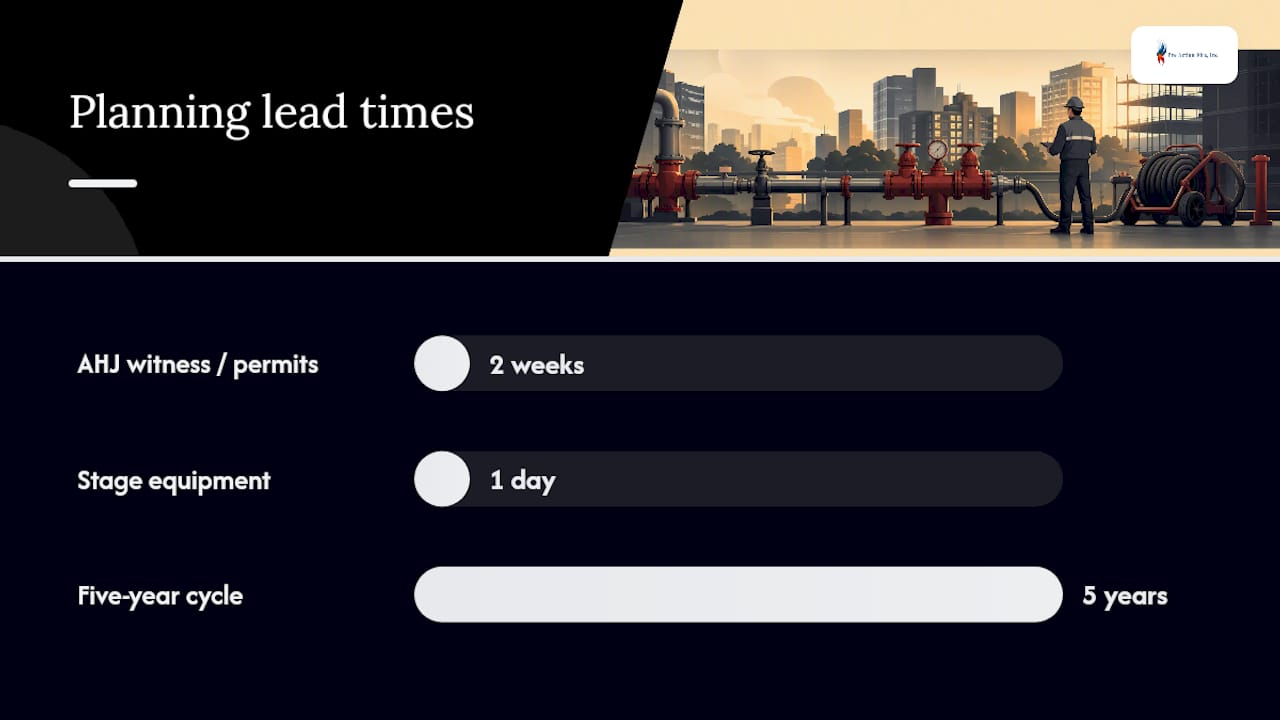
- Secure the AHJ witness appointment and any required permits at least two weeks out.
- Finalize the water supply and backflow plan with the utility, including pump involvement if applicable.
- Stage calibrated flow meters, gauges, and backup equipment the day before, not the morning of.
- Assign personnel to each measurement point and confirm the communications plan works before water moves.
During the test:
Measurement happens at three points: the fire department connection, the base of the riser, and the hydraulically most remote outlet. Outlets open in the sequence the hydraulic calculations specify, most remote pair first, with flow and pressure logged at each point as it happens rather than reconstructed afterward. Anyone spotting a leak, a stuck valve, or an unexpected pressure drop flags it immediately so it gets captured as a live deficiency rather than a mystery discovered days later.
Pro Tip: Photograph every gauge reading at the moment it’s taken. A timestamped photo settles disputes about recorded numbers far faster than a handwritten log entry someone questions six months later.
After the test, deliver a signed, dated report with photos, equipment serial numbers and calibration dates, and cost estimates for any corrective work identified. Facility teams that keep this template on hand for every NFPA compliance inspection cycle spend far less time scrambling before each five-year deadline.
Where to find official standpipe testing standards
Keep a short list of primary sources in your compliance folder rather than relying on secondhand summaries. Start with NFPA 25’s Chapter 6 for inspection and testing minimums, and NFPA 14’s acceptance testing provisions for installation criteria. The NFSA’s explanatory articles translate the code into plain language, and Charleston’s published acceptance-test procedure is a useful real-world illustration of how one AHJ structures its expectations.
Why most standpipe testing failures aren’t about the water at all
The research on standpipe compliance points to a pattern that doesn’t get enough attention: the tests fail on documentation and shortcuts far more often than on genuine hydraulic shortfalls. Partial, single-outlet testing keeps showing up as a substitute for full-demand testing, and it’s the kind of shortcut that looks fine until an AHJ asks harder questions.
The conventional advice treats standpipe testing as a once-every-five-years event you schedule and forget. That’s backwards. The buildings that pass cleanly are the ones treating the annual inspection as the real compliance backbone, catching a blocked outlet or a drifting gauge long before it becomes a five-year test-day failure. The five-year flow or hydrostatic test should confirm what routine maintenance already suggests, not reveal a surprise.
If you manage a building with a standpipe system, prioritize two things above everything else: know which NFPA edition your AHJ enforces before you schedule anything, and insist on full-demand testing at the actual hydraulically most remote outlet, not a convenient stand-in closer to the riser. Everything else in the compliance process follows from getting those two decisions right.
— Results
Get standpipe testing handled by a Denver fire protection team that knows local AHJs
Reading through the gpm allocations, residual pressure targets, and five-year cycle rules is one thing. Running the actual test, coordinating with your AHJ, and producing a report that holds up under audit is another. A qualified fire protection team with experience in the Denver Metro Area can assist with compliance, staffed by technicians familiar with NFPA editions and AHJ paperwork preferences.
That local familiarity is the real advantage over trying to coordinate a standpipe test yourself or hiring a contractor unfamiliar with Colorado’s specific AHJ expectations. Such teams handle flow meters, gauge calibration, AHJ scheduling, and documentation to help ensure your five-year test produces a report that satisfies both code and insurer requirements. If your standpipe system is coming up on a testing deadline, or you’re not sure which cycle it’s currently in, schedule a fire safety inspection with Preactionfire and get a clear answer on where your building stands.
Sources
- Understanding the five-year inspection and testing requirements for manual and automatic standpipe systems | NFSA (2026)
- NFPA 25 — Chapter 6 — Standpipe and Hose Systems (2026)
- Standpipe final acceptance test (City of Charleston example)