
If your property has a testable backflow prevention assembly, an initial test at installation and annual retesting after that are the standard rule across most U.S. water utilities. The exact schedule, forms, and penalties depend on your city or state code, so your first move is simple: identify your assembly type, check your local water utility’s cross-connection program, and get a certified tester on the calendar before your compliance window closes.
TL;DR:
- Most jurisdictions require an initial backflow test at installation and annual retesting for high-hazard assemblies like fire sprinklers and industrial systems.
- Certified testers must hold recognized licenses or certifications and provide calibration proof for their gauges to ensure test validity.
- Test reports need to be submitted promptly within specific windows, often 30 days, to avoid fines or water shutoffs, with recordkeeping recommended for at least three years.
- Devices such as reduced pressure zone assemblies generally demand annual testing, whereas simple air gaps are usually non-testable in most codes.
- Centralized tracking of backflow devices, certification verification, and early scheduling help prevent compliance failures and streamline property management.
Table of Contents
- What Backflow Is and Why Testing Protects Public Water
- Who Must Test and How Often
- Who Can Legally Test Your Backflow Assembly?
- What Happens During a Backflow Test?
- Reporting, Records, and What Happens if You Skip It
- Device Types and How Testing Requirements Change
- A Compliance Checklist You Can Use This Week
- Why Property Owners Trust Preactionfire With Backflow Compliance
- What Multi-Site Portfolio Management Taught Me About Backflow Deadlines
- Get Ahead of Your Backflow Testing Deadline
- Sources
What Backflow Is and Why Testing Protects Public Water
Backflow happens when water reverses direction in a pipe and flows backward into the clean supply instead of forward to the fixture. It occurs two ways: backsiphonage, caused by a pressure drop in the main (a water main break or heavy firefighting draw), and backpressure, where a downstream system like a boiler or fire pump pushes water back against the incoming flow with greater force than the supply line.
The danger is concrete, not theoretical. An irrigation system with chemical fertilizer injectors, a boiler loop treated with corrosion inhibitors, or a commercial fire sprinkler line dosed with antifreeze can all siphon contaminated water into the drinking supply if a check valve fails and no backflow assembly stands guard. That’s the entire reason EPA cross-connection control guidance treats backflow prevention as a shared duty between the property owner and the water utility, requiring testing, inspection, and recordkeeping proportional to the hazard.
For an owner, this isn’t abstract public-health policy. A failed assembly that contaminates a water main can trigger liability claims, emergency shutoffs, and regulatory fines, on top of the reputational damage to a boil-water notice traced back to your building. Common cross-connection points include:
- Irrigation systems with chemical injection
- Boiler and chiller loops
- Fire sprinkler systems with antifreeze or foam additives
- Industrial process water and cooling towers
- Reclaimed or non-potable water lines run near potable plumbing
Who Must Test and How Often
Not every property owner faces the same clock, but the pattern across most jurisdictions is consistent enough to plan around. Here’s the rule of thumb utilities apply almost everywhere:
- Initial test at installation. Any new backflow assembly gets tested and certified before the water utility signs off on service, a step the City of Tampa Cross-Connection Control Manual spells out explicitly for commercial connections.
- Annual testing for health-hazard assemblies. Devices protecting against high-hazard cross-connections, think chemical feed systems, medical facilities, or industrial processes, typically require a passing test every 12 months.
- Post-repair or post-relocation retesting. Any time an assembly is repaired, replaced, or moved, it needs a fresh test before it goes back into service, regardless of where it sits in the annual cycle.
- Residential exceptions exist but aren’t universal. Single-family homes with a simple irrigation system may fall under a lighter testing schedule or even qualify for a non-testable device, but that depends entirely on your local ordinance.
The devices most likely to trigger a mandatory testing obligation are fire sprinkler systems, irrigation systems, boilers, commercial kitchens, industrial process lines, and any connection to reclaimed water. Multi-tenant commercial buildings often have several assemblies scattered across the property, each with its own due date, which is where owners get tripped up.
None of these figures are guaranteed for your address. TCEQ guidance, Tampa’s manual, and NYC DEP’s backflow prevention program all set slightly different specifics, so the only reliable move is calling your water utility or pulling the municipal ordinance before you assume a national default applies.
Who Can Legally Test Your Backflow Assembly?
A passing test only counts if the person performing it holds the right credential, and utilities check this before they’ll accept a report. Requirements vary by state, but the shape is consistent: a recognized certification, sometimes utility registration on top of it, and calibrated equipment.
- State-issued licenses. Texas requires testers to hold a Backflow Prevention Assembly Tester (BPAT) license under TCEQ guidance (RG-478), and similar state-run programs exist elsewhere.
- National certifying bodies. ASSE, ABPA, and AWWA all run tester certification programs, though which one your jurisdiction accepts varies, so don’t assume a certification good in one state transfers automatically to another.
- Utility-level registration. Some cities require testers to register directly with the water department, separate from holding a state or national certification, an inconsistency the Tampa manual highlights explicitly.
- Gauge calibration proof. TCEQ guidance requires test gauges to be verified for accuracy at least annually, and a report generated on an out-of-calibration gauge can be rejected outright.
Pro Tip: Before you sign off on any tester, ask for two documents up front: their current certification card and a calibration certificate for the specific gauge they’re using on your property. A tester without both is a compliance risk you’re inheriting, not avoiding.
What Happens During a Backflow Test?
A backflow test is a hands-on field procedure, not a paperwork exercise, and it typically runs 15 to 45 minutes per assembly depending on device complexity and site access. Here’s the sequence a certified tester follows:
- Visual inspection. The tester checks for leaks, corrosion, and proper installation orientation before touching a gauge.
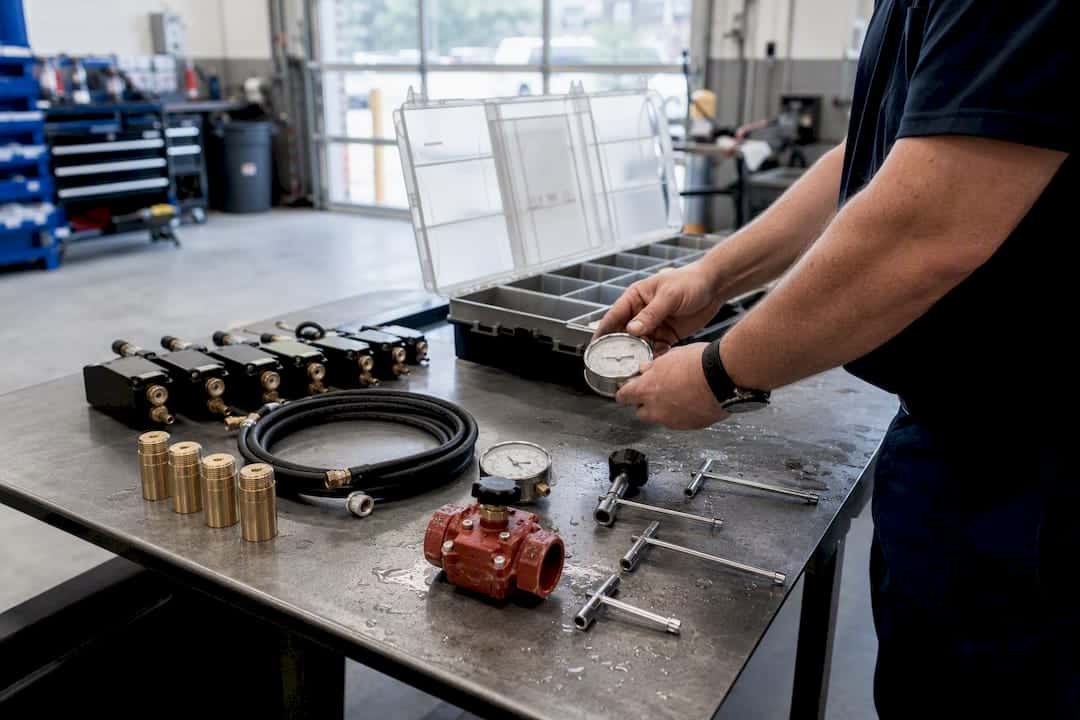
- Gauge hookup. A calibrated differential pressure gauge connects to the test cocks on the assembly.
- Valve differential checks. The tester opens and closes shutoff valves in sequence, measuring pressure differentials across each check valve to confirm they’re holding.
- Relief valve verification. On reduced pressure zone (RPZ) assemblies, the relief valve has to open at the correct differential, a step that catches a lot of failures other device types simply don’t have.
- Report generation. Results get logged on a standardized Test & Maintenance Report, either on paper or through a utility’s online portal.
A failed test isn’t the end of the world, but it does start a clock. Most utilities, including Tampa’s program, give owners a limited window, commonly 30 days, to complete repairs and pass a retest. Miss that window and some utilities grant a short extension; miss the extension too and enforcement steps kick in. The test report itself becomes your proof of compliance, so submitting it promptly to the utility (and keeping your own copy) matters as much as passing the test.
Reporting, Records, and What Happens if You Skip It
Passing the test is only half the job. The report has to reach the right hands, and you need to hold onto your own copy longer than most owners assume. Many water utilities, following patterns like Tampa’s cross-connection program, retain backflow test records for at least three years, and smart owners keep their own file going back further than that, especially across property sales or refinancing.
Enforcement isn’t theoretical. NYC DEP requires certified testers for both initial and annual tests, and failure to comply can lead to fines or outright water service disconnection. That’s not a rare outcome for chronic non-responders. A typical enforcement sequence looks like this:
- A reminder notice goes out before the annual due date
- A formal deadline notice follows if no test report is filed
- A final warning with a hard shutoff date if the owner still doesn’t respond
- Water service interruption until a passing test is submitted and reviewed
Different cities run this timeline at different speeds. Some utilities allow 30 to 60 days of grace after a missed deadline before escalating; others move faster, particularly for high-hazard connections like industrial or medical facilities. Check your specific utility’s ordinance rather than assuming a national standard, because the consequence for missing a deadline in one city can be a warning letter, and in another, an actual shutoff notice within weeks.
Device Types and How Testing Requirements Change
Not every backflow device on your property needs annual testing, and knowing which ones do starts with correctly identifying what’s actually installed. The EPA’s cross-connection control manual references ASSE, AWWA, and FCCCHR standards for classifying these assemblies by hazard level:
- Reduced pressure zone (RPZ) assemblies protect against high-hazard cross-connections and require annual testing in almost every jurisdiction.
- Double check valve assemblies (DCVA) guard against lower-hazard connections and often carry the same annual testing requirement, though enforcement can be less aggressive.
- Pressure vacuum breakers (PVB) and spill-resistant vacuum breakers (SVB) are common on irrigation systems and are testable devices in most codes.
- Atmospheric vacuum breakers (AVB) and simple air gaps are typically non-testable because they have no moving parts that degrade the same way.
Don’t assume your property’s device matches the neighbor’s or a prior tenant’s setup. Verify the manufacturer plate and serial number on your actual assembly, since a mislabeled device can mean testing to the wrong standard or skipping a legally required test altogether.
A Compliance Checklist You Can Use This Week
Getting ahead of testing deadlines comes down to a short list of habits, not a complicated system. Run through this sequence:
- Inventory every backflow assembly on the property by serial number, location, and device type.
- Set calendar reminders 60 days ahead of each annual due date, not the week of.
- Confirm your local utility’s specific forms, portal, and submission deadlines.
- Verify each tester’s current certification and request gauge calibration proof before the appointment.
- Schedule testing early enough to leave room for repairs if the device fails.
- File the report with the utility and retain your own copy for at least three years.
Pro Tip: If you manage more than one site, centralize this inventory in a single spreadsheet or work order system tied to due dates, and require every vendor to upload a signed report to your own file, not just the utility portal. That single habit prevents the scramble that happens when an audit or property sale suddenly demands five years of records you don’t actually have.
Coordinate directly with your utility’s cross-connection department when scheduling, since some cities batch inspections by neighborhood or require advance notice for site access.
Why Property Owners Trust Preactionfire With Backflow Compliance
Preactionfire has served the Denver Metro Area since 2009, working directly with commercial and industrial property owners on the fire protection systems that intersect with backflow compliance, sprinkler lines, fire pumps, and standpipe systems among them. The team includes NICET-certified technicians with hands-on experience meeting NFPA standards and local code requirements across Colorado.
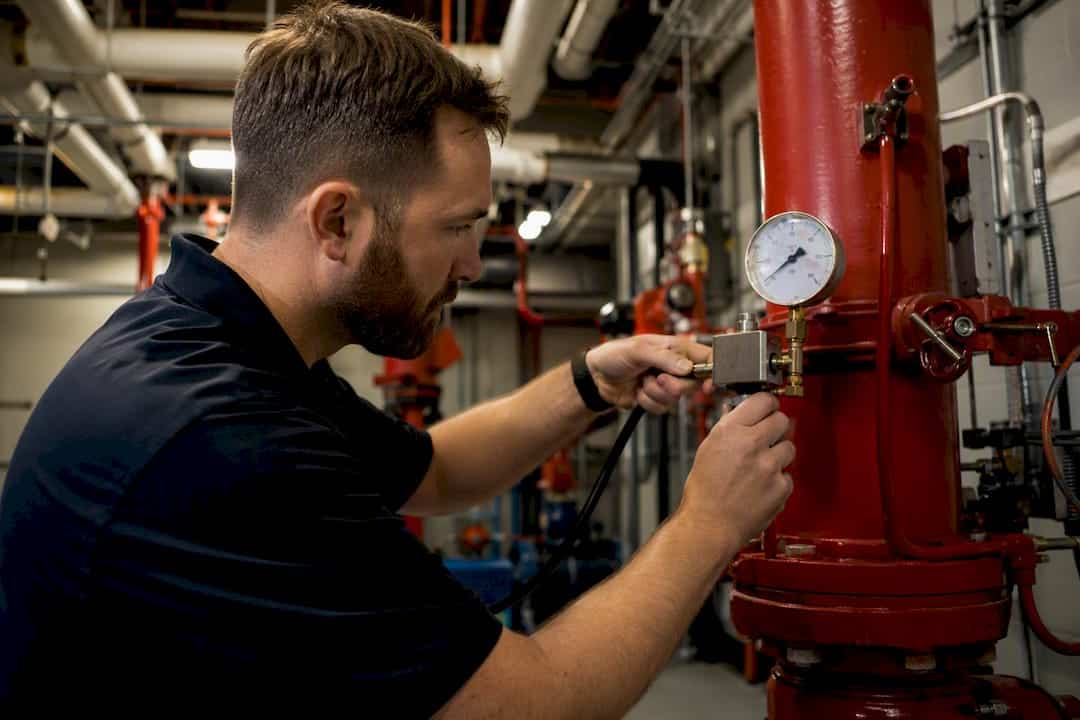
On the backflow side, Preactionfire handles inspections and testing, repairs when an assembly fails, gauge calibration verification, and submission of test records to the appropriate authority. For property managers juggling fire alarm, sprinkler, and backflow compliance across one building or several, having a single technical team that understands how these systems interact removes a lot of the coordination headache that comes with hiring separate vendors for each.
What Multi-Site Portfolio Management Taught Me About Backflow Deadlines
Managing testing across several properties exposes a pattern fast: the buildings that stay compliant are the ones with a centralized calendar and a standing rule to verify tester credentials before every visit, not after a report gets rejected. The single habit that prevents the most surprises is requiring proof of gauge calibration with every test, no exceptions, before you file anything with the utility.
— Results
Get Ahead of Your Backflow Testing Deadline
Preactionfire is the direct alternative to juggling separate vendors for fire systems and water compliance in the Denver Metro Area: one team handles your backflow testing, repairs, and report submission alongside the fire alarm and sprinkler work you already need inspected on schedule.
The team coordinates testing dates around your other compliance deadlines, verifies gauge calibration on every visit, and files the paperwork your utility requires so you’re not tracking down a signed Test & Maintenance Report the week before it’s due. If contractor vetting is part of your process, understanding what plumbing compliance means when hiring outside help is worth a read before you sign anyone on. For backflow assemblies tied to your fire protection systems specifically, start with Preactionfire’s backflow inspection services page, or check the local service pages for Arvada, Lakewood, and Thornton to see coverage near your property. Reach out to schedule a test before your annual deadline puts your water service at risk.
Sources
- EPA cross-connection control guidance
- City of Tampa Cross-Connection Control Manual
- TCEQ cross-connection and backflow prevention guidance (RG-478)
- NYC DEP — Backflow prevention / cross connection controls