
A hydrant flow test for building systems measures static pressure, residual pressure, and flow rate so engineers can produce a water-supply curve used to size or verify sprinklers, standpipes, and fire pumps. Testing follows NFPA 291 methodology, with NFPA 13 and NFPA 20 governing how the results translate into sprinkler and pump design. Get this test wrong and you either oversize a fire pump you didn’t need or discover mid-construction that your water supply can’t support the sprinkler design.
TL;DR:
- Hydrant flow tests must be conducted during ordinary demand hours with properly calibrated gauges to ensure accurate water supply data.
- Tests should use multiple hydrants to avoid turbulence distortion, log elevation differences, and include details like nozzle size and flow duration.
- Results are reliable only if the report documents device calibration, hydrant IDs, and an appropriate 20 PSI pressure extrapolation worksheet.
- A built water-supply curve will determine if the system is adequate, needs a fire pump, or requires piping or main upgrades.
- Inaccurate or poorly documented tests can lead to design errors, unnecessary equipment, or costly system modifications.
Table of Contents
- When Do You Need a Hydrant Flow Test?
- How a Hydrant Flow Test Is Performed
- What Happens on Hydrant Flow Test Day
- Interpreting the Water-Supply Curve
- Spotting a Bad Hydrant Flow Test Report
- What We’ve Learned Testing Hydrants Across the Denver Metro
- Get a Defensible Hydrant Flow Test for Your Denver Building
- Sources
When Do You Need a Hydrant Flow Test?
Most Denver-area facility managers encounter this test at a handful of predictable moments, not on a routine schedule. A test almost always shows up when you’re designing a new sprinkler system, selecting or accepting a fire pump, upgrading an existing system’s coverage, or when earlier hydraulic calculations came back marginal and an engineer wants confirmed field data instead of assumed numbers.
This article covers private, site-specific flow tests used to size building fire protection systems, not municipal surveys that cities run to check hydrant condition or water-main capacity across a neighborhood. Those are a different test for a different audience.
Timing matters more than most owners realize. Some jurisdictions require a flow-test report dated within 12 months of construction-document submittal, and testing during ordinary demand rather than off-peak hours gives designers a realistic baseline instead of an optimistic one. Local authorities having jurisdiction (AHJs) and water purveyors frequently layer their own safety factors on top of NFPA minimums, so a result that looks adequate on paper can still trigger a design change once the local margin gets applied.
- New sprinkler or standpipe design requiring confirmed water supply
- Fire pump selection, replacement, or acceptance testing
- System upgrades that increase hydraulic demand
- Marginal or outdated hydraulic calculations needing field verification
- Plan-submittal deadlines with a required test-report age limit
How a Hydrant Flow Test Is Performed
A defensible flow test almost always uses a multi-hydrant setup: one hydrant serves as the residual (or test) hydrant where pressure is monitored, and one or more separate flow hydrants are opened to draw water. Flowing water through a separate outlet avoids the turbulence and piping restrictions that distort readings when a single hydrant tries to both flow and measure at once.
Three measurements anchor the whole test:
- Static pressure at the residual hydrant before any water flows.
- Residual pressure at that same hydrant while the flow hydrant (or hydrants) is open.
- Flow rate, read with a Pitot gauge and nozzle or a calibrated flowmeter, factoring in nozzle diameter and its discharge coefficient.
Gauge calibration isn’t optional paperwork. An uncalibrated Pitot gauge can throw off the entire supply curve, and if a single flow hydrant doesn’t produce enough pressure drop to be meaningful, the technician needs to open additional hydrants to get a usable spread between static and residual readings. Elevation between hydrants and the test point also affects available pressure and should be logged on-site rather than reconstructed later.
Pro Tip: Ask your tester how many flow hydrants they plan to open before the crew arrives. If the answer is “just one, we’ll see how it goes,” you’re likely to get a supply curve built on too small a pressure drop to trust.
What Happens on Hydrant Flow Test Day
Good results start well before anyone cracks a hydrant cap. Preparation determines whether the field data holds up under engineering review.
Before the test:
- Identify which hydrants will serve as residual and flow hydrants, based on proximity to the building and main size.
- Notify the local water purveyor and AHJ, since many require advance coordination or a permit for hydrant flow testing.
- Schedule the test during ordinary demand hours. Testing before dawn to avoid traffic gives you a curve that overstates typical capacity.
- Set up traffic control and site safety measures, especially at hydrants near roadways or parking areas.
- Confirm the hydrants are physically accessible and operable. A rusted or partially closed valve will wreck your numbers before the test even starts.
On-site sequence:
- Attach the gauge cap to the residual hydrant and record static pressure.
- Open the flow hydrant(s) and let flow stabilize.
- Take the Pitot reading at the flow hydrant’s nozzle and record residual pressure simultaneously at the test hydrant.
- Log the flow duration and shut off the flow hydrant(s) in a controlled sequence.
- Recheck static pressure at the residual hydrant after shutoff to confirm the system returned to baseline.
The paperwork matters as much as the fieldwork. A usable report logs hydrant IDs, elevations, nozzle sizes and coefficients, Pitot pressures, static and residual values, flow duration, the tester’s name, and the flowmeter’s calibration date. Skip any of these and an engineer reviewing the report later has no way to verify the numbers or explain an odd result.
The deliverable you should expect back is a water-supply curve, an annotated field worksheet showing the raw readings, and a set of recommended next steps. Those steps might be as simple as “supply is adequate as designed” or as involved as “install a fire pump” or “upsize the incoming main.” A water-flow alarm integration downstream depends on this data being accurate in the first place, since alarm thresholds get calibrated against the same supply assumptions.
Interpreting the Water-Supply Curve
Once the field data is in hand, an engineer plots flow against residual pressure to build the water-supply curve, then compares it against the building’s sprinkler and standpipe demand curves calculated under NFPA 13 and NFPA 14. The supply curve is the empirical basis for every downstream decision, often extrapolated to the pressure needed at the system’s most remote sprinkler head, commonly 20 psi.
Sprinkler and standpipe demands get calculated independently of each other, and in a combined system the higher single demand controls the sizing decision, not an average of the two. A building with a modest sprinkler demand but a heavy standpipe requirement for firefighter hose streams gets sized to the standpipe number, full stop.
NFPA 20 adds another layer when a fire pump enters the picture: the pump has to be capable of 150% of its rated flow during performance testing, and the design has to verify positive suction pressure at that elevated flow rate. Denver-area AHJs frequently ask for suction-pressure margins above the NFPA minimum, which is exactly the kind of local requirement worth confirming before you commit to a pump model.
Depending on what the curve shows, the practical outcome typically lands in one of four buckets:
- Supply is adequate; system accepted as designed
- A fire pump is required to boost pressure or flow
- A storage tank is needed to supplement inadequate main capacity
- Piping or main upgrades are required before the system can be accepted
None of these decisions should get made from a single data point. If a result sits right on the edge of adequate, engineers often request a repeat test at a different time of day to confirm the number wasn’t a fluke of unusually low demand at the moment of testing.
Spotting a Bad Hydrant Flow Test Report
Not every report you receive deserves your signature. A handful of pitfalls show up often enough that they’re worth checking for before you forward a report to your engineer or AHJ.
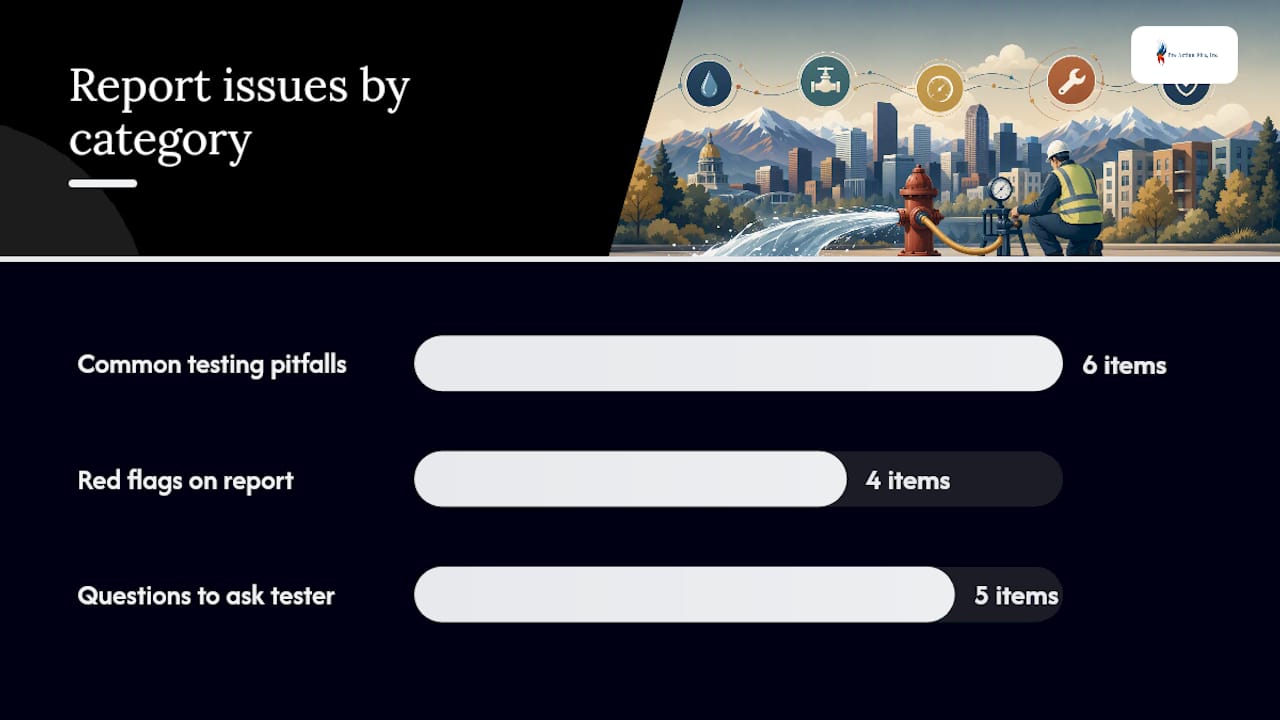
Common testing pitfalls:
- Testing during peak demand hours, which understates real capacity
- No documented gauge or flowmeter calibration
- Insufficient pressure drop between static and residual readings
- Wrong hydrant butt type for the fittings on hand, forcing improvised adapters
- Ignored elevation differences between hydrants and the test point
- Flow duration cut short, producing an unstable reading
Red flags on the report itself include missing hydrant IDs or elevation data, no calibration records for the device used, an unexplained extrapolation down to 20 psi with no worksheet showing the math, or no listed test time and operator name. If a tester’s own guidance doesn’t match what landed on your desk, that’s worth a direct conversation before you rely on the numbers.
Before signing off, ask the tester these five questions directly: Was this done per NFPA 291? Can you show device calibration records? Which hydrants were used, and why those? How was seasonal or peak demand factored in? Who built the water-supply curve, and can we get the raw worksheet?
Pro Tip: If a report can’t answer “who calibrated the gauge and when,” treat every number in it as provisional until someone can. When results come back marginal, your options are a re-test, a licensed fire protection engineer’s review, or moving straight to mitigation planning for a pump, tank, or pipe upgrade.
What We’ve Learned Testing Hydrants Across the Denver Metro
Pre Action Fire, Inc has run fire protection work across the Denver Metro Area since 2009, and the pattern we see most often isn’t a bad hydrant. It’s a report nobody can defend six months later because the calibration records went missing or the elevation notes never made it past a technician’s truck. NICET-certified technicians who understand both the field procedure and how an AHJ will read the resulting numbers tend to catch those gaps before they become a rejected submittal.
The recurring lesson is that a flow test isn’t a formality you check off a list. It’s the number every subsequent design decision, from pump selection to pipe sizing, gets built on. Get it wrong at this stage and the mistake compounds through every drawing that follows.
— Results
Get a Defensible Hydrant Flow Test for Your Denver Building
Preactionfire runs hydrant flow tests the way an AHJ actually wants to see them documented, not the way a rushed subcontractor hopes will pass. We handle the NFPA 291-based field procedure, coordinate directly with your local water purveyor and AHJ, and hand back a water-supply curve and worksheet your engineer can act on without chasing down missing calibration records.

What you get: NICET-certified technicians on-site, a documented water-supply curve tied to real field data, and specific remediation recommendations if the supply falls short, whether that means a pump, a tank, or a main upgrade. If your building needs a fire pump evaluated against that new data, our fire pump inspection team picks up right where the flow test leaves off.
Contact Preactionfire to schedule your hydrant flow test, or start with our fire safety inspections page to see how testing fits into your building’s broader compliance calendar.
Sources
- NFPA 291 — Recommended Practice for Fire Flow Testing and Marking of Hydrants
- How to conduct fire hydrant flow testing — Consulting-Specifying Engineer / CSEmag
- MWUA — NFPA 291 Hydrant flow testing guidance