
The fire alarm control panel, or FACU (fire alarm control unit), is the operational brain of any building’s fire protection system. It receives signals from initiating devices like smoke detectors and pull stations, processes those signals, and triggers the right outputs — audible alarms, sprinkler releases, HVAC shutdowns, elevator recalls, and emergency lighting activation. Every one of those functions depends on the panel’s built-in capabilities.
Here is what fire control panel features actually cover at a system level:
- Detection and monitoring: Continuous polling of connected sensors and devices
- Signal processing: Distinguishing real alarms from faults or supervisory conditions
- Notification control: Activating horns, strobes, and voice evacuation systems
- Emergency output control: Releasing suppression systems, closing fire doors, recalling elevators
- Integration: Coordinating with HVAC, BMS, and emergency lighting
- Power management: Primary AC supply plus supervised battery backup
- Compliance reporting: Event logging and audit trails per NFPA 72 requirements
Panels must meet NFPA 72 and UL 864 to be accepted by US authorities having jurisdiction (AHJ). Those standards govern everything from wiring class designations to battery standby duration, so compliance is not optional — it is the baseline.
Table of Contents
- How addressable and conventional panels differ from each other
- Core components that every fire control panel contains
- What a fire control panel actually does during normal and emergency operation
- Advanced capabilities that set addressable panels apart
- How self-diagnostics and testing features keep systems reliable
- Preactionfire brings expert fire panel service to the Denver Metro Area
- Key Takeaways
How addressable and conventional panels differ from each other
The single biggest decision in fire alarm system specs is panel architecture: addressable or conventional. They solve the same problem differently, and the gap in capability is significant.
Addressable panels assign a unique digital address to every device on the loop. The panel continuously polls each device for status, supporting up to 254 devices per loop. When a detector triggers, the panel reports the exact device location — room 412, detector 7 — not just a general zone. That precision changes how fast a responder can act.

Conventional panels work by zones. A zone circuit covers a physical area, and when any device on that circuit activates, the panel reports the zone, not the specific device. Conventional panels typically handle multiple zones, which suits small or straightforward buildings well. Wiring runs from each zone back to the panel separately, which adds conduit and labor in larger buildings.
Key comparison points:
- Detection granularity: Addressable pinpoints the device; conventional identifies only the zone
- Wiring: Addressable uses a single loop (SLC) for many devices; conventional requires home-run wiring per zone
- False alarm management: Addressable panels support drift compensation and coincidence detection; conventional panels offer neither
- Scalability: Addressable systems expand by adding devices to existing loops; conventional systems require new zone cards
- Cost profile: Conventional panels cost less upfront for small buildings; addressable panels pay off in larger or complex facilities
Both types are fully code-compliant per NFPA. The choice comes down to building size, occupancy complexity, and how much diagnostic detail the facility needs.
Core components that every fire control panel contains
Understanding what is physically inside a panel clarifies why certain fire panel functionalities exist and what can fail.
Central processing unit (CPU): The CPU runs the panel’s operating software, executes cause-and-effect logic, manages device polling, and handles all event processing. Panel families like the Fike FCP-75, FCP-300, and FCP-2100 scale their CPU capacity to match point counts — the FCP-75 handles smaller facilities while the FCP-2100 supports large, multi-building campuses.
Signaling line circuits (SLC) and initiating device circuits (IDC): SLCs carry the digital communication loop in addressable systems. IDCs are the traditional zone wiring in conventional systems. The CIE-A-400 and CIE-A-200 panels use addressable SLC architecture, allowing high device counts on a single loop with supervised wiring throughout.
Notification appliance circuits (NAC): These output circuits power horns, strobes, and speakers. NAC capacity — measured in milliamps — determines how many notification devices the panel can drive without an external booster.
Power supply module: Every compliant panel carries a primary 120V AC input and a supervised battery charger. Battery capacity must sustain the system through a defined standby period (typically 24 hours) followed by a full alarm load, per NFPA 72.
User interface: Ranges from basic LED zone indicators on conventional panels to full-color touchscreens on advanced addressable units. The Fike Cheetah® Xi and Fike SHP-PRO® both feature LCD displays with programmable custom maps and event-driven navigation.
| Feature Category | Conventional Panel | Addressable Panel |
|---|---|---|
| Device identification | Zone only | Individual device address |
| Wiring topology | Home-run per zone | Single loop (SLC) |
| Max device capacity | 4–32 zones | Up to 254 per loop |
| False alarm tools | None | Drift compensation, coincidence detection |
| BMS integration | Limited | BACnet/IP, Modbus |
| Self-diagnostics | Manual walk-down required | Automatic fault reporting |
| User interface | LED indicators | LCD/touchscreen with custom maps |
What a fire control panel actually does during normal and emergency operation
The panel’s job is not just to sound an alarm. Its fire control system capabilities span four distinct operational modes.
Signal processing and alarm initiation: When a detector crosses its threshold, the panel validates the signal, classifies it (alarm, supervisory, or trouble), and initiates the appropriate response sequence. Cause-and-effect programming defines exactly what happens next — which NACs activate, which suppression zones release, which HVAC dampers close.
Device health monitoring: Addressable panels automatically report faults and maintenance needs, flagging a dirty detector or a wiring ground fault without anyone walking the building. Conventional systems require a technician to physically check each zone circuit to locate a fault.
Emergency control functions: Per NFPA 72, the panel manages emergency control functions including elevator recall, stairwell pressurization, smoke control dampers, and door holder releases. The Fike SHP-PRO® supports complex cause-and-effect matrices that can handle hundreds of these relationships simultaneously.
Event logging and audit trail: Every alarm, fault, supervisory signal, and operator action gets time-stamped and stored in the panel’s event log. That log is the primary record for post-incident review and AHJ inspections. Fire alarm control panels in Denver must maintain these records to satisfy local compliance requirements.
Remote monitoring support: Most modern addressable panels include a network interface card that transmits events to a central monitoring station over IP. That connection also allows remote diagnostics, reducing truck rolls for routine status checks.
Advanced capabilities that set addressable panels apart
Addressable fire detection features go well beyond basic alarm reporting. For facility managers running large or complex properties, these capabilities change day-to-day operations.
Device-level fault isolation with loop isolators: A single short circuit on a conventional loop can silence every device on that circuit. Addressable systems use loop isolators to contain faults to the segment between two isolator modules, keeping the rest of the loop operational. The Fike Cheetah® Xi and SHP-PRO® both support loop isolator modules as standard components.
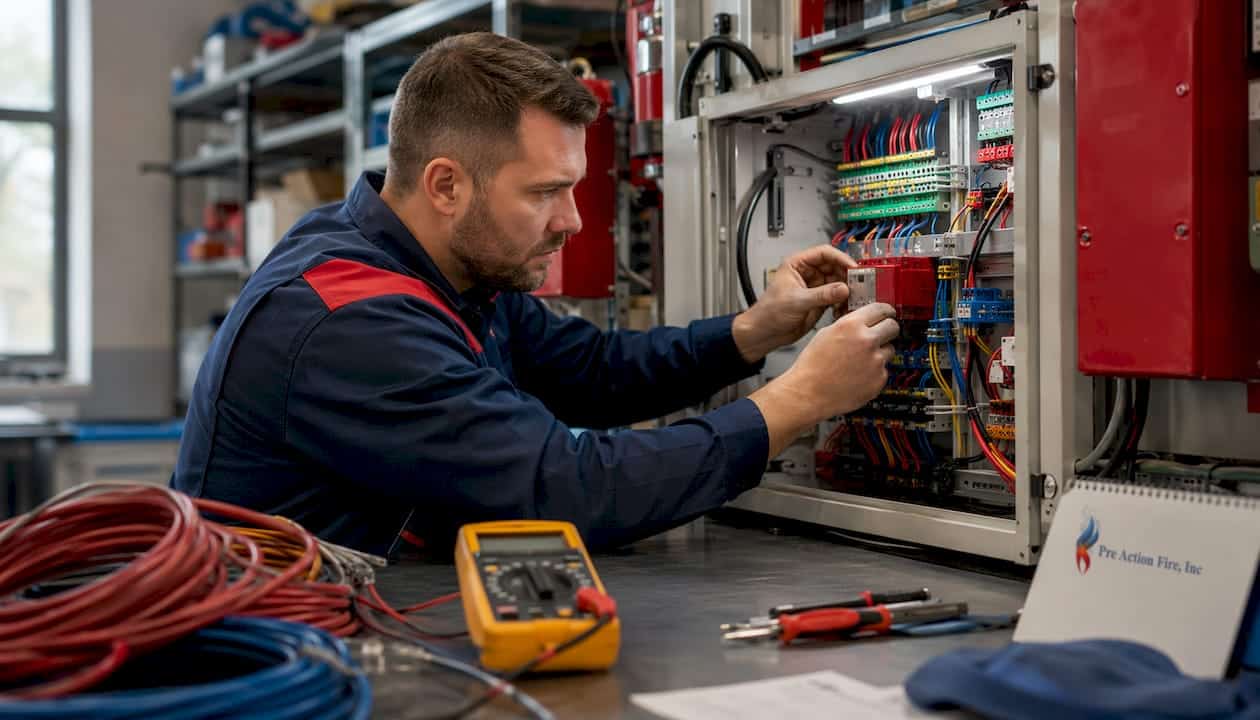
False alarm reduction: Addressable panels significantly reduce unwanted alarms through drift compensation (adjusting detector sensitivity as the sensing chamber ages) and coincidence detection (requiring two adjacent detectors to trigger before initiating a full alarm). In high-occupancy buildings, that difference translates directly into fewer evacuations and less disruption.
BMS integration over open protocols: Modern addressable panels expose their full event stream over BACnet/IP or Modbus, letting building management systems display real-time fire alarm graphics and execute cross-system automation. The CIE-A-400 supports this kind of integration natively, making it a practical choice for facilities with existing BMS infrastructure.
Custom user interface maps: Panels like the Fike SHP-PRO® support InfoAlarm-style displays with custom site maps showing device locations graphically. During an emergency, an operator sees exactly which detector triggered and where it sits in the building, without interpreting a device address list.
Commissioning complexity: Addressable system startup requires assigning every device a unique address and mapping it in the panel software. That process takes longer than wiring a conventional zone panel, but the downstream benefit — precise diagnostics, remote monitoring, and scalable expansion — justifies the investment for most commercial facilities.
Pro Tip: Design the panel’s custom site map before commissioning begins, not after. Mapping device locations to a floor plan during address assignment saves significant rework and makes the interface genuinely useful for first responders who have never seen the building.
Remote diagnostics from addressable panels improve operational efficiency particularly in large properties where walking every device location for a routine check is impractical.
How self-diagnostics and testing features keep systems reliable
A fire alarm system that fails silently is worse than no system at all. Modern panels address this through built-in self-diagnostic routines that run continuously in the background.
Addressable panels monitor every device on the loop for communication integrity. If a detector stops responding, the panel logs a trouble condition and identifies the exact device address — the kind of specificity that lets a NICET-certified technician go directly to the problem rather than tracing wire across a floor. Conventional panels flag a zone trouble but cannot narrow it further without a manual walk-down.
Battery supervision is another layer. The panel monitors charge voltage and load capacity, flagging a degraded battery before it fails the standby requirement. NFPA 72 mandates periodic battery load tests, and panels with automated battery diagnostics simplify that process considerably.
Walk-test modes let technicians activate individual devices and verify panel response without triggering a full alarm. The Fike FCP family and the CIE-A-200 both include walk-test functionality that logs each tested device, generating a record that satisfies inspection documentation requirements. Knowing which devices were tested, when, and by whom matters when an AHJ audits the system.
Fault alerts can route to a fire monitoring service so that off-hours troubles reach a technician immediately rather than sitting unnoticed until the next business day. That kind of continuous supervision is what separates a well-maintained system from one that passes inspection and then drifts toward failure.
Preactionfire brings expert fire panel service to the Denver Metro Area
Selecting the right panel architecture and getting it installed correctly are two different problems. Pre Action Fire has been solving both for Denver Metro commercial and industrial clients since 2009. The team holds NICET certifications and works across new construction and system upgrades, covering addressable and conventional panel installations, cause-and-effect programming, BMS integration, and ongoing inspection services.
Where a general contractor hands off fire alarm work to whoever is available, Preactionfire focuses exclusively on fire protection. That specialization shows up in the details: proper loop isolator placement, accurate device addressing, and custom site maps that actually help first responders. For Denver businesses that need fire alarm systems built for compliance and long-term reliability, contact Preactionfire directly for a consultation.
Key Takeaways
A fire control panel’s architecture — addressable versus conventional — determines the precision, scalability, and diagnostic depth of the entire fire alarm system.
| Point | Details |
|---|---|
| Addressable vs. conventional | Addressable panels identify each device individually; conventional panels report by zone only. |
| Device capacity | Addressable loops support up to 254 devices per loop with continuous polling. |
| False alarm management | Drift compensation and coincidence detection in addressable panels reduce unwanted alarms significantly. |
| Self-diagnostics | Addressable panels automatically report device faults; conventional systems require manual walk-downs. |
| Preactionfire | NICET-certified fire protection specialists serving Denver Metro with addressable and conventional panel installation, programming, and inspection. |