
Every fire alarm circuit in the United States runs on one of three power-limited cable types: FPL, FPLR, or FPLP, plus special variants like FPL-CI for circuit integrity and shielded constructions for noise-sensitive loops. FPLP is rated for plenums and ducts, FPLR for vertical risers, and FPL for general indoor runs. NEC Article 760 and the cable’s own jacket marking, not its color, determine where each one is legally allowed.
TL;DR:
- Using FPLP cable in plenum spaces is mandatory because it passes NFPA 262 and UL 910 tests, whereas FPL uses less demanding standards.
- Correctly identifying fire alarm cable type by jacket printing and UL marking is crucial to avoid code violations during inspection and ensure proper environmental classification.
- FPLP is suitable for plenums, FPLR for risers, and FPL for general indoor runs, with substitution only permitted downward from higher to lower ratings.
- Circuits must be classified as power-limited or non-power-limited based on panel specifications, as mixing these without proper separation causes frequent inspection failures.
- Proper installation practices, including separation, support, and firestopping, are critical, as many failures originate from support and separation violations rather than cable type inaccuracies.
Table of Contents
- Fire Alarm Wire Specifications by Type
- What NEC Article 760 Actually Requires
- Substitution Rules and How to Verify Cable Markings
- Choosing the Right Gauge and Shielding for Each Circuit
- Installation and Inspection Checklist for Fire Alarm Cable
- When You Need FPL-CI, Armored, or Outdoor Cable
- Field Notes: Common Mistakes We See on Denver Job Sites
- Why Cable Type Confusion Persists Even Among Experienced Crews
- Sources
Fire Alarm Wire Specifications by Type
Each fire alarm cable type earns its rating through a specific flame and smoke test, and that test dictates where the cable can legally run. Get the type wrong and you fail inspection, no matter how clean the installation looks.
**FPLP (plenum-rated) is at the top of the hierarchy. It has to pass NFPA 262 or UL 910, the Steiner tunnel test that measures flame spread and smoke production in air-handling spaces. Because plenums and ducts recirculate air throughout a building, a cable burning in that space can spread toxic smoke fast. FPLP jackets commonly use fluoropolymer materials like FEP or a similar low-smoke compound instead of standard PVC, which is why FPLP cable costs more per foot than the other two types. Conductor counts run anywhere from 2 to 22, with AWG sizes typically between 22 and 12 depending on the circuit.
FPLR (riser-rated) is built for vertical shafts that connect floors, stairwells, and elevator hoistways, where fire can travel upward unusually fast if the cable itself fuels it. FPLR has to pass UL 1666, a vertical-tray flame test designed specifically for riser applications. Most FPLR cable uses a standard PVC jacket, which keeps it more affordable than FPLP while still meeting the vertical spread requirements risers demand. You’ll see it most in multi-story commercial buildings where fire alarm wiring climbs between floors outside a plenum path.
FPL (general-purpose) covers everything else: horizontal indoor runs that aren’t in a plenum or a riser shaft. It references UL 1581 and UL 1424 test methods for wire and cable construction, and it’s the cable you’ll find in a majority of ordinary office, retail, and warehouse installations. FPL costs the least of the three, which is exactly why installers get tempted to overuse it where a riser or plenum rating is actually required.
Beyond the base three, a few variants solve specific problems:
- FPL-CI (circuit integrity) uses fire-resistant construction, often mica tape or ceramic-filled insulation, to keep circuits operating during an active fire for a rated survival window.
- Shielded fire alarm cable adds a foil or braid layer to block electromagnetic interference on sensitive addressable loops.
- Outdoor and water-resistant cables carry additional listings for direct burial or wet locations, since standard FPL, FPLR, and FPLP jackets aren’t rated for continuous moisture exposure.
Choosing among the types of fire alarm wiring available for a project comes down to matching the pathway environment to the test standard behind the cable, not to habit or whatever happens to be on the truck.
What NEC Article 760 Actually Requires
NEC Article 760 splits every fire alarm circuit into two categories, and which one applies changes your wiring method entirely. Get the classification wrong and the whole installation is technically non-compliant even if every cable is properly listed.
Power-limited fire alarm (PLFA) circuits are the norm in modern systems. They run at limited voltage and current, which is why listed FPL-type cable can be installed in most open, non-raceway locations without conduit. Non-power-limited fire alarm (NPLFA) circuits carry higher power and generally have to follow Chapter 3 raceway wiring methods, the same conduit and box rules that apply to standard branch circuits. You determine which classification applies by checking the fire alarm control panel’s circuit ratings, not by guessing based on the wire gauge.
That distinction matters most on the supply side. A power-limited source feeding a load-side FPL cable run is straightforward. But if a legacy panel or a retrofit introduces an NPLFA circuit into a system built around PLFA wiring, mixing the two without proper isolation or raceway protection is one of the fastest ways to fail a final acceptance test.
Article 760 also spells out baseline obligations that apply regardless of which classification you’re working with:
- Cable must be listed and marked for its intended installation environment.
- Conductors need a minimum temperature rating, generally not less than 60°C.
- PLFA conductors must stay separated from electric light, power, Class 1, and NPLFA conductors unless a raceway or approved barrier protects them.
- Voltage ratings on the cable must match or exceed the circuit’s operating voltage.
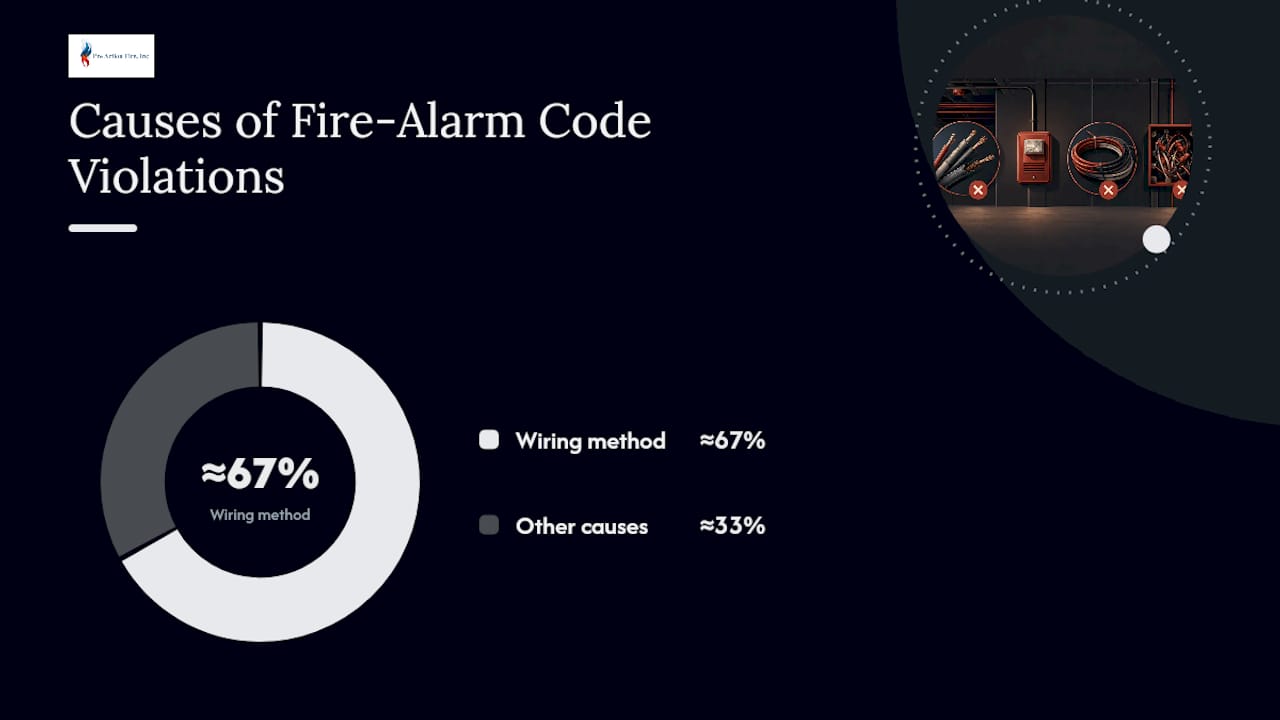
Roughly two-thirds of the fire alarm code violations inspectors flag in the field trace back to wiring-method confusion between PLFA and NPLFA circuits rather than a bad cable choice, which tells you the classification step deserves more attention than most crews give it.
Substitution Rules and How to Verify Cable Markings
The substitution hierarchy runs one direction only: FPLP can substitute for FPLR or FPL, FPLR can substitute for FPL, but FPL can never substitute for FPLR or FPLP. A plenum space demands FPLP, full stop. Using FPL there because it’s what’s on hand is a code violation, not a shortcut.
The logic ties directly back to the test standards each rating has to pass:
- FPLP meets NFPA 262 / UL 910 for plenum and duct spaces.
- FPLR meets UL 1666 for vertical riser shafts.
- FPL meets UL 1581 / UL 1424 baseline construction and flame tests for general-purpose runs.
Because each higher rating passes a more demanding test, it automatically satisfies the requirements of every rating below it. The reverse isn’t true, which is why the substitution rule only flows downward.
Verifying compliance on delivery takes a few minutes and saves a failed inspection later. Run this checklist every time cable arrives on site:
- Read the jacket print, not the color. Look for the actual “FPL,” “FPLR,” or “FPLP” designation stamped along the cable length.
- Confirm the UL listing mark appears next to the cable type designation.
- Match the marked rating against the installation environment on your plan set, plenum, riser, or general.
- Check AWG and conductor count against the panel manufacturer’s wiring specifications.
- Keep a sample tag or cut-off from each reel for the inspector’s reference during final walk-through.
A quick reference on what a UL listed device actually certifies helps clarify what that mark is guaranteeing before you sign off on a delivery.
Choosing the Right Gauge and Shielding for Each Circuit
Cable selection isn’t one-size-fits-all across a fire alarm system. Initiating device loops, notification circuits, and audio paths each have their own electrical demands, and picking the wrong gauge or skipping shielding causes nuisance faults long after the inspector has left.
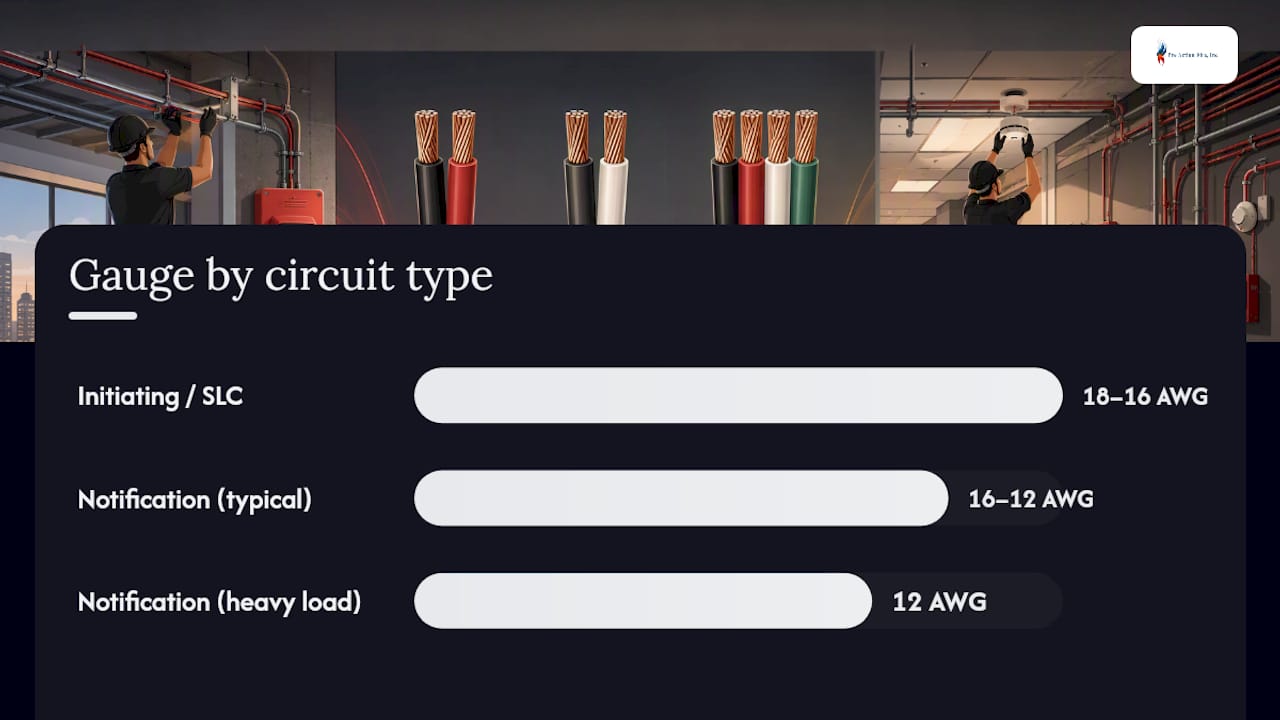
- Initiating device circuits and addressable SLC loops typically use 18 to 16 AWG conductors. These loops carry low current but are sensitive to voltage drop over long runs, so gauge selection depends heavily on total loop length.
- Notification appliance circuits (NAC), which power horns, strobes, and speakers, generally call for 16 to 12 AWG depending on the current draw and distance from the panel. Heavier notification loads with multiple devices on one circuit often push toward the 12 AWG end.
- Audio and digital audio loops for voice evacuation systems need tighter impedance control, often specified as 100-ohm differential pairs, along with lower capacitance to preserve signal quality over distance.
Shielding matters most on addressable SLC loops running near variable-frequency drives, elevator equipment, or other electromagnetic interference sources, and on any audio loop where signal integrity is critical. Unshielded cable in those conditions picks up noise that a panel reads as a fault even when every device on the loop is functioning normally.
Pro Tip: When a run is close to your panel’s maximum loop distance, check the manufacturer’s capacitance and DC resistance specs before you pull cable, not after. A loop that tests fine at 500 feet on paper can still generate ground faults if the actual cable’s capacitance runs higher than the panel’s tolerance.
Installation and Inspection Checklist for Fire Alarm Cable
Passing final inspection comes down to details that have nothing to do with the cable’s rating and everything to do with how it’s installed. Support spacing, separation, and firestopping cause more callbacks than wrong cable types do.
- Support fire alarm cable at intervals specified by the manufacturer and local code, using metal or listed non-combustible fasteners; avoid plastic-only fasteners in plenum and riser spaces where they’re prohibited.
- Keep PLFA conductors separated from power, Class 1, and NPLFA conductors unless a raceway or approved barrier protects them, a rule installers skip more often than any other in Article 760.
- Respect the cable manufacturer’s minimum bend radius, generally four to eight times the cable’s outer diameter, to avoid conductor damage inside the jacket.
- Firestop every penetration through a fire-rated wall or floor assembly with a listed system rated for that specific wall type and cable count.
- Label cable runs at junction points and panels so future technicians and inspectors can trace circuits without guessing.
- Remove abandoned cable rather than leaving it in place, a requirement under NEC 760 that gets overlooked during system upgrades and retrofits.
A facility manager’s guide to fire alarm device placement covers how routing decisions upstream affect these support and separation requirements downstream. Roughly a third of failed final inspections nationally come down to separation or support violations rather than device or wiring defects, which is why these checklist items deserve the same attention as the cable specification itself. Property managers coordinating multiple contractors on a single project may also find compliance-focused resources for facility operations useful for tracking these requirements across a portfolio.
When You Need FPL-CI, Armored, or Outdoor Cable
Standard FPL, FPLR, and FPLP cover the overwhelming majority of fire alarm installations, but a handful of applications demand something tougher. Fire pump controllers, elevator recall circuits, and any life-safety pathway required to keep functioning during an active fire fall into this category.
FPL-CI (circuit integrity) cable uses fire-resistant construction, commonly mica tape wrapping or ceramic-filled insulation, engineered to keep the circuit operating for a rated survival window, often one to two hours. That survivability rating has to be checked against your specific AHJ’s requirements and the cable’s own listing documentation, since not every FPL-CI product carries the same rated duration.
Armored or MC-style cable adds a metal-clad layer for mechanical protection in areas prone to physical damage, at the cost of a larger bend radius and higher material cost. Mineral-insulated cable goes further, using magnesium oxide insulation inside a copper sheath, delivering the highest survivability but at a significant cost and installation complexity premium over standard constructions.
Outdoor and direct-burial applications need cable specifically listed for that use. A standard FPL or FPLR jacket isn’t built for continuous ground or moisture exposure, and using one outdoors voids the listing entirely regardless of how well the installation otherwise looks.
Field Notes: Common Mistakes We See on Denver Job Sites
A number of companies have been installing and inspecting fire alarm systems in the Denver Metro Area since 2009, and the same handful of mistakes show up on job sites again and again. Our NICET-certified technicians see crews rely on jacket color instead of checking the printed listing, mix PLFA and NPLFA wiring methods during panel retrofits, and pull FPL cable into plenum spaces because it happened to be on the truck that day.
Wrong AWG selection on NAC and SLC circuits is another repeat offender, especially on retrofits where the new notification load exceeds what the original wiring was sized for. When a run needs circuit integrity protection, when a listing on delivered cable looks ambiguous, or when a system is approaching final acceptance testing, that’s the point to bring in a licensed installer or loop in the AHJ directly rather than guess. A code-compliant installation approach built around verified listings from day one avoids most of these callbacks entirely.
Why Cable Type Confusion Persists Even Among Experienced Crews
The conventional advice on fire alarm cable treats it as a simple lookup: match the rating to the space, done. That’s technically correct and still manages to miss what actually causes violations in the field. Most crews know the plenum-riser-general distinction cold. What trips them up is the boundary cases, retrofit projects where an old NPLFA circuit shares a chase with new PLFA wiring, or a ceiling plenum that only becomes a plenum once the drop ceiling goes in during a later phase of construction.
The substitution hierarchy gets treated as a safety net more than a rule, and that’s backwards. Pulling FPLP everywhere “to be safe” costs real money across a large project and isn’t actually necessary outside plenum and duct spaces. The better habit is classifying the pathway correctly before ordering cable, not after.
If there’s one thing worth prioritizing above gauge charts and jacket colors, it’s this: verify the listing on every reel against the installation environment before pulling a single foot. That single habit prevents more failed inspections than any spec sheet.
— Results
Sources
The code text and test standards behind every cable type live in a handful of primary documents worth keeping on hand for any installation or inspection project.
- Fire alarm cable guide (Ramcorp)
- Fire Cable Explained (Winnie Industries)
- Fire alarm systems (Mike Holt technical guide)
Get compliant fire alarm system design and installation from a Denver-based team that lives in NEC Article 760 every day. Request a consultation for fire alarm system design and compliance and get your cable specifications right before the first reel gets pulled.