
Commercial fire alarm backup batteries need professional replacement and load testing, not a homeowner’s swap of a 9-volt cell. Certified technicians must verify capacity against NFPA 72’s standby and alarm duration requirements before returning a panel to service. NICET-certified providers handle this as a documented, load-tested procedure. That documentation, not just a fresh battery, is key to compliance.
TL;DR:
- Fire alarm backup batteries must undergo load testing by certified technicians to verify they meet NFPA 72’s duration requirements before the panel is returned to service.
- Immediate replacement is necessary for batteries showing visible damage, past their manufacturer’s lifespan, or failing load tests with capacity below 80 percent.
- Proper battery replacement involves disconnecting batteries in the correct order, matching voltage and capacity, and documenting load test results for compliance.
- Sealed lead-acid batteries cost between $200 and $500, last three to five years, and require hazardous waste recycling, while lithium-ion options last longer but are more expensive.
- NFPA 72 mandates monthly visual inspections, annual load testing, and detailed record-keeping, with expert intervention required for capacity drops below standards or visible defects.
Table of Contents
- When Do You Need Fire Alarm Battery Replacement?
- How Does a Technician Replace and Test Fire Alarm Batteries?
- What Battery Types, Lifespans, and Costs Should You Budget For?
- What Records Does NFPA 72 Require for Battery Maintenance?
- When Should You Call a Certified Fire Alarm Technician?
- How Pre Action Fire Approaches Battery Maintenance
- Schedule Professional Battery Replacement and Load Testing
- Sources
When Do You Need Fire Alarm Battery Replacement?
Some situations demand a call to a licensed technician immediately, and others fit into your normal maintenance calendar. Knowing which is which keeps a minor issue from becoming an out-of-service panel.
Here’s a working priority order for facility teams:
- Panel trouble signal active. A low-battery or “trouble” LED on the fire alarm control panel indicates the system may be running outside the required backup capacity. Schedule service within days, not weeks.
- Visible battery damage. Bulging, leaking, or corroded terminals on a sealed lead-acid battery are hazards on their own, separate from any alarm function. Isolate and replace immediately.
- Battery past manufacturer life expectancy. Most sealed lead-acid units are rated several years; once past the typical lifespan, treat replacement as due even without a fault signal.
- Failed annual load test. If a technician’s load test shows capacity below 80% of rated amp-hours, the battery gets replaced that visit, not scheduled for later.
Before any hands-on work, notify your monitoring station so a service disconnect doesn’t trigger a false dispatch, and loop in maintenance staff so nobody re-arms the panel mid-service.
Budget-wise, expect a per-battery cost in the low hundreds of dollars for standard sealed lead-acid units, plus labor and an annual load-test fee, as covered in the cost breakdown below. Order replacements two to three weeks ahead of the scheduled swap. Lead times on specific amp-hour ratings can stretch longer during high-demand seasons, and a panel sitting on a degraded battery is not a place to gamble on rush shipping.
How Does a Technician Replace and Test Fire Alarm Batteries?
The actual swap takes minutes. Everything around it, the checks before and the verification after, is what separates a compliant replacement from a battery that merely looks new.
- Review records first. A technician pulls the logbook to check manufacture dates and the results of the prior load test before touching the panel. This tells them whether they’re dealing with a scheduled replacement or a battery that failed early.
- Notify the monitoring station. The alarm gets placed on test status so the swap doesn’t generate a false dispatch to the fire department.
- Remove the old batteries safely. Sealed lead-acid units get disconnected in the correct order, negative terminal first, to avoid arcing, and handled as hazardous waste from that point forward.
- Install matched replacements. Voltage, amp-hour rating, and terminal type all need to match the panel’s charging circuit specifications. A battery with lower amp-hours than the original can quietly shrink your standby window below the required 24 hours.
- Run the load test. The technician simulates a power loss, measures voltage under load, and confirms the battery holds at least 80% of rated capacity through a simulated alarm run, following the calculation method NFPA outlines for required amp-hours at a given standby duration.
- Reset and document. The panel gets reset, trouble signals clear, and the technician leaves a written report with voltage and load numbers, entered into the building’s ITM logbook.
Annual load testing catches what a visual check never will. A battery can look fine and still have degraded internal capacity that only shows up under simulated load, which is why a voltage reading alone isn’t an acceptable substitute for a load test.
Pro Tip: Ask your vendor for the actual voltage and amp-hour figures on the test report, not just a pass/fail checkmark. Numbers on paper are what an inspector wants to see, and what you want on file if a warranty dispute comes up later.
What Battery Types, Lifespans, and Costs Should You Budget For?
Two battery chemistries dominate commercial fire alarm panels, and picking wrong on capacity is the most common sizing mistake facility teams make.
- Sealed lead-acid (SLA/VRLA): the standard choice, typically rated for 3 to 5 years, cheaper upfront, but sensitive to heat. A mechanical room, kitchen, or server closet running hot can shave a year or more off that lifespan.
- Lithium-ion: a longer-lived option, often rated 5 to 10 years, with better performance in temperature swings, at a meaningfully higher unit cost.
- Amp-hour matching: the replacement battery’s amp-hour rating needs to meet or exceed the original spec calculated for your system’s total connected load, because undersizing quietly erodes your 24-hour standby margin even when the panel reports normal.
- Charger compatibility: a lithium-ion swap into a charging circuit designed for lead-acid can undercharge or overcharge the battery, so confirm compatibility before switching chemistries.
On cost, industry estimates put sealed lead-acid units at roughly $200 to $500 per battery, with lithium-ion running $400 to $1,000 or more. Labor typically adds $100 to $300, and an annual load test runs $50 to $150 separately. A mid-size commercial building replacing a full battery set, with testing included, often lands in the $500 to $2,000 range for the full cycle.
Disposal isn’t optional paperwork. Lead-acid batteries are hazardous waste and require recycling through a certified handler rather than a dumpster. Reputable fire protection vendors fold this into the service call, so ask upfront whether disposal is included in the quoted price.

What Records Does NFPA 72 Require for Battery Maintenance?
Inspectors don’t just check that the panel is quiet. They ask for paper. NFPA 72 sets both the testing cadence and the documentation trail an authority having jurisdiction expects to see on a walk-through.
- Monthly visual inspections to catch corrosion, swelling, or loose connections before they become failures.
- Annual load testing that measures actual capacity under simulated alarm conditions, not just a resting voltage check.
- Manufacture date marking on every battery, logged separately from the installation date, since a battery’s clock starts when it’s made.
- Written test reports retained in the building’s ITM logbook, including voltage readings, load parameters, and the technician’s name and certification number.
- Retained records available on demand, since most jurisdictions expect several years of ITM history at inspection time, not just the most recent report.
A practical scheduling habit: set a calendar reminder tied to each battery’s manufacture date, not its installation date, and order replacements before the reminder fires. Buildings with a backup generator should coordinate battery testing with generator transfer tests, since the standby requirement drops to 4 hours when a generator is present, versus 24 hours on batteries alone.
When Should You Call a Certified Fire Alarm Technician?
Some battery issues are a same-day parts swap. Others mean your system is technically out of compliance until a qualified person intervenes.
- A failed load test. Once capacity drops below the acceptance threshold, the panel is running on borrowed time until it’s replaced and retested.
- Visible battery defects. Bulging, leaking, or corrosion at the terminals isn’t a wait-and-see item.
- No qualified staff on-site. If nobody on your maintenance team holds the training to interpret panel diagnostics or run a load test correctly, that’s the moment to bring in outside help rather than guess.
When vetting a vendor, ask directly: Are your technicians NICET-certified? Will I get a written report with actual voltage and load numbers? How is battery disposal handled? A vendor who can’t answer all three clearly isn’t ready for your compliance file.
Pro Tip: Keep a copy of every load test report for at least three inspection cycles. A one-time bad report from years ago means little; a pattern of declining capacity readings tells you a battery brand or a hot mechanical room is chronically underperforming.
How Pre Action Fire Approaches Battery Maintenance
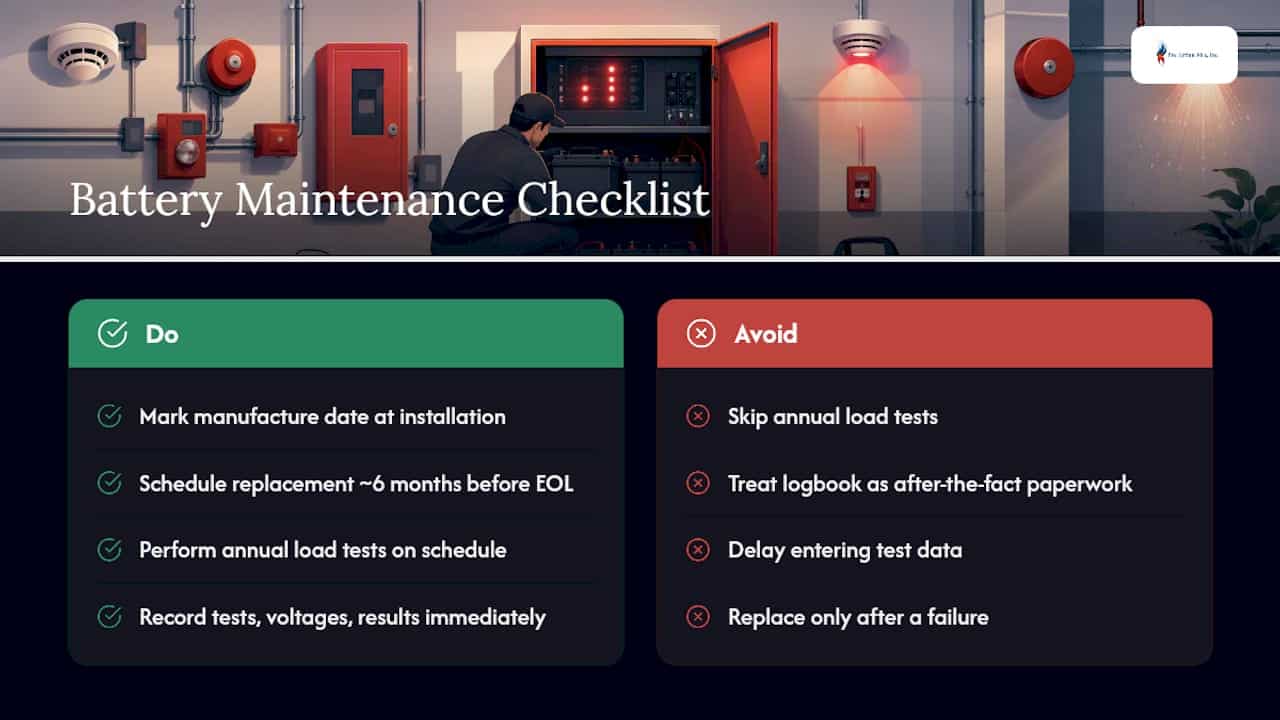
The pattern observed across commercial buildings is consistent: batteries that fail early almost always trace back to skipped annual load tests, not bad luck. Marking manufacture dates the moment a battery goes in, and scheduling replacement roughly six months before its expected end-of-life, turns an emergency call into a planned line item.
The teams that stay out of compliance trouble treat the logbook as a working tool, not paperwork filed after the fact. Every test report, voltage figure, and load result goes in immediately, because an inspector asking for three years of history shouldn’t send anyone scrambling through email attachments.
— Results
Schedule Professional Battery Replacement and Load Testing
Professional providers handle battery replacement, annual load testing, and NFPA ITM documentation as part of one visit, not three separate calls. A service appointment includes written voltage and load test results, a full panel verification, and hazardous battery disposal handled by the technician on-site, so nothing gets left for you to arrange separately.
If you manage scheduling across multiple properties, a platform like Equiptrack’s maintenance compliance tools can help keep test dates and documentation organized between vendor visits.
Denver-area facility managers can review Pre Action Fire’s fire alarm system services for full design and compliance details, or request a site visit directly to get a written estimate for battery replacement and load testing before your next scheduled inspection window closes in.
Sources
- Fire Alarm Systems and Loss of Power | NFPA
- Fire Alarm Panel Battery Guide | Life Safety Consultants
- Fire alarm system reliability and battery health – Kord Fire Protection