
TL;DR:
- Fire alarm systems detect fire or smoke, warn occupants, and alert emergency responders based on four key elements. Building owners must ensure system design and maintenance comply with NFPA 72, NFPA 101, and local authorities, using licensed contractors with NICET-certified technicians. Proper integration, regular inspections, and adherence to code updates like cybersecurity requirements are essential for reliable life safety performance.
A fire alarm system is a building life-safety system that detects fire or smoke, warns occupants, and — when required — alerts emergency responders. Every commercial fire alarm system is built from four functional elements: initiating devices, the Fire Alarm Control Panel (FACP), notification appliances, and power supplies including battery backup. Get those four elements right, and you have a system that performs when it counts.
TL;DR: Building owners and facility managers are legally responsible for designing, installing, and maintaining fire alarm systems that comply with NFPA 72, NFPA 101, and the requirements of their local Authority Having Jurisdiction (AHJ). A licensed contractor with NICET-certified technicians is the right starting point for any new system, upgrade, or inspection.
Key things to know before you read further:
- NFPA 72 governs design, installation, testing, and documentation in the U.S.
- Addressable systems identify the exact device that triggered; conventional systems identify only a zone.
- Battery backup is mandatory and must be labeled with the manufacture date per NFPA 72.
- Annual inspections by qualified technicians are the baseline requirement for most commercial buildings.
- The 2025 edition of NFPA 72 added cybersecurity requirements for network-connected equipment.
Table of Contents
- How a fire alarm system is designed: objectives and functional elements
- What are the main components of a fire alarm system?
- Which detector type is right for your building?
- How fire alarm systems signal: alarm, supervisory, and trouble
- Power supplies, battery backup, and pathway survivability
- What U.S. codes and standards govern fire alarm systems?
- Installation, inspection, and testing: who does what and how often
- How fire alarm systems integrate with sprinklers, smoke control, and elevators
- Residential vs. commercial fire alarm systems: what’s the real difference?
- How to choose, procure, or upgrade a fire alarm system
- Common signs of malfunction and when to call a professional
- Key Takeaways
- Why integrated design matters more than most owners realize
- Preactionfire serves Denver-area buildings with full-service fire alarm solutions
- Useful sources and further reading
How a fire alarm system is designed: objectives and functional elements
Every system starts with three non-negotiable objectives: protect life, protect property, and comply with applicable codes. Those objectives map directly onto the four functional elements, and understanding that mapping is what separates a well-designed system from one that just passes inspection.
Life safety is the primary driver. The system must detect a fire condition early enough to give occupants time to evacuate, which means initiating devices need to be placed and selected based on the expected fire modes in each space. Property protection is secondary but still shapes decisions about detector sensitivity and monitoring. Code compliance sets the floor: NFPA 72 and NFPA 101 define minimum requirements, and the AHJ enforces them.
The signal flow in any system follows a simple path: an initiating device senses a condition and sends a signal to the FACP, which processes it and activates the appropriate outputs — notification appliances, relay modules, and monitoring transmitters. That flow sounds straightforward, but the design decisions at each step have real consequences for reliability, maintainability, and cost.
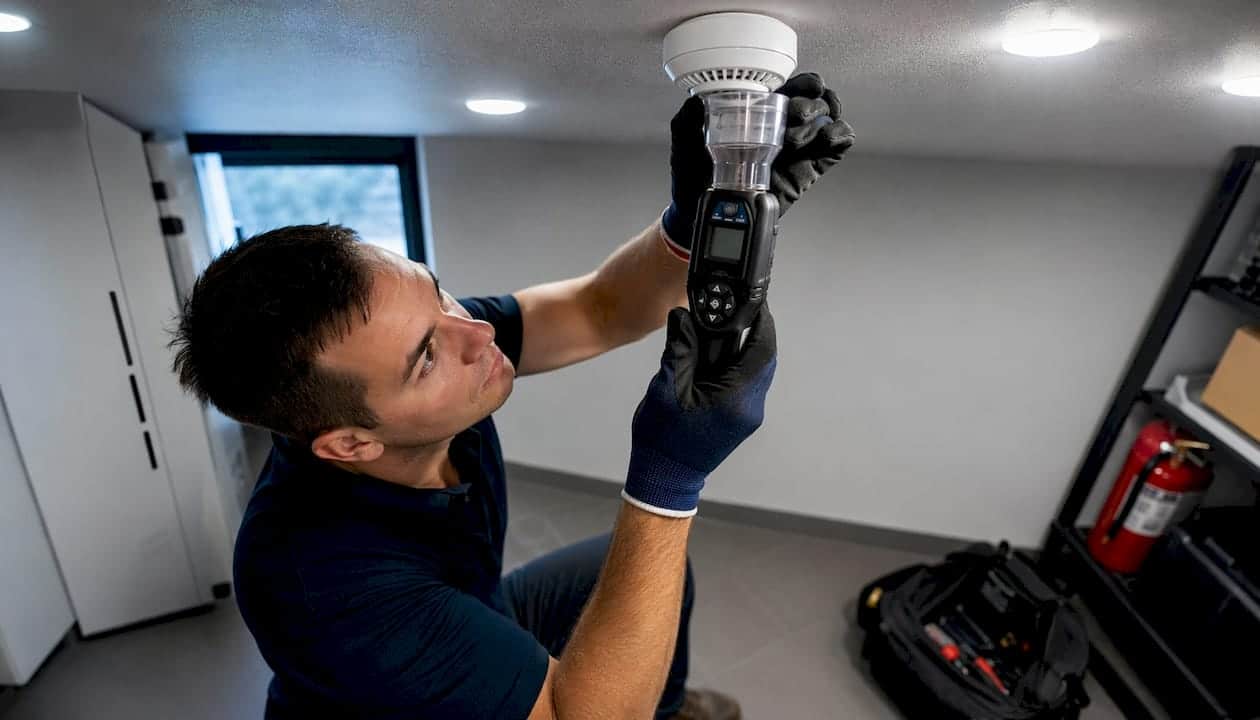
Wiring topology is one of the first design choices. Conventional IDC vs. addressable SLC is not just a technical preference — it determines how fast your team can locate a fault, how much labor a service call takes, and whether your panel can grow with the building.
Pro Tip: In a building with multiple floors or complex occupancy zones, an addressable SLC pays for itself in reduced maintenance time. A conventional IDC might cost less upfront, but every fault becomes a zone-wide hunt. For a single-story retail space, conventional may be perfectly adequate.
What are the main components of a fire alarm system?
Understanding what each component does — and what it requires — helps owners ask better questions during design reviews and catch problems during inspections.
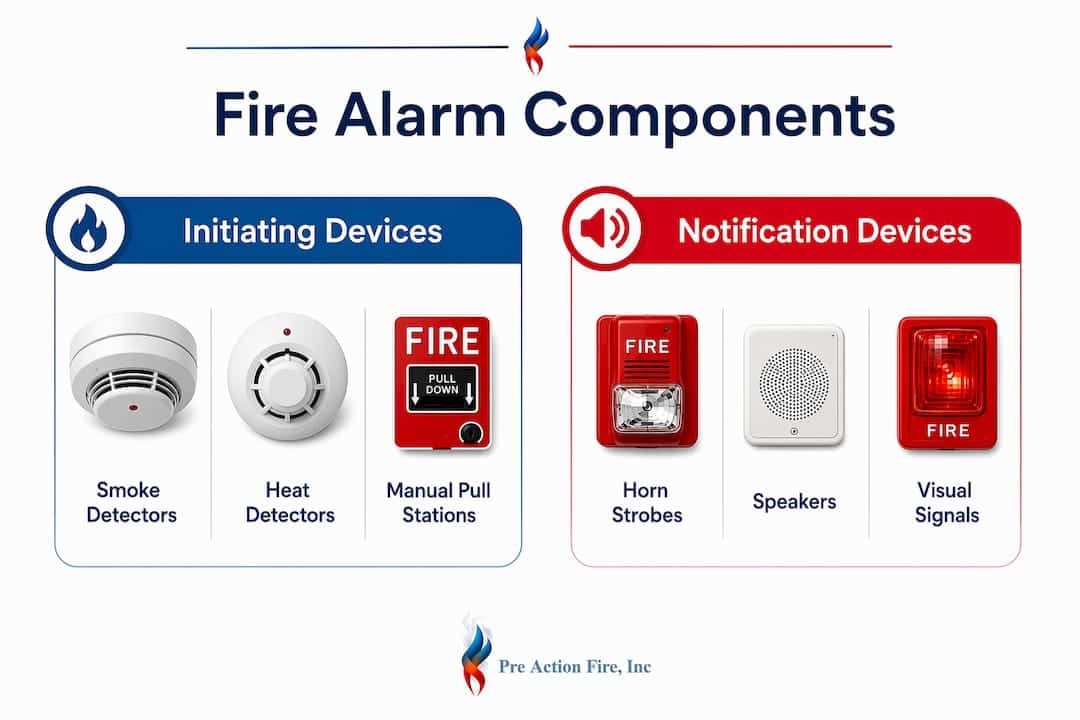
Initiating devices
These are the sensors and manual devices that start the signal chain. The main categories:
- Manual pull stations: Wall-mounted, typically red, placed at exits and stairwells. Required at specific locations per NFPA 72 and must be listed for the application.
- Smoke detectors: Ceiling-mounted devices using photoelectric, ionization, or multi-sensor technology. Listing under UL 268 is the standard for commercial applications.
- Heat detectors: Fixed-temperature or rate-of-rise types. Used in spaces where smoke detectors would produce false alarms (dusty environments, kitchens, garages).
- Waterflow switches: Installed on sprinkler system piping; signal the FACP when water flows through the system, indicating a sprinkler has activated.
- Supervisory devices: Monitor the status of sprinkler control valves, pressure, and tamper conditions. They generate supervisory signals, not alarm signals.
All initiating devices must be listed for their intended application. A device listed for clean office environments is not automatically suitable for a parking garage or commercial kitchen.
Fire Alarm Control Panel (FACP) and annunciation
The FACP is the brain. It receives signals from initiating devices, processes them, and activates outputs. For large buildings, a remote annunciator or Graphic Annunciator Panel (GAP) is often installed near the main entrance so responding firefighters can immediately see which zone or device triggered. Addressable panels display the specific device address; conventional panels show only the zone.
Panel capacity matters at design time. A panel sized for 50 devices cannot grow to 200 without replacement. Specifying adequate SLC capacity and expansion slots upfront avoids a costly panel swap during the next renovation.
Notification appliances
The devices that tell occupants to act. Three main types:
- Horns and horn/strobes: The most common combination. Strobes must meet minimum candela ratings per NFPA 72 for spaces requiring visible notification.
- Speakers (voice evacuation): Required in high-rise buildings and many assembly occupancies. They deliver pre-recorded or live voice messages and must meet intelligibility standards.
- Low-frequency sounders: Required in sleeping areas per NFPA 72 for new construction; the 520 Hz square wave signal wakes sleeping occupants more reliably than standard high-frequency tones.
Notification Appliance Circuits (NACs) carry power and supervision to these devices. NAC extenders are used when the panel’s built-in NAC capacity is insufficient for the building’s device count. For Denver-area compliance specifics on device selection, notification appliance requirements vary by occupancy and AHJ.
Auxiliary devices and interfaces
| Device | Function | Key Spec Note |
|---|---|---|
| Duct smoke detectors | Detect smoke in HVAC ductwork; shut down air handlers | Must be listed for duct use; duct sensor placement affects HVAC integration |
| Relay/control modules | Interface with elevators, door holders, dampers | Must be supervised; output verified during acceptance testing |
| NAC extenders | Boost NAC capacity for large buildings | Must be compatible with panel listing |
| Remote annunciators | Display alarm/trouble status at secondary locations | Required in many high-rise and complex occupancy buildings |
Typical NAC voltage runs at 24VDC. Strobe candela ratings range from 15 cd to 110 cd depending on room size and placement height. Speaker sound pressure levels (SPL) must meet intelligibility requirements per NFPA 72 Chapter 18.
Which detector type is right for your building?
Detector selection is primarily about matching the detection principle to the expected fire mode and the environment. A detector that performs well in a clean office can be a chronic false-alarm source in a woodworking shop. Getting this right at design time prevents years of nuisance calls and potential code violations.
| Detector Type | Detection Principle | Best-Use Scenarios | Common False-Alarm Causes |
|---|---|---|---|
| Photoelectric smoke | Light-scattering by smoke particles | Smoldering fires, corridors, sleeping areas | Steam, dust, insects |
| Ionization smoke | Ion current disruption by combustion particles | Fast-flaming fires, clean spaces | Cooking aerosols, steam |
| Fixed-temperature heat | Bimetallic element or fusible link at set temp | Kitchens, garages, dusty/dirty environments | None (slow to respond to smoldering) |
| Rate-of-rise heat | Rapid temperature increase detection | Boiler rooms, attics | Rapid HVAC temperature changes |
| Multi-sensor | Combines smoke + heat or CO signals | General commercial, near kitchens | Reduced vs. single-sensor; varies by algorithm |
| Aspirating smoke (ASD) | Air drawn to central detection chamber | Data centers, clean rooms, early-warning critical spaces | Contaminated air samples if poorly maintained |
| Linear beam | Light beam across large open space | Warehouses, atriums, high-bay spaces | Beam obstruction, vibration |
| Carbon monoxide (CO) | Electrochemical cell detects CO gas | Attached garages, mechanical rooms, sleeping areas | High CO from nearby combustion sources |
Device listing requirements under UL 217 and UL 268 now include nuisance-resistance testing, which directly affects where certain detectors can be placed. A detector listed for resistance to cooking nuisance sources can be installed closer to a kitchen than a standard unit — but that listing must be verified, not assumed.
Placement rules under NFPA 72 set maximum spacing between detectors (typically 30-foot radius for spot-type smoke detectors on smooth ceilings), but local conditions often require tighter spacing. For practical placement guidance for facility managers, spacing near HVAC supply registers and obstructions requires additional attention.
Pro Tip: Multi-sensor detectors reduce false alarms in mixed-use spaces, but aspirating systems are the right call for server rooms and archives where early warning matters more than cost. An aspirating detector can sense smoke at concentrations far below what a spot detector would register.
How fire alarm systems signal: alarm, supervisory, and trouble
Three distinct signal types come out of a fire alarm system, and confusing them leads to bad decisions during an event.
An alarm signal means a fire condition has been detected or manually initiated. It requires immediate evacuation and emergency response. An supervisory signal means a monitored condition is off-normal — a sprinkler valve is closed, a pressure is low — but no fire has been detected. It requires investigation, not evacuation. A trouble signal means the system itself has a fault: a broken wire, a missing device, a low battery. It requires service, not evacuation.
Conventional vs. addressable topologies
In a conventional system, initiating devices are wired in zones on Initiating Device Circuits (IDC). When a device activates, the panel knows which zone triggered but not which specific device. Locating the exact device requires a physical walk of the zone. This works fine for small buildings with simple layouts, but in a 10-story office building, a zone-level fault can mean searching dozens of devices.
In an addressable system, devices communicate over a Signaling Line Circuit (SLC). Each device has a unique address, and the panel displays exactly which device triggered. Maintenance time drops significantly, and false-alarm investigations become faster. The IDC vs. SLC tradeoff is fundamentally a question of how much you value diagnostic speed versus upfront installation cost.
Quick glossary:
- IDC: Initiating Device Circuit — conventional zone wiring
- SLC: Signaling Line Circuit — addressable device loop
- NAC: Notification Appliance Circuit — powers horns, strobes, speakers
- MAP: Master Alarm Panel — sometimes used for large multi-building campuses
- Annunciator: Remote display showing alarm/zone/device status
Operational checks to verify each signal type during testing:
- Confirm alarm signal activates all NAC devices and transmits to monitoring station
- Confirm supervisory signal activates supervisory indicator without triggering evacuation
- Confirm trouble signal activates trouble indicator and audible trouble tone at panel
- Verify each signal type is logged in the panel event history with correct timestamp
- Confirm monitoring station receives and correctly categorizes each signal type
For buildings that rely on off-site monitoring, fire monitoring service advantages include faster emergency dispatch and documented signal receipt — both of which matter during AHJ inspections.
Power supplies, battery backup, and pathway survivability
Primary power for a fire alarm system comes from a dedicated AC circuit, typically 120VAC. Secondary power — the battery backup — must be capable of sustaining the system for a minimum period defined by NFPA 72: generally 24 hours in standby followed by 5 minutes in full alarm for most commercial applications, though specific occupancies and monitoring configurations may require longer durations.
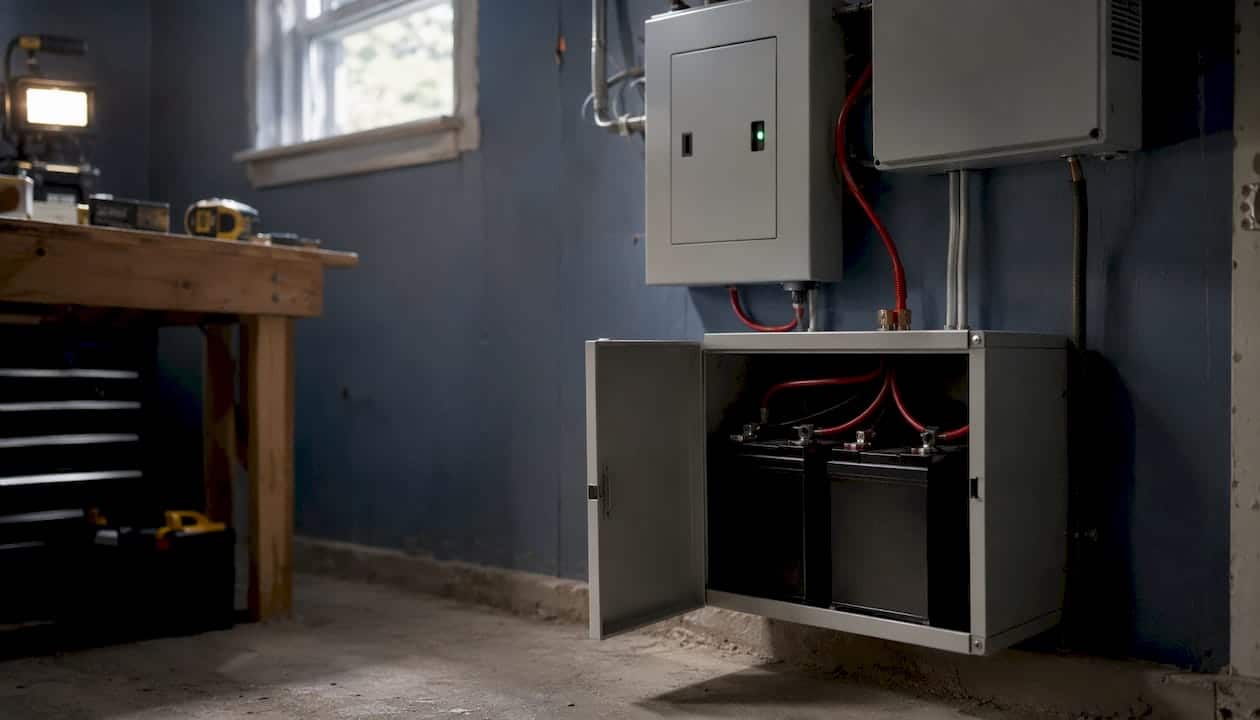
Generators can serve as secondary power in some configurations, but NFPA 72 sets strict requirements for transfer time and generator supervision. A generator alone does not eliminate the battery requirement.
Battery basics
NFPA 72 Section 10.6.10 requires that stored backup batteries be labeled with their manufacturing date. This is not a suggestion — it is a code requirement, and inspectors check it. Sealed lead-acid batteries typically have a service life of 3–5 years; nickel-cadmium batteries last longer but require different maintenance. Visual inspection alone cannot confirm a battery is functional. A battery that looks fine can fail under load during a power outage.
Battery replacement triggers:
- Battery has reached the manufacturer’s stated service life
- Manufacture date label is missing or illegible
- Battery fails load testing during annual inspection
- System records repeated low-battery trouble signals
Pathway survivability
Chapter 7 of NFPA 72 defines pathway survivability levels, which describe how well wiring can survive a fire event. Class A wiring (loop topology) continues to function even if one segment is damaged. Class B wiring (open-style) loses the devices beyond a break. Higher survivability levels require fire-rated cable or conduit in specific locations.
For most commercial buildings, the AHJ and the designer determine the required survivability level during the design review. Buildings with high occupant loads or complex egress paths typically require higher survivability designations.
Pro Tip: When batteries are replaced, photograph the new battery label and log the date in your maintenance records. An inspector who cannot verify the manufacture date will flag it as a deficiency — and a deficiency on a battery is one of the easiest to prevent.
What U.S. codes and standards govern fire alarm systems?
Two documents form the backbone of fire alarm regulation in the United States.
NFPA 72, the National Fire Alarm and Signaling Code, sets requirements for design, installation, operation, inspection, testing, and documentation. It covers everything from device listing requirements to battery labeling to the specific test methods technicians must use. NFPA 101, the Life Safety Code, ties fire alarm requirements to occupancy classification and means of egress. NFPA 101 references NFPA 72 for alarm specifics and NFPA 25 for sprinkler maintenance — the two codes work together, not independently.
All devices installed in a listed system must be UL-listed and compatible with the listed panel. Mixing devices from different manufacturers without verified compatibility is a code violation and a liability risk.
The AHJ’s role
The Authority Having Jurisdiction is the local official — typically a fire marshal or building department — who enforces the adopted edition of NFPA 72 in your jurisdiction. Not every jurisdiction has adopted the same edition. Some Colorado jurisdictions still enforce the 2016 or 2019 edition; others have moved to 2022. The AHJ reviews design documents, issues permits, and conducts acceptance inspections. Their approval is required before a new or modified system can be placed in service.
For NFPA rules that affect facility managers, the adopted edition in your jurisdiction determines which requirements apply to your building.
Documentation to maintain
- Approved design drawings and specifications
- Acceptance test report (signed by the installing contractor and AHJ)
- Battery manufacture date labels and replacement log
- Inspection and testing records (NFPA 72 requires specific forms)
- Any AHJ-issued variances or special conditions
Recent code changes that should trigger a system review
The 2025 edition of NFPA 72 moved cybersecurity guidance into the body of the code for network-connectable equipment — not an appendix, but a mandatory requirement. It also added pathway survivability level 4, thermal imaging detectors as a recognized device category, and Reduced Audible Mode Operation (RAMO), which requires a risk analysis and AHJ approval. If your system connects to a network for remote access or monitoring, the cybersecurity provisions now apply directly.
Installation, inspection, and testing: who does what and how often
Only licensed contractors with qualified technicians should install or modify a fire alarm system. NICET (National Institute for Certification in Engineering Technologies) certification is the recognized credential for fire alarm technicians in the U.S. Many AHJs require NICET Level II or higher for acceptance testing sign-off. Some states have additional licensing requirements.
Inspection and testing frequency
| Activity | Frequency | Who Performs It |
|---|---|---|
| Acceptance testing | Once, at system commissioning | Licensed contractor; AHJ witness or review |
| Visual inspection | Quarterly (some components) / Annual (all) | Qualified technician |
| Functional testing of initiating devices | Annual minimum | NICET-certified or equivalent technician |
| NAC and speaker testing | Annual | Qualified technician |
| Battery load test | Annual | Qualified technician |
| Battery replacement | Per manufacturer life / test results | Qualified technician |
| Monitoring station signal verification | Annual | Technician + monitoring station |
| Full system test (high-rise/complex) | Annual or per AHJ | NICET-certified technician |
The fire alarm maintenance checklist for a commercial building should include documentation produced at each inspection, not just the test results.
Documentation at handover and during inspections
- Completed NFPA 72 inspection/test form (ITM form)
- As-built drawings reflecting any field changes
- Panel programming printout (for addressable systems)
- Battery manufacture dates and load test results
- List of any deficiencies noted and corrective actions taken
The 2025 NFPA 72 update introduced a formal “observations” category: technicians can now flag conditions that are not code deficiencies but may affect performance after a renovation or occupancy change. This is useful for owners planning upgrades — an observation in the inspection record creates a documented basis for a design review.
Professional inspections by NICET-certified technicians also protect building owners during insurance claims and AHJ audits, since the documentation trail demonstrates due diligence.
How fire alarm systems integrate with sprinklers, smoke control, and elevators
A fire alarm system rarely operates in isolation. In most commercial buildings, it is the central coordinator for multiple life-safety systems, and a change to one system can break the coordination with others.
NFPA 101 treats fire alarm systems as part of an integrated life-safety strategy. A failing sprinkler or smoke-control function can cascade into alarm system compliance issues — which is why any renovation or system modification needs to be reviewed for its effect on all connected systems.
Common integration interfaces
Sprinkler waterflow switches connect to the FACP as initiating devices. When a sprinkler activates, the waterflow switch signals the panel, which triggers the alarm sequence. This is why sprinkler installation and fire alarm design must be coordinated from the start.
Elevator recall is one of the most safety-critical integrations. When smoke is detected on a floor, the FACP signals the elevator controller to recall cars to the ground floor and lock them out of the affected floor. This prevents occupants from inadvertently entering a fire floor via elevator.
HVAC and smoke control interfaces include duct smoke detectors that shut down air handlers on alarm, and smoke damper controls that isolate fire compartments. These are supervised outputs — the FACP monitors whether the damper actually moved, not just whether it received the signal.
Door release and hold-open controls allow fire doors held open by magnetic holders to close automatically on alarm, maintaining compartmentalization.
Mass notification systems (MNS) in large or high-risk facilities can be integrated with the FACP to deliver coordinated voice messages across a campus or complex.
Pro Tip: Any time a contractor modifies an HVAC system, elevator controller, or door hardware in a building with an integrated fire alarm, the fire alarm designer and the AHJ should review the change before it is finalized. Uncoordinated changes are one of the most common causes of integration failures discovered during annual testing.
Residential vs. commercial fire alarm systems: what’s the real difference?
The threshold question is not “do I need a fire alarm?” — it is “what kind, and to what standard?” Occupancy type, occupant load, building height, and code requirements all drive that answer.
A single-family home needs smoke alarms (battery or hardwired) in sleeping areas and on each level, per NFPA 72 and local codes. That is not a fire alarm system in the commercial sense — it is a household fire warning system. The moment you have a commercial occupancy, a multi-family building above a certain size, or a building with specific hazards, you are in fire alarm system territory.
Key differences between residential and commercial systems:
- Scale: Commercial systems may have hundreds or thousands of devices; residential systems have a handful.
- Supervision: Commercial systems are continuously supervised — every circuit is monitored for faults. Standard residential smoke alarms are not supervised in the same way.
- Monitoring: Commercial buildings in most occupancies are required to have their systems monitored by a listed central station. Residential monitoring is optional.
- Documentation: Commercial systems require formal acceptance testing, inspection records, and as-built drawings. Residential installations have no equivalent documentation requirement.
- Testing frequency: Commercial systems require annual (or more frequent) testing by qualified technicians. Residential smoke alarms require monthly button-test by the occupant and battery replacement per manufacturer guidance.
- Device types: Commercial systems use listed commercial-grade devices. Residential systems use UL 217-listed smoke alarms, which are single-station or interconnected but not part of a supervised system.
Placement also differs. In a dwelling, detectors go in each sleeping area, outside each sleeping area, and on each level. In a commercial building, corridor spacing, ceiling height, HVAC proximity, and occupancy-specific rules from NFPA 72 govern placement. A hotel room is a sleeping area in a commercial building — it gets both the commercial system requirements and the sleeping-area notification requirements (including low-frequency sounders in new construction).
How to choose, procure, or upgrade a fire alarm system
The most common upgrade triggers are straightforward: the system is old enough that spare parts are no longer available, the jurisdiction has adopted a newer NFPA 72 edition that the existing system does not meet, false alarms are frequent enough to create operational problems, or a major renovation has changed the occupancy or layout significantly.
Age alone is not always a trigger, but a system that predates addressable technology is almost certainly running on a conventional panel with limited diagnostic capability. When that panel needs a repair and the manufacturer has discontinued the part, replacement becomes the only option.
Questions to ask vendors and the AHJ before procurement
- Is the proposed panel and all devices UL-listed and compatible as a listed system?
- What edition of NFPA 72 has the AHJ adopted, and does the proposed design comply?
- What is the SLC capacity of the panel, and how much headroom does it leave for future expansion?
- Does the panel support remote access, and if so, what cybersecurity provisions does it include per the 2025 NFPA 72 requirements?
- What pathway survivability level is required by the AHJ for this occupancy?
- What monitoring options are available, and is the monitoring station listed under UL 827?
- What is the warranty period for the panel and devices, and what is the service response SLA?
- Who will perform the acceptance test, and what is their NICET certification level?
- What documentation will be provided at handover (as-builts, programming printout, ITM forms)?
- How will the contractor coordinate with the AHJ during the permit and inspection process?
Decision checklist for budget planning
- Device count drives cost more than almost any other factor — get an accurate count before budgeting.
- Addressable systems cost more per device but less per service call over the system’s life.
- Wire paths in existing buildings (conduit, fire-rated cable) can represent a significant portion of retrofit cost.
- Monitoring fees are ongoing — confirm the annual cost and contract terms before signing.
- AHJ permit fees vary by jurisdiction and project scope.
For a structured fire system needs assessment, working through occupancy classification, device count, and AHJ requirements before contacting vendors puts you in a much stronger position during procurement.
Common signs of malfunction and when to call a professional
The top warning signs that a fire alarm system needs attention: repeated false alarms with no identified cause, a panel trouble light that stays on, supervisory signals that recur after being cleared, and battery trouble signals. Any of these, left unaddressed, can result in a system that fails during an actual fire event.
Basic troubleshooting steps owners can perform safely
- Check the annunciator display. Read the exact message — “trouble,” “supervisory,” or “alarm” — and note the zone or device address. Write it down before silencing anything.
- Verify primary power. Confirm the panel’s AC power indicator is lit. A tripped breaker on the dedicated fire alarm circuit is a common and easily corrected cause of trouble signals.
- Inspect for obvious wiring damage. Look for visible damage near the panel, junction boxes, or recently modified areas. Do not open or modify wiring yourself.
- Check the battery manufacture date. If the battery is past its service life or the label is missing, that is likely the source of a low-battery trouble signal.
- Review the panel event log. Addressable panels store a history of events. A pattern of alarms from the same device address points to a specific detector that needs service or replacement.
When to stop troubleshooting and call a professional immediately: If the panel shows an alarm signal and you cannot confirm it is a false alarm, treat it as real and evacuate. If a trouble signal indicates a loss of supervision on a circuit, the system may not be able to detect a fire in that zone. If any life-safety integration (elevator recall, HVAC shutdown, door holders) is not functioning, the building may not be safe for occupancy without an approved fire watch per NFPA 101. Never silence a panel and walk away without understanding what caused the signal.
For a structured fire alarm troubleshooting walkthrough specific to Denver-area buildings, the steps above are a starting point — not a substitute for professional diagnosis.
When calling a professional, look for a contractor whose technicians hold NICET Level II or higher certification, who is licensed in your state, and who has documented experience with AHJ acceptance testing in your jurisdiction. A technician who knows your local AHJ’s preferences and documentation requirements will save you time and re-inspection fees.
For fire alarm malfunction signs that go beyond basic troubleshooting, professional diagnosis is the only safe path forward.
Key Takeaways
A properly designed, installed, and maintained fire alarm system requires NFPA 72 compliance, NICET-certified technicians, documented battery management, and AHJ coordination at every stage from design through annual inspection.
| Point | Details |
|---|---|
| Four functional elements | Every system needs initiating devices, an FACP, notification appliances, and supervised power supplies with battery backup. |
| NFPA 72 and AHJ govern everything | The adopted NFPA 72 edition in your jurisdiction sets the design, testing, and documentation floor — confirm which edition your AHJ enforces. |
| Battery labels are a code requirement | NFPA 72 Section 10.6.10 requires manufacture date labels on backup batteries; missing labels are a documented deficiency during inspection. |
| Addressable vs. conventional | Addressable SLC systems cost more upfront but reduce maintenance time and fault-location effort significantly over the system’s life. |
| Preactionfire for Denver-area compliance | Preactionfire provides design, installation, inspection, and monitoring services with NICET-certified technicians for commercial buildings in the Denver Metro Area. |
Why integrated design matters more than most owners realize
The conventional wisdom in fire protection is that compliance equals safety. Pass the inspection, file the paperwork, done. That framing misses something important.
A fire alarm system that meets code on paper but was designed without accounting for the building’s actual occupancy patterns, HVAC layout, and renovation history is a system that will generate false alarms, miss integration failures, and surprise the AHJ at the next inspection. Code compliance is the floor, not the ceiling.
The buildings that perform best during actual fire events are the ones where the alarm system was designed as part of a coordinated life-safety plan — where the designer knew how the sprinklers were zoned, where the elevator recall logic was tested against the actual elevator controller, and where the duct detectors were placed with input from the mechanical engineer. That coordination does not happen automatically. It requires a contractor who treats the fire alarm as one component of a system, not a standalone box to be checked.
The 2025 NFPA 72 cybersecurity requirements are a good example of where this matters going forward. A panel with remote access that was installed five years ago may now have network-connected features that fall under mandatory cybersecurity provisions. The owner who waits for the AHJ to flag it during an inspection is already behind. The owner who proactively reviewed the system when the 2025 edition was adopted has a documented compliance posture and no surprises.
Annual inspections by NICET-certified technicians are not just a regulatory obligation. They are the mechanism by which a building owner learns whether their system still matches their building. Occupancies change, renovations happen, and devices age. The inspection is the feedback loop.
Preactionfire serves Denver-area buildings with full-service fire alarm solutions
If the guidance in this article has surfaced questions about your own system — whether it meets the current NFPA 72 edition, whether your batteries are labeled and within service life, or whether your panel can handle a planned renovation — Preactionfire is the local resource to call.
Pre Action Fire has served commercial and industrial buildings in the Denver Metro Area since 2009. The team includes NICET-certified technicians who handle the full project lifecycle: system design, installation, acceptance testing, annual inspections, and 24/7 monitoring. For building owners navigating AHJ permit requirements or planning a system upgrade, that combination of local AHJ familiarity and NICET credentials shortens the path from design approval to final sign-off.
Services include fire alarm system design and installation, fire safety inspections for existing systems, ongoing monitoring, and emergency repair response. For buildings that need a complete assessment before deciding whether to repair or replace, Preactionfire’s customized fire solutions approach starts with a site review and a clear recommendation tied to your occupancy, your AHJ’s adopted code edition, and your budget.
Contact Preactionfire to schedule an inspection or request a design consultation for your Denver-area property.
Useful sources and further reading
Authoritative references for fire alarm system design, codes, and compliance in the United States:
- NFPA 72, National Fire Alarm and Signaling Code — the primary U.S. standard for design, installation, testing, and documentation
- NFPA 101, Life Safety Code — occupancy classification, egress requirements, and integration with fire alarm systems
- What you need to know about the 2025 edition of NFPA 72 — cybersecurity provisions, new device categories, and pathway survivability updates
- What to know about the 2022 edition of NFPA 72 — UL listing changes, nuisance-resistance requirements, and documentation updates
- A Guide to Fire Alarm Basics (NFPA) — accessible overview of the four functional elements and system types
- NFPA 72 Chapters 1–10 Overview — battery labeling, power supply requirements, and inspection/testing rules
- Fire Alarm Basics Course FP101 — IDC vs. SLC circuit types and practical tradeoffs
- Key fire inspection documents for facility managers — checklist of documentation to maintain for compliance
- NFPA rules every facility manager should know — summary of key NFPA requirements and recent updates
Consult your local AHJ before applying any code requirement to your specific building. The adopted edition of NFPA 72 in your jurisdiction determines which provisions apply, and requirements can differ significantly between municipalities.