
TL;DR:
- Routine fire exit maintenance involves inspections, testing, and corrective actions to ensure safety and compliance. Property managers who neglect these steps face costly fines, failed audits, and liability risks exceeding one million dollars. Consistent documentation and adherence to NFPA 101 standards are essential for maintaining fire door, lighting, and egress path safety in commercial facilities.
Fire exit maintenance consists of routine inspections, functional testing, and corrective actions that keep evacuation routes safe and code-compliant in commercial and industrial facilities. Property managers who skip or delay these fire exit maintenance steps face fines, failed audits, and liability that can exceed $1 million in negligence claims. The governing standard is NFPA 101, the Life Safety Code, which sets the testing cadences, hardware requirements, and documentation rules every facility must follow. This guide covers each major component: fire doors, emergency lighting, egress paths, and compliance records.
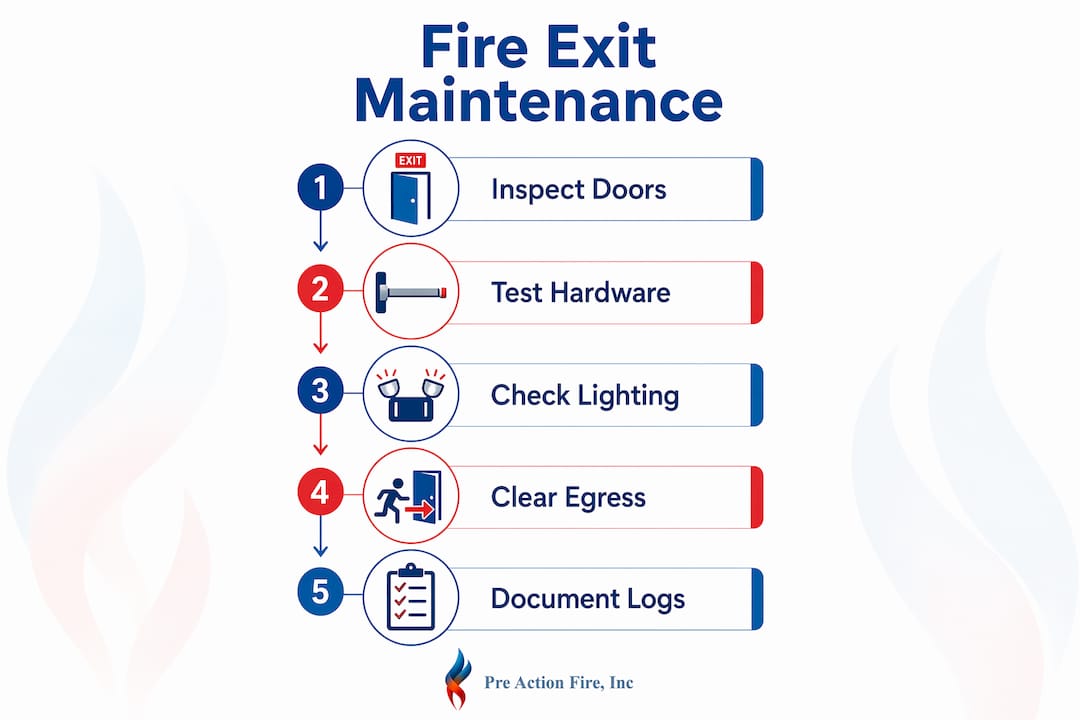
What are the key fire exit maintenance steps for doors?
Fire exit door inspection is the most critical component of any emergency exit maintenance program. Fire exit doors must open from the inside with a single motion using no more than 30 lbs of force. That standard exists because panicked occupants cannot operate complex hardware under stress.
Door gap measurement is a step most facility teams underestimate. Door gaps must stay below 4mm to maintain fire and smoke sealing. A coin gauge is the standard field tool for this check. Gaps wider than 4mm allow smoke migration and void the door’s fire rating.
Here is what to verify on every fire door inspection:
- Latch and closer function: The door must self-close and latch fully within 3–5 seconds of release.
- Hardware compliance: No padlocks, chains, or deadbolts that require a key from the egress side.
- Seal condition: Intumescent strips and smoke seals must be intact with no tears or compression damage.
- Frame integrity: Check for warping, cracks, or gaps between the door frame and the wall.
- Signage: “Fire Door Keep Closed” or “Fire Door Keep Shut” labels must be present and legible.
Unauthorized modifications void fire ratings and cause forced replacements during audits. Drilling new holes, swapping hardware without manufacturer approval, or using non-rated replacement parts are the most common DIY mistakes. Log every defect you find and assign it to a licensed technician. Do not attempt field repairs yourself.
Pro Tip: Test fire doors during peak occupancy hours. High-traffic testing reveals air pressure and crowding issues that never appear during off-hours inspections.
For a detailed field protocol, the fire door inspection guide from Preactionfire covers hardware checks and documentation steps specific to commercial facilities.
How do you maintain emergency exit lighting and signs?
Emergency lighting and exit sign maintenance follows a two-tier testing schedule under NFPA 101. Missing either tier is a direct compliance failure.
Monthly test procedure:
- Press the test switch on each emergency lighting unit.
- Confirm the unit transfers to battery power within 10 seconds.
- Verify all lamps illuminate and hold for the full 30-second test period.
- Record the unit ID, test date, and pass or fail result in your maintenance log.
- Replace any unit that fails to transfer or dims below acceptable output immediately.
Annual test procedure:
- Conduct a full 90-minute battery duration test on every emergency lighting unit.
- Measure illumination at floor level along the entire egress route.
- Minimum 1 foot-candle at floor level is required throughout the escape path. Simply confirming a unit is “on” does not satisfy this standard.
- Document results and flag any unit that falls below threshold for immediate replacement.
Exit sign inspection goes beyond confirming the sign is lit. Exit sign lettering must meet minimum size standards: 1 inch of letter height per 30 feet of viewing distance. Directional arrows must point accurately toward the travel path. Even temporary decorations placed in front of or near exit signs can trigger a compliance failure during an Authority Having Jurisdiction (AHJ) inspection.
| Test Type | Frequency | Duration | Pass Criteria |
|---|---|---|---|
| Functional test | Monthly | 30 seconds | Battery transfer confirmed, all lamps lit |
| Full duration test | Annual | 90 minutes | Minimum 1 foot-candle at floor level maintained |
| Sign visibility check | Monthly | Visual | Unobstructed, correct arrows, legible lettering |
Pro Tip: Standardize battery types and lamp models across all emergency units. Keep a cross-reference list in your maintenance room so replacements happen the same day a failure is logged.
What procedures keep egress paths safe and compliant?
Egress path maintenance is the simplest category to execute and the most frequently failed during inspections. Corridors must maintain a minimum 44-inch clear width at all times, or 36 inches in certain assembly areas. Blocked paths carry liability exposure that can exceed $1 million in personal injury claims.
The most common egress obstructions found during walkthroughs include:
- Stored boxes, pallets, or equipment pushed against corridor walls
- Propped-open fire doors held by wedges or furniture
- Seasonal decorations or displays narrowing aisle widths
- Locked or chained exit doors that require a key to open from inside
- Damaged or missing floor markings that indicate exit routes
Conduct walkthroughs on a weekly schedule in high-traffic facilities and monthly in lower-occupancy buildings. Assign a specific staff member to each zone so accountability is clear. When you find an obstruction, remove it immediately. Do not log it and schedule removal for later. The path must be clear before you leave the area.
The table below is a quick reference for your walkthrough program:
| Check Item | Standard | Action if Failed |
|---|---|---|
| Corridor width | 44 inches minimum | Remove obstruction immediately |
| Exit door operation | Single motion, no key required | Tag out of service, call licensed tech |
| Floor markings | Visible and continuous | Repaint or replace within 48 hours |
| Stairwell clearance | No storage at any landing | Remove and relocate items same day |

For a broader view of how egress compliance fits into your overall fire safety in Colorado program, Preactionfire has published analysis specific to Denver Metro commercial properties.
How should you document fire exit maintenance for audits?
Documentation is the difference between a passed audit and a citation. Detailed maintenance logs covering test results, defects, and corrective actions are the primary evidence an AHJ inspector reviews. A log with gaps or missing dates signals a facility that is not managing its program seriously.
Every log entry should include:
- Fixture or door ID: Use a consistent numbering system tied to your floor plan.
- Inspection date and inspector name: Both are required for legal defensibility.
- Test result: Pass or fail, with specific measurements where applicable.
- Defect description: Be specific. “Door closer slow” is not sufficient. “Door closer on Exit 3 takes 8 seconds to latch” is.
- Corrective action taken: Date the repair was completed and by whom.
Photographic evidence before and after repairs strengthens your due diligence record. A photo of a blocked corridor with a timestamp, followed by a photo of the cleared path, creates a defensible record that protects you during inspections and litigation.
Internal staff can perform monthly visual checks and clearance walkthroughs. Annual functional testing and certifications require a licensed professional. Licensed professionals maintain legal compliance and keep your insurance coverage intact. Mixing those responsibilities is a common and costly mistake.
Digital maintenance platforms like Oxmaint or FMX automate inspection reminders, store photos, and generate audit-ready reports. Paper logs work, but they create manual retrieval burdens when an inspector asks for three years of records on short notice.
Pro Tip: Organize logs by system type and building zone, not just by date. An inspector asking for all Exit 4 door records should be able to find them in under two minutes.
Key takeaways
Consistent fire exit maintenance requires documented inspections, licensed annual testing, and zero tolerance for egress obstructions.
| Point | Details |
|---|---|
| Door force and gap limits | Doors must open with 30 lbs or less of force and maintain gaps below 4mm. |
| Two-tier lighting tests | Run monthly 30-second tests and annual 90-minute tests per NFPA 101 requirements. |
| Egress width compliance | Keep corridors at 44 inches minimum and remove obstructions immediately when found. |
| No unauthorized repairs | DIY hardware changes void fire ratings and trigger costly forced replacements at audits. |
| Documentation protects you | Logs with photos, fixture IDs, and corrective actions are your primary defense during AHJ inspections. |
What most facilities get wrong about fire exit maintenance
Most compliance failures I see are not caused by ignorance. They are caused by inconsistency. A facility team that inspects fire doors perfectly in january and then skips march and april because of a renovation project has created a gap that an AHJ inspector will find and cite.
The second most common mistake is treating monthly checks as a formality. Staff members walk the corridor, see no obvious obstruction, and check the box. They do not test the door closer timing. They do not press the emergency light test switch. They do not measure the gap. That kind of surface-level inspection creates false confidence and real liability.
The most effective programs I have seen share one trait: they separate the inspection role from the maintenance role. The person who finds defects should not be the same person who decides whether they are serious enough to report. That separation removes the temptation to minimize findings.
Technology helps, but it does not replace judgment. Digital platforms like Oxmaint generate reminders and store records efficiently. They do not tell you that the door closer on Exit 7 is borderline and will fail in two months. That call requires a trained eye and a willingness to escalate.
Invest in training your facility staff on what a compliant door looks and feels like. Send them through a half-day session with your licensed fire protection contractor once a year. That investment costs less than one failed audit.
— Preactionfire
How Preactionfire supports your fire exit compliance program
Maintaining fire exits across a commercial or industrial facility is a year-round responsibility. Preactionfire has served the Denver Metro Area since 2009, providing NICET-certified technicians who handle the annual functional testing, door hardware inspections, and compliance documentation that your in-house team cannot legally perform alone.
Whether you manage a single commercial building or a portfolio of industrial facilities, Preactionfire’s fire safety inspection services cover the full scope of exit and egress compliance. Their team also supports fire alarm system compliance for Denver businesses, ensuring your detection and notification systems meet the same NFPA standards as your exits. Contact Preactionfire to schedule an inspection and get your facility audit-ready.
FAQ
What does NFPA 101 require for fire exit maintenance?
NFPA 101 requires monthly 30-second functional tests and annual 90-minute full-duration tests for emergency lighting and exit signs. Fire doors must open with no more than 30 lbs of force using a single motion, with gaps below 4mm.
How often should egress paths be inspected?
Egress paths should be inspected weekly in high-traffic facilities and at minimum monthly in lower-occupancy buildings. Any obstruction found must be removed immediately, not scheduled for later correction.
Can facility staff perform all fire exit inspections?
Internal staff can conduct monthly visual inspections and clearance walkthroughs. Annual functional testing and certifications must be completed by a licensed fire protection professional to maintain legal compliance and insurance coverage.
What voids a fire door’s rating?
Unauthorized modifications void fire ratings, including drilling new holes, swapping hardware without manufacturer approval, or installing non-rated replacement parts. These changes also cause forced replacements during audits at significant cost.
What records should a fire exit maintenance log include?
Each log entry should include the fixture or door ID, inspection date, inspector name, test result with measurements, a specific defect description, and the corrective action taken with completion date. Photographic evidence before and after repairs strengthens the record further.