TL;DR:
- The 2026 fire code updates in Colorado focus on implementing the statewide Wildfire Resiliency Code and the NFPA revisions, increasing the technical and property-specific requirements for facilities. Facility managers must verify local code editions, assess fire-intensity zones, and prepare for new triggers like the 25% repair threshold and Class L fire classification for lithium-ion batteries. Engaging early with local authorities, maintaining detailed compliance documentation, and aligning materials with new standards are essential for smooth adaptation to these evolving regulations.
The role of fire code updates in 2026 is to set legally enforceable safety standards that determine exactly what materials, systems, and inspections your Colorado facility must have. Two frameworks drive this year’s changes: the Colorado Wildfire Resiliency Code (CWRC), mandated by Senate Bill 23-166, and the 2026 NFPA model code revisions covering everything from lithium-ion battery fires to energy storage systems. Together, they create a compliance landscape that is more property-specific, more technically demanding, and more consequential for facility managers and business owners than any update in recent memory.
What are the key fire code updates for Colorado in 2026?
The most significant state-level change is the Colorado Wildfire Resiliency Code, which requires local jurisdictions to adopt the CWRC by April 1, 2026, with enforcement commonly starting July 1, 2026. The CWRC applies to new construction and major exterior repairs in designated Wildland-Urban Interface (WUI) zones, mandating ignition-resistant materials and fire-hardening standards. This is Colorado’s first statewide wildfire building code, and its scope extends well beyond residential properties to commercial and industrial facilities in fire-prone areas.

On the national side, the 2026 NFPA code updates address automation in fire extinguisher inspection, stronger electrical safety standards, and expanded energy storage system requirements. These updates reflect the growing presence of battery-based systems in commercial buildings and the unique fire hazards they introduce. Facilities that have installed solar storage arrays, EV charging infrastructure, or backup battery banks need to pay close attention.
One of the most technically notable additions is the formal introduction of Class L fires under ISO 3941:2026, a new classification specifically for lithium-ion battery fires. This classification matters because lithium-ion fires behave differently from conventional Class A, B, or C fires. They require different suppression agents and response protocols, which means your existing fire extinguisher inventory and suppression system design may need reassessment.
Key changes at a glance:
- CWRC adoption deadline: April 1, 2026, with enforcement starting July 1, 2026 in most WUI jurisdictions
- CWRC trigger threshold: Exterior wall and roof repairs exceeding 25% of total structure area activate full fire-hardening compliance
- NFPA 2026: Updated inspection automation standards and expanded energy storage safety requirements
- Class L classification: New lithium-ion battery fire category requiring updated suppression protocols
- Fire-intensity zone mapping: Property-specific compliance tiers based on assigned hazard zones
How do local jurisdictions in Colorado affect fire code compliance in 2026?
Colorado operates under a home-rule structure with no single mandatory statewide fire code for private and commercial buildings. Each city and county adopts and amends codes independently through its Authority Having Jurisdiction (AHJ). This means the fire code in Denver may differ meaningfully from the code in Aurora, Lakewood, or Colorado Springs, even when both jurisdictions are drawing from the same NFPA model code edition.
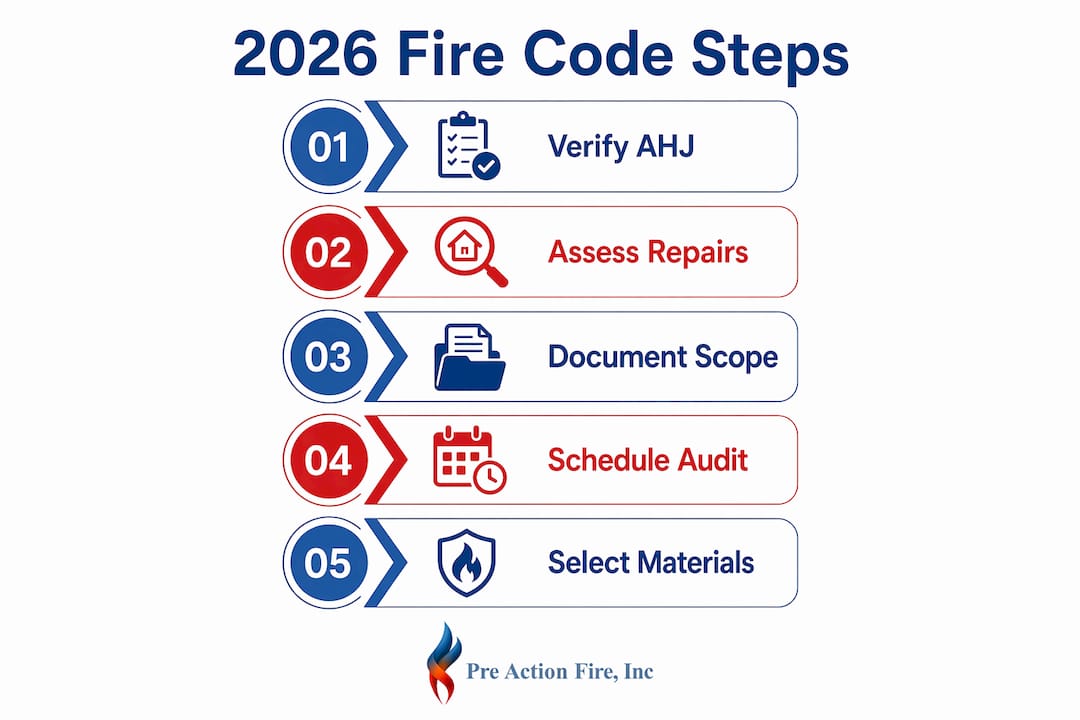
For facility managers, this creates a practical problem. You cannot assume that a code version your contractor used on a project in Jefferson County applies to your facility in Arapahoe County. The AHJ controls which edition of the International Fire Code or NFPA standards is in force, what local amendments have been added, and when enforcement of new provisions actually begins. Confirming these details before permitting is not optional. Skipping this step leads to costly redesigns and permit delays.
Here is how the local jurisdiction process typically works:
- The state or a model code body (NFPA, ICC) publishes a new code edition.
- The local AHJ reviews and votes to adopt the edition, often with local amendments.
- The AHJ sets an enforcement start date, which may lag the adoption date by months.
- Permits submitted after the enforcement date must comply with the newly adopted edition.
- Projects already in permitting may be grandfathered under the prior edition, depending on local rules.
Pro Tip: Before submitting any permit application in 2026, call your local fire marshal’s office directly and ask which code edition is currently enforced, whether any local amendments apply, and whether the CWRC has been formally adopted. Document the response in writing.
Fire-intensity zone mapping adds another layer of complexity. Two neighboring properties may face entirely different fire-hardening obligations depending on which intensity tier they fall into. If your jurisdiction has not published its own fire-intensity map, the state default map applies. Checking your property’s zone assignment early in any project planning process can prevent expensive mid-project scope changes.
What practical implications do the 2026 fire code updates have for facility managers?
The 25% repair threshold under the CWRC is the single most operationally significant trigger for existing commercial facilities. If your exterior wall and roof repairs exceed that threshold, the entire project must comply with fire-hardening standards, including ignition-resistant cladding, ember-resistant vents, and compliant roofing materials. This changes how you scope and contract repair work.
For project planning, the repair scope calculation deserves careful documentation. Splitting a large repair project into smaller phases may affect which compliance tier applies, but this approach requires precise contract structuring and documentation. Align repair contracts proactively with your contractor and legal counsel to avoid unintended compliance triggers.
| Compliance Factor | What It Means for Your Facility |
|---|---|
| CWRC 25% repair threshold | Exterior repairs above this level trigger full fire-hardening requirements |
| Fire-intensity zone tier | Determines the specific materials and systems required for your property |
| AHJ enforcement start date | Sets the actual deadline for compliance, which may differ from adoption date |
| Class L fire classification | May require updated extinguisher types and suppression system review |
| NFPA energy storage standards | Applies to facilities with battery banks, EV charging, or solar storage |
Implementation lag is a real operational risk. Even after a jurisdiction formally adopts the CWRC, local inspection workflows, approved materials lists, and inspector training may not be fully operational on day one. Plan your compliance timeline with buffer time built in. A project that is technically compliant on paper can still face delays if the local inspection office is not yet equipped to process the new requirements.
Pro Tip: Budget for a compliance audit before starting any major exterior repair or new construction project in 2026. The cost of identifying your fire-intensity zone, confirming your AHJ’s adopted code edition, and reviewing your repair scope against the 25% threshold is far lower than the cost of a mid-project redesign.
For material selection, work with suppliers who can provide documentation that their products meet CWRC ignition-resistance standards. Not all compliant products are on every local approved list yet, so verify with your AHJ before purchasing.
How do the updated NFPA codes fit into Colorado’s 2026 fire safety landscape?
NFPA’s 2026 updates matter even when local adoption lags, because they signal where enforcement is heading and because many Colorado jurisdictions will adopt these editions within the next one to two code cycles. Facility managers who build to the 2026 NFPA standard today avoid costly retrofits when their AHJ catches up.
The 2026 NFPA standards expand safety requirements for stationary energy storage systems, covering a broader range of battery technologies and requiring formal hazard assessments. This is directly relevant to any Colorado commercial facility that has installed or is planning to install battery energy storage, solar backup systems, or large-scale UPS infrastructure. The NFPA 2026 inspection compliance guide from Preactionfire breaks down how these requirements translate to Colorado-specific inspection and maintenance schedules.
| NFPA Provision | Prior Standard | 2026 Update |
|---|---|---|
| Energy storage systems | Limited to specific battery types | Expanded to cover broader battery technologies with formal hazard assessment |
| Fire extinguisher inspection | Manual inspection protocols | Automation and digital tracking now addressed |
| Lithium-ion battery fires | No dedicated classification | Class L classification introduced under ISO 3941:2026 |
| Fire sprinkler provisions | Existing model code language | Under active review via NFSA’s May 2026 governmental consensus voting |
NFSA’s May 2026 Online Governmental Consensus Voting includes code recommendations that may affect fire sprinkler provisions and future life safety editions. Colorado jurisdictions that are currently on older NFPA editions will eventually adopt these changes. Tracking the NFSA voting outcomes now gives you a preview of what your next compliance cycle will require.
What are best practices for ensuring compliance with 2026 fire code updates?
Compliance failures in Colorado’s fragmented code environment almost always trace back to one root cause: assumptions made without verification. The following steps eliminate the most common and costly mistakes.
- Verify your AHJ’s current code edition before any permit application. Ask specifically which NFPA edition is adopted, whether the CWRC is in force, and what local amendments apply.
- Determine your fire-intensity zone using your jurisdiction’s published map or the state default map. This single step defines your material and system requirements.
- Calculate your repair scope accurately before contracting any exterior work. Document the calculation method and retain it in your project file.
- Build enforcement lag into your schedule. Assume a minimum of 60 to 90 days of friction between formal code adoption and fully operational local inspection workflows.
- Maintain a compliance matrix that links your jurisdiction, adopted code edition, permit date, fire-intensity zone, and system inventory. This compliance matrix practice is the most effective tool for managing Colorado’s fragmented code landscape.
- Engage your fire marshal early. Bring code officials into the project planning conversation before design is finalized, not after permit submission.
Pro Tip: Create a one-page compliance summary for each facility you manage, listing the AHJ contact, current code edition, fire-intensity zone, and last inspection date. Update it every January. This document alone will save you hours of research on every future project.
Partnering with a construction consulting service that understands Colorado’s 2026 code environment can also reduce risk on complex projects where multiple jurisdictions or mixed-use occupancies are involved.
Key takeaways
Colorado’s 2026 fire code compliance requires verifying your AHJ’s adopted code edition, confirming your fire-intensity zone, and calculating repair scope against the CWRC’s 25% threshold before any project begins.
| Point | Details |
|---|---|
| CWRC is the primary 2026 change | Adoption required by April 1, enforcement typically July 1, in WUI zones statewide. |
| The 25% repair threshold is the key trigger | Exterior repairs exceeding this level activate full CWRC fire-hardening requirements. |
| Home-rule means no single statewide code | Confirm your AHJ’s adopted edition and amendments before every permit application. |
| NFPA 2026 expands energy storage rules | Facilities with battery systems or EV charging must review new hazard assessment requirements. |
| Compliance matrices prevent costly gaps | Document jurisdiction, code edition, zone, and system inventory for every facility you manage. |
What I’ve learned from watching Colorado’s code landscape shift
Working in fire protection in the Denver Metro Area for over 15 years, I have watched facility managers get caught off guard by exactly the kind of complexity that 2026 is delivering. The home-rule system is not a flaw. It is a feature that allows local communities to calibrate fire safety to their specific risk profiles. But it demands a level of due diligence that many facility managers underestimate until a permit gets rejected.
The wildfire zone mapping issue is where I see the most expensive surprises. Two properties on the same block can sit in different intensity tiers, and the owner of the higher-tier property often does not find out until mid-project. The fix is simple: check the map before you design, not after you build.
My honest advice is to treat the CWRC and NFPA 2026 updates not as compliance burdens but as a forcing function for deferred maintenance and system upgrades that were already overdue. The facilities that will struggle most in 2026 are those that have been deferring fire system reviews for years. The ones that will move through this cycle smoothly are those that already have current inspection records, documented system inventories, and a working relationship with their local fire marshal.
— Preactionfire
How Preactionfire helps Colorado businesses meet 2026 fire code requirements
Staying ahead of Colorado’s 2026 fire safety regulations requires more than reading the code. It requires experienced technicians who know how Denver Metro jurisdictions interpret and enforce these standards.
Pre Action Fire has served the Denver Metro Area since 2009, with NICET-certified technicians who specialize in fire alarm compliance and fire sprinkler installation aligned with 2026 NFPA and CWRC requirements. Whether you need a compliance audit, a system upgrade, or a full inspection to confirm your facility meets current standards, Preactionfire delivers solutions built for Colorado’s specific code environment. Contact Preactionfire today to schedule a consultation and get a clear picture of exactly where your facility stands.
FAQ
What is the Colorado Wildfire Resiliency Code?
The Colorado Wildfire Resiliency Code (CWRC) is a statewide fire-hardening standard mandated by Senate Bill 23-166, requiring ignition-resistant materials and construction practices for new builds and major repairs in WUI zones. Jurisdictions were required to adopt it by April 1, 2026, with enforcement typically starting July 1, 2026.
When does the CWRC apply to existing commercial buildings?
The CWRC applies to existing buildings when exterior wall and roof repairs exceed 25% of the total structure area. Projects below that threshold are generally not subject to the new fire-hardening requirements.
How do I find out which fire code my Colorado jurisdiction enforces?
Contact your local Authority Having Jurisdiction (AHJ) directly, typically the fire marshal’s office, and ask which code edition is currently adopted and whether any local amendments apply. Colorado’s home-rule structure means each jurisdiction sets its own code independently.
What is a Class L fire and why does it matter in 2026?
A Class L fire is a new classification for lithium-ion battery fires introduced under ISO 3941:2026. It matters because lithium-ion fires require different suppression agents and response protocols than conventional fire classes, which may require updates to your extinguisher inventory and suppression system design.
How do NFPA 2026 updates affect Colorado facilities even if my jurisdiction hasn’t adopted them yet?
NFPA 2026 updates signal the direction of future local code adoptions, so building to the current NFPA standard now reduces retrofit costs when your AHJ adopts the new edition. Facilities with energy storage systems, EV charging, or battery infrastructure should review the 2026 NFPA safety standards regardless of local adoption status.