
TL;DR:
- Fire pumps are essential in tall or high-hazard buildings to ensure adequate water pressure during fires.
- Proper selection, installation, and regular testing per NFPA standards are critical for compliance and safety.
- Ongoing maintenance and correct system calibration prevent costly failures and ensure reliable fire protection.
Most facility managers assume a properly installed sprinkler system is enough to protect their building. It’s a reasonable assumption, but it’s wrong for a large share of industrial properties. Sprinklers depend entirely on adequate water pressure and flow, and in tall buildings, high-hazard zones, or facilities far from a municipal supply, that pressure simply isn’t there without a fire pump. For Denver Metro Area facility managers, this isn’t just a technical detail. It’s a compliance issue with real financial and safety consequences. This guide walks through fire pump types, how they operate, what testing looks like, and how to prevent failures before they put your facility at risk.
Table of Contents
- What is a fire pump and why is it needed?
- Types of fire pumps used in industrial facilities
- How fire pumps work: Mechanics, operation, and power sources
- Performance standards, testing, and compliance
- Fire pump failures, maintenance, and how to prevent costly downtime
- What most facility managers miss about fire pump reliability
- Connect with Denver’s fire pump experts
- Frequently asked questions
Key Takeaways
| Point | Details |
|---|---|
| Fire pump basics | Fire pumps are essential for protecting large Denver facilities when water supply pressure is insufficient. |
| Types and selection | Facility size, risk, and local code dictate pump type—horizontal split-case and vertical turbine are most common for industrial needs. |
| Testing compliance | Weekly, monthly, and annual tests are required by NFPA 20/25 to avoid costly fines and ensure safety. |
| Reliability tips | Regular maintenance and expert inspection help prevent pump failures and compliance issues. |
| Denver-specific advice | Local industrial managers must prioritize testing schedules and choose compliant pump drivers to meet Denver regulations. |
What is a fire pump and why is it needed?
A fire pump is a mechanical device that boosts water pressure in a fire protection system. When a sprinkler activates or a standpipe is opened, the pump kicks on to deliver water at the flow rate and pressure the system was designed for. Without it, the sprinklers may discharge water, but not nearly enough to suppress a serious fire.
Think of it this way: a garden hose connected to a municipal line works fine for watering your lawn. But if you need to push water to the 12th floor of a warehouse or across a sprawling industrial campus, you need something far more powerful driving that flow.
The governing standard for fire pumps is NFPA 20, which sets requirements for installation, performance, testing, and maintenance. In Denver, the local fire marshal enforces these standards alongside the International Fire Code, and inspectors do check for compliance during permitting and annual reviews.
Facilities that typically require a fire pump include:
- Buildings taller than four to five stories
- Large warehouses and distribution centers
- Facilities with high-hazard occupancies (chemical storage, manufacturing)
- Properties where municipal water pressure falls below system demand
- Campuses with long water supply runs from the street main
Key stat: NFPA 20 requires that fire pump systems deliver a minimum net pressure of 40 psi at rated flow, a benchmark that many municipal supplies cannot meet on their own in larger buildings.
For Denver facility managers, the stakes are concrete. A fire pump that isn’t installed, tested, or maintained correctly can result in a failed inspection, an insurance coverage dispute after a loss, or worse, a fire suppression system that doesn’t perform when it matters most.
Types of fire pumps used in industrial facilities
Not every fire pump is built for the same job. Choosing the wrong type for your facility is a common and costly mistake. Common types include horizontal split-case, vertical turbine, vertical inline, and end-suction pumps, each with distinct advantages depending on your building layout and water supply.
| Pump type | Best application | Key advantage | Consideration |
|---|---|---|---|
| Horizontal split-case | Large industrial facilities | High flow capacity, easy maintenance | Requires significant floor space |
| Vertical turbine | Below-grade water sources (tanks, wells) | Works with limited surface space | More complex installation |
| Vertical inline | Smaller facilities, limited space | Compact footprint | Lower flow capacity |
| End-suction | Light commercial, smaller buildings | Simple design, lower cost | Not ideal for high-demand systems |
Quick selection guide:
- Large warehouse or manufacturing plant: Horizontal split-case is typically the right fit
- Facility drawing from an underground storage tank: Vertical turbine is purpose-built for this
- Mid-size office or light industrial building with space constraints: Vertical inline works well
- Smaller commercial property with modest demand: End-suction is cost-effective
For Denver high-rises or facilities with significant building fire risks, engineers sometimes specify series pump configurations. This means two pumps installed in sequence, each adding pressure, to reach the system demand that a single unit can’t achieve alone. It’s a redundancy strategy that also protects against a single-pump failure during an emergency.
When selecting a pump type, factor in your mechanical room dimensions, your water supply source and depth, your system’s peak demand, and how much maintenance your team can realistically handle. A vertical turbine in a facility without a qualified technician on staff can become a compliance headache fast.
Pro Tip: Always request the pump curve from the manufacturer before finalizing selection. The curve shows exactly how the pump performs across different flow rates and pressures, and your fire protection engineer needs it to verify the pump meets your system’s design point.
How fire pumps work: Mechanics, operation, and power sources
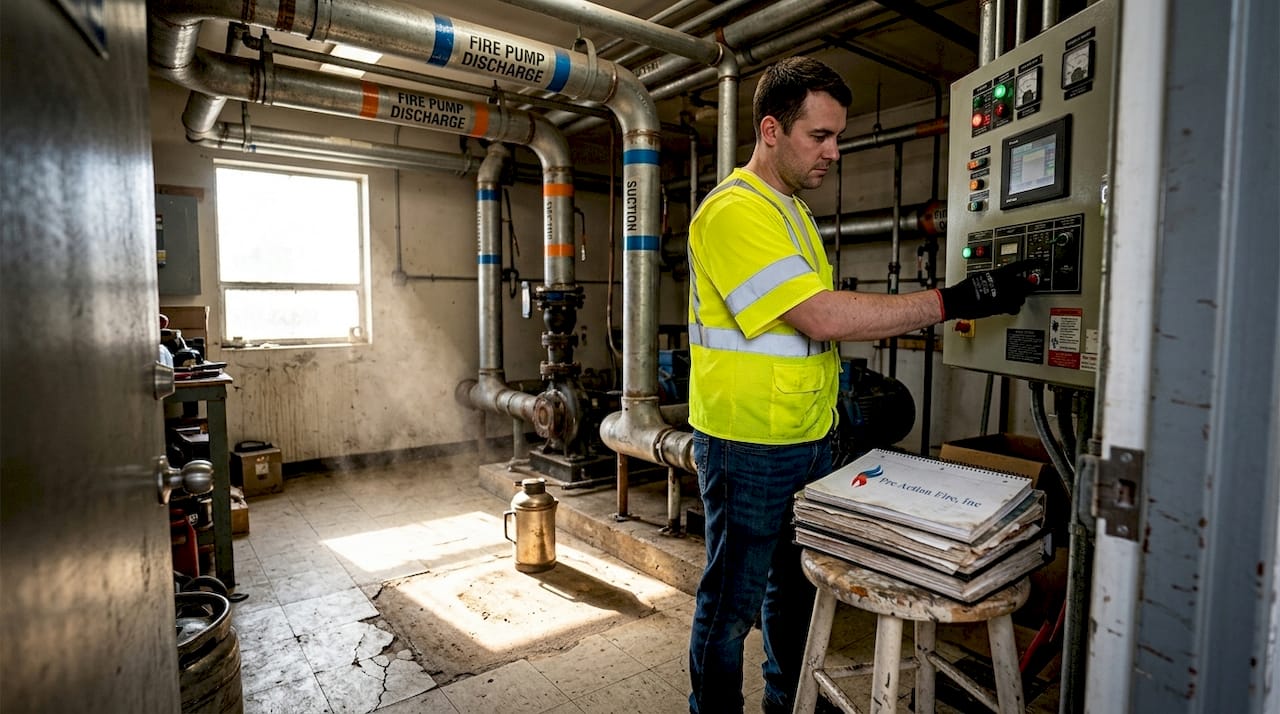
Understanding the mechanics helps you catch problems early and communicate clearly with your fire protection contractor. Here’s how a fire pump system operates from the moment a fire starts:
- Normal conditions: The jockey pump (also called a pressure maintenance pump) runs periodically to keep the system pressurized. It compensates for minor pressure drops from small leaks or thermal expansion.
- Pressure drop detected: When a sprinkler activates or a standpipe valve opens, pressure drops sharply. The controller senses this and signals the main fire pump to start.
- Pump activation: The fire pump activates automatically using a centrifugal impeller to accelerate water and boost pressure throughout the system.
- Sustained operation: The pump runs continuously until manually shut down by a trained operator, even after the fire is controlled. This is by design, not a malfunction.
- Post-event inspection: After any activation, the system must be inspected and reset before returning to service.
The jockey pump is often overlooked but it’s critical. If it runs too frequently, that’s a sign of a leak somewhere in the system. Ignoring it leads to nuisance starts on the main pump, which adds wear and can mask real problems.
Electric vs. diesel fire pump drivers
| Feature | Electric driver | Diesel driver |
|---|---|---|
| Reliability | High with stable utility power | High even during outages |
| Maintenance | Lower (monthly checks) | Higher (weekly fuel, battery, coolant) |
| NFPA compliance | Accepted with reliable power supply | Required where power reliability is uncertain |
| Denver context | Standard for most facilities | Critical for facilities in areas with outage risk |
Electric drivers work well where utility power is stable, but Denver facilities in industrial corridors or areas prone to weather-related outages should seriously consider diesel backup. NFPA 20 allows either, but some local authorities having jurisdiction require diesel in specific occupancy types.
Pro Tip: If you have a diesel fire pump, run a weekly no-flow test and check fuel levels, battery charge, and coolant every single week. A diesel pump that won’t start during a power outage is worse than no backup at all, because it creates a false sense of security.
Performance standards, testing, and compliance
This is where many Denver facility managers fall short, not because they don’t care, but because the testing schedule is more demanding than most people expect.
NFPA 20 performance benchmarks require that a fire pump deliver 100% of its rated flow at rated pressure, at least 150% of rated flow at no less than 65% of rated pressure, and that churn pressure (no-flow pressure) not exceed 140% of rated pressure.
NFPA 25 testing requirements include:
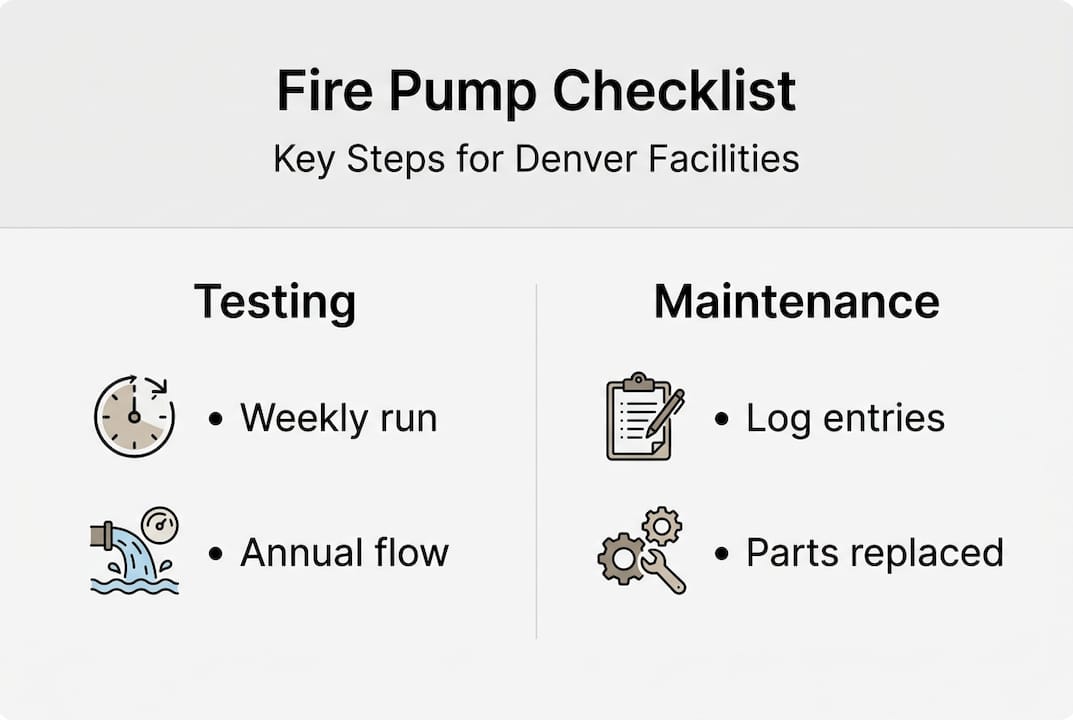
- Weekly: Churn test (no-flow run) to verify the pump starts and operates without flow
- Monthly: Visual inspection of all components, controller checks, and driver checks
- Annual: Full flow test to verify the pump meets its performance curve
- After any activation: Full inspection before returning to service
OSHA references fire pump maintenance compliance as part of broader facility safety requirements, and violations can carry penalties up to $165,000 for willful non-compliance. That’s not a theoretical risk. Denver OSHA enforcement has cited facilities for inadequate fire protection documentation.
“A fire pump that has never been flow-tested is a fire pump you cannot trust.” This is the standard our NICET-certified technicians apply on every fire pump inspection we conduct in the Denver Metro Area.
Record-keeping is just as important as the tests themselves. Inspectors want to see dated logs showing who performed each test, what the results were, and what corrective actions were taken. A gap in records is treated almost the same as a missed test during a compliance review.
Pro Tip: Schedule your annual flow test in spring or early fall. Denver’s winter conditions can complicate outdoor discharge testing, and summer heat affects diesel engine performance. Timing your tests strategically reduces complications and keeps your schedule consistent.
Fire pump failures, maintenance, and how to prevent costly downtime
Fire pump failures rarely happen without warning. The problem is that most facilities aren’t watching for the right signs.
Common causes of fire pump failure in industrial settings include:
- Mechanical wear: Bearings and impellers degrade over time, especially in pumps that aren’t regularly exercised
- Cavitation: Occurs when suction pressure is too low, causing vapor bubbles that erode impeller surfaces rapidly
- Suction problems: Air leaks in suction piping or blockages in the supply line reduce flow dramatically
- Electrical and fuel issues: Corroded contacts, dead batteries, and stale diesel fuel are the top diesel pump killers
- Poor maintenance records: Gaps in documentation lead to missed service intervals and non-compliance findings
Warning signs to watch for include the jockey pump cycling more than once per hour, unusual vibration or noise during test runs, pressure readings outside normal range on the controller gauge, and slow or failed starts on diesel units.
Pro Tip: Cavitation is often misdiagnosed as a pump problem when it’s actually a suction supply problem. Before replacing any pump components, verify that your suction source is clean, properly sized, and free of air infiltration. Fixing the wrong thing is expensive.
For Denver facility managers, staying on top of building fire risks means building a maintenance calendar and sticking to it. Pair that with a qualified local contractor who knows Denver’s specific code environment and can flag issues before they become violations. Scheduling regular fire pump inspections with a certified provider is the most reliable way to catch problems early.
What most facility managers miss about fire pump reliability
After years of working with Denver industrial facilities, we’ve noticed a consistent pattern. Managers focus on equipment brand and model when selecting a fire pump, but the factors that actually determine long-term reliability are pressure settings, room access, and jockey pump calibration.
A pump set with a churn pressure that’s too close to the system’s normal operating pressure will experience nuisance starts constantly. Over time, that wears out the motor and masks real pressure loss events. Getting the pressure differential right between the jockey pump cutoff and the main pump start point is more important than which manufacturer built the unit.
Room access is another undervalued factor. We’ve seen fire pump rooms in Denver facilities where the controller panel is partially blocked, where there’s no floor drain for discharge testing, and where the clearances around the pump make routine inspection genuinely difficult. These aren’t code violations on day one, but they become compliance problems when an inspector can’t perform a proper evaluation.
The uncomfortable truth is that a well-sized, correctly calibrated pump from a mid-tier manufacturer, maintained by a qualified technician who performs fire pump inspections on schedule, will outperform a premium pump that’s been neglected. Specs matter less than the system around the pump.
Connect with Denver’s fire pump experts
Knowing how fire pumps work is the first step. Making sure yours is compliant, tested, and ready to perform is the next one.
Pre Action Fire, Inc has been serving Denver Metro Area industrial and commercial facilities since 2009. Our NICET-certified technicians handle everything from fire pump inspection and annual flow testing to full system installation and compliance consultation. We understand Denver’s local code environment and work directly with facility managers to keep documentation current and inspections on schedule. Whether you need fire safety inspections across your entire property or are planning a new fire sprinkler installation, our team is ready to help. Contact us today to schedule a consultation.
Frequently asked questions
How often does a fire pump need to be tested?
NFPA 25 requires weekly churn tests, monthly component inspections, and annual full flow tests for fire pumps in industrial facilities. Missing any of these intervals creates a compliance gap.
What is the difference between electric and diesel fire pumps?
Electric pumps offer reliable performance with lower maintenance demands, while diesel pumps provide critical backup during power outages but require weekly fuel level, battery, and coolant checks to stay ready.
What are common causes of fire pump failure?
Common failures include mechanical wear on bearings and impellers, cavitation from low suction pressure, air leaks or blockages in suction lines, electrical or fuel system problems, and gaps in maintenance records that allow issues to go undetected.
How can Denver facility managers stay compliant with fire pump requirements?
Follow NFPA 20 and 25 testing schedules, align with Denver’s local fire code requirements, and maintain dated inspection logs. Willful non-compliance can result in OSHA penalties reaching $165,000, making consistent documentation as important as the tests themselves.